
As filed with the U.S. Securities and Exchange Commission on August 14, 2026
Registration No. 333-
UNITED
STATES
SECURITIES AND EXCHANGE COMMISSION
Washington, D.C. 20549
FORM
REGISTRATION
STATEMENT
UNDER
THE SECURITIES ACT OF 1933
(Exact Name of Registrant as Specified in Its Charter)
| 1000 | N/A | |||
| (State or Other Jurisdiction
of Incorporation or Organization) |
(Primary Standard Industrial Classification Code Number) |
(I.R.S. Employer Identification No.) |
(Address and Telephone Number of Registrant’s Principal Executive Offices)
(Name, Address, and Telephone Number of Agent for Service)
Copies to:
| Robert
D. Giannattasio, Esq. Eric Scarazzo, Esq. Gibson, Dunn & Crutcher LLP 200 Park Avenue New York, NY 10166 Tel: (212) 351-4000 |
Approximate date of commencement of proposed sale to the public: As soon as practicable after this registration statement becomes effective.
If any of the securities being registered on this Form are to be offered on a delayed or continuous basis pursuant to Rule 415 under the Securities Act of 1933, check the following box. ☒
If this Form is filed to register additional securities for an offering pursuant to Rule 462(b) under the Securities Act, check the following box and list the Securities Act registration statement number of the earlier effective registration statement for the same offering. ☐
If this Form is a post-effective amendment filed pursuant to Rule 462(c) under the Securities Act, check the following box and list the Securities Act registration statement number of the earlier effective registration statement for the same offering. ☐
If this Form is a post-effective amendment filed pursuant to Rule 462(d) under the Securities Act, check the following box and list the Securities Act registration statement number of the earlier effective registration statement for the same offering. ☐
Indicate by check mark whether the registrant is an emerging growth company as defined in Rule 405 of the Securities Act of 1933.
Emerging
growth company
If
an emerging growth company that prepares its financial statements in accordance with U.S. GAAP, indicate by check mark if the registrant
has elected not to use the extended transition period for complying with any new or revised financial accounting standards† provided
pursuant to Section 7(a)(2)(B) of the Securities Act.
† The term “new or revised financial accounting standard” refers to any update issued by the Financial Accounting Standards Board to its Accounting Standards Codification after April 5, 2012.
The registrant hereby amends this registration statement on such date or dates as may be necessary to delay its effective date until the registrant shall file a further amendment which specifically states that this registration statement shall thereafter become effective in accordance with Section 8(a) of the Securities Act of 1933, as amended, or until this registration statement shall become effective on such date as the U.S. Securities and Exchange Commission, acting pursuant to such Section 8(a), may determine.
The information in this prospectus is not complete and may be changed. The Resale Shareholder may not sell these securities until the registration statement filed with the Securities and Exchange Commission is effective. This prospectus is not an offer to sell these securities and is not the solicitation of an offer to buy these securities in any jurisdiction where the offer or sale is not permitted.
SUBJECT TO COMPLETION — DATED AUGUST 14, 2026
PRELIMINARY PROSPECTUS

10,110,000 Ordinary Shares
This Resale Prospectus relates to the resale of 10,110,000 ordinary shares, par value $0.0001 (the “ordinary shares”) underlying warrants held by Americas Rare Earths Holdings Ltd. (the “Resale Shareholder” or “Americas Holdings”). We will not receive any of the proceeds from the sale of ordinary shares by the Resale Shareholder.
Americas Holdings is the parent company of our offtake partner, Mineradora Havilah Importação e Exportação Ltda. (“Havilah”), and is wholly-owned by Francesco Scolaro, our Chief Executive Officer and Chair.
The ordinary shares offered by this Resale Prospectus are issuable upon exercise of warrants that we granted to Americas Holdings in connection with the offtake relationship (the “Offtake Warrants”) and represent a portion of the ordinary shares issuable upon exercise of the Offtake Warrants in full.
Any shares sold by the Resale Shareholder covered by this prospectus will be sold upon expiration or waiver of the applicable lockup, and begin at prevailing market prices or in privately negotiated prices. The distribution of securities offered hereby may be effected in one or more transactions that may take place in ordinary brokers’ transactions, privately negotiated transactions or through sales to one or more dealers for resale of such securities as principals, and pursuant to a Rule 10b5-1 Plan. The Resale Shareholder will sell its shares at prevailing market prices or in privately negotiated prices. Usual and customary or specifically negotiated brokerage fees or commissions may be paid by the Resale Shareholder.
Our ordinary shares are listed on the NYSE American (the “NYSE American”) under the symbol “IMC”. On , 2026, the last reported sale price of our ordinary shares on the NYSE American was $ per ordinary share.
The ordinary shares registered for resale as part of this Resale Prospectus, once registered, will constitute a considerable percentage of our public float. The sales of a substantial number of registered shares could result in a significant decline in the public trading price of our ordinary shares and could impair our ability to raise capital through the sale or issuance of additional ordinary shares. We are unable to predict the effect that such sales may have on the prevailing market price of our ordinary shares. Despite any potential decline in the public trading price of our ordinary shares, the Resale Shareholder may still experience a positive rate of return on its ordinary shares due to the lower price that it acquired the ordinary shares for compared to other public investors, and may be incentivized to sell its ordinary shares when others are not. See “Risk Factors—Risks Related to Investing in Our Ordinary Shares—Future sales of ordinary shares by existing shareholders, including sales pursuant to the Resale Prospectus, may adversely affect the market price of our ordinary shares.”
We are an “emerging growth company” and a “foreign private issuer” as defined under the U.S. federal securities laws and, as such, have elected to comply with certain reduced public company reporting requirements for this prospectus and may elect to do so in future filings. Francesco Scolaro, our Chief Executive Officer and Chair, and entities affiliated with Mr. Scolaro control approximately 68% of the voting power of our outstanding ordinary shares. As a result, we are considered a “controlled company” within the meaning of the corporate governance standards of the NYSE American. Under these rules, we may elect not to comply with certain corporate governance requirements applicable to most companies listed on the NYSE American. In such case, you will not have the same protections afforded to shareholders of companies that are subject to all of these corporate governance requirements. See “Management—Controlled Company Status” and “Risk Factors—Risks Related to Being a Public Company—We are currently a “controlled company” and, as a result, qualify for and could rely on exemptions from certain corporate governance requirements.”
Investing in our ordinary shares involves risks. See the “Risk Factors” section of this prospectus.
Neither the U.S. Securities and Exchange Commission (the “SEC”) nor any state securities commission has approved or disapproved of these securities or determined if this prospectus is truthful or complete. Any representation to the contrary is a criminal offense.
The date of this Resale Prospectus is , 2026.
TABLE OF CONTENTS
| i |
ABOUT THIS PROSPECTUS
As used in this prospectus, unless the context otherwise requires or otherwise states, references to “IMC”, the “Company”, “we”, “us”, “our” and similar references refer to IMC Rare Earths Ltd, an exempted company incorporated in the Cayman Islands, and its subsidiaries.
Trademarks and Service Marks
We own or have rights to various trademarks, service marks and trade names that we use in connection with the operation of our business. This prospectus may also contain trademarks, service marks and trade names of third parties, which are the property of their respective owners. Our use or display of a third party’s trademarks, service marks, trade names or products in this prospectus is not intended to and does not imply a relationship with, or endorsement or sponsorship by, us. Solely for convenience, the trademarks, service marks and trade names referred to in this prospectus may appear without the ®, TM or SM symbols, but the omission of such references is not intended to indicate, in any way, that we will not assert, to the fullest extent under applicable law, our rights or the right of the applicable licensor to these trademarks, service marks and trade names.
Financial Information
Our audited consolidated financial statements were prepared in accordance with International Financial Reporting Standards (which we refer to as “IFRS”), as issued by the International Accounting Standards Board (which we refer to as the “IASB”), and audited in accordance with auditing standards generally accepted in the United States of America established by the Public Company Accounting Oversight Board (which we refer to as the “PCAOB”).
Our fiscal year ends on March 31 of each year as does our reporting year. Therefore, any references to 2026 and 2025 are references to the fiscal and reporting years ended March 31, 2026 and March 31, 2025, respectively. See Note 2 to our audited consolidated financial statements as of and for the years ended March 31, 2026 and 2025 for a discussion of the basis of preparation of our financial statements.
Our Company’s functional currency and reporting currency is the U.S. dollar, the legal currency of the United States (“USD”, “US$” or “$”).
Rounding
Certain figures and some percentages included in this prospectus have been subject to rounding adjustments. Accordingly, the totals included in certain tables contained in this prospectus may not correspond to the arithmetic aggregation of the figures or percentages that precede them.
Mineral Disclosure
As used in this prospectus, references to the “Technical Report” are to the Technical Report, dated March 27, 2026, relating to the Itarantim Project, our rare earth mining project located in the States of Bahia and Minas Gerais, Brazil (the “Itarantim Project”). The Technical Report was prepared by ERM Australia Consultants Pty Ltd (“ERM”) in accordance with the requirements of subpart 1300 of Regulation S-K—Disclosure by Registrants Engaged in Mining Operations (“S-K 1300”) under the Securities Act of 1933, as amended (the “Securities Act”), which governs disclosure for registrants with material mining operations. ERM is an independent qualified person under S-K 1300, and is not affiliated with IMC Rare Earths Ltd or another entity that has an ownership interest in the property that is the subject of the Technical Report.
A summary of the Technical Report is included as Exhibit 96.1 to our registration statement of which this prospectus forms a part.
| ii |
Market and Industry Data
This prospectus contains references to market data and industry forecasts and projections, which were obtained or derived from publicly available information, reports of governmental agencies, market research reports, and industry publications and surveys. These sources generally state that the information contained therein has been obtained from sources believed to be reliable, but that the accuracy and completeness of that information is not guaranteed. Although we believe such information to be accurate, we have not independently verified the data from these sources. Forecasts and other forward-looking information obtained from these sources are subject to the same qualifications and additional uncertainties and risks regarding the other forward-looking statements in this prospectus due to a variety of factors, including those described in the sections entitled “Cautionary Note Regarding Forward-Looking Statements” and “Risk Factors” and elsewhere in this prospectus. These and other factors could cause results to differ materially from those expressed in the forecasts and projections.
| iii |
GLOSSARY
Abbreviations
In this prospectus, the following abbreviations are used to express elements:
| Abbreviation | Meaning | |
| “Dy” | dysprosium | |
| “Nd” | neodymium | |
| “Pr” | praseodymium | |
| “Tb” | terbium |
In this prospectus, the following abbreviations are used to express units of measurement:
| Abbreviation | Meaning | |
| “km” | kilometers | |
| “km2” | square kilometers | |
| “ppm” | parts per million | |
| “MT” | metric tonnes | |
| “Mt” | million tonnes |
Technical Terms
This prospectus utilizes the following defined terms:
The term “heavy rare earth oxides” or “HREO” means oxidized compounds composed of heavier rare earth elements exhibiting high density, magnetic strength and stability.
The term “ionic adsorbed clay” or “IAC” means ionic adsorbed clay deposits, and the term “ionic adsorption deposits” or “IAD” means ionic adsorption deposits in general.
The term “indicated mineral resource” or “indicated resource” under S-K 1300 means that part of a mineral resource for which quantity and grade or quality are estimated on the basis of adequate geological evidence and sampling. The level of geological certainty associated with an indicated mineral resource is sufficient to allow a qualified person to apply modifying factors in sufficient detail to support mine planning and evaluation of the economic viability of the deposit. Because an indicated mineral resource has a lower level of confidence than the level of confidence of a measured mineral resource, an indicated mineral resource may only be converted to a probable mineral reserve.
The term “inferred mineral resource” or “inferred resource” under S-K 1300 means that part of a mineral resource for which quantity and grade or quality are estimated on the basis of limited geological evidence and sampling. The level of geological uncertainty associated with an inferred mineral resource is too high to apply relevant technical and economic factors likely to influence the prospects of economic extraction in a manner useful for evaluation of economic viability. Because an inferred mineral resource has the lowest level of geological confidence of all mineral resources, which prevents the application of the modifying factors in a manner useful for evaluation of economic viability, an inferred mineral resource may not be considered when assessing the economic viability of a mining project, and may not be converted to a mineral reserve.
The term “measured mineral resource” under S-K 1300 means that part of a mineral resource for which quantity and grade or quality are estimated on the basis of conclusive geological evidence and sampling. The level of geological certainty associated with a measured mineral resource is sufficient to allow a qualified person to apply modifying factors, as defined in this section, in sufficient detail to support detailed mine planning and final evaluation of the economic viability of the deposit. Because a measured mineral resource has a higher level of confidence than the level of confidence of either an indicated mineral resource or an inferred mineral resource, a measured mineral resource may be converted to a proven mineral reserve or to a probable mineral reserve.
| iv |
The term “mineral reserve” under S-K 1300 means an estimate of tonnage and grade or quality of indicated and measured mineral resources that, in the opinion of the qualified person, can be the basis of an economically viable project. More specifically, it is the economically mineable part of a measured or indicated mineral resource, which includes diluting materials and allowances for losses that may occur when the material is mined or extracted.
The term “mineral resource” under S-K 1300 means a concentration or occurrence of material of economic interest in or on the Earth’s crust in such form, grade or quality, and quantity that there are reasonable prospects for economic extraction. A mineral resource is a reasonable estimate of mineralization, taking into account relevant factors such as cut-off grade, likely mining dimensions, location or continuity, that, with the assumed and justifiable technical and economic conditions, is likely to, in whole or in part, become economically extractable. It is not merely an inventory of all mineralization drilled or sampled.
The term “light rare earth oxides” or “LREO” means oxidized compounds composed of rare earth elements that have lower atomic numbers.
The term “magnet rare earth elements” or “MREE” means rare earth elements that exhibit strong magnetic properties.
The term “magnetic rare earth oxides” or “MREO” means magnetic rare earth oxides, which are oxidized compounds composed of rare earth elements that exhibit strong magnetic properties.
The term “Neoproterozoic Itabuna Intrusive Suite” means the group of igneous rocks formed in connection with changes to the São Francisco terrane during the Neoproterozoic era.
The term “probable mineral reserve” under S-K 1300 means the economically mineable part of an indicated and, in some cases, a measured mineral resource.
The term “proven mineral reserve” under S-K 1300 means the economically mineable part of a measured mineral resource and can only result from conversion of a measured mineral resource.
The term “REE” means rare earth elements.
The term “rare earth oxides” or “REO” means oxidized compounds composed of rare earth elements.
The term “total rare earth oxides” or “TREO” means the sum of all rare earth elements in a given sample or deposit, expressed in their oxide form.
| v |
CAUTIONARY NOTE REGARDING FORWARD-LOOKING STATEMENTS
This prospectus includes forward-looking statements about us and our industry that involve substantial risks and uncertainties. All statements, other than historical facts, in this prospectus are forward-looking statements. Forward-looking statements can be identified by the use of forward-looking terminology, including the terms “believe,” “estimate,” “anticipate,” “expect,” “seek,” “project,” “intend,” “plan,” “may,” “will,” “should,” “could,” “would,” “expect,” “intends,” “potential,” “aim,” “assume,” “forecast,” “guidance,” “may,” “ongoing,” “predict” or “target,” in each case, their negative or other variations or comparable terminology, but the absence of these words does not necessarily mean that a statement is not forward-looking. Such forward-looking statements appear in a number of places throughout this prospectus and include statements regarding our opinions, expectations, beliefs, plans, objectives, assumptions or projections concerning our mineral resources estimates, exploration and development of the Itarantim Project, anticipated results and progress of our operations, results of operations, financial condition, liquidity, prospects, growth, strategies and the markets in which the Company operates or intends to operate. You are cautioned that any such forward-looking statements are not guarantees of future performance and involve risks, uncertainties and other important factors, which, if they were to ever materialize or prove incorrect, could cause the results of the Company to differ materially from those expressed or implied by such forward-looking statements. You should evaluate all forward-looking statements made in this prospectus in the context of these risks, uncertainties and other factors. Potential risks, uncertainties and other factors include those set forth under “Risk Factors,” “Management’s Discussion and Analysis of Financial Condition and Results of Operations” and elsewhere in this prospectus, including without limitation:
| ● | the economic viability of the Itarantim Project; | |
| ● | the need for significant capital resources for the development of the Itarantim Project; | |
| ● | our ability to successfully begin and sustain mining operations at the Itarantim Project; | |
| ● | our ability to manage our development, growth and operating expenses; | |
| ● | our lack of operating history on which to judge our business prospects and management; | |
| ● | the availability of suitable infrastructure and labor; | |
| ● | delays or failures in the performance of the third parties on which we rely; | |
| ● | our ability to obtain the necessary permits and licenses for the Itarantim Project, including that, once obtained, such permits and licenses may be suspended, terminated or not renewed by governmental authorities; | |
| ● | outbreaks, epidemics or pandemics; | |
| ● | mining industry operational risk; | |
| ● | severe adverse weather conditions; | |
| ● | reputational harm, including as a result of the actual or perceived occurrence of any number of events; | |
| ● | our relationships with local communities and other stakeholders; | |
| ● | changes in environmental and mining laws, regulations and other legislation; | |
| ● | the prices of or demand for rare earth elements; and | |
| ● | an adverse change in trade relations between the U.S. and Brazil. |
We caution you that the risks, uncertainties and other factors referred to above and elsewhere in this prospectus may not contain all of the risks, uncertainties and other factors that may affect our future results and operations. Moreover, new risks will emerge from time to time. It is not possible for us to predict all risks. All forward-looking statements in this prospectus are based upon our current expectations and various assumptions and apply only as of the date made and are expressly qualified in their entirety by the cautionary statements included in this prospectus. In addition, statements that “we believe” and similar statements reflect our beliefs and opinions on the relevant subject, and while we believe such information forms a reasonable basis for such statements, such information may be limited or incomplete, and our statements should not be read to indicate that we have conducted an exhaustive inquiry into, or review of, all potentially available relevant information.
Except as required by law, we disclaim any intent to publicly update or revise any forward-looking statements to reflect subsequent events or circumstances.
| vi |
PROSPECTUS SUMMARY
This summary highlights selected information contained elsewhere in this prospectus and does not contain all of the information that you should consider before deciding to invest in our ordinary shares. You should read the entire prospectus carefully, including the sections titled “Risk Factors” and “Management’s Discussion and Analysis of Financial Condition and Results of Operations,” and our financial statements and the related notes included elsewhere in this prospectus, before making a decision to invest in our ordinary shares. Some of the statements in this summary constitute forward-looking statements; see the section titled “Cautionary Note Regarding Forward-Looking Statements.”
Overview
We are a mineral exploration and development company, and our main rare earth element (or “REE”) project is the Itarantim Project located in the States of Bahia and Minas Gerais, Brazil. Drilling on this ionic adsorbed clay (“IAC”) REE deposit has identified a mineral resource of 1.1 billion tonnes with an average grade of 1,233 ppm total rare earth oxides (“TREO”). We have no operating revenues and do not anticipate generating revenues for the foreseeable future. We were incorporated on September 19, 2025 in the Cayman Islands as IMC Rare Earths Ltd.
We are developing rare earth mining projects in Brazil with a focus on exploration, development and long-term supply of certain REEs. We are seeking to establish one of the largest high-grade magnet rare earth element (or “MREE”) deposits outside of China and Myanmar, with the ability to supply to rare earth metal markets in the United States and Europe. Based on our exploration results to date, we believe we have the potential to integrate the Itarantim Project into an emerging U.S. rare earth supply chain by supplying our target markets’ growing demand for MREOs.
Magnet Rare Earths Overview
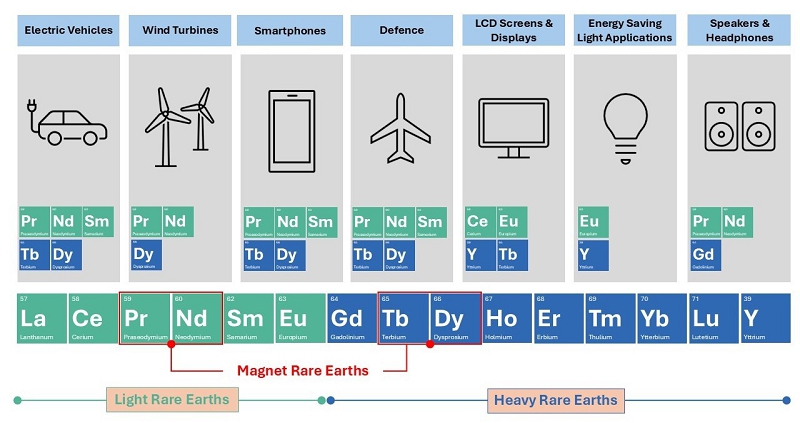
REE are essential inputs for advanced technologies that enable and power modern innovation in transportation systems, consumer electronics, renewable energy infrastructure and industrial automation. The so-called MREEs—primarily neodymium (“Nd”), praseodymium (“Pr” and, together with Nd, “NdPr”), dysprosium (“Dy”) and terbium (“Tb” and, together with Dy, “DyTb”)—are critical for manufacturing high-performance permanent magnets used in advanced technologies, including semiconductors, drones, military targeting systems, electric vehicles, wind turbines and other advanced electronics, such as smart phones, computer hard drives, data center components, robotics and automation and data storage.
| 1 |
Heavy Rare Earths
DyTb plays a critical role in improving the thermal stability and magnetic coercivity of permanent magnets. These properties enable magnets to maintain their strength even at elevated temperatures, which is important for applications that operate in high-heat environments. DyTb enhances a magnet’s ability to withstand thermal stress, which allows for enhanced efficiency and durability of the applications that utilize the magnet.
Dy is primarily used in high-performance permanent magnets, especially those found in electric vehicle motors, wind turbine generators and industrial robotics. Dy enhances magnetic coercivity, enabling magnets to retain their strength at high temperatures, which makes Dy important in applications where heat resistance and long-term performance are critical.
Tb is used in smaller amounts within permanent magnets to further improve thermal stability and magnetic strength under significantly stressful conditions. Tb is also used in solid-state devices, fluorescent lighting and as a green phosphor in display technologies. Its ability to modulate magnetic and optical properties makes it a versatile material in advanced electronics and clean energy systems.
Light Rare Earths
NdPr is highly valued for its use in generating strong magnetic fields and high energy densities within permanent magnets. NdPr is primarily used in neodymium-iron-boron (“NdFeB”) permanent magnets for electric machines such as EV traction motors, wind power generators, drones, robotics, electronics and a growing list of other applications. NdPr enables high magnetic performance with excellent efficiency, which is fundamental to the operation of clean energy technologies and advanced industrial applications.
Nd is used in high-performance permanent magnets, such as NdFeB magnets, which are widely used in electric vehicles, wind turbines, and a range of consumer electronics. Nd provides exceptionally high magnetic strength, allowing for miniaturization and improved efficiency of devices that rely on magnetic components. In addition to magnets, Nd is used in specialty optics and lasers, where its electronic transitions are harnessed to generate coherent light for industrial and medical applications.
Pr is primarily used in combination with Nd in magnet production to enhance thermal stability and reduce material costs, while maintaining strong magnetic performance. Pr also improves the resistance of magnets to demagnetization at elevated temperatures, contributing to overall durability. Beyond its role in magnets, Pr is utilized as a colorant in glass and ceramics and in certain high-temperature alloys, where it enhances mechanical strength and oxidation resistance.
Market Opportunity for Magnet Rare Earths
According to Adamas Intelligence Inc., total magnet-related rare earth oxide (“REO”) demand is forecasted to increase at a CAGR of 8.4% by 2040, with prices projected to increase at CAGRs of 4.0% to 5.5% over the same period (Adamas Intelligence Inc., Global market for magnet rare earth oxides to increase 7-fold by 2040 (January 2026)). Rare earth materials are used in a diverse array of end markets, including electric vehicles, robotics, renewable energy generation and storage, consumer products, medical devices and defense systems.
The global transition to clean energy and advanced technology is fueling an unprecedented surge in demand for magnet rare earths, particularly Dy and Tb, elements critical to electric vehicles, wind turbines, and defense systems. As China continues to dominate over 90% of rare earth refining capacity, Western markets are urgently seeking secure, sustainable supply alternatives. We believe we are uniquely positioned to fill this gap by offering significant and high-grade resources and simple, low-cost extraction, delivering both economic and environmental advantages that we believe few competitors can match. Supported by strong local infrastructure, a stable regulatory environment, and advanced discussions for U.S.-based processing partnerships, we are poised to become a cornerstone supplier to Western supply chains. We believe that this combination of resource quality, timing, and strategic alignment provides us with a compelling opportunity to lead the next generation of rare earth production.
| 2 |
Our Strategy
Our strategy is to develop into a globally significant, sustainable supplier of high-value MREEs, particularly Dy and Tb, by advancing our flagship Itarantim Project in the States of Bahia and Minas Gerais, Brazil. We are focused on rapidly de-risking the project through a staged exploration and development approach, targeting high-grade MREO domains delineated by drilling. By prioritizing environmentally responsible ionic-adsorption clay extraction methods, operating in an ideal mining jurisdiction, and leveraging Brazil’s strategic position between Eastern and Western markets, we aim to establish a reliable Western source of critical rare earths. Over the longer term, our strategy extends beyond mining to the creation of a vertically integrated, closed-loop rare earth supply chain in Brazil, encompassing carbonate and oxide production, separation, and ultimately permanent magnet manufacturing, supporting global energy transition and advanced technology markets.
Exploration Plans. To date, our exploration of the Itarantim Project has only covered a small portion of the licensed area. Over the next two years, we plan to conduct further exploration activities at the Itarantim Project, including geological and geophysical surveys, drilling, sampling, assaying and technical and metallurgical studies, to advance the evaluation of the project’s mineral resources, with the goal of converting the Itarantim Project to a development stage property. In particular, we plan to drill an additional 175 holes to delineate both an increase in TREO and contained MREO into the inferred category. Our goal for additional resource definition drilling at the Itarantim Project is to delineate a further 650 MT of TREO and an additional 200 MT of high-grade resource within existing and new MREO domains. We may in the future evaluate and acquire additional interests in REE development and exploration projects.
Development Plans. Our development plan is a staged, conservative strategy designed to rapidly advance the Itarantim Project from exploration into development and long-term production while minimizing capital intensity and technical risk. We plan to undertake detailed metallurgical testing and other technical studies, supported by field trials and pilot plant testing targeting high-grade MREO domains, to optimize the metallurgy and validation of operating costs, with the completion of permitting and technical studies. Our development approach will leverage near-surface, free-dig mining, proven ionic adsorption clay processing, modular plant design, and progressive rehabilitation, that we believe will allow for flexible expansion, strong ESG performance, and a clear pathway to downstream integration and future value growth.
Strategic Partnerships. We view strategic partnerships as a key pillar in accelerating development, reducing execution risk, and building long-term value from the Itarantim Project. We intend to collaborate with established third-party refiners for early-stage processing of mixed rare earth carbonate, enabling near-term market access while minimizing capital intensity. We are also pursuing relationships with downstream end-users, magnet manufacturers, and government-supported critical minerals initiatives in Western markets to support offtake, supply chain security, and future vertical integration. In parallel, technical partnerships with specialist processing groups and research institutions will be sought to optimize ionic adsorption clay REE extraction, in-situ recovery techniques, and environmentally responsible processing. Together, these partnerships are designed to support our evolution into a reliable, Western supplier of high-value MREE within diversified global supply chains.
Our Competitive Strengths
Compelling Value Proposition with Potential for Expansion. The Itarantim Project contains an estimated 1.1 billion tonnes of inferred mineral resources, based on a cut-off grade of 650 ppm TREO. The deposit hosts critical rare earth elements, including NdPr and DyTb, which are essential inputs for high-performance permanent magnets and other advanced technologies. Given the limited exploration conducted to date, we believe there is significant potential to expand the known resource base through additional drilling and exploration activities. The Itarantim Project positions us to capture the growing demand for strategically important rare earth elements and to strengthen our presence in the global supply chain.
Strategic Location with Established Infrastructure. Brazil is an ideal mining jurisdiction that boasts a stable regulatory framework, strong mining investment support, and Mercosur trade benefits. Brazil’s geographic position also provides a strategic advantage, with proximity to key U.S. and European markets relative to the current primary sources of REE supply, supporting shorter logistics chains and more resilient delivery routes. The Itarantim Project is situated near and on the border of the States of Bahia and Minas Gerais, a region with well-developed infrastructure, including established transportation networks, power and water utilities, and an experienced local workforce with deep mining expertise. The area is already home to several large-scale mining operations, and we believe that its existing infrastructure will be an asset as we scale up our operations. This combination of favorable jurisdictional conditions and robust regional infrastructure positions us to efficiently advance project development and ultimately support the supply of REE to global markets.
| 3 |
Use of Lower Cost Mining Methods that Result in Reduced Environmental Impact. If we are able to advance the Itarantim Project to the development stage, we intend to leverage simple, low-cost mining and extraction methods, with scalable leaching and processing methods that offer competitive operating advantages over conventional hard-rock rare earth projects. Such mining methods are possible because the Itarantim Project is an ionic adsorption clay deposit in which REEs are loosely bound to clay particles within the near-surface regolith. The deposit occurs at the surface and extends to depths of 30 meters or more, and can be mined without the need for drill and blast operations, expensive crushing, milling, or energy-intensive mining methods associated with traditional hard-rock rare earth projects. We expect to be able to extract REEs from the Itarantim Project in a cost-efficient manner that enables high leachable recovery rates and REE grades. In parallel, we are evaluating opportunities to integrate downstream separation and purification technologies designed to produce higher-value, separated oxides into our development plans. Moreover, using leach mining to extract our REEs is expected to avoid large-scale rock excavation and blasting, require less energy and minimize waste, which is expected to reduce health and safety risk and environmental impact.
Market Potential Supported by Demand. The MREE market is entering a dynamic growth phase driven by increased demand for electric vehicles, renewable energy systems, electronics and advanced defense technologies. This demand trend is underpinned by an undersupply of MREOs in U.S. and European markets, and China accounting for approximately 60% of the world’s mined rare earth output and over 90% of the world’s rare earth refining capacity. However, recent discussions in the United States and European Union around stockpiling and diversifying sources of REEs have intensified as geopolitical tensions with China, including China’s recent restrictions on rare earth exports, have accelerated efforts to reduce reliance on China as a source of REEs. According to S&P Global, China’s export controls have driven up prices for REEs, underscoring a tightening supply amid global efforts to diversify away from China (S&P Global, Rare earth supply bottlenecks set to persist in 2026 (January 2026)). We aim to position ourselves as a reliable supplier of critical rare earth materials to Western markets. With rising prices of MREOs and Western governments prioritizing secure critical mineral supply, we believe the Itarantim Project has the potential to become a key source of MREOs in the evolving global rare earths value chain.
The Itarantim Project
The following information is condensed and extracted from our Technical Report, which is filed as an exhibit to the registration statement of which this prospectus forms a part. You should refer to the full text of the Technical Report for further information regarding the Itarantim Project.
Project Description, Location and Access
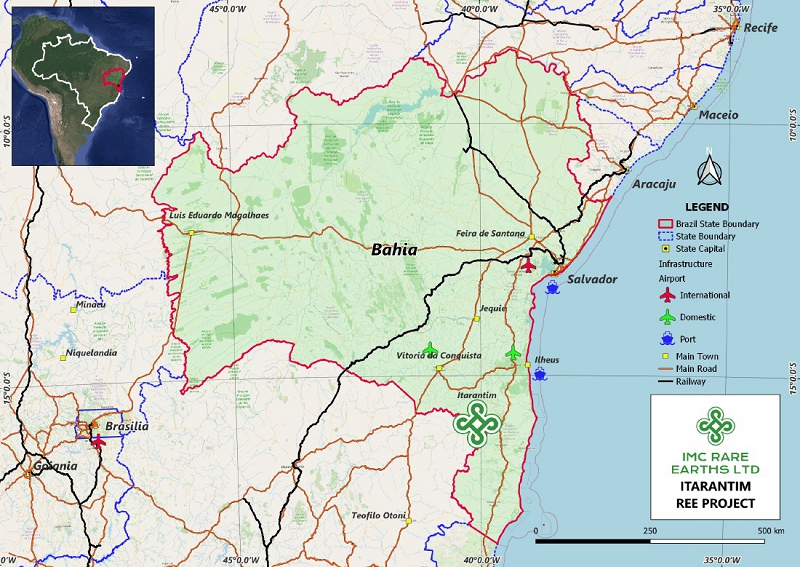
The Itarantim Project is an IAC REE exploration project located in the States of Bahia and Minas Gerais, northeastern Brazil, approximately 10 km west of the town of Itarantim. The Itarantim Project is centered at approximately 15°41′ S latitude and 40°09′ W longitude (WGS 84).
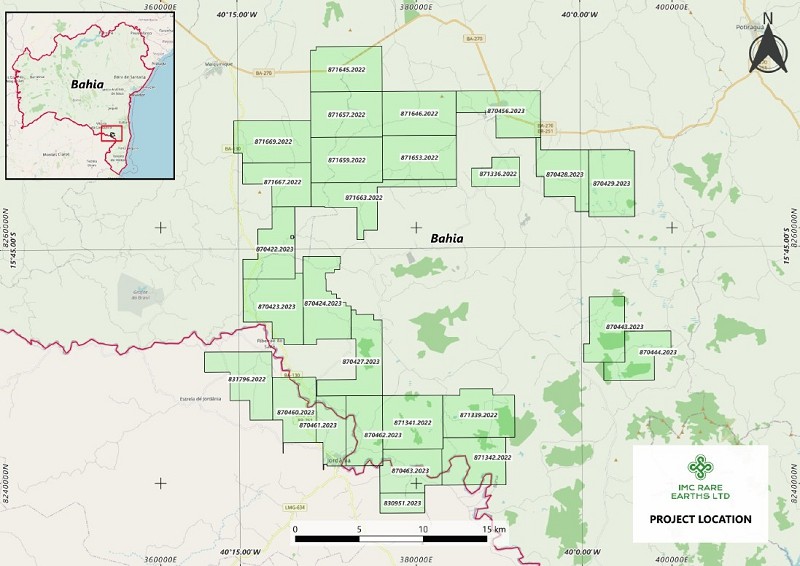
The project consists of 27 mining exploration licenses, the so-called “Alvará de Pesquisa” (which we refer to as our “Research Permits”), covering approximately 111,700 acres (452 km²), all held by Niobium Brazil Importação e Exportação Ltda., a wholly owned subsidiary of IMC. All licenses are in good standing with expiry dates between the date of this prospectus and December 2028, provided that several Research Permits due to expire in January 2026 were renewed to December 2028. The Research Permits are renewable for up to the same initial period.
Access to the property is via sealed highways from Vitória da Conquista to Itarantim (approximately two hours travel time by road), followed by unsealed rural roads leading directly into the license areas. The Research Permits grant the right to access the land for which the permits cover. The right to access the land does not confer control or economic benefits. The regional infrastructure is well developed, with power, fuel, and supplies available locally. The nearest airport is located in Vitória da Conquista (110 km northwest), and major ports at Salvador (350 km northeast), as well as a planned deep-water port at Porto Sul (150 km northeast), provide potential export routes. Basic electricity supply is available to the Itarantim Project via the State electrical grid and water supply is readily available via local sources including local storage facilities and water bores. There is a reliable labor source locally in Itarantim and adjacent locales. Bahia State is located adjacent to the State of Minas Gerais, an established mining jurisdiction in Brazil, and therefore experienced mining personnel should be easily sourced for future mining activities from this region.
| 4 |
The surrounding area is characterized by moderately rugged topography with elevations ranging from low-lying grasslands to granite ridges. A lateritic regolith, locally up to 30 meters thick, has developed over alkaline granite bedrock and forms the principal host for the REE mineralization. The area experiences a tropical climate with seasonal rainfall and temperatures that are warm to hot year-round. Cattle ranching is the dominant land use, and vegetation is mostly grass and shrubland.
The following map sets forth the location of the Itarantim Project:
| 5 |
The following map sets forth the tenure of the Itarantim Project:
Geological Setting, Mineralization and Deposit Types
Geological Setting
The Itarantim Project lies within the São Franciscan Craton and is underlain by the Itarantim Alkaline Granite Complex, part of the Neoproterozoic Itabuna Intrusive Suite. The complex comprises a series of alkaline granites, syenites and nepheline syenites, with localized aegirine- and biotite-bearing phases. These intrusions form part of a regional belt of alkaline and carbonatitic rocks known to host REE and niobium mineralization elsewhere in the States of Bahia and Minas Gerais.
Weathering of the Itarantim Complex under tropical conditions has produced an extensive regolith profile of lateritic soils, saprolite, and saprock, generally 4–30 meters thick. The regolith is the principal host to REE mineralization at the project.
Mineralization and Deposit Types
The REE mineralization at the Itarantim Project occurs as a regolith-hosted IAC deposit, similar in style to deposits mined in southern China and Myanmar. REEs are predominantly adsorbed onto fine-grained clay minerals, mainly kaolinite and halloysite, within the saprolite horizon (Chemical Index of Alteration 65–95 percent).
Analytical results indicate total rare earth oxide (TREO) grades of 500 ppm to 3,000 ppm, with 60–90 percent of REEs ionically adsorbed onto clays and therefore recoverable through mild inorganic salt leaching. The mineralization exhibits a distinct negative cerium anomaly typical of IAC systems derived from the weathering of monazite-bearing granites. The deposit is enriched in light and magnet REEs (Nd, Pr, Dy, Tb), key elements in high-performance permanent magnets.
| 6 |
Drilling
Between 2023 and 2025, we have completed a total of 532 machine-auger drillholes, comprising approximately 7,080 meters of drilling, across five contiguous resource blocks (A through E). Drilling was undertaken under the supervision of Cacto Geologia Mineração e Meio Ambiente Ltda., following documented standard operating procedures.
Each hole was drilled vertically, typically to depths of 10–20 meters, with 1 m sample intervals. Sample recovery averaged nearly 100 percent, and each interval was logged in detail for color, grain size and mineralogy. Samples were sealed, weighed, and dispatched to accredited laboratories for analysis. Drill collars were surveyed using RTK GPS and registered to high-resolution LiDAR topography.
The auger drilling confirmed continuous mineralization across multiple blocks, with TREO grades and leach recoveries consistent between holes and mineralization remaining open laterally and at depth. No prior exploration activities for any mineral commodity are known to have occurred on the Itarantim Project. Drilling for water resources for the provision of water to local farms is believed to have occurred, but details are unknown.
Mineral Processing and Metallurgical Testing
Extensive metallurgical test work has verified that the REE mineralization at the Itarantim Project is ionically adsorbed and readily leachable using simple inorganic salt solutions. Testing programs were conducted at CDTN (Belo Horizonte), ALS Global, and the University of Brighton (UK) between 2023 and 2025.
Results demonstrated average leach recoveries of 55 percent for light REEs (“LREE”) and 58 to 70 percent for heavy REEs (“HREE”), with maximum recoveries exceeding 80 percent. Mineralogical analyses identified kaolinite and halloysite as the principal clay hosts, with negligible deleterious elements or radionuclides detected. The deposit is therefore metallurgically amenable to low-cost, environmentally manageable leaching processes similar to those used for Chinese IAC deposits.
Mineral Resource Estimates
The following table sets forth the mineral resource estimate in the Technical Report, with an effective date of March 31, 2025, and date of issue of January 16, 2026:
| Block | Tonnes (Mt) | TREO | LREO | HREO | MREO | NdPr | DyTb | |||||||||||||||||||||
| A | 190 | 1,148 | 951 | 198 | 239 | 214 | 25 | |||||||||||||||||||||
| B | 120 | 1,170 | 941 | 228 | 237 | 209 | 28 | |||||||||||||||||||||
| C | 330 | 1,127 | 934 | 193 | 216 | 191 | 24 | |||||||||||||||||||||
| D | 410 | 1,390 | 1,175 | 216 | 251 | 224 | 27 | |||||||||||||||||||||
| E | 40 | 1,057 | 898 | 159 | 222 | 202 | 21 | |||||||||||||||||||||
| Total (Inferred) | 1,100 | 1,233 | 1,027 | 205 | 236 | 210 | 26 | |||||||||||||||||||||
| 7 |
Foreign Private Issuer Status
We are considered a “foreign private issuer” within the meaning of the rules under the Exchange Act. Accordingly, we report under the Exchange Act as a non-U.S. company with foreign private issuer status. This means that, as long as we qualify as a foreign private issuer under the Exchange Act, we will be exempt from certain provisions of the Exchange Act that are applicable to U.S. domestic public companies, including:
| ● | the sections of the Exchange Act and related rules regulating the solicitation of proxies, consents or authorizations in respect of a security registered under the Exchange Act; | |
| ● | the sections of the Exchange Act and related rules requiring insiders to file public reports of their share ownership and trading activities and liability for insiders who profit from trades made in a short period of time; and | |
| ● | the rules under the Exchange Act requiring the filing with the SEC of quarterly reports on Form 10-Q containing unaudited financial and other specified information, or current reports on Form 8-K, upon the occurrence of specified significant events. |
We expect to take advantage of these exemptions until such time, if any, as we are no longer a foreign private issuer. Under current SEC rules, we would cease to be a foreign private issuer if, on the last day of our fiscal year, more than 50% of our outstanding voting securities are held by U.S. residents and any of the following three circumstances applies: (i) the majority of our executive officers or directors are U.S. citizens or residents, (ii) more than 50% of our assets are located in the United States or (iii) our business is administered principally in the United States. See “Risk Factors—Risks Related to Our Incorporation and Operation Outside the United States—As a foreign private issuer, we are exempt from certain U.S. securities law and NYSE American corporate governance requirements, which may result in less protection and information for investors. We may also lose our foreign private issuer status or fail to maintain our NYSE American listing, which could increase compliance costs and adversely affect our share price.”
In addition, as a company incorporated in the Cayman Islands, we are permitted to adopt certain home country practices in relation to corporate governance matters that differ significantly from the NYSE American corporate governance listing standards. These practices may afford less protection to shareholders than they would enjoy if we complied fully with the NYSE American corporate governance listing standards. Currently, we plan to rely on home country practices with respect to our corporate governance. See “Risk Factors—Risks Related to Our Incorporation and Operation Outside the United States—As a foreign private issuer within the meaning of the NYSE American corporate governance rules, we are permitted to adopt certain home country practices in relation to corporate governance matters that differ significantly from NYSE American corporate governance listing standards.”
Emerging Growth Company Status
We qualify as an “emerging growth company” as defined in the Jumpstart Our Business Startups Act of 2012 (the “JOBS Act”). An emerging growth company may take advantage of specified exemptions from various requirements that are otherwise applicable generally to public companies in the United States. These provisions include:
| ● | the ability to present more limited financial data for our initial public offering, including presenting only two years of audited financial statements, as well as only two years of related management’s discussion and analysis of financial condition and results of operations disclosure; | |
| ● | an exemption from the auditor attestation requirement in the assessment of our internal control over financial reporting pursuant to Sarbanes-Oxley; and | |
| ● | (1) reduced disclosure obligations regarding executive compensation in our periodic reports and proxy statements and (2) exemption from the requirements of holding a nonbinding advisory vote on executive compensation, including golden parachute compensation. |
We may take advantage of certain of these provisions for up to five years following our initial public offering or such earlier time that we are no longer an emerging growth company. We will remain an emerging growth company until the earlier of (1) the last day of the fiscal year (a) following the fifth anniversary of the completion of our initial public offering, (b) in which we have total annual revenues of at least US$1.235 billion or (c) in which we are deemed to be a large accelerated filer, which means the market value of our ordinary shares that is held by non-affiliates exceeds US$700 million as of the prior September 30, and (2) the date on which we have issued more than US$1.0 billion in non-convertible debt during the prior three-year period. While we have not taken advantage of any of these reduced reporting burdens in this prospectus, we may choose to do so in future filings and if we do, the information that we provide shareholders may be different than you might get from other public companies in which you hold equity.
| 8 |
Controlled Company Status
Francesco Scolaro, our Chief Executive Officer and Chair, and entities affiliated with Mr. Scolaro control approximately 68% of the voting power of our outstanding ordinary shares. As a result, we are considered a “controlled company” within the meaning of the corporate governance standards of the NYSE American. Under these rules, the Company may elect not to comply with certain corporate governance requirements applicable to most companies listed on the NYSE American. In such case, you will not have the same protections afforded to shareholders of companies that are subject to all of these corporate governance requirements. See “Risk Factors—Risks Related to Being a Public Company—We are currently a “controlled company” and, as a result, qualify for and could rely on exemptions from certain corporate governance requirements.”
Our Corporate Structure
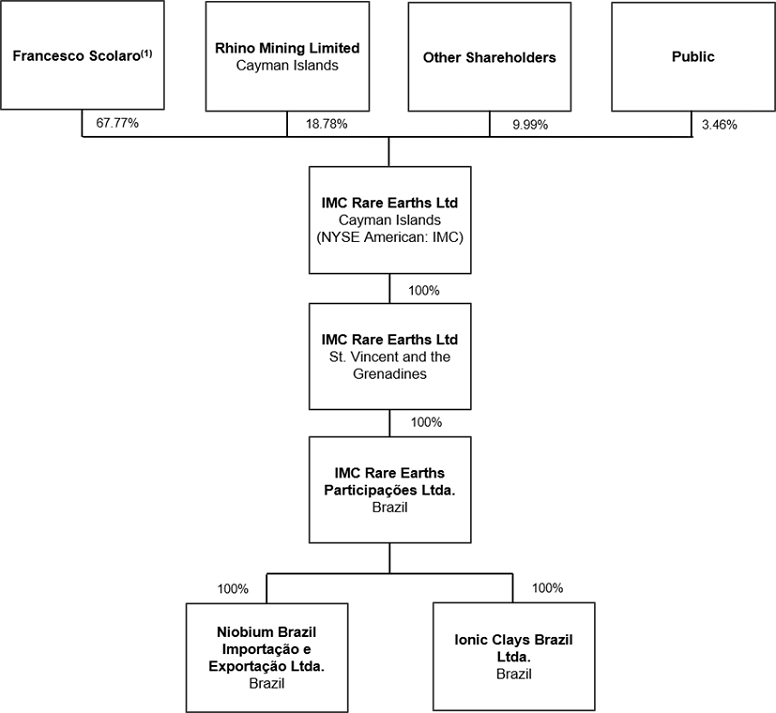
Following the completion of the offering, our corporate structure will not change, except for a reduction in ownership by Mr. Scolaro through Americas Rare Earths Holdings Ltd. Our corporate structure is as follows:
(1) Represents shares held through International Mineral Corporation Holdings Ltd and Americas Rare Earths Holdings Ltd.
| 9 |
The diagram below depicts our organizational structure, including the relevant ownership percentages of various shareholders, following the completion of the offering and assuming the sale of 10,110,000 ordinary shares:
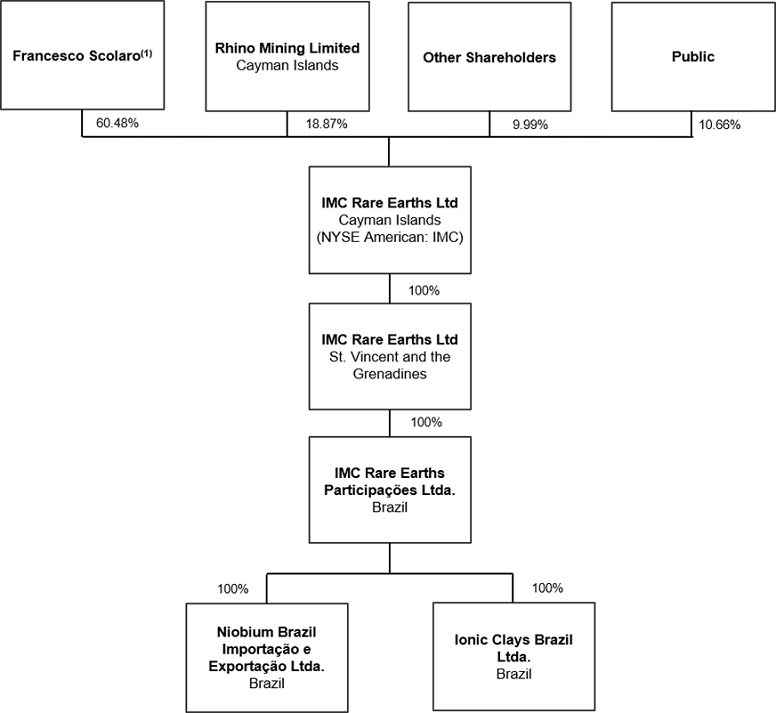
(1) Represents shares held through International Mineral Corporation Holdings Ltd and Americas Rare Earths Holdings Ltd.
Corporate Information
Our global headquarters and principal executive office is located at Avenida Paulista, 1765, 7th Floor, São Paulo, São Paulo, 0311-930, Brazil. Our registered office in the Cayman Islands is located at the offices of Compass OFM Limited, 18 Forum Lane, Camana Bay, 3rd Floor -Suite 5304, P.O. Box 31230, Grand Cayman, KY1-1205, Cayman Islands. On July 30, 2026, we completed our initial public offering of 4,600,000 ordinary shares (inclusive of the exercise in full of the underwriters’ option to purchase an additional 600,000 ordinary shares) at a price to the public of $5.00 per ordinary share (the “IPO”), resulting in gross proceeds to us of $23.0 million before underwriting discounts and commissions and offering expenses.
Our website is http://www.imcrareearths.com. Information contained on, or that can be accessed through, our website is not part of, and shall not be incorporated by reference into, this prospectus. Our agent for service of process in the United States is Puglisi & Associates, 850 Library Avenue, Suite 204, Newark, Delaware 19711.
| 10 |
Summary Risk Factors
Risks Related to Our Business and Industry
| ● | We have a limited operating history, currently generate no revenue, and if we are not successful in continuing to advance our business to production, then we may have to scale back or even cease our ongoing business operations. | |
| ● | The Itarantim Project requires significant additional exploration and technical studies before a development decision can be made, and there can be no assurance that such efforts will be successful. | |
| ● | Our success depends on the exploration, development and operation of the Itarantim Project, an exploration stage project which is currently our main project. | |
| ● | Our mineral resource is entirely classified as inferred and may not support the economic viability of the Itarantim Project. | |
| ● | We operate no mines, and the exploration and development of the Itarantim Project, or any other projects we may acquire in the future, into mines is highly speculative in nature, may be unsuccessful, and may never result in the development of an operating mine. | |
| ● | Our mineral resource estimates and technical models rely on limited and potentially non-representative data, which may result in inaccuracies. | |
| ● | The prices of the minerals for which we are principally exploring change on a daily basis, and a substantial or extended decline in the prices of these minerals could adversely affect our ability to raise capital, conduct exploration activities, and develop or operate a mine. | |
| ● | The success of our business will depend, in part, on the growth of existing and emerging uses for rare earth products. | |
| ● | Mineral resource estimates, and any mineral reserve estimates we may declare, may change adversely and such changes may negatively impact the viability of developing a mineral project into a mine. | |
| ● | We face risks related to minerals extraction, exploration and site construction. | |
| ● | Our operations are subject to extensive government regulation, and changes in applicable laws or the failure to obtain or maintain required permits could adversely affect our business. | |
| ● | Our mining operations may be impaired due to restrictions on the acquisition or lease of rural properties by foreign investors or by Brazilian entities under foreign control or with the majority of its capital stock held by foreign persons. | |
| ● | The failure to acquire, lease, purchase, or obtain rights to occupy all of the land intended for the operation of the Itarantim Project could adversely impact our development of the Itarantim Project. | |
| ● | A significant portion of any future mining revenue from our operations is expected to come from a small number of mines. | |
| ● | The existence of our mining claims depends on our ability to fund exploratory activity or to pay fees. | |
| ● | Our financial situation creates substantial doubt whether we will continue as a going concern. |
Risks Related to Our Incorporation and Operation Outside the United States
| ● | Because we are incorporated in the Cayman Islands, you may face difficulties in protecting your interests and enforcing your rights under U.S. laws. |
| 11 |
| ● | Because substantially all of our assets and operations are in Brazil, we are subject to Brazilian laws, regulations and jurisdiction, which may limit our ability to enforce rights or protect the interests of our shareholders. | |
| ● | Brazilian environmental legislation may expose our shareholders, investors, lenders, contractors or business partners to environmental liability. | |
| ● | We are subject to various levels of political, economic and other risks and uncertainties associated with operating in Brazil. | |
| ● | We are subject to Brazilian mining laws, regulatory oversight and jurisdiction, which may subject us to significant compliance burdens, regulatory change risk, and enforcement uncertainties. | |
| ● | We are a holding company, and we conduct substantially all of our business through our Brazilian subsidiary Niobium Brazil Importação e Exportação Ltda., which is controlled by our Brazilian holding company, IMC Rare Earths Participações Ltda. | |
| ● | As a foreign private issuer, we are exempt from certain U.S. securities law and NYSE American corporate governance requirements, which may result in less protection and information for investors. We may also lose our foreign private issuer status or fail to maintain our NYSE American listing, which could increase compliance costs and adversely affect our share price. | |
| ● | Our executives, directors, major shareholders, and their respective affiliates exercise significant control over us, which may limit your ability to influence corporate matters and could delay or prevent a change in corporate control. |
Risks Related to Being a Public Company
| ● | We have limited experience operating as a public company and fulfilling our obligations as a U.S. reporting company may be expensive and time consuming. | |
| ● | We identified a material weakness in our internal control over financial reporting for the year ended March 31, 2026. If we are not able to remediate this material weakness and otherwise maintain an effective system of internal control over financial reporting, the reliability of our financial reporting, investor confidence in us and the value of our ordinary shares could be adversely affected. | |
| ● | As an “emerging growth company,” we are eligible for reduced reporting and governance requirements, which may make our ordinary shares less attractive to investors and could increase our costs once we no longer qualify for this status. | |
| ● | We are currently a “controlled company” and, as a result, qualify for and could rely on exemptions from certain corporate governance requirements. | |
| ● | If we fail to meet applicable listing requirements, the NYSE American may delist our ordinary shares from trading, in which case the liquidity and market price of our ordinary shares could decline. |
Risks Related to Investing in Our Ordinary Shares
| ● | Our insiders and major shareholders will beneficially own a significant percentage of our ordinary shares and will be able to exert substantial influence over matters requiring shareholder approval. | |
| ● | Conflicts of interest could arise in the future between us, on the one hand, and Francesco Scolaro and entities owned by or affiliated with him, on the other hand, concerning among other things, business transactions, potential competitive business activities or business opportunities. | |
| ● | We engage in transactions with related parties and such transactions present possible conflicts of interest that could have an adverse effect on us. | |
| ● | Anti-takeover provisions in our organizational documents could delay or prevent a change of control. | |
| ● | We currently do not expect to pay dividends in the foreseeable future after this offering and you must rely on price appreciation of our ordinary shares for a return on your investment. | |
| ● | There is a risk that we will be a passive foreign investment company, or PFIC, for U.S. federal income tax purposes for our current or future taxable year, which could result in adverse U.S. federal income tax consequences for U.S. Holders of our ordinary shares. | |
| ● | Future issuances of our ordinary shares could dilute the interests of existing shareholders. |
| 12 |
THE OFFERING
| Ordinary shares offered by the Resale Shareholder | 10,110,000 ordinary shares. | |
| Ordinary shares outstanding after this Offering | 115,810,000 ordinary shares. | |
| Use of proceeds | We will not receive any proceeds from the sale of ordinary shares held by the Resale Shareholder. | |
| Risk factors | Investment in the ordinary shares involves a high degree of risk. See the “Risk Factors” section beginning on page 15 for a discussion of factors and uncertainties that you should consider in evaluating an investment in our securities. | |
| Listing | Our ordinary shares are listed on the NYSE American under the symbol “IMC”. | |
| Terms of this Offering | The Resale Shareholder will determine when and how it will sell the ordinary shares offered in this Resale Prospectus. |
| 13 |
SELECTED HISTORICAL FINANCIAL INFORMATION
The following tables set forth, for the periods and dates indicated, certain selected historical financial information of IMC Rare Earths Ltd. You should read the following selected financial data in conjunction with “Management’s Discussion and Analysis of Financial Condition and Results of Operations” and the audited financial statements and respective notes included elsewhere in this prospectus. Historical results are not necessarily indicative of the results that may be expected in the future.
| (USD) | For the Years ended March 31, | |||||||
| 2026 | 2025 | |||||||
| Operations Data: | ||||||||
| Exploration and evaluation expenses | $ | (1,270,257 | ) | $ | (1,774,102 | ) | ||
| General and administrative expenses | (1,920,709 | ) | (156,039 | ) | ||||
| Operating loss | (3,190,966 | ) | (1,930,141 | ) | ||||
| Finance cost | (167,757 | ) | (134,193 | ) | ||||
| Gains on fair value changes | 201,590 | - | ||||||
| Loss before tax | (3,157,133 | ) | (2,064,334 | ) | ||||
| Income tax expenses | - | - | ||||||
| Loss for the year | (3,157,133 | ) | (2,064,334 | ) | ||||
| Total comprehensive loss for the year | (3,157,133 | ) | (2,064,334 | ) | ||||
| Loss per share attributable to the ordinary equity holders of the company: | ||||||||
| Basic/diluted loss per share | (0.03 | ) | (0.02 | ) | ||||
| (USD) | As
at March 31, | |||||||
| 2026 | 2025 | |||||||
| Consolidated Statements of Financial Position Data: | ||||||||
| ASSETS | ||||||||
| Current assets | ||||||||
| Cash | $ | 9,303 | $ | 296 | ||||
| Marketable securities | 2,716,949 | - | ||||||
| Amounts due from related parties | 50,777 | - | ||||||
| Prepayments | 117,156 | - | ||||||
| Total current assets | 2,894,185 | 296 | ||||||
| Total assets | 2,894,185 | 296 | ||||||
| LIABILITIES | ||||||||
| Current liabilities | ||||||||
| Trade and other payables | (679,794 | ) | (58,174 | ) | ||||
| Amounts due to related parties | (371,050 | ) | (350,900 | ) | ||||
| Royalty option liability | (2,273,000 | ) | - | |||||
| Warrant liability | (3,785,924 | ) | - | |||||
| Loan from related party | - | (2,451,325 | ) | |||||
| Total current liabilities | (7,109,768 | ) | (2,860,399 | ) | ||||
| Loan from related party | (2,877,995 | ) | - | |||||
| Total non-current liabilities | (2,877,995 | ) | - | |||||
| Net current liabilities | (4,215,583 | ) | (2,860,103 | ) | ||||
| Net liabilities | (7,093,578 | ) | (2,860,103 | ) | ||||
| EQUITY | ||||||||
| Share capital | ˗ | ˗ | ||||||
| Share premium | 1,087,486 | - | ||||||
| Capital reserves | 387,321 | 203,149 | ||||||
| Accumulated losses | (8,568,385 | ) | (3,063,252 | ) | ||||
| Total deficiency in equity | (7,093,578 | ) | (2,860,103 | ) | ||||
| 14 |
RISK FACTORS
An investment in our ordinary shares is highly speculative and involves a high degree of risk. You should carefully consider the risks and uncertainties described below and the other information in this prospectus before making an investment in our ordinary shares. Our business, financial condition, results of operations or prospects could be materially and adversely affected if any of these risks occurs, and as a result, the market price of our ordinary shares could decline and you could lose all or part of your investment. This prospectus also contains forward-looking statements that involve risks and uncertainties. See “Cautionary Note Regarding Forward-Looking Statements.”
Risks Related to Our Business and Industry
We operate no mines, and the exploration and development of the Itarantim Project, or any other projects we may acquire in the future, into mines is highly speculative in nature, may be unsuccessful, and may never result in the development of an operating mine.
The Itarantim Project is at the exploration stage, and we do not have any interest in any mining operations or mines in development. Mineral exploration and mine development are highly speculative in nature, involve many uncertainties and risks and are frequently unsuccessful. Mineral exploration is performed to demonstrate the dimensions, position and mineral characteristics of mineral deposits, estimate mineral resources, assess amenability of the deposit to mining and processing scenarios and estimate potential deposit size. Once mineralization is discovered, it may take a number of years from the initial exploration phases before mine development and production is possible, during which time the potential feasibility of the project may change adversely. Even if mineralization is discovered, that mineralization may not be economic to mine. A significant number of years, several studies, and substantial expenditures are typically required to establish economic mineralization in the form of mineral reserves, to determine processes to extract the metals and, if required, to construct mining and processing facilities and obtain the rights to the land and the resources (including capital) required to develop the mining operation. In addition, if we discover mineralization that becomes a mineral reserve, it may take several years to a decade or more from the initial phases of exploration until production is possible. During this time, the economic feasibility of production may change. As a result of these uncertainties, we may not be able to successfully develop a commercially viable producing mine.
In addition, whether developing a producing mine is economically feasible will depend upon numerous additional factors, most of which are beyond our control, including the availability and cost of required development capital and labor, movement in the price of commodities, securing and maintaining title to mining tenements as well as obtaining all necessary consents, permits and approvals for the development of the mine. The economic feasibility of development projects is based upon many factors, including the accuracy of mineral resource and mineral reserve estimates; metallurgical recoveries; capital and operating costs; government regulations relating to prices, taxes, royalties, land tenure, land use, importing and exporting and environmental protection; and metal prices, which are highly volatile. Development projects are also subject to the successful completion of feasibility studies, issuance of necessary governmental permits and availability of adequate financing. Any of these factors may result in us being unable to successfully develop a commercially viable operating mine.
Our success depends on the exploration, development and operation of the Itarantim Project, an exploration stage project which is currently our main project.
At present, our primary mineral property is the interest that we hold in the Itarantim Project, which is in the exploration stage. Unless we acquire or develop additional mineral properties, we will be solely dependent upon this property and our future success will be largely driven by our ability to explore and develop the Itarantim Project successfully, including the results of such exploration and development efforts. If no additional mineral properties are acquired by us, any adverse development affecting our operations and further exploration or development of the Itarantim Project may have a material adverse effect on our business, financial condition, results of operations or prospects.
| 15 |
We cannot guarantee that our properties will result in the commercial extraction of mineral deposits or mines.
We currently have no operating mines, nor do we have any interest in any active mining operations. The Itarantim Project is at the exploration stage and has never been mined by us nor have we produced any revenue from mining operations. We also have no operating history upon which to base estimates of future operating costs and capital requirements. We may never be able to develop and produce minerals from a commercially viable mineral deposit or mine. Accordingly, it is unlikely that we will realize profits in the short term, and we cannot assure you that we will realize profits in the medium to long term, if any at all. Any profitability in the future from our business will be dependent upon development of mineral deposits and further exploration and development of other economic deposits of minerals, each of which is subject to numerous risk factors. Further, we cannot assure you that, even to the extent mineral deposits have been located, any of our property interests can be commercially mined. The exploration and development of mineral deposits involves a high degree of financial risk over a significant period of time, which a combination of careful evaluation, experience and knowledge of management may not eliminate. While discovery of additional REE deposits may result in substantial rewards, few properties which are explored are ultimately developed into producing mines. Major expenses may be required to construct mining and processing facilities. It is impossible to ensure that our current development and exploration programs will result in profitable commercial mining operations. The profitability of our operations will be, in part, directly related to the cost and success of our development and exploration programs which may be affected by a number of factors. Additional expenditures are required to commercially mine and to construct, complete and install mining and processing facilities in those properties that are actually mined and developed.
We have a limited operating history, currently generate no revenue, and if we are not successful in continuing to advance our business to production, then we may have to scale back or even cease our ongoing business operations.
We have no history of revenues from operations, no earnings and there can be no assurance that we will ever operate profitably. We have limited operating history and are in the exploration stage. The success of our Company is dependent on a successful exploration and development of the Itarantim Project through to production. Our operations are subject to all the risks inherent in the establishment of a developing mining enterprise and the uncertainties arising from the absence of a significant operating history. We may be unable to locate recoverable mineral reserves or operate on a profitable basis. We are in the exploration stage and potential investors should be aware of the difficulties normally encountered by mining enterprises in the exploration stage. If our business plan is not successful, and we are not able to operate profitably, investors may lose some or all of their investment in our company.
The Itarantim Project requires significant additional exploration and technical studies before a development decision can be made, and there can be no assurance that such efforts will be successful.
The Itarantim Project is at an early stage of exploration and development and will require additional work before a determination can be made as to whether it can be developed into a commercially viable mining operation. This work includes, among other things, infill and step-out drilling, geological modeling, metallurgical testing, hydrogeological and geotechnical studies, environmental baseline studies, feasibility studies and permitting activities.
These activities will require significant time and financial resources, and their outcomes are uncertain. There can be no assurance that such work will confirm the technical or economic viability of the project or that we will be able to complete such work on a timely basis or within budget. In addition, delays, cost overruns or adverse results from any of these activities could materially affect our ability to advance the Itarantim Project. If we are unable to complete the necessary exploration and technical studies or if the results are unfavorable, we may be unable to proceed with development of the Itarantim Project, which could have a material adverse effect on our business, financial condition, results of operations and prospects.
The exploration and development of the Itarantim Project is a capital-intensive business that requires the commitment of substantial resources; if we do not have sufficient resources to provide for such exploration and development, it could have a material adverse effect on our business, financial condition, results of operations or prospects.
Our ability to continue the exploration and development of the Itarantim Project requires the commitment of substantial resources and capital expenditures. Our estimated expenses may increase for a variety of factors, including as a result of inflationary pressures. The progress, the amounts and timing of expenditures and the success of the Itarantim Project will depend in part on the following: (i) our ability to timely procure new equipment and materials, certain of which may involve long lead-times, or to repair existing equipment; the ability of service providers or vendors to meet contractually-negotiated delivery or completion deadlines or meet performance specifications or guarantees; maintaining and procuring the permits required for our operations; (ii) if we determine to commence the development of a mine, negotiating contracts for equipment, earthwork, construction, equipment installation, labor and completing infrastructure and construction work following commencement; impact of planned and unplanned shut-downs and delays in our operations; impact of stoppages or delays on construction projects; disputes with contractors or other third parties; negotiating sales and offtake contracts for any planned future production; and (iii) the execution of any joint venture agreements or similar arrangements with strategic partners; and other factors, many of which are beyond our control.
Most of these activities require significant lead times and must be advanced concurrently. Unanticipated costs or delays could have a material adverse effect on our business, financial condition, results of operations or prospects and could require us to seek additional capital, which may not be available on commercially acceptable terms or at all.
| 16 |
We will need additional capital to explore and develop the Itarantim Project. If we cannot raise this additional capital, we will not be able to continue to explore and develop the Itarantim Project, and our business could fail.
We will need additional capital to continue our exploration and development efforts. In addition, even if we establish mineral resources in commercially exploitable quantities at the Itarantim Project, we will be required to expend substantial resources to establish the extent of the resource, engage in drilling operations and develop extraction and processing facilities (or make arrangements therefor) and infrastructure. We currently do not have adequate capital to develop necessary facilities and infrastructure and will need to raise additional funds. There can be no assurance that financing sources will continue to be available to finance our operations, that the discovery of commercially exploitable deposits will be significant enough to justify commercial operations or that we will be able to raise the funds required for development on a timely basis. Future financings may not be available on a timely basis, in sufficient amounts, or on terms acceptable to us, if at all. If we cannot raise the necessary capital to continue exploration and development of the Itarantim Project, our business may fail.
Additionally, there are significant uncertainties in the capital markets impacting the availability of financing for the purposes of mineral exploration and development, including uncertainties relating to the global economy, increasing geopolitical risk, increasing volatility in REE prices, as well as increasing volatility in the foreign currency exchange markets. Our intended operations are also exposed to various levels of regulatory, economic, political and other risks and uncertainties that may impact our ability to raise new capital.
Furthermore, any debt financings or other financings through the sale and issuance of securities senior to our ordinary shares will likely include financial and other covenants that will restrict our flexibility. Any failure to comply with these covenants would have a material adverse effect on our business, financial condition, and prospects because we could lose our existing sources of financing and/or impair our ability to secure new sources of funding. If we do not obtain additional financing, our mining operations may never commence, in which case you may lose the entirety of your investment in us.
We have a history of negative operating cash flows and net losses, and we have never achieved and may never achieve or sustain profitability.
We have a history of negative operating cash flows and net losses. We expect to continue to incur negative operating cash flows and net losses until such time as the Itarantim Project generates sufficient revenues to fund our continuing operations. We had negative cash flows from operating activities of approximately $2.7 million and $1.5 million during the years ended March 31, 2026 and March 31, 2025, respectively. We also had net losses of approximately $3.2 million and $2.1 million for the years ended March 31, 2026 and March 31, 2025, respectively. Given our history of negative operating cash flows and net losses, and potential future negative operating cash flows and net losses, we expect to use the net proceeds from the IPO to fund our continuing operations. See “Use of Proceeds”.
Additionally, we have never achieved and may never achieve or sustain profitability. To become and remain profitable, we must succeed in generating significant revenues from the Itarantim Project, which will require us to be successful in a range of challenging activities and is subject to numerous risks, including the risk factors set forth in this “Risk Factors” section. Furthermore, we may encounter unforeseen difficulties, complications, delays and other unknown factors which may adversely affect our revenues, expenses and profitability. Our failure to achieve or sustain profitability would depress our market value, could impair our ability to execute our business plan, raise capital or continue our operations, and could cause our shareholders to lose all or part of their investment.
| 17 |
Our mineral resource is entirely classified as inferred and may not support the economic viability of the Itarantim Project.
All of the mineral resources currently identified for the Itarantim Project are classified as inferred mineral resources. Inferred mineral resources have the lowest level of geological confidence under S-K 1300 and are subject to significant uncertainty as to their existence, continuity, grade and economic viability. Inferred mineral resources may not be considered when assessing the economic viability of a mining project and cannot be converted into mineral reserves without substantial additional exploration and analysis.
There is no assurance that further exploration work will result in the reclassification of inferred mineral resources into indicated or measured mineral resources or that any mineral resources will ultimately be converted into mineral reserves. In addition, as additional geological data becomes available through infill drilling, sampling or other exploration activities, the size, grade, continuity or overall estimate of the mineral resources may change materially, and such changes may be adverse. If our mineral resources are not upgraded or are materially reduced, the economic viability of the Itarantim Project could be adversely affected, and we may not be able to develop a commercially viable mining operation.
Our metallurgical test work is preliminary and may not be indicative of commercial-scale processing performance.
Metallurgical test work conducted to date for the Itarantim Project has been limited in scope and primarily performed at laboratory scale. While such testing indicates that the mineralization may be amenable to extraction using certain leaching methods, laboratory results may not accurately reflect performance at commercial scale. Differences in ore variability, scale-up factors, processing conditions, reagent consumption, recovery rates, environmental controls and operational constraints may result in materially different outcomes in a full-scale mining and processing operation.
We have not yet completed pilot-scale or commercial-scale metallurgical testing, and there can be no assurance that the recovery rates, processing costs or operational efficiencies assumed in our development plans will be achieved. If actual metallurgical performance is lower than expected or costs are higher than anticipated, the economic viability of the Itarantim Project could be materially adversely affected, which in turn could have a material adverse effect on our business, financial condition, results of operations and prospects.
Our current drilling density and exploration coverage may be insufficient to support reliable geological interpretations and resource estimates.
The current drilling density and spatial distribution of exploration data across the Itarantim Project are limited and may not be sufficient to adequately define the geometry, continuity and grade variability of the mineralization. Significant portions of the Itarantim Project area remain sparsely explored or unexplored, and existing drill spacing may be too wide to capture variations in mineralization, including localized high-grade or low-grade zones.
As a result, our current geological interpretations and mineral resource estimates are based on limited data and may not accurately reflect the actual characteristics of the deposit. Additional drilling, including infill drilling at closer spacing and step-out drilling in unexplored areas, will be required to improve geological confidence. Such work may reveal discontinuities, lower grades, or other adverse geological features that could materially reduce the estimated size or quality of the mineral resource. If our exploration efforts do not confirm the continuity or grade of mineralization as currently interpreted, our business, financial condition, results of operations and prospects could be materially adversely affected.
Our mineral resource estimates and technical models rely on limited and potentially non-representative data, which may result in inaccuracies.
Any figures presented for mineral resources in this prospectus, including our mineral resource estimates and related technical models, block models, grade interpolation and tonnage calculations, are based on a limited dataset, including a relatively small number of drill holes, sampling points and density measurements. Certain key technical parameters, such as bulk density, may be derived from a limited number of samples and may not fully capture variability across the deposit. In addition, some datasets may not have been independently verified to the extent required for higher-confidence resource classifications.
| 18 |
If the underlying data is incomplete, inaccurate or not representative of the deposit as a whole, our resource estimates may be materially overstated or understated. Future exploration, testing or analysis may identify discrepancies in the data or require adjustments to key assumptions, which could result in material revisions to our resource estimates. Any such revisions could adversely affect our assessment of the Itarantim Project’s economic viability and could have a material adverse effect on our business, financial condition, results of operations and prospects.
The prices of the minerals for which we are principally exploring change on a daily basis, and a substantial or extended decline in the prices of these minerals could adversely affect our ability to raise capital, conduct exploration activities, and develop or operate a mine.
Our business, financial performance and prospects will be significantly affected by fluctuations in the prices of the MREEs we are principally exploring for. The prices of MREEs are volatile, can fluctuate substantially and are affected by numerous factors that are beyond our control, including prevailing interest rates and returns on other asset classes; expectations regarding inflation, monetary policy and currency values; speculative activities; governmental and foreign exchange rate decisions; decisions regarding the creation and disposal of mineral stockpiles; changes in trade policies, such as the implementation of tariffs, sanctions, import or export restrictions or other barriers to trade, in significant markets for MREEs, including China, the United States or the European Union; structural changes in demand including electrification; the availability and costs of metal substitutes; the location and the demand for products containing these key minerals; technological changes and changes in industrial processes, as well as economic slow-downs or recessions.
We cannot predict the effect of these factors on REE prices. Significant and/or prolonged reductions in REE prices could adversely affect the viability of the Itarantim Project and our ability to raise capital, and if not considered viable for exploration and resource evaluation activities, could cause us to delay, halt or stop exploration and development activities altogether. If we are operating a producing mine at the time of such reduction, we would expect to suffer decreasing revenues and profitability which could adversely affect our results of operations, prospects and financial condition.
Significant and/or prolonged increase in MREE prices for these minerals may decrease the demand for these minerals and increase the demand for substitute minerals. A fall in demand could also decrease MREE prices, thereby reducing the attractiveness of conducting exploration activities for MREE. A fall in demand may also adversely affect our ability to raise capital and develop or operate a mine. In addition, an increase in worldwide supply, and consequent downward pressure on prices, may result over the longer term from increased mineral production from mines developed or expanded as a result of current MREE price levels.
The success of our business will depend, in part, on the growth of existing and emerging uses for rare earth products.
Our strategy is to produce REE that are used in critical existing and emerging technologies, such as hybrid and electric vehicles, wind turbines, robotics, medical equipment, military equipment and other high-growth, advanced motion technologies. The success of our business depends on the continued growth of these end-markets and the successful commercialization of rare earth products in such markets. If the market for these critical existing and emerging technologies does not grow as we expect, grows slower than we expect, or if the demand for our products in these markets decreases, then our business, prospects, financial condition and operating results could be harmed. In addition, the market for these technologies, particularly in the automotive industry, tends to be cyclical, which exposes us to increased volatility, and it is uncertain as to how such macroeconomic factors will impact our business. Any unexpected costs or delays in the manufacturing of separated REE products or rare earth magnets, or less than expected demand for the critical existing and emerging technologies that use rare earth products, could have a material adverse effect on our financial condition, results of operations or prospects.
| 19 |
An increase in the global supply of rare earth carbonate, dumping, predatory pricing and other tactics designed to inhibit our further downstream integration by our competitors may adversely affect the economic viability of the Itarantim Project.
The pricing of and demand for rare earth carbonate are influenced by factors beyond our control, including global macroeconomic conditions and shifts in the worldwide supply and demand for rare earth oxide (REO) products. China currently accounts for the significant majority of global separated REO production and continues to dominate the manufacturing of metals and magnets derived from rare earths — capabilities that are not presently available at scale in the United States. In recent years, the Chinese rare earth industry has undergone substantial restructuring, further consolidating control of production within state-owned enterprises. Chinese producers or other market participants may engage in predatory pricing or other competitive practices intended to limit the development of new entrants or inhibit our downstream integration. Additionally, any increase in the supply of rare earth carbonate from other nations or intensified global competition could result in lower product prices, reduced margins, or the loss of potential market share. Should these factors persist or worsen, the revenues expected from the Itarantim Project could decline to levels that render such projects uneconomic, which could materially and adversely affect our business, financial condition, and prospects.
Mineral resource estimates, and any mineral reserve estimates we may declare, may change adversely and such changes may negatively impact the viability of developing a mineral project into a mine.
Estimated mineral resource estimates, and any mineral reserve estimates we may declare, may have to be recalculated based on changes in commodity prices, further exploration or development activity, loss or change in permits or actual production experience. Such changes could adversely affect estimates of the volume or grade of mineralization, estimated recovery rates or other important factors that influence mineral resource estimates. The extent to which our mineral resources may ultimately be reclassified as mineral reserves depends on the demonstration of their profitable recovery and economic mineability.
In addition, mineral resource estimates have been determined and valued based on assumed future metal prices, cut-off grades and operating costs that may prove to be inaccurate. Extended declines in the market price for MREEs may render portions of our mineralization uneconomic and result in reduced reported volume and grades, which in turn could have a material adverse effect on our financial performance, financial position, results of operations or prospects, as well as a reduction in the amount of mineral resources. In addition, inferred mineral resources have a great amount of uncertainty as to their existence and their economic and legal feasibility. You should not assume that any part of an inferred mineral resource will be upgraded to a higher category or that any of the mineral resources will be reclassified as mineral reserves. In addition, it may not be possible to economically mine or process any of our mineral resources.
Material changes in mineral resources, if any, grades, stripping ratios or recovery rates may affect the economic viability of any project. Our future growth and productivity will depend, in part, on our ability to develop and maintain commercially mineable mineral rights at our existing properties or identify and acquire other commercially mineable mineral rights, and on the costs and results of continued exploration and potential development programs.
Our future capital and operating cost estimates at the Itarantim Project may not be accurate.
Capital and operating cost estimates made in respect of the Itarantim Project may not prove to be accurate. Capital and operating costs are estimated based on the interpretation of geological data, feasibility studies, anticipated climatic conditions and other factors. Any of the following events, among the other events and uncertainties described herein, could affect the ultimate accuracy of such estimates: unanticipated changes in grade and tonnage of ore to be mined and processed; incorrect data on which engineering assumptions are made; delay in construction schedules and unanticipated transportation costs; the accuracy of major equipment and construction cost estimates; labor negotiations; changes in government regulation (including regulations regarding prices, cost of consumables, royalties, duties, taxes, permitting and restrictions on production quotas on exportation of minerals); and title claims.
Our growth strategy and future exploration and development efforts may be unsuccessful.
In addition to our exploration and development of the Itarantim Project, we may seek to acquire additional mineral interests or merge with or invest in new companies or opportunities to grow our business. A failure to make acquisitions or investments may limit our growth. In pursuing acquisition and investment opportunities, we face competition from other companies having similar growth and investment strategies, many of which may have substantially greater resources than us. Competition for these acquisitions or investment targets could result in increased acquisition or investment prices, higher risks and a diminished pool of businesses, services or products available for acquisition or investment. Additionally, if we lose or abandon our interest in the Itarantim Project, there is no assurance that we will be able to acquire another mineral property of merit or that such an acquisition would be approved by applicable regulators.
| 20 |
We face risks related to minerals extraction, exploration and site construction.
It is impossible to ensure that the current and future exploration programs or feasibility studies on our existing properties will establish reserves. Whether it will be economically feasible to extract REEs depends on a number of factors, including, but not limited to: the particular attributes of the deposit, such as size, grade and proximity to infrastructure; sales prices; minerals extraction, processing and transportation costs; the willingness of lenders and investors to provide project financing; labor costs and possible labor strikes; and governmental regulations, including, without limitation, regulations relating to prices, taxes, royalties, land tenure, land use, importing and exporting materials, foreign exchange, environmental protection, employment, worker safety, transportation, and reclamation and closure obligations. The exact effect of these factors cannot be accurately predicted, but the combination of these factors may result in us receiving an inadequate return on invested capital. In addition, we are subject to the risks normally encountered in the minerals extraction industry, such as: the discovery of unusual or unexpected geological formations; accidental fires, floods, earthquakes or other natural disasters; unplanned power outages and water shortages; controlling water and other similar extraction hazards; operating labor disruptions and labor disputes; the ability to obtain suitable or adequate machinery, equipment, or labor; our liability for pollution or other hazards; and other known and unknown risks involved in the conduct of exploration and operation of minerals extraction sites. The nature of these risks is such that liabilities could exceed any applicable insurance policy limits or could be excluded from coverage. There are also risks against which we cannot insure or against which we may elect not to insure. The potential costs which could be associated with any liabilities not covered by insurance, or in excess of insurance coverage, or compliance with applicable laws and regulations may cause substantial delays and require significant capital outlays, adversely affecting our results of operations and financial viability.
Suitable infrastructure may not be available for exploration or development of the Itarantim Project or damage to existing infrastructure may occur.
Mining, processing, development and exploration activities depend on adequate infrastructure. Reliable roads, bridges, port and/or rail transportation, power sources, water supply and access to key consumables are important determinants for capital and operating costs. The lack of availability on acceptable terms or the delay in the availability of any one or more of these items could prevent or delay exploration, development or exploitation of the Itarantim Project. If adequate infrastructure is not available, the future exploration, development or mining of the Itarantim Project may not be commenced or completed on a timely basis, or at all, the resulting operations may not achieve the anticipated development or mine production results, and any exploration, construction and operating costs associated with the future exploration, development or mining of the Itarantim Project may be higher than anticipated. Shortages of water supply, critical spare parts, maintenance service and new equipment and machinery may adversely affect our future exploration, development or mining of the Itarantim Project.
Our operations are subject to extensive government regulation, and changes in applicable laws or the failure to obtain or maintain required permits could adversely affect our business.
Our exploration, development, and future mining operations are subject to a wide range of laws, regulations, and governmental policies relating to the exploration, extraction, and processing of mineral resources; environmental protection; health and safety; labor standards; and taxation. These include, among others, laws governing the removal of natural resources from the ground, the discharge of materials into the environment, and the design and use of drilling methods and equipment. Compliance with these requirements requires us to obtain and maintain numerous permits, licenses, and approvals from governmental authorities. Our ability to continue the exploration and development of the Itarantim Project is subject to permits granted to us by Brazil’s primary federal regulatory authority, Agência Nacional de Mineração (“ANM”). Currently our permits allow us to conduct geological surveys and mapping, geophysical and geochemical surveys, drilling, opening of visitable excavations and carrying out surveys of the mineral body, tests on the processing of ores or useful mineral substances, to obtain concentrates in accordance with market specifications or for industrial use. The continuation of this work is dependent on the renewal of our permit. In addition, except in extraordinary cases in which ANM authorizes the extraction of minerals in an area titled prior to the granting of the mining concession, we cannot extract any minerals from the Itarantim Project until we are granted a mining concession by the ANM and other applicable licenses, such as environmental licenses. There can be no assurance that such permits or licenses will be granted, renewed, or maintained in a timely manner, or on commercially reasonable terms, or that the conditions of existing permits will not be amended or revoked. Delays or failures in obtaining or maintaining these authorizations could materially adversely affect our ability to carry out exploration, development, or production activities.
| 21 |
Environmental, safety, and other legal standards may also change over time, and new regulations or policies may be introduced or interpreted in a way that increases compliance costs, restricts planned operations, or otherwise adversely affects our business. Compliance with evolving regulatory frameworks may cause substantial delays or require capital expenditures in excess of those currently anticipated. Moreover, we may be subject to liability for environmental damage or pollution, which may not be fully covered by insurance due to prohibitive premiums or exclusions from coverage. In addition, the future taxation of mining operators is inherently uncertain, and any unfavorable changes in tax laws, rates, or interpretations could have a material adverse effect on our financial condition, results of operations, and prospects.
See the section titled “Business—Regulatory Overview” for a more detailed description of the laws that may affect our exploration and exploitation activities.
Our long-term success depends, in part, on our ability to negotiate and enter into binding offtake or sales agreements with, and deliver our product to, third party customers on commercially viable terms. This may not occur or, if it should occur, such offtake arrangements may expose us to risks.
If we are successful in developing the Itarantim Project into an operating mine, our long-term success will depend in part on our ability to identify target customers and convert such contacts into meaningful orders or expand on current customer relationships. We do not currently have any revenue or sales agreements with customers in place, and we can make no guarantee that we will be able to enter into such arrangements. If we are unable to negotiate, finalize or maintain such agreements and satisfy the conditions thereto in order to enter into definitive agreements, or are only able to do so on terms that are unfavorable to us, we will not be able to generate any revenue, which would have a material adverse effect on our business, prospects, operating results and financial condition.
In addition, we may enter into joint ventures, partnership arrangements, or offtake agreements with other parties in relation to the exploration, development, and production of the properties in which we have an interest. Any failures of these parties to meet their obligations to us or to third parties, or any disputes with respect to the parties’ respective rights and obligations, could have a material adverse effect on us, the development and production at our properties, including the Itarantim Project, and on future joint ventures, if any, or their properties, and therefore could have a material adverse effect on our results of operations, financial performance, cash flows and the price of our ordinary shares.
Title to surface and mineral rights within the Itarantim Project may be uncertain or defective, which could put our investment in such properties at risk.
Title to our properties may be challenged, and we may not have, or may not be able to obtain, all necessary surface rights to develop the Itarantim Project. An unknown title defect on the Itarantim Project (or any portion thereof) could adversely affect our ability to explore, develop and/or mine the Itarantim Project and/or process the minerals that we may mine in the future. In addition to termination, failure to make timely tenement maintenance payments and otherwise comply with applicable laws, regulations and local practices relating to mineral right applications and tenure could result in reduction or expropriation of entitlements.
Title insurance is generally not available for mineral projects, or where available, is cost prohibitive, and our ability to ensure that we have obtained secure claim to individual mineral projects or mining tenements may be severely constrained. We rely on title information and/or representations and warranties provided by the grantors. Any challenge to our title could result in litigation, insurance claims and potential losses, hinder our access to capital, delay the exploration and development of a property and ultimately result in the loss of some or all of our interest in the mineral project. A successful challenge could also result in our not being compensated for our prior expenditures relating to the property.
| 22 |
Our mining operations may be impaired due to restrictions on the acquisition or lease of rural properties by foreign investors or by Brazilian entities under foreign control or with the majority of its capital stock held by foreign persons.
Pursuant to applicable Brazilian laws and regulations, including Decree No. 74965/1974, Opinion CGU/AGU dated as of August 23, 2010, issued by the General Counsel of the Federal Government Office of Brazil (which we refer to as “Opinion CGU/AGU”), foreign individuals and foreign legal entities are subject to restrictions on the acquisition or lease of rural properties in Brazil. Such restrictions also apply to Brazilian legal entities controlled by foreign investors or with the majority of their capital stock held by foreign investors, such as in the case of Niobium, our operating subsidiary. As such, our future ownership and/or possession of any rural properties in Brazil may be subject to legal challenges, and our operations at the Itarantim Project may be impaired due to such restrictions on the acquisition or lease of rural properties.
The legality of Opinion CGU/AGU has been, and is currently being, challenged, however, prior challenges to Opinion CGU/AGU have been unsuccessful. Under current Brazilian laws and regulations, a foreign investor may only acquire or lease rural property in Brazil, in compliance with Opinion CGU/AGU, if certain conditions are met, including, among others, that (i) foreign investors obtain approvals from the Brazilian National Institute of Rural Settlement and Agrarian Reform and from the applicable Ministries; (ii) the aggregate amount of rural property held by a foreign investor does not exceed 25% of the total surface area of the municipality in which such property is located; (iii) the acquisition of areas in excess of 100 indefinite exploitation modules will be subject to prior approval by the Brazilian Congress; (iv) the acquisition must be formalized by means of a public deed of sale and purchase; and (v) the acquisition of rural properties located at or near Brazil’s border areas is subject to the fulfilment of additional requirements, such as the prior authorization by the Brazilian National Defense Council. Pursuant to these laws and regulations, any agreements relating to the acquisition, lease, purchase or direct or indirect ownership or possession of rural properties by foreign individuals or entities, as well as any agreements relating to corporate changes which might imply indirect acquisition or lease of rural properties by foreign individuals or entities, may be considered null and void. Thus, our future ownership and/or possession of any rural properties in Brazil could be subject to legal challenges and/or be considered null, any of which could result in a material adverse effect on our business, results of operations, financial condition, and cash flows.
The failure to acquire, lease, purchase, or obtain rights to occupy all of the land intended for the operation of the Itarantim Project could adversely impact our development of the Itarantim Project.
We have rights of access to or have rights to occupy, through Niobium, the properties on which the facilities and infrastructure for the Itarantim Project will be located. The Research Permits grant the right to access the land for which the permits cover. The right to access the land does not confer control or economic benefits. This includes the land on which our proposed facilities and infrastructure for the Itarantim Project will be located. We intend to conduct administrative land regularization proceedings with applicable Brazilian governmental agencies (such as the Brazilian National Institute of Rural Settlement and Agrarian Reform, the Brazilian Ministry of Industry and Trade, and other agencies), the purpose of which is to acquire ownership of these properties. As of the date of this prospectus, we have not yet commenced any land regularization proceedings, which will generally be conducted in accordance with Opinion CGU/AGU (as more fully described in “Business—Land Access”). There is no guarantee that such applicable Brazilian governmental agencies will issue administrative decisions approving our acquisition and ownership of such properties on a timely basis or at all, as our acquisition of properties in Brazil will depend on us following the applicable legal procedures and meeting the required legal standards, which will be assessed by such applicable Brazilian governmental agencies within an uncertain timeline.
If we fail to acquire the properties to which we currently have rights of access, or renew the lease agreements for, or acquire, we may be forced to find replacement sites for our facilities at the Itarantim Project, which sites may be less convenient or difficult to access, which in turn would increase the time and/or costs to develop and construct the Itarantim Project, decrease productivity at the Itarantim Project once operational, and adversely affect our business, results of operations, and financial condition.
| 23 |
Land reclamations and mine closures may be burdensome and costly.
Land reclamation and mine closure requirements are generally imposed on mining companies, such as ours, which could require us, among other things, to minimize the effects of land disturbance. Such requirements may include controlling the discharge of potentially dangerous effluents from a site and restoring a site’s landscape to its pre-exploration form. The actual costs of land reclamations and mine closures are uncertain and planned expenditures may differ from the actual expenditures incurred. Therefore, the amount that we may be required to spend could be materially higher than any current or future estimates. Any additional amounts required to be spent on land reclamations and mine closures may cause us to alter our operations, and may have a material adverse effect on our results of operation and financial condition. Additionally, we may be required to maintain financial assurances, such as letters of credit, to secure reclamation obligations under certain laws and regulations. The failure to acquire, maintain or renew such financial assurances could subject us to fines and penalties or suspension of our operations. Letters of credit or other forms of financial assurance may represent only a portion of the total amount of money that will be spent on reclamation over the life of a mine’s operations.
Outbreaks, epidemics or pandemics could have an adverse effect on our business.
Outbreaks of infectious diseases, epidemics or pandemics can significantly and adversely affect the national and global economy and commodity and financial markets. Impacts may include, among other things, extreme volatility in financial markets, a slowdown in economic activity, extreme volatility in commodity prices and a global recession. Outbreaks, epidemics or pandemics may lead to significant restrictions on travel, temporary business closures, quarantines, and a general reduction in consumer activity and sentiment globally and may impact our business and operations by, among others, increasing the cost of operations, causing shipping delays, reducing employee productivity, limiting travel of our personnel, adversely affecting the health and welfare of our personnel, or preventing or delaying important third-party service providers from performing normal and contracted activities crucial to the operation of our business.
Decisions beyond our control, such as canceled events, restricted travel, barriers to entry, temporary closures or limited availability of county, state or federal government agencies, or other factors may affect our ability to perform mining operations, corporate activities, and other actions that would normally be accomplished without such limitations. The extent to which an outbreak, epidemic or pandemic will impact our operations, our business and the economy is highly uncertain and will also depend on future developments that cannot be predicted, including new information which may emerge concerning the severity of the disease, the duration and spread of the outbreak, including the spread of variants, the scope of travel restrictions imposed, mandatory or voluntary business closures, the impact on businesses and financial and capital markets, and the extent and effectiveness of actions taken throughout the world to contain the virus or treat its impact, including the effectiveness and availability of vaccines. We cannot predict the impact of an outbreak, epidemic or pandemic, but it may adversely affect our business, financial condition, results of operations or prospects.
We depend on the continued service of key personnel and face significant competition in attracting and retaining qualified employees.
Our success depends heavily on the performance, expertise and continued service of our Chief Executive Officer, other key members of our leadership team, and our technical, financial and operational personnel. The loss of any of these individuals could adversely affect our ability to execute our business strategy, advance our exploration and development activities, and operate efficiently. We do not maintain “key person” insurance for any of our executives or employees.
The number of individuals with the specialized skills required for the acquisition, exploration, development and operation of rare earth mining projects is limited, and competition for such personnel is intense. As our business grows, we will require additional qualified financial, administrative, geologic, mining and operational staff, and we may not be successful in attracting, training or retaining these individuals. Certain areas in which we operate are highly competitive, and we may experience delays or vacancies in filling key roles, or be required to incur significant costs to recruit and retain experienced personnel. If we fail to attract and retain the personnel necessary to support our business, our exploration and development activities could be delayed or reduced, which could have a material adverse effect on our business, financial condition, results of operations and prospects.
| 24 |
The development of the Itarantim Project or any other projects we may acquire in the future into an operating mine will be subject to all of the risks associated with establishing and operating new mining operations.
If the development of the Itarantim Project or any other projects we may acquire in the future is found to be economically feasible and we seek to develop an operating mine, the development of such a mine will require obtaining permits and financing the construction and operation of the mine itself, processing plants and related infrastructure. As a result, we will be subject to certain risks associated with establishing new mining operations, including:
| ● | uncertainties in timing and costs, which can be highly variable and considerable in amount, of the construction of mining and processing facilities and related infrastructure; | |
| ● | we may find that skilled labor, mining equipment and principal supplies needed for operations, including explosives, fuels, chemical reagents, water, power, equipment parts and lubricants are unavailable or available at costs that are higher than we anticipated; | |
| ● | we will need to obtain necessary environmental and other governmental approvals and permits and the receipt of those approvals and permits may be delayed or extended beyond what we anticipated, or that the approvals and permits may contain conditions and terms that materially impact our ability to operate a mine; | |
| ● | we may not be able to obtain the financing necessary to finance construction and development activities or such financing may be on terms and conditions costlier than anticipated, which may make mine development activities uneconomic; | |
| ● | we may suffer industrial accidents as part of building or operating a mine that may subject us to significant liabilities; | |
| ● | we may suffer mine failures, shaft failures or equipment failures which delay, hinder or halt mine development activities or mining operations; | |
| ● | the Itarantim Project may suffer from adverse natural phenomena such as inclement weather conditions, floods, droughts, rock slides and seismic activity; | |
| ● | we may discover unusual or unexpected geological and metallurgical conditions that could cause us to have to revise or modify mine plans and operations in an adverse manner; and | |
| ● | the development or operation of our mines may become subject to opposition from nongovernmental organizations, environmental groups or local groups, which may delay, prevent, hinder or stop development activities or operations. |
In addition, we may find that the costs, timing and complexities of developing the Itarantim Project or any other future projects to be greater than we anticipated. Cost estimates may increase significantly as more detailed engineering work is completed on a project. It is common in mining operations to experience unexpected costs, problems and delays during construction, development and mine start-up. Accordingly, our activities may not result in profitable mining operations at our mineral properties.
If we determine to commence mine construction or development, delays in the performance of any of the contractors, suppliers, consultants or other persons on which we are dependent in connection with our construction activities, delay in or failure to receive the required governmental approvals and permits in a timely manner or on reasonable terms or termination of any required approvals or permits, or a delay in or failure in connection with the completion and successful operation of the operational elements of new mines could delay or prevent the construction and start-up of new mines.
The Itarantim Project is at the exploration stage, and we do not expect to undertake any mine construction or development at this time. If we determine to commence mine construction or development, the success of any such construction projects and the development of new mines by us at the Itarantim Project will be subject to a number of factors including the availability and performance of engineering and construction contractors, mining contractors, suppliers and consultants, the receipt of required governmental approvals and permits in connection with the construction of mining facilities, the conduct of mining operations (including environmental permits), and the successful completion and operation of injection and extraction wells, among other operational elements. Any delay in the performance of any one or more of the contractors, suppliers, consultants or other persons on which we are dependent in connection with our construction activities, delay in or failure to receive the required governmental approvals and permits in a timely manner or on reasonable terms or termination of any required approvals or permits, or a delay in or failure in connection with the completion and successful operation of the operational elements of new mines could delay or prevent the construction and start-up of new mines as planned. There can be no assurance that future construction and start-up plans implemented by us will be successful, that we will be able to obtain sufficient funds to finance construction and start-up activities, that personnel and equipment will be available in a timely manner or on reasonable terms to successfully complete construction projects, that we will be able to obtain all necessary governmental approvals and permits or that the construction, start-up and ongoing operating costs associated with the development of new mines will not be significantly higher than anticipated by us. Any of the foregoing factors could adversely impact our business, financial conditions, results of operations or prospects.
| 25 |
The Itarantim Project has no operating history upon which to base estimates of future cash flow. The capital expenditures and time required to develop new mines or other projects are considerable and changes in costs or construction schedules can affect project economics. Thus, it is possible that actual costs may change significantly, and economic returns may differ materially from our estimates.
Commercial viability of a new mine or development project is predicated on many factors such as estimation of mineral reserves, anticipated metallurgical recoveries, environmental considerations and permitting and anticipated capital and operating costs of the Itarantim Project, as well as available capital to develop such project. Development projects are subject to the completion of successful feasibility studies and environmental assessments, issuance of necessary governmental permits and availability of adequate financing. Development projects are uncertain, and it is possible that actual capital and operating costs and economic returns will differ significantly from those estimated for a project prior to production. Consequently, there is a risk that start-up of new mine and development projects at the Itarantim Project may be subject to write-down and/or closure as they may not be commercially viable.
Because of the dangers involved in the mining of minerals and the manufacture of mineral products, there is a risk that we may incur liability or damages as we conduct our business.
The mining of minerals and the manufacture of mineral products involve numerous hazards that could cause bodily harm or environmental damage and subject us to liability. These hazards include: groundwater, surface water or soil contamination; radiation exposure; chemical hazards; environmental hazards; industrial accidents and/or processing upsets; periodic interruptions due to inclement or hazardous weather conditions or other acts of God; and mechanical equipment failure and facility performance problems.
Although we maintain insurance to address certain risks involved in our business, such as coverage for property damage, business interruption, natural disasters, terrorism and workers compensation, there can be no assurance that our coverage will be adequate for liabilities incurred or that insurance will continue to be available to us on economically reasonable terms. Additionally, we cannot be certain that all claims we may make under our insurance policies will be deemed to be within the scope of, or fully covered by, our policies. We might also become subject to liability for environmental issues, damage or other hazards that may be uninsurable or for which we may elect not to insure because of premium costs or commercial impracticality. These policies contain limits of coverage and exclusions that are typical of such policies generally. The payment of such premiums, or the assumption of such liabilities, may have a material adverse effect on our financial position, results of operations or prospects.
Severe adverse weather conditions may adversely affect our business operations.
We are subject to environmental risks which could harm our results of operations or prospects and increase our costs and expenses. The occurrence of severe adverse weather conditions, including increased temperatures, hail, droughts, fires, floods, mudslides or landslides may have an adverse impact on our operations. Adverse weather may result in delays to our exploration activities, physical damage to our operations, instability of infrastructure and equipment, washed-out roads to the Itarantim Project, and alter the supply of water and electricity to the Itarantim Project site. Increased temperatures may also decrease worker productivity at the Itarantim Project and raise cooling costs. Should the impacts of adverse weather conditions be material in nature or occur for lengthy periods of time, our business, financial condition, results of operations or prospects could be adversely affected.
| 26 |
The presence or lack of water may adversely affect our future mining operations.
Any future mines that we may develop will require the use of significant quantities of water for mining activities, processing and related auxiliary facilities. Water usage, including extraction, containment and recycling requires appropriate permits granted by governmental authorities.
Water may not be available in sufficient quantities to meet our future production needs and may not prove sufficient to meet our water supply needs. In addition, necessary water rights may not be granted and/or maintained. A reduction in our water supply could adversely affect our business, results of operations, prospects and financial condition. This and we have not yet obtained the water rights to support some of our potential development activities and our inability to obtain those rights could prevent us from pursuing those activities.
Our reputation could be damaged, including as a result of the actual or perceived occurrence of any number of events, and could include any negative publicity, whether true or not, which could have an adverse impact on our financial performance, cash flows and prospects.
As a result of the increased usage and the speed and global reach of social media and other web-based tools used to generate, publish and discuss user-generated content and to connect with other users, companies today are at a much greater risk of being perceived negatively in the marketplace. Damage to our reputation can be the result of the actual or perceived occurrence of any number of events, and could include any negative publicity, whether true or not. We place a great emphasis on protecting our image and reputation, but we do not ultimately have direct control over how it is perceived by others. Reputation loss may lead to increased challenges in developing and maintaining community relations, decreased investor confidence and an impediment to our overall ability to advance the Itarantim Project, thereby having a material adverse impact on financial performance, cash flows and prospects.
Reputation loss, including reputation loss by other mining companies operating in jurisdictions where we operate, may result in decreased investor confidence, increased challenges in developing and maintaining community and stakeholder relations and an impediment to our overall ability to advance the Itarantim Project and our strategy, which could have a material adverse impact on our results of operations, financial condition and prospects. While we are committed to operating in a socially responsible manner, there is no guarantee that our efforts in this respect will mitigate this potential risk.
Our success depends on developing and maintaining relationships with local communities and stakeholders.
Our ongoing and future success depends on developing and maintaining productive relationships with the communities surrounding the Itarantim Project, including local indigenous people who may have rights or may assert rights to certain of our properties, and other stakeholders in our operating locations. Local communities and stakeholders may be dissatisfied with our activities or the level of benefits provided, which may result in legal or administrative proceedings, civil unrest, protests, direct action or campaigns against us. Any such occurrence could adversely affect our business, financial condition, prospects or results of operations, as well as our ability to commence or continue exploration or mine development activities.
We may face opposition from organizations that oppose mining which may disrupt or delay the Itarantim Project.
There is an increasing level of public concern relating to the effects of mining on the natural landscape, in communities and on the environment. Certain non-governmental organizations, community groups, public interest groups and reporting organizations (“NGOs”) that oppose resource development are vocal critics of the mining industry. In addition, there have been many instances in which local community groups have opposed resource extraction activities, which have resulted in disruption and delays to the relevant operation, and in some cases halted development altogether. NGOs or local community organizations could direct adverse publicity against and/or disrupt and/or halt our operations in respect of one or more of our mineral properties regardless of our successful compliance with social and environmental best practices, due to political factors, activities of unrelated third parties on lands in which we have an interest, or our operations specifically. Any such actions and the resulting media coverage could have an adverse effect on our reputation and financial condition or our relationships with the communities in which we operate, which could have a material adverse effect on our business, prospects, financial condition or results of operations.
| 27 |
Our operations could be adversely affected if we fail to maintain satisfactory labor relations; work stoppages or similar difficulties could significantly disrupt our operations.
The development and exploration of the Itarantim Project is dependent upon the efforts of our employees. Although none of our employees are currently subject to any collective bargaining arrangements, our employees could, in the future, choose to be represented as a collective unit, which may result in labor disputes, work stoppages or other disruptions in our production efforts that could adversely affect us.
A work stoppage by any of the third parties providing services in connection with the Itarantim Project could significantly delay the completion of such projects and disrupt our operations and adversely affect our results of operations or prospects.
A significant portion of any future mining revenue from our operations is expected to come from a small number of mines.
If and when we begin generating revenue from future mining operations, a significant portion of our revenue is expected to come from a small number of mines, which means that adverse developments at these properties could have a more significant or lasting impact on our results of operations or prospects than if our revenue was less concentrated.
Increasing costs or limited access to raw materials may adversely affect our financial condition, results of operations or prospects.
Our principal expenses are contractor costs, materials, personnel costs and energy. Changes in costs at the Itarantim Project could occur as a result of unforeseen events, including international and local economic and political events such as increased energy costs, increased costs and scarcity of labor, and could result in changes in the prospects of the Itarantim Project. Many of these factors may be beyond our control.
We rely on third-party suppliers for a number of raw materials. Any material increases in the cost of raw materials, or our inability to source viable and economic alternative third-party suppliers for the supply of our raw materials, could have an adverse effect on our results of operations, prospects or financial position.
The existence of our mining claims depends on our ability to fund exploratory activity or to pay fees.
Our mining claims, which are the central part of our business, require that we either pay fees, or incur certain minimum development costs annually, or the claims will be forfeited. Due to our current financial situation, we may not be able to meet these obligations and we could therefore lose our claims. This would impair our ability to raise capital and would negatively impact the value of our company.
We operate in a highly competitive industry.
The rare earth mining and processing and magnet manufacturing industry is capital intensive with competitive market dynamics. Production of MREEs and magnet products is dominated by our Chinese competitors. These competitors may have greater financial resources, as well as other strategic advantages to operate, maintain, improve, and possibly expand their facilities. Additionally, our Chinese competitors have historically been able to produce at relatively low costs due to domestic economic and regulatory factors, including less stringent environmental and governmental regulations and lower labor and benefit costs. If we are not able to develop mining operations that achieve consistent product quality at our anticipated costs of production, then any strategic advantages that our competitors may have over us, including, without limitation, lower labor, compliance, and production costs, could have a material adverse effect on our business.
| 28 |
Technological changes or the development of substitute materials could adversely affect the economic viability of the Itarantim Project.
The industries and end-markets that utilize rare earth materials evolve rapidly as new technologies and materials are developed. We do not currently sell any products and have not generated any revenue to date, and the future success of our business depends on the commercial demand for the rare earth carbonate we expect to produce from the Itarantim Project. If industries adopt new technologies that reduce or eliminate the need for rare earth materials, or if alternative materials or substitutes emerge that offer superior performance or lower cost, demand for rare earth carbonate could decrease materially.
Because the Itarantim Project is not yet operational and future revenues depend on achieving economically viable production and pricing levels, any sustained decline in demand or pricing resulting from such technological shifts could render the Itarantim Project uneconomic to develop or operate. This would materially and adversely affect our business, financial condition, and results of operations.
Significant political, trade, regulatory developments, and other circumstances beyond our control, could have a material adverse effect on the economic viability of the Itarantim Project.
Significant political, trade, or regulatory developments, such as those stemming from the change in U.S. federal administration, are difficult to predict and may negatively impact the economic viability of the Itarantim Project. Similarly, changes in U.S. federal policy that affect the geopolitical landscape could give rise to circumstances outside our control that could have negative impacts on our business operations. For example, on February 1, 2025, the United States imposed a 25% tariff on imports from Canada and Mexico, which were subsequently suspended for a period of one month. Historically, tariffs have led to increased trade and political tensions between the United States and countries in the international community. In response to tariffs, other countries have implemented retaliatory tariffs on U.S. goods. More recently, the United States has expanded its use of trade measures against other major trading partners, including Brazil. In July 2025, the United States announced a new reciprocal tariff regime increasing duties on a range of Brazilian imports. These new tariffs, which took effect in August 2025, apply to a significant portion of Brazil’s exports to the United States and were met with reciprocal measures by the Brazilian government, which implemented new legislation authorizing retaliatory tariffs and other trade countermeasures. Political tensions as a result of trade policies could reduce trade volume, investment, technological exchange, and other economic activities between major international economies, resulting in a material adverse effect on global economic conditions and the stability of global financial markets. More specifically, any related tariffs or other changes in trade policy, sanctions or other barriers to trade that adversely impact the market for MREEs could have a material adverse effect on the development of the Itarantim Project by rendering it economically unviable. Therefore, certain changes in political, trade, regulatory, and economic conditions, including, but not limited to, U.S. and Brazil trade policies, could have an adverse effect on our financial condition, results of operations or prospects.
We are dependent upon information technology systems, which are subject to cyber threats, disruption, damage and failure.
We depend upon information technology systems in the conduct of our operations. Our information technology systems are subject to disruption, damage or failure from a variety of sources, including, without limitation, computer viruses, security breaches, cyber-attacks, natural disasters and defects in design. Cybersecurity incidents, in particular, are evolving and include, but are not limited to, malicious software, attempts to gain unauthorized access to data and other electronic security breaches that could lead to disruptions in systems, unauthorized release of confidential or otherwise protected information or the corruption of data. We have implemented various measures to manage our risks related to information technology systems and network disruptions. However, given the unpredictability of the timing, nature and scope of information technology disruptions, we have been in the past or could potentially be subject to downtimes, operational delays, the compromising of confidential or otherwise protected information, destruction or corruption of data, security breaches, other manipulation or improper use of our systems and networks or financial losses from remedial actions, any of which could have a material adverse effect on our business, operating results and financial condition.
| 29 |
Our directors and officers may have conflicts of interest as a result of their relationships with other mining companies that are not affiliated with us.
Francesco Scolaro and some of our other directors and officers are also, or may also become, directors, officers and stockholders of other companies, including companies that are similarly engaged in the business of developing and exploiting natural resource properties. Consequently, there is a possibility that our directors and officers may have conflicts of interest from time to time. To the extent that such other companies may participate in ventures in which we may participate in, or in ventures which we may seek to participate in, our directors and officers may have a conflict of interest in negotiating and concluding terms respecting the extent of such participation. In all cases where our directors and officers have an interest in other companies, such other companies may also compete with us for the acquisition of mineral property investments.
Currency fluctuations may affect our results of operation and financial condition.
We pay for goods and services in a number of currencies, including the U.S. dollar and other currencies. We also raise capital in U.S dollars. Adverse fluctuations in these currencies relative to each other and relative to the currencies in which we incur expenditures could adversely affect our financial position and the costs of our exploration and development activities. We do not engage in currency or commodity hedging activities.
Changes and uncertainties in the tax system in the countries in which we have operations could adversely affect our financial condition, results of operations or prospects, and reduce net returns to our shareholders.
Our taxes are affected by several factors, some of which are outside of our control, including the application and interpretation of the relevant tax laws and treaties. If our filing position, application of tax incentives or similar “holidays” or benefits were to be challenged for any reason, this could have a material adverse effect on our business, results of operations, prospects and financial condition.
We are subject to routine tax audits by various tax authorities. Tax audits may result in additional tax, interest payments and penalties which would adversely affect our financial condition and operating results. New laws and regulations or changes in tax rules and regulations or the interpretation of tax laws by the courts or the tax authorities may also have a substantial negative impact on our business. There is no assurance that our current financial condition will not be adversely affected in the future due to such changes.
We are unable to predict what tax reform may be proposed or enacted in the future or what effect such changes would have on our business, but such changes, to the extent they are brought into tax legislation, regulations, policies or practices in jurisdictions in which we operate, could increase the estimated tax liability that we have expensed to date and paid or accrued on our balance sheets, and otherwise affect our financial position, future results of operations, prospects, cash flows in a particular period and overall or effective tax rates in the future in countries where we have operations, reduce post-tax returns to our shareholders and increase the complexity, burden and cost of tax compliance.
Our financial situation creates substantial doubt whether we will continue as a going concern.
Since inception, we have not generated revenues and have incurred losses, and, as of March 31, 2026, we had a total deficit of approximately $7.1 million. Additionally, we expect to incur a net loss in the foreseeable future, primarily as a result of the estimated operating expenses related to the planned development of the Itarantim Project. There can be no assurances that we will be able to develop the Itarantim Project or achieve a level of revenues adequate to generate sufficient cash flow from operations or obtain funding from the IPO or additional financing through private placements, public offerings and/or bank financings necessary to support our working capital requirements. Furthermore, no assurance can be given that additional financing will be available, or if available, will be on acceptable terms. These conditions represent material uncertainties that could result in our inability to continue as a going concern. If adequate working capital is not available, we may be forced to discontinue operations, which would cause investors in our ordinary shares to lose their entire investment.
| 30 |
Risks Related to Our Incorporation and Operation Outside the United States
Because we are incorporated in the Cayman Islands, you may face difficulties in protecting your interests and enforcing your rights under U.S. laws.
We are an exempted company with limited liability incorporated under the laws of the Cayman Islands. As a result, its corporate affairs are governed by our memorandum and articles of association, the Companies Act (As Revised) of the Cayman Islands and the common law of the Cayman Islands. The rights of shareholders to take action against our directors, actions by our minority shareholders and the fiduciary duties of our directors to us under Cayman Islands law are to a large extent governed by the common law of the Cayman Islands. The common law of the Cayman Islands is derived in part from comparatively limited judicial precedent in the Cayman Islands and from the common law of England, the decisions of whose courts are of persuasive authority, but are not binding, on a court in the Cayman Islands. The rights of our shareholders and the fiduciary duties of our directors under Cayman Islands law are not as clearly established as they would be under statutes or judicial precedents in some jurisdictions in the United States. In particular, Cayman Islands has a less developed body of securities and corporate law than the United States. Some U.S. states, such as Delaware, have more fully developed and judicially interpreted bodies of corporate law than the Cayman Islands. In addition, Cayman Islands companies generally do not have standing to initiate shareholder derivative actions in U.S. federal courts.
Our corporate records are not subject to the same inspection rights available to shareholders of U.S. companies. Under Cayman Islands law, shareholders of Cayman Islands exempted companies generally have no right to obtain copies of corporate records, other than our memorandum and articles of association, special resolutions, and register of mortgages and charges, or lists of shareholders. Our directors have discretion under our memorandum and articles of association to determine whether shareholders may inspect additional records but are not obliged to make them available to our shareholders. These limitations may make it more difficult for shareholders to obtain information needed to establish any facts necessary for a shareholder motion or to solicit proxies from other shareholders in connection with a proxy contest.
Certain corporate governance practices in the Cayman Islands, which is our home country, differ significantly from requirements for companies incorporated in other jurisdictions such as the United States. Currently, we plan to rely on home country practice with respect to certain corporate governance matters, and as a result our shareholders may be afforded less protection than they otherwise would under rules and regulations applicable to U.S. domestic issuers.
As a result of all of the above, our shareholders may have more difficulty in protecting their interests in the face of actions taken by management, members of our board of directors (our “Board”) or controlling shareholders than they would as shareholders of a company incorporated in the United States. For a discussion of significant differences between the provisions of the Companies Act (As Revised) of the Cayman Islands and the laws applicable to companies incorporated in the United States and their shareholders, see “Description of Share Capital — Differences in Corporate Law.”
Brazilian environmental legislation may expose our shareholders, investors, lenders, contractors or business partners to environmental liability.
Brazilian environmental legislation adopts a broad concept of liability, which may extend beyond the direct polluter to include indirect polluters. Pursuant to Article 3, item IV, of Law No. 6,938/1981, shareholders, investors, lenders, contractors, and business partners who contribute to, finance, or benefit from polluting activities may be held jointly and severally liable for environmental damage. In this context, foreign shareholders, including new shareholders entering the Company through this offering or the IPO as indirect shareholders, may, in theory, be exposed to environmental claims in Brazil involving the Itarantim Project, even in the absence of direct operational involvement. In addition, environmental incidents or alleged impacts related to Brazilian operations may give rise to claims and legal proceedings in foreign jurisdictions, as illustrated by the Mariana dam case, in which the English High Court recognized the potential liability of BHP as the controlling shareholder of Samarco. Furthermore, under Article 4 of Law No. 9,605/1998 (Environmental Crimes Law), Brazilian courts may pierce the corporate veil whenever it constitutes an obstacle to full compensation for environmental damage, potentially allowing the assets of shareholders, including foreign shareholders, to be reached if the Brazilian entity lacks sufficient resources to remedy the damage. If we or our shareholders, investors, lenders, contractors or business partners are exposed to such liability, our business, financial condition and results of operations may be materially and adversely affected.
Because substantially all of our assets and operations are in Brazil, we are subject to Brazilian laws, regulations and jurisdiction, which may limit our ability to enforce rights or protect the interests of our shareholders.
We conduct the vast majority of our operations in Brazil and hold substantially all of our material assets there. As a result, we are subject to the laws, regulations, policies and judicial systems of Brazil, including those governing mining, environmental protection, permitting, licensing, land use, taxation, foreign investment, property rights, and administrative and judicial enforcement.
Brazilian courts and regulators may interpret and enforce local laws differently from expectations based on U.S. law. In particular, Brazilian courts may be reluctant to apply foreign law or enforce foreign judgments, and may give precedence to mandatory Brazilian legal or regulatory provisions. Moreover, judicial processes in Brazil may involve delays, higher costs, limited ability to obtain discovery, and procedural rules that differ materially from those in U.S. courts.
Because of the foregoing, investors in the United States may face difficulties in (i) effecting service of process on our Brazilian subsidiaries, affiliates, or personnel; (ii) bringing actions against our affiliates in U.S. courts; (iii) enforcing U.S. judgments in Brazil (or in Brazilian courts) or obtaining recognition or enforcement of U.S. judgments in Brazil; (iv) compelling production of documents, testimony, or evidence located in Brazil; or (v) ensuring that Brazil’s regulatory or judicial bodies fully uphold contractual rights, property rights, or remedies granted under U.S. law.
| 31 |
In addition, regulatory changes, political shifts, or evolving enforcement priorities in Brazil could adversely affect our operations, profitability or ability to safeguard our legal rights. Because we depend on Brazilian operations, adverse rulings, regulatory decisions, changes in law, or delays in Brazilian enforcement actions could significantly harm our business and impair U.S. shareholders’ ability to protect their investments.
We are subject to various levels of political, economic and other risks and uncertainties associated with operating in Brazil.
The Itarantim Project is located in Brazil, and, as a result, our operations are exposed to various levels of political, economic and other risks and uncertainties associated with operating in a foreign jurisdiction. These risks and uncertainties include, but are not limited to:
| ● | fluctuations in currency exchange rates, restrictions on foreign exchange, currency controls, and currency remittance; | |
| ● | price controls; | |
| ● | import or export controls; | |
| ● | high rates of inflation; | |
| ● | labor unrest; | |
| ● | community relations; | |
| ● | renegotiation or nullification of existing concessions, licenses, permits, applications and contracts; | |
| ● | expropriation and nationalization; | |
| ● | illegal mining; | |
| ● | tax disputes and changes in tax policies; | |
| ● | governmental regulations that may require the awarding of contracts of local contractors or require foreign contractors to employ citizens of, or purchase supplies from, a particular jurisdiction; | |
| ● | changing political conditions, including corruption; | |
| ● | terrorism and hostage taking; and | |
| ● | risks of war or civil unrest, including military repression. |
Changes, if any, in mining or investment policies or shifts in political attitudes in Brazil may adversely affect our operations. We may become subject to local political unrest or poor community relations that could have a debilitating impact on our operations and could result in damage to site infrastructure and injury to personnel. Additionally, our planned operations may be affected to varying degrees by government regulations with respect to, among other things, restrictions on production, price controls, export controls, currency remittance, income taxes, expropriation of property, foreign investment, maintenance of claims, environmental legislation, land use, land claims of local people, water use, and mine safety. Any failure by us to comply with applicable laws, regulations and local practices may result in loss, reduction or expropriation of entitlements, and enforcement actions, including corrective measures requiring capital expenditures, installing of additional equipment, increasing security at the site, or other remedial actions. Parties engaged in mining operations may be required to compensate those suffering loss or damage as a result of mining activities, and may have administrative, civil or criminal fines or penalties imposed for violations of applicable laws or regulations, which may adversely affect our results of operations, financial condition, and prospects.
Furthermore, on October 31, 2022, Luiz Inácio “Lula” da Silva (“President Lula”) was elected as the next president of Brazil with a four-year term commencing in January 2023. As part of President Lula’s electoral campaign, he made public statements regarding being committed to stopping illegal mining, but was also supportive of legal, permitted mining in Brazil. Nonetheless, it is difficult to predict how President Lula’s new term will affect Brazil’s mining industry and regulatory regime at this time. In the event that President Lula determines to pass more stringent regulations on Brazil’s mining industry, our business and prospects could be adversely impacted. Moreover, Brazil’s next presidential election will take place in October 2026, and it is unclear what actions, if any, a different presidential administration could take that may have an impact on Brazil’s mining industry.
| 32 |
The occurrence of any of these various factors and uncertainties cannot be accurately predicted and could have an adverse effect on our operations and profitability.
We are subject to Brazilian mining laws, regulatory oversight and jurisdiction, which may subject us to significant compliance burdens, regulatory change risk, and enforcement uncertainties.
As a company with the majority of our mining assets and operations located in Brazil, we are governed by Brazilian mining, environmental, licensing and land use laws, and permitted and regulated by Brazilian authorities such as the Ministry of Mines and Energy and the ANM. Our rights to explore, develop and operate mining concessions, special mining permits, prospecting permits, and related authorizations are conditioned upon compliance with these laws, and are subject to governmental oversight, renewal requirements, and potential cancellation, relinquishment, or suspension.
Brazil’s legal regime for mining imposes substantial obligations, including permitting, environmental licensing, local community consultation, health and safety standards, obligations related to the use of land and rights over the surface and subsoil, transfer or encumbrance of mining rights, and reporting requirements. Moreover, changes to Brazilian mining laws, regulations, decrees, or administrative interpretations, or shifts in enforcement, could impose additional obligations, costs, or restrictions on our operations, and could render some of our existing activities noncompliant or require us to modify or suspend operations.
In Brazil, judicial and administrative processes may be slower, less predictable, or less favorable to foreign participants than in other jurisdictions. We may face challenges in interpreting the applicable regulatory requirements, engaging with local authorities, or appealing adverse administrative or judicial decisions. In addition, even if we obtain favorable decisions in Brazilian courts or administrative bodies, it may be difficult to enforce those decisions, especially if counterparty assets or relevant personnel are located outside Brazil or in jurisdictions with weak mechanisms for cross-border enforcement.
Because so much of our value depends on our Brazilian operations, any adverse change in Brazilian mining law or regulatory practice, delays or denials in obtaining or renewing required authorizations, increased compliance costs, enforcement actions, or the inability to enforce legal rights or remedies in Brazil could adversely affect our business, financial condition, results of operations, prospects and the value of your investment.
See the section titled “Business—Regulatory Overview” for a more detailed description of the laws that may affect our exploration and exploitation activities.
We are a holding company, and we conduct substantially all of our business through our Brazilian subsidiary Niobium Brazil Importação e Exportação Ltda., which is controlled by our Brazilian holding company, IMC Rare Earths Participações Ltda.
Our investors are subject to the risks attributable to Niobium Brazil Importação e Exportação Ltda., our Brazilian-incorporated operating subsidiary. As a holding company, we conduct substantially all of our business through Niobium. Our future operating revenues are dependent on the Itarantim Project and the distribution of those earnings to us. There is no independent obligation for Niobium to pay dividends to our Company. The ability of Niobium to pay dividends and other distributions will depend on its operating results and will be subject to applicable laws and regulations, which require that solvency and capital standards be maintained by Niobium, and, if applicable, any contractual restrictions contained in any instruments governing our indebtedness. In the event of a bankruptcy, liquidation, or reorganization of Niobium, holders of indebtedness and trade creditors may be entitled to payment of their claims from the assets of Niobium before us.
| 33 |
As a foreign private issuer within the meaning of the NYSE American corporate governance rules, we are permitted to adopt certain home country practices in relation to corporate governance matters that differ significantly from NYSE American corporate governance listing standards.
As an exempted company incorporated in the Cayman Islands, we are permitted to adopt certain home country practices in relation to corporate governance matters that differ significantly from the corporate governance listing requirements of the NYSE American. These practices may afford less protection to shareholders than they would enjoy if we complied fully with corporate governance listing requirements of the NYSE American. We rely on home country practice to be exempted from certain of the corporate governance requirements of the NYSE American, namely:
| ● | there is not a necessity to hold meetings of board of directors on at least a quarterly basis, or the requirement for independent directors to have regularly scheduled executive sessions at least annually without the presence of non-independent directors and management; and | |
| ● | there is no requirement for the Company to obtain shareholder approval with respect to (a) the establishment (or material amendment to) a stock option or purchase plan or other equity compensation arrangement as specified in Section 711 of the NYSE American LLC Company Guide; (b) the issuance of additional shares as sole or partial consideration for an acquisition of the stock or assets of another company in the circumstances specified in Section 712 of the NYSE American LLC Company Guide; and (c) the issuance of additional shares in connection with a transaction specified in Section 713 of the NYSE American LLC Company Guide, or that will result in a change of control of the Company. |
To the extent we choose to follow home country practice in the future, our shareholders may be afforded less protection than they otherwise would enjoy under NYSE American corporate governance standards applicable to U.S. domestic issuers.
As a foreign private issuer, we are exempt from certain U.S. securities law and NYSE American corporate governance requirements, which may result in less protection and information for investors. We may also lose our foreign private issuer status or fail to maintain our NYSE American listing, which could increase compliance costs and adversely affect our share price.
We qualify as a “foreign private issuer” under SEC rules and, as such, are exempt from certain U.S. securities laws and NYSE American corporate governance requirements applicable to U.S. domestic issuers. As a result, we may follow corporate governance practices in accordance with Cayman Islands law rather than the NYSE American Listing Rules. Cayman Islands law does not require a majority of our Board to be independent, nor does it require separate independent committees for compensation or nominations.
As a foreign private issuer, we are also exempt from certain Exchange Act requirements applicable to U.S. public companies, including Regulation FD, which prohibits selective disclosure of material nonpublic information. Consequently, there may be less publicly available information about us, and our officers and directors may trade in its securities without the same prompt disclosure obligations as U.S. company insiders. We will file an annual report on Form 20-F and furnish current reports on Form 6-K, but will not be required to file quarterly reports or comply with all ongoing disclosure obligations applicable to domestic issuers.
Our status as a foreign private issuer is determined annually and may be lost in the future if a majority of our ordinary shares are held by U.S. residents and certain other conditions are met. If we cease to qualify as a foreign private issuer, we would become subject to the full reporting and governance requirements applicable to U.S. domestic issuers, including more frequent and detailed SEC filings, compliance with Regulation FD, and adherence to the NYSE American’s corporate governance rules requiring a majority of independent directors and independent board committees. Complying with these additional requirements would result in significant additional legal, accounting, and administrative costs. Failure to satisfy such obligations could subject us to penalties or potential delisting from the NYSE American.
| 34 |
In addition, maintaining our NYSE American listing requires ongoing compliance with NYSE American’s continued listing standards, including minimum shareholder equity, share price, and market value thresholds. If we cannot meet or continue to meet these requirements, our securities could be delisted, which would adversely affect the liquidity and market price of our ordinary shares. Delisting could also reduce the availability of market quotations, limit analyst coverage, decrease trading activity, and impair our ability to raise additional capital or issue securities in the future.
Our executives, directors, major shareholders, and their respective affiliates exercise significant control over us, which may limit your ability to influence corporate matters and could delay or prevent a change in corporate control.
The current holdings of our executives, directors, and major shareholders represent beneficial ownership, in the aggregate, of approximately 97% of our outstanding ordinary shares. See also “Principal Shareholders.” As a result, these shareholders are able to influence our management and affairs and control the outcome of matters submitted to our shareholders for approval, including matters such as the election of directors and any sale, merger, consolidation, or sale of all or substantially all of our assets. These shareholders may have interests, with respect to their ordinary shares, that are different from those of the investors in this offering. In addition, this concentration of voting power among one or more of these shareholders may adversely affect the market price of our ordinary shares by:
| ● | delaying, deferring or preventing a change of control in us; | |
| ● | impeding a merger, consolidation, takeover or other business combination involving us; or | |
| ● | discouraging a potential acquirer from making a tender offer or otherwise attempting to obtain control of us. |
You may be unable to present proposals before annual general meetings or extraordinary general meetings not called by shareholders.
Cayman Islands law provides shareholders with only limited rights to requisition a general meeting, and does not provide shareholders with any right to put any proposal before a general meeting. These rights, however, may be provided in a company’s articles of association. Our memorandum and articles of association allow one or more of our shareholders who together hold not less than 10% of the rights to vote to requisition a general meeting of our shareholders, in which case our directors are obliged to call such meeting. Advance notice of at least five (5) clear days is required to be given to the shareholders for the convening of any general meeting. A quorum required for a general meeting is one or more holders holding shares that represent not less than one-third of the outstanding shares of the Company carrying the right to vote at such general meeting. For these purposes, “clear days” means that period excluding (a) the day when the notice is given or deemed to be given and (b) the day for which it is given or on which it is to take effect.
Risks Related to Being a Public Company
We have limited experience operating as a public company and fulfilling our obligations as a U.S. reporting company may be expensive and time consuming.
Our directors and officers have limited experience operating a public company, which makes our ability to comply with applicable laws, rules and regulations uncertain. Our failure to comply with all laws, rules and regulations applicable to U.S. public companies could subject us or our management to regulatory scrutiny or sanction, which could harm the Company’s reputation and share price.
| 35 |
As a public company we will incur significant legal, accounting, and other expenses that we did not incur as a private company. We are subject to reporting requirements of the Exchange Act, the Sarbanes-Oxley Act, the rules subsequently implemented by the SEC, the rules and regulations of the listing standards of the NYSE American, and other applicable securities rules and regulations. Stockholder activism, the current political and social environment and the current high level of government intervention and regulatory reform may lead to substantial new regulations and disclosure obligations, which will likely result in additional compliance costs and could impact the manner in which we operate our business in ways we cannot currently anticipate. Compliance with these rules and regulations may strain our financial and management systems, internal controls, and employees. The Exchange Act requires, among other things, that we file annual, half yearly, and current reports with respect to its business and operating results. Moreover, the Sarbanes-Oxley Act requires, among other things, that we maintain effective disclosure controls and procedures, and internal control, over financial reporting. In order to maintain and, if required, improve disclosure controls and procedures, and internal control over, financial reporting to meet this standard, significant resources and management oversight may be required. If we encounter material weaknesses or deficiencies in internal control over financial reporting, we may not detect errors on a timely basis and our consolidated financial statements may be materially misstated. Effective internal control is necessary for us to produce reliable financial reports and is important to prevent fraud.
As an emerging growth company, we are not required to have our independent auditor attestation of management assessment of its internal controls over financial reporting. However, when we cease to be an emerging growth company, our independent registered public accounting firm may be required to formally attest to the effectiveness of internal control over financial reporting at some point in the future on Form 20-F. We expect to incur significant expenses and devote substantial management effort toward ensuring compliance with the auditor attestation requirements of Section 404 of the Sarbanes-Oxley Act. As a result of the complexity involved in complying with the rules and regulations applicable to public companies, our management’s attention may be diverted from other business concerns, which could harm the business, operating results, and financial condition. Although we have already hired additional employees to assist in complying with these requirements, our finance team is small and it may need to hire more employees in the future, or engage outside consultants, which will increase operating expenses.
We also expect that being a public company and complying with applicable rules and regulations will make it more expensive for us to maintain director and officer liability insurance, and we may be required to incur substantially higher costs and premiums to maintain the same or similar coverage. These factors could also make it more difficult for us to attract and retain qualified members of our Board and qualified executive officers.
A potential failure to maintain effective internal control over financial reporting in accordance with Section 404 of the Sarbanes-Oxley Act could have a material adverse effect on our business, financial condition, results of operations and prospects. We may be unable to accurately report our financial results or prevent fraud if we cannot maintain an effective system of internal controls over our financial reporting.
We will be subject to reporting obligations under the U.S. securities laws. The SEC, as required by Section 404 of the Sarbanes-Oxley Act of 2002, or the “Sarbanes-Oxley Act,” adopted rules requiring every public company to include a management report on such company’s internal controls over financial reporting in its annual report, which contains management’s assessment of the effectiveness of our internal controls over financial reporting. We will be an “emerging growth company,” and are expected to first include a management report on our internal controls over financial reporting in our second annual report after the close of the IPO. Our management may conclude that our internal controls over financial reporting are not effective, and our reporting obligations as a public company will place a significant strain on our management, operational and financial resources, and systems for the foreseeable future, which will increase our operating expenses.
The establishment of effective internal controls over financial reporting is necessary for us to produce reliable financial reports and are important to help prevent fraud. Our failure to achieve and maintain effective internal controls over financial reporting could consequently result in the loss of investor confidence in the reliability of our financial statements, which in turn could harm our business and negatively impact the trading price of our ordinary shares.
We identified a material weakness in our internal control over financial reporting for the year ended March 31, 2026. If we are not able to remediate this material weakness and otherwise maintain an effective system of internal control over financial reporting, the reliability of our financial reporting, investor confidence in us and the value of our ordinary shares could be adversely affected.
As a public company, we are required to maintain internal control over financial reporting and to report any material weaknesses in such internal control. A material weakness is defined as a deficiency, or combination of deficiencies, in internal control over financial reporting such that there is a reasonable possibility that a material misstatement of annual or interim financial statements will not be prevented or detected and corrected on a timely basis. In connection with preparation of our consolidated financial statements for the year ended March 31, 2026, a material weakness in our internal control over financial reporting was identified relating to an isolated misstatement in the preparation of our consolidated financial statements related to the accounting for complex instruments in valuing the royalty option. While we have made changes to our accounting processes and other internal controls and engaged additional accounting personnel in an effort to remediate the foregoing material weaknesses and in preparation for operating as a public company, we cannot assure that the measures we have taken to date, actions we continue to take, and actions we may take in the future, will be sufficient to remediate the control deficiencies that led to these material weaknesses or to avoid potential future material weaknesses. If our steps are insufficient to successfully remediate the material weakness and otherwise establish and maintain an effective system of internal control over financial reporting, the reliability of our financial reporting, investor confidence in us and the value of our ordinary shares could be materially and adversely affected. Effective internal control over financial reporting is necessary for us to provide reliable and timely financial reports and, together with adequate disclosure controls and procedures, are designed to reasonably detect and prevent fraud. Any failure to implement required new or improved controls, or difficulties encountered in their implementation could cause us to fail to meet our reporting obligations. As a result of such failures, we could also become subject to investigations by NYSE American, the SEC or other regulatory authorities, and become subject to litigation from investors and shareholders, which could harm our reputation and financial condition or divert financial and management resources from our regular business.
| 36 |
As an “emerging growth company,” we are eligible for reduced reporting and governance requirements, which may make our ordinary shares less attractive to investors and could increase our costs once we no longer qualify for this status.
We qualify as an “emerging growth company,” as defined in Section 2(a)(19) of the Securities Act and as modified by the JOBS Act. As such, we are permitted to take advantage of certain exemptions from various reporting and governance requirements applicable to other public companies. These include exemptions from the auditor attestation requirements of Section 404 of the Sarbanes-Oxley Act, reduced disclosure obligations regarding executive compensation, and exemptions from shareholder advisory votes on executive compensation and approval of certain golden-parachute payments. We have also elected to use the extended transition period for adopting new or revised financial accounting standards, which allows us to delay adoption until such standards apply to private companies. This may make comparisons of our financial statements with those of other public companies more difficult.
While these reduced requirements decrease our compliance costs, they also result in less information and fewer rights for our shareholders compared to those investing in companies that are not emerging growth companies. As a result, our ordinary shares may be less attractive to certain investors, which could adversely affect the trading market and price of our ordinary shares. Once we cease to qualify as an emerging growth company—which will occur no later than five years following the IPO, or earlier if we meet certain thresholds—we will be required to comply fully with the reporting and governance obligations applicable to other public companies.
We are currently a “controlled company” and, as a result, qualify for and could rely on exemptions from certain corporate governance requirements.
Our ordinary shares are listed on the NYSE American. Francesco Scolaro, our Chief Executive Officer and Chair, and entities affiliated with Mr. Scolaro control approximately 68% of the voting power of our outstanding ordinary shares. As a result, we are a “controlled company” within the meaning of the NYSE American corporate governance requirements. The NYSE American corporate governance requirements provide that a company of which more than 50% of the voting power for the election of directors is held by an individual, a group or another company, is a “controlled company” and may elect not to comply with certain corporate governance requirements, including the requirements that:
| ● | a majority of our board of directors consists of independent directors; | |
| ● | a majority of the independent directors select or recommend our director nominees; | |
| ● | the compensation committee be responsible for determining or recommending the compensation of executive officers other than our chief executive officer; and | |
| ● | the compensation committee be composed entirely of independent directors. |
We have elected to rely on the “controlled company” exemption provided in the NYSE American corporate governance requirements to permit our compensation committee to include a non-independent director, and we could elect to rely on other exemptions in the future. Our status as a controlled company could cause our securities to look less attractive to certain investors or otherwise harm the trading price of our ordinary shares. Even if we cease to be a controlled company, we may still rely on exemptions available to foreign private issuers, including being able to adopt home country practices in relation to corporate governance matters.
If we fail to meet applicable listing requirements, the NYSE American may delist our ordinary shares from trading, in which case the liquidity and market price of our ordinary shares could decline.
Although our ordinary shares are listed on the NYSE American, we cannot assure you that we will be able to meet the continued listing standards of the NYSE American in the future. If we fail to comply with the applicable listing standards and the NYSE American delists our ordinary shares, we and our shareholders could face significant material adverse consequences, including:
| ● | a limited availability of market quotations for our ordinary shares; | |
| ● | reduced liquidity for our ordinary shares; | |
| ● | a determination that our ordinary shares are “penny stock”, which would require brokers trading in our ordinary shares to adhere to more stringent rules and possibly result in a reduced level of trading activity in the secondary trading market for our ordinary shares; | |
| ● | a limited amount of news about us and analyst coverage of us; and | |
| ● | a decreased ability for us to issue additional equity securities or obtain additional equity or debt financing in the future. |
| 37 |
The National Securities Markets Improvement Act of 1996, which is a federal statute, prevents or pre-empts the states from regulating the sale of certain securities, which are referred to as “covered securities.” Because ordinary shares are listed on the NYSE American, such securities are covered securities. Although the states are pre-empted from regulating the sale of our securities, the federal statute does allow the states to investigate companies if there is a suspicion of fraud, and, if there is a finding of fraudulent activity, then the states can regulate or bar the sale of covered securities in a particular case. Further, if we were no longer listed on the NYSE American, our securities would not be covered securities and we would be subject to regulations in each state in which we offer our securities.
Risks Related to Investing in Our Ordinary Shares
Our insiders and major shareholders will beneficially own a significant percentage of our ordinary shares and will be able to exert substantial influence over matters requiring shareholder approval.
Our insiders beneficially own approximately 97% of our issued and outstanding ordinary shares. In addition, our major shareholder, Francesco Scolaro, together with entities affiliated with him, beneficially owns approximately 68% of our issued and outstanding ordinary shares. As a result, these shareholders have substantial influence over the outcome of matters requiring shareholder approval, including the election and removal of directors, amendments to our organizational documents, mergers, consolidations, or the sale of substantially all of our assets, as well as any other major corporate actions.
This concentration of ownership may prevent or discourage a change in control of our company, even where such a transaction could be favorable to other shareholders. The interests of our insiders and major shareholders may not always align with those of our other shareholders, and they may make decisions that conflict with the interests of minority investors. So long as these shareholders continue to hold a substantial number of our ordinary shares, they will effectively control many of our corporate decisions, which could adversely affect the market price of our ordinary shares and limit your ability to influence company matters.
Conflicts of interest could arise in the future between us, on the one hand, and Francesco Scolaro and entities owned by or affiliated with him, on the other hand, concerning among other things, business transactions, potential competitive business activities or business opportunities.
Conflicts of interest could arise in the future between us, on the one hand, and Francesco Scolaro and entities owned by or affiliated with him, on the other hand, concerning among other things, business transactions, potential competitive business activities or business opportunities. In the normal course of business, we have engaged in transactions with some of these companies, including Mineradora Havilah Importação e Exportação Ltda. See “Related Party Transactions.” Furthermore, Mr. Scolaro and businesses owned by or affiliated with him may now, or in the future, directly or indirectly, compete with us for investment or business opportunities.
Mr. Scolaro, or entities owned by or affiliated with him are not restricted from owning assets or engaging in businesses that compete directly or indirectly with us and will not have any duty to refrain from engaging, directly or indirectly, in the same or similar business activities or lines of business as us, including those business activities or lines of business deemed to be competing with us, or doing business with any of our customers or vendors.
Mr. Scolaro, or entities owned by or affiliated with him may become aware, from time to time, of certain business opportunities (such as acquisition opportunities) and may direct such opportunities to other businesses in which he has invested, in which case we may not become aware of or otherwise have the ability to pursue such opportunity. In addition, Mr. Scolaro and entities owned by or affiliated with him may dispose of their interests in other companies or other assets in the future, without any obligation to offer us the opportunity to purchase any of those interests or assets.
| 38 |
We engage in transactions with related parties and such transactions present possible conflicts of interest that could have an adverse effect on us.
We have historically entered into a number of transactions with related parties. In particular, we have certain agreements with Mineradora Havilah Importação e Exportação Ltda which is owned and controlled by Francesco Scolaro. These arrangements include a long-term offtake agreement and royalty interests entitling affiliated parties to receive a percentage of gross proceeds from production from the Itarantim Project in perpetuity, together with the option to convert the royalty interest into ordinary shares or cash. These royalty obligations are calculated based on gross proceeds rather than net profits and are payable regardless of the profitability of the project. Because these arrangements were entered into among affiliated parties, they involve inherent conflicts of interest. Such a conflict could cause an individual in our management to seek to advance the economic interests of a related party above ours. The economic and commercial terms of these arrangements may differ from those that would have been obtained in transactions negotiated with unaffiliated third parties. In addition, these arrangements may reduce the net revenues and cash flows available to us and may affect our business, financial condition, results of operations and prospects. It is possible that a conflict of interest could have a material adverse effect on our liquidity, results of operations and financial condition.
Anti-takeover provisions in our organizational documents could delay or prevent a change of control.
Certain provisions of our memorandum and articles of association may have an anti-takeover effect and may delay, defer or prevent a merger, acquisition, tender offer, takeover attempt or other change of control transaction that a shareholder might consider in its best interest, including those attempts that might result in a premium over the market price for the ordinary shares held by our shareholders.
These provisions provide for, among other things: (i) no cumulative voting with respect to the election of our Board; (ii) ability of the Board to issue further ordinary shares without the need to obtain shareholders’ approval; (iii) limitations on shareholders’ rights to requisition shareholder meetings; (iv) the ability of our Board to fill a vacancy created by the expansion of the Board or the resignation, death, or removal of a director in certain circumstances; (v) that our memorandum and articles of association may be amended only by the affirmative vote of at least two thirds of the shares entitled to vote in the general meeting.
These anti-takeover provisions could make it more difficult for a third party to acquire us, even if the third party’s offer may be considered beneficial by many of our shareholders. As a result, our shareholders may be limited in their ability to obtain a premium for their ordinary shares. These provisions could also discourage proxy contests and make it more difficult for you and other shareholders to elect directors of your choosing and to cause us to take other corporate actions you desire.
If securities industry analysts do not publish research reports on us, or publish unfavorable reports on us, then the market price and market trading volume of our ordinary shares could be adversely affected.
Any trading market for our ordinary shares may be influenced in part by any research reports that securities industry analysts publish about us. We do not currently have and may never obtain research coverage by securities industry analysts. If no securities industry analysts commence coverage of us, the market price and market trading volume of our ordinary shares could be adversely affected. In the event we are covered by analysts, and one or more of such analysts downgrade our ordinary shares, or otherwise reports on us unfavorably, or discontinues coverage of us, the market price and market trading volume of our ordinary shares could be adversely affected.
The dual listing of our ordinary shares may adversely affect the liquidity and value of the ordinary shares.
Our ordinary shares are listed in the U.S. on the NYSE American and we may also list in Brazil on the B3. Trading in our ordinary shares on these markets will take place in different currencies (U.S. dollars on the NYSE American and Brazilian real on the B3), and at different times (due to differences in trading days and public holidays between the United States and Brazil). The trading prices of our ordinary shares on these two markets may differ due to these and other factors. Any decrease in the price of our ordinary shares on the B3 could cause a decrease in the trading price of our ordinary shares on the NYSE American. Investors could seek to sell or buy our ordinary shares to take advantage of any price differences between the two markets through a practice referred to as arbitrage. Any arbitrage activity could create unexpected volatility in both the trading prices on one exchange and the ordinary shares available for trading on the other exchange. In addition, the dual listing of the ordinary shares may reduce the liquidity of the ordinary shares in one or both markets and may adversely affect the development of an active trading market for the ordinary shares in the United States.
| 39 |
We currently do not expect to pay dividends in the foreseeable future after this offering and you must rely on price appreciation of our ordinary shares for a return on your investment.
We currently intend to retain most, if not all, of our available funds and any future earnings after this offering to fund our development and growth. As a result, we do not expect to pay any cash dividends in the foreseeable future. Therefore, you should not rely on an investment in our ordinary shares as a source for any future dividend income.
Our Board has complete discretion as to whether to distribute dividends, subject to certain requirements of Cayman Islands law. In addition, our shareholders may by ordinary resolution declare a dividend, but no dividend may exceed the amount recommended by our directors. Under Cayman Islands law, a Cayman Islands company may pay a dividend out of either profit or share premium account, provided that in no circumstances may a dividend be paid if this would result in the company being unable to pay its debts as they fall due in the ordinary course of business. Even if our Board decides to declare and pay dividends, the timing, amount and form of future dividends, if any, will depend on our future results of operations and cash flow, our capital requirements and surplus, the amount of distributions, if any, received by us from the operating entities, our financial condition, contractual restrictions and other factors deemed relevant by our Board. Accordingly, the return on your investment in our ordinary shares will likely depend entirely upon any future price appreciation of our ordinary shares. There is no guarantee that our ordinary shares will appreciate in value after this offering or even maintain the price at which you purchased the ordinary shares. You may not realize a return on your investment in our ordinary shares and you may even lose your entire investment in our ordinary shares. See “Dividend Policy” for more information.
There is a risk that we will be a passive foreign investment company, or PFIC, for U.S. federal income tax purposes for our current or future taxable year, which could result in adverse U.S. federal income tax consequences for U.S. Holders of our ordinary shares.
In general, we will be treated as a passive foreign investment company (“PFIC”) for any taxable year in which either (1) at least 75% of our gross income (looking through certain 25% or more-owned subsidiaries) is passive income or (2) at least 50% of the average value of our assets (looking through certain 25% or more-owned subsidiaries) is attributable to assets that produce, or are held for the production of, passive income. Cash is generally a passive asset. Goodwill is active to the extent attributable to activities that produce or are intended to produce active income. Passive income generally includes, without limitation, dividends, interest, rents, royalties, and gains from the disposition of passive assets. As of the date hereof, we have not made a determination of our PFIC status for our fiscal year ended March 31, 2025. Further, based on our operating history and the projected composition of our income and valuation of our assets, including goodwill, it is uncertain whether we will be a PFIC for our current taxable year or in future taxable years. Our PFIC status is subject to a number of uncertainties, and therefore neither we nor our tax advisors can provide any assurances regarding our current or future PFIC status.
If we are a PFIC for any taxable year (or portion thereof) that is included in the holding period of a U.S. Holder (as defined in the Section of this prospectus captioned “U.S. Federal Income Tax Considerations”) of our securities, we generally would continue to be treated as a PFIC with respect to that U.S. Holder for all succeeding years during which the U.S. Holder holds our securities, even if we ceased to meet the threshold requirements for PFIC status. Such a U.S. Holder may be subject to increased U.S. federal income tax liability (including ineligibility for any preferential tax rates on capital gains or on actual or deemed dividends, interest charges on certain taxes treated as deferred) and may be subject to additional reporting requirements. A U.S. Holder may, in certain circumstances, make a timely qualified electing fund (“QEF”) election or a mark-to-market election to avoid or minimize the adverse tax consequences described above. However, we currently have not determined whether we will prepare or provide information necessary for a U.S. Holder to make a QEF election if we determine that we are a PFIC. We urge U.S. Holders to consult their tax advisors regarding the possible application of the PFIC rules in light of their individual circumstances.
Future issuances of our ordinary shares could dilute the interests of existing shareholders.
We may issue additional ordinary shares in the future, including upon the exercise of the warrants we have granted to St. James Place Limited and Americas Rare Earths Holdings Ltd. Assuming the exercise in full of all outstanding warrants, and the Royalty Option (as defined herein), Francesco Scolaro (through International Mineral Corporation Holdings and Americas Rare Earths Holdings Ltd), St. James Place Limited, and Rhino Mining Limited beneficially own approximately 97% of our ordinary shares. Other shareholders, including public shareholders, hold approximately 3%. The issuance of a substantial number of ordinary shares could have the effect of substantially diluting the interests of our shareholders. In addition, the sale of a substantial amount of ordinary shares in the public market, in the initial issuance, in a situation in which we acquire a company, a business or an asset and the acquired company or the owner of the business or asset receives ordinary shares as consideration and the acquired company or the owner of the business or asset subsequently sells its ordinary shares, or by investors who acquired such ordinary shares in a private placement, could have an adverse effect on the market price of our ordinary shares.
| 40 |
Future issuances of debt securities, which would rank senior to our ordinary shares upon our bankruptcy or liquidation, and future issuances of preferred shares, which could rank senior to our ordinary shares for the purposes of dividends and liquidating distributions, may adversely affect the level of return you may be able to achieve from an investment in our ordinary shares.
In the future, we may attempt to increase our capital resources by offering debt securities. Upon bankruptcy or liquidation, holders of our debt securities, and lenders with respect to other borrowings we may make, would receive distributions of our available assets prior to any distributions being made to holders of our ordinary shares. Moreover, if we issue preferred shares, the holders of such preferred shares could be entitled to preferences over holders of ordinary shares in respect of the payment of dividends and the payment of liquidating distributions. Because our decision to issue debt or preferred shares in any future offering, or borrow money from lenders, will depend in part on market conditions and other factors beyond our control, we cannot predict or estimate the amount, timing or nature of any such future offerings or borrowings. Holders of our ordinary shares must bear the risk that any future offerings we conduct or borrowings we make may adversely affect the level of return, if any, they may be able to achieve from an investment in our ordinary shares.
Future sales of ordinary shares by existing shareholders, including sales pursuant to the Resale Prospectus, may adversely affect the market price of our ordinary shares.
As a relatively small-capitalization company with relatively small public float we may experience greater ordinary share price volatility, extreme price run-ups, lower trading volume and less liquidity than large-capitalization companies. The ordinary shares registered for resale as part of the Resale Prospectus, once registered, will constitute a considerable percentage of our public float. Sales of a substantial number of our ordinary shares in the public market could occur at any time, including sales by our largest shareholders such as Mr. Scolaro and Rhino Mining Limited. The sales of a substantial number of registered shares could result in a significant decline in the public trading price of our ordinary shares and could impair our ability to raise capital through the sale or issuance of additional ordinary shares. We are unable to predict the effect that such sales may have on the prevailing market price of our ordinary shares. Despite any potential decline in the public trading price of our ordinary shares, the Resale Shareholder may still experience a positive rate of return on its ordinary shares due to the lower price that it acquired the ordinary shares for compared to other public investors, and may be incentivized to sell its ordinary shares when others are not.
Cayman Islands economic substance requirements may have an effect on our business and operations.
Pursuant to the International Tax Cooperation (Economic Substance) Act, 2018 of the Cayman Islands, or the ES Act, that came into force on January 1, 2019, a “relevant entity” conducting a “relevant entity” is required to satisfy the economic substance test set out in the ES Act. A “relevant entity” includes an exempted company incorporated in the Cayman Islands as is our Company. There are nine designated “relevant activities” under the ES Act, and for so long as our Company is carrying on activities which falls within any of the designated relevant activities, it shall comply with all applicable requirements under the ES Act. If the only business activity that the Company carries on is to hold equity participation in other entities and only earns dividends and capital gains, then based on the current interpretation of the ES Act, our Company is a “pure equity holding company” and will therefore only be subject to the minimum substance requirements, which require us to (i) comply with all applicable requirements under the Companies Act and (ii) have adequate human resources and adequate premises in the Cayman Islands for holding and managing equity participations in other entities. However, there can be no assurance that we will not be subject to more requirements under the ES Act. Uncertainties over the interpretation and implementation of the ES Act may have an adverse impact on our business and operations.
Certain judgments obtained against us by our shareholders may not be enforceable.
We are a Cayman Islands company and substantially all of our assets are located outside of the United States. In addition, most of our current directors and officers are nationals and residents of countries other than the United States. As a result, it may be difficult or impossible for you to bring an action against us or against these individuals in the United States in the event that you believe that your rights have been infringed under the U.S. federal securities laws or otherwise. Even if you are successful in bringing an action of this kind, the laws of the Cayman Islands may render you unable to enforce a judgment against our assets or the assets of our directors and officers.
| 41 |
INDUSTRY OVERVIEW
REE are crucial enablers of modern technologies spanning transportation, electronics, and robotics that have permeated modern society. REE are used in hundreds of different ways for commercial, industrial, social, medical, and environmental applications. In the last several decades, modern technology and industry has come to depend on REE, and REE have proven to be difficult to replace.
The REE group includes 17 elements, primarily the 15 lanthanide elements:
| ● | Light REE, or LREE – lanthanum, cerium, praseodymium, neodymium and promethium; | |
| ● | Medium REE – samarium, europium and gadolinium; | |
| ● | Heavy REE, or HREE – terbium, dysprosium, holmium, erbium, thulium, ytterbium and lutetium are considered “heavy” REE. |
Two additional elements, yttrium and scandium, are often classified as HREE although they are not lanthanides. Depending upon the rare earth-bearing mineral, the relative abundance of light, medium and heavy REE will differ. The Itarantim Deposit primarily contains allanite, monazite and related minerals in which HREE tend to be dominant.
According to Adamas Intelligence Inc., total magnet-related rare earth oxide demand is forecasted to increase at a CAGR of 8.4% by 2040, with prices projected to increase at CAGRs of 4.0% to 5.5% over the same period (Adamas Intelligence Inc., Global market for magnet rare earth oxides to increase 7-fold by 2040 (January 2026)). REOs are compounds of REEs that occur naturally in minerals, but are unusable without industrial processing. To produce usable REOs, ores are mined, concentrated, and chemically treated through acid leaching, solvent extraction, and ion exchange to separate and purify individual elements. Once purified, REOs are converted into rare earth metals through chemical reduction processes, which are critical inputs in technologies such as electric vehicles, robotics, renewable energy generation and storage, consumer products, medical devices and defense systems.
| 42 |
CAPITALIZATION AND INDEBTEDNESS
The following table sets forth our cash, cash equivalents and marketable securities and capitalization as of March 31, 2026:
| ● | on an actual basis; |
| ● | on a pro forma basis to give effect to (i) bonus share issuance; and (ii) the granting of the Offtake Warrants; and |
| ● | on a pro forma as adjusted basis to give effect to the issuance and sale by us of 4,600,000 ordinary shares in the IPO at an initial public offering price of $5.00 per share, after deducting estimated underwriting discounts, commissions and other expenses related to the Offering. |
The table below does not give effect to an exercise of SJP Warrants, including the issuance of the ordinary shares underlying such warrants or the Company’s receipt of the related exercise proceeds, since such exercise does not automatically occur, and is not expected to occur, in connection with this offering.
You should read this table in conjunction with the sections entitled “Management’s Discussion and Analysis of Financial Condition and Results of Operations” and “Description of Capital Stock” and our consolidated financial statements and related notes included elsewhere in this prospectus.
| Actual | Pro Forma | Pro Forma as Adjusted | ||||||||||
| Cash and cash equivalents(5) | $ | 2,726,252 | 2,726,252 | 18,683,864 | ||||||||
| Debt: | ||||||||||||
| SJP Warrant liability(1) | 3,785,924 | - | - | |||||||||
| Offtake Warrant liability(2) | - | 3,911,604 | 3,911,604 | |||||||||
| Loans from related party | 2,877,995 | 2,877,995 | 2,877,995 | |||||||||
| Royalty option liability | 2,273,000 | 2,273,000 | 2,273,000 | |||||||||
| Total debt | 8,936,919 | 9,062,599 | 9,062,599 | |||||||||
| Shareholders’ equity (deficit): | ||||||||||||
| Share capital(3)(5) | - | 10,110 | 10,510 | |||||||||
| Share premium(4)(5) | 1,087,486 | 1,087,486 | 17,044,698 | |||||||||
| Capital reserves | 387,321 | 387,321 | 387,321 | |||||||||
| SJP Warrant reserve (1) | - | 4,086,948 | 4,086,948 | |||||||||
| Accumulated losses(4) | (8,568,385 | ) | (12,791,123 | ) | (12,791,123 | ) | ||||||
| Total shareholders’ equity (deficit) | (7,093,578 | ) | (7,219,258 | ) | 8,738,354 | |||||||
| Total capitalization | $ | 1,843,341 | 1,843,341 | 17,800,953 | ||||||||
Actual number of ordinary shares outstanding at March 31, 2026 of 1,011 (101,100,000 after the bonus issue) and number of shares per the pro forma adjusted of 105,100,000 ordinary shares.
| (1) | As of March 31, 2026, the SJP Warrants were classified as a financial liability with a fair value of $3,785,924. As a result of the changes made in the Third Amendment, dated June 26, 2026, described further in this prospectus, the SJP Warrants are now classified as an equity instrument. The changes to the warrant and reclassification also changed the fair value from $3,785,924 to $4,086,948, which is a difference of $301,024. Accordingly, the pro forma capitalization reflects the reclassification of SJP Warrant liability to SJP Warrant reserve, with the difference reflected in Accumulated losses. | |
| (2) | The Offtake Warrants have a cashless exercise feature and as a result are classified as a financial liability and recognized at fair value of $3,911,604. | |
| (3) | Pro forma share capital increases by $10,110 due to the bonus issue on May 12, 2026 which resulted in an increase of issued ordinary shares to 101,100,000. | |
| (4) | Pro forma accumulated loss reflects the Offtake Warrant liability of ($3,911,604), the bonus issuance of ($10,110), and fair value adjustment resulting from the reclassification of the SJP Warrants of ($301,024). | |
| (5) | Pro forma as adjusted gives effect to the completion of the Offering, reflecting $15,957,612 from the sale of 4,000,000 ordinary shares for $5.00 per ordinary share, less underwriting fees and other expenses related to the Offering. |
| 43 |
USE OF PROCEEDS
The Resale Shareholder will receive all of the proceeds from any sales of ordinary shares offered hereby. However, we will incur expenses in connection with the registration of our ordinary shares offered hereby.
| 44 |
SHARE ADJUSTMENT
On May 12, 2026, we effected a 100,000 for 1 share adjustment to increase the number of our outstanding ordinary shares. The ownership interest in IMC by our shareholders—including Rhino Mining Limited, St. James Place Limited, and International Mineral Corporation Holdings Ltd—were not affected by the share adjustment. Unless otherwise indicated, and other than the consolidated financial statements and the related notes included elsewhere in this prospectus, the number of ordinary shares of IMC presented in this prospectus is adjusted to reflect the share adjustment.
| 45 |
DIVIDEND POLICY
We have never declared or paid any cash dividends on our ordinary shares, and we do not intend to pay any cash dividends in the foreseeable future. Our Board has complete discretion in deciding whether to distribute dividends, subject to certain restrictions under Cayman Islands law, namely that our company may only pay dividends out of profits or share premium, and provided always that in no circumstances may a dividend be paid if this would result in our company being unable to pay its debts as they fall due in the ordinary course of business. In addition, our shareholders may by ordinary resolution declare a dividend, but no dividend may exceed the amount recommended by our Board. Even if our Board determines to pay dividends, the timing, amount and form of future dividends, if any, and will depend on many factors, including our financial condition, results of operations, liquidity, earnings, projected capital and other cash requirements, legal requirements, restrictions in the agreements governing any indebtedness we may enter into, our business prospects and other factors that our Board deems relevant.
Any dividends to be paid by us are not subject to taxation in the Cayman Islands under current laws and regulations. See “Taxation—Cayman Islands Tax Considerations.”
| 46 |
MANAGEMENT’S
DISCUSSION AND ANALYSIS OF FINANCIAL CONDITION
AND RESULTS OF OPERATIONS
The following discussion of the Company’s financial condition and results of operations should be read together with the Company’s audited consolidated financial statements for fiscal year ended March 31, 2026 and 2025, each prepared in accordance with IFRS and the related notes and the other financial information included elsewhere in this prospectus. Amounts for subtotals, totals and percentage variances included in tables may not sum or calculate using the numbers as they appear in the tables due to rounding. This discussion contains forward-looking statements that involve significant risks and uncertainties. The Company’s actual results, performance and achievements could differ materially from those anticipated in these forward-looking statements as a result of various factors, including those discussed below and elsewhere in this prospectus, particularly under “Risk Factors” and “Cautionary Note Regarding Forward-looking Statements.”
Overview
We are an exploration stage company, and our main project is currently the Itarantim Project. We have no operating revenues and do not anticipate generating revenues for the foreseeable future. The Itarantim Project is a rare earth element (“REE”) exploration project located in the States of Bahia and Minas Gerais, Brazil. See “Business—Property, Plants and Equipment” for further information regarding the Itarantim Project. We may also in the future evaluate and acquire additional interests in rare earth element projects. We are in the pre-revenue development stage and have not yet commenced any mining operations. As we are in the exploration stage, our expenses primarily consist of geological studies, drilling programs, and related administrative costs.
Exploration and Development Plans
Our plan of operations for the next few years includes continuing our exploration of the Itarantim Project and commencing primary construction of the infrastructure of the Itarantim Project. We also may in the future evaluate and acquire additional interests in other REE projects.
Once our operations commence, our operating activities will be focused on the extraction and processing of REE from the Itarantim Project and selling and distributing the processed REE. We hold all of the mineral rights for the Itarantim Project through our wholly-owned local subsidiary in Brazil, Niobium Brazil Importação e Exportação Ltda., and such mineral rights are registered with the ANM. The Research Permits grant the right to access the land for which the permits cover. The right to access the land does not confer control or economic benefits. This includes all of the land on which our proposed mine and processing infrastructure will be constructed. For additional information, see “Business—Regulatory Overview—Brazilian Mining Regulations,” Business—Land Access,” and “The Itarantim Project.”
Results of Pre-Operation Development Activities
The following discussion and analysis of our financial condition and results of operations for the years ended March 31, 2026 and 2025 should be read in conjunction with our audited consolidated financial statements and the related notes for the years ended March 31, 2026 and 2025.
Year ended March 31, 2026 compared to year ended March 31, 2025
| (USD) | For the Years ended March 31, | |||||||
| 2026 | 2025 | |||||||
| Operations Data: | ||||||||
| Exploration and evaluation expenses | $ | (1,270,257 | ) | $ | (1,774,102 | ) | ||
| General and administrative expenses | (1,920,709 | ) | (156,039 | ) | ||||
| Operating loss | (3,190,966 | ) | (1,930,141 | ) | ||||
| Finance cost | (167,757 | ) | (134,193 | ) | ||||
| Gains on fair value changes | 201,590 | - | ||||||
| Loss before tax | (3,157,133 | ) | (2,064,334 | ) | ||||
| Income tax expenses | ˗ | ˗ | ||||||
| Loss for the year | (3,157,133 | ) | (2,064,334 | ) | ||||
| Total comprehensive loss for the year | (3,157,133 | ) | (2,064,334 | ) | ||||
| Loss per share attributable to the ordinary equity holders of the company: | ||||||||
| Basic/diluted loss per share | (0.03 | ) | (0.02 | ) | ||||
| 47 |
Exploration and evaluation expenses
For the year ended March 31, 2026, we incurred exploration and evaluation costs of $1.3 million compared to $1.8 million for the year ended March 31, 2025. These costs relate to geological consulting services including geological mapping, geochemical sampling, exploratory drilling, preliminary metallurgical test work, and the estimation of a mineral resource. The costs decreased year-over-year due to less drilling activity during the year ended March 31, 2026, despite the project continuing to gain momentum. Given the early stage of the project and the uncertainties of success, management have expensed all exploration and evaluation expenses as per the guidance under IFRS 6.
General and administrative expenses
General and administrative expenses were $1.9 million for the year ended March 31, 2026 compared to $0.2 million for the year ended March 31, 2025. General and administrative costs increased in the year ended March 31, 2026 as we prepared for the pending IPO which resulted in an increase of audit fees, legal fees and other professional fees. There are currently no employees, however, Mr. Scolaro was engaged as a contractor during the year ended March 31, 2026 for $0.3 million. There was no such cost in the year ended March 31, 2025.
Finance costs
We incurred finance costs of $0.2 million for the year ended March 31, 2026 compared to $0.1 million for the year ended March 31, 2025. The cost relates to an imputed interest charge on the related party loan that is advanced with a zero interest charge. The imputed interest is calculated in accordance with IFRS 9.
Gains on fair value changes
On November 11, 2025, we entered into a subscription agreement with SJP that provides for SJP to acquire 1% of our issued share capital and warrants for $5 million (the “SJP Warrants”). The subscription was completed on December 1, 2025, with 11 ordinary shares issued to SJP and 5,000,000 warrants granted to SJP with an exercise price of $15 per warrant. The SJP Warrants, if fully exercised, convert into 15% our issued ordinary share capital at the time of exercise. If the SJP Warrants are not fully exercised the ordinary shares will be issued on a pro rata basis. The SJP Warrants have a maturity date of December 1, 2028. The SJP Warrants also include a contingent settlement provision triggered by a change of control event. Under this provision, any unexercised SJP Warrants are automatically exchanged for ordinary shares equivalent to 15% of the Company’s issued ordinary share capital immediately prior to the event, without payment of the exercise price or any other consideration. The fair value of the instrument between issue date and March 31, 2026 was $0.1 million.
On December 1, 2025, we granted Havilah the right to exchange the royalty interest for ordinary shares, cash, or a combination thereof, of IMC (the “Royalty Option”). Upon exercise of the Royalty Option, the number of IMC common shares issuable to Havilah shall be equal to the value of the royalty, discounted at a rate of five percent, divided by the volume-weighted average price per IMC common shares for the thirty trading days immediately preceding. Management has determined that the royalty option agreement meets the definition of a derivative financial instrument under IFRS 9 due to its variable settlement features and dependency on underlying royalty values. The fair value of the instrument between issue date and March 31, 2026 was $0.1 million.
There was no warrant liability and royalty option liability during the year ended March 31, 2025.
Our total comprehensive loss was $3.2 million for the year ended March 31, 2026 compared to $2.1 million for the year ended March 31, 2025.
Trend Information
Because we are still in the pre-revenue development stage and have not yet commenced any mining operations, we are unable to identify any recent trends in our revenue or expenses, including any known trends relating to uncertainties, demands, commitments or events involving our business that are reasonably likely to have a material effect on our revenues, income from operations, profitability, liquidity or capital resources, or that would cause the financial information in this prospectus to be indicative of future operating results or financial condition.
Liquidity and Capital Resources
Overview
We commenced operations without company bank accounts and as such, expenses were initially paid directly by Francesco Scolaro which resulted in a related party loan balance of $2.9 million at March 31, 2026 compared to $2.5 million at March 31, 2025. We now have a banking relationship with Santander Bank and Pictet Group and expenses are now, in the main, being paid from these accounts.
As of March 31, 2026, we had cash and cash equivalents of $2.7 million as compared to $296 as of March 31, 2025 and an outstanding loan from Mr. Scolaro of $2.9 million as of March 31, 2026 as compared to $2.5 million as of March 31, 2025. During the year ended March 31, 2026, we received an equity investment of $5.0 million from St. James Place of which $1.4 million was used to repay a portion of the loan from Mr. Scolaro. The loan is advanced with zero interest charge and is due to be repaid in full by June 30, 2027. There are also balances due to other related parties controlled by Mr. Scolaro that amount to $0.4 million as of March 31, 2026 and March 31, 2025. These amounts are outstanding with no interest charge.
We will require additional financing to continue exploration activities and to advance projects. It is anticipated that the cash we currently hold and the IPO proceeds, will be sufficient to fund the Company’s current needs.
| 48 |
Cash Flows
The following table summarizes our cash flow data and cash and cash equivalents for the years ended March 31, 2026 and 2025:
| (USD) | For the Years ended March 31, | |||||||
| 2026 | 2025 | |||||||
| Cash flows from operating activities | ||||||||
| Loss for the year | $ | (3,157,133 | ) | $ | (2,064,334 | ) | ||
| Adjustments: | ||||||||
| Finance costs | 184,172 | 134,193 | ||||||
| Gains on fair value changes | (201,590 | ) | - | |||||
| Increase in prepayments | (117,156 | ) | - | |||||
| Increase in trade and other payables | 621,620 | 58,174 | ||||||
| Increase in amounts due to related parties | (30,627 | ) | 324,230 | |||||
| Net cash outflow from operating activities | (2,700,714 | ) | (1,547,737 | ) | ||||
| Cash flows from financing activities | ||||||||
| Loans from related party | 426,670 | 1,548,033 | ||||||
| Issuance of shares and warrants | 5,000,000 | |||||||
| Net cash inflow from financing activities | 5,426,670 | 1,548,033 | ||||||
| Net increase in cash and cash equivalents | 2,725,956 | 296 | ||||||
| Cash (at beginning of period) | 296 | ˗ | ||||||
| Cash and cash equivalents (at end of period) | 2,726,252 | 296 | ||||||
| Cash and cash equivalents comprised of: | ||||||||
| Cash | 9,303 | 296 | ||||||
| Marketable securities | 2,716,949 | - | ||||||
2,726,252 | 296 | |||||||
Cash Flows from Operating Activities
Cash outflows from operating activities were $2.7 million for the year ended March 31, 2026 compared to outflows of $1.5 million for the year ended March 31, 2025. Of the operating cash outflows incurred during the year ended March 31, 2026, $1.3 million consisted of evaluation and explorations costs compared to $1.4 million for the year ended March 31, 2025. Other operating outflows during the year ended March 31, 2026 related to audit, legal and professional fees in relation to the IPO together with a fee paid to Mr. Scolaro of $0.3 million.
Cash Flows from Investing Activities
There were no material cash flows from investing activities during the years ended March 31, 2026 or 2025.
Cash Flows from Financing Activities
Total cash inflows from financing activities were $5.4 million during the year ended March 31, 2026 compared to inflows of $1.5 million during the year ended March 31, 2025. Our cash flows from financing activities in the year ended March 31, 2026 were from a zero interest-based loan from Mr. Scolaro and the subscription of $5 million from St. James Place Ltd.
Critical Accounting Policies; Estimates
We prepare our consolidated financial statements in accordance with IFRS, which requires us to make judgments, estimates, and assumptions. We continually evaluate these judgements, estimates and assumptions based on the most recently available information, historical experience, and various other assumptions that we believe to be reasonable under the circumstances. Since the use of estimates is an integral component of the financial reporting process, actual results could differ from our expectations as a result of changes in our estimates. Some of our accounting policies require a higher degree of judgment than others in their application and require us to make significant accounting estimates.
The following descriptions of significant accounting policies, judgments, and estimates should be read in conjunction with our consolidated financial statements and other disclosures included in this prospectus. When reviewing our consolidated financial statements, you should consider (i) our selection of significant accounting policies, (ii) the judgments and other uncertainties affecting the application of such policies, and (iii) the sensitivity of reported results to changes in conditions and assumptions.
| 49 |
Exploration and Evaluation Expenditures
IFRS 6 provides guidance on the accounting of exploration and evaluation expenditures, and in particular if such expenditures should be capitalized or expensed. In order to determine the treatment, IFRS 6 provides the below criteria:
| a) | Expensed as incurred; or |
| b) | Partially or fully capitalized, and recognized as an exploration and evaluation asset if the below requirements are satisfied: |
| a. | The rights to tenure of the area of interest are current; and |
| b. | At least one of the following conditions is met: |
| i. | the exploration and evaluation expenditures are expected to be recouped through successful development and exploitation of the area of interest, or alternatively, by its sale; and |
| ii. | exploration and evaluation activities in the area of interest have not at the end of the reporting period reached a stage which permits a reasonable assessment of the existence or otherwise of economically recoverable reserves, and active and significant operations in, or in relation to, the area of interest are continuing. |
Given the early stages of our business and the uncertainties associated with our success, our management has taken the approach to expense all exploration and evaluation costs incurred during the years ended March 31, 2026 and 2025.
Business Combinations Under Common Control
We have expanded as a group through the introduction of new legal entities that were owned by a common controlling shareholder, Mr. Scolaro. As such our consolidated financial statements reflect a position that the existing structure has been in place throughout the years ended March 31, 2026 and 2025. As such, the reserves are fully reflected and no goodwill is calculated when new entities, under common control, have joined the IMC group structure. This presentation ensures comparability and reflects the continuity of entities under common control.
As of March 31, 2025, IMC Cayman, NBI, IMC Brazil, IMC St Vincent and Ionic have been combined in the financial statements to show continuity of entities under common control and present the Group as it would look once the reorganization had been complete with IMC Cayman being incorporated as the parent to the Group and Ionic being transferred from another entity controlled by Mr. Scolaro. As of March 31, 2026, after the completion of the reorganization, IMC Cayman, NBI, IMC Brazil, IMC St Vincent and Ionic have been consolidated in the financial statements.
Determination of Market Interest Rate for Shareholder Loan
In determining the fair value of the loan from a related party at initial recognition, management was required to estimate the market interest rate that would apply to an equivalent loan provided by an unrelated lender under similar terms and conditions. This involved the exercise of significant judgement, as there are no directly observable market rates for financing arrangements of this nature, particularly given the related party relationship and the absence of contractual interest.
Management considered factors such as the IMC group’s credit risk profile, prevailing market lending rates within the rare earth mineral mining industry, the maturity of the business and the IMC group’s access to alternative sources of funding. The rate applied represents management’s best estimate of a market-based rate of interest at the reporting date.
SJP Warrants
In the process of classifying SJP Warrants (as defined herein), management has made various judgments. Judgment is needed to determine whether the instrument on initial recognition is classified as a financial liability or an equity instrument in accordance with the substance of the contractual arrangement and the definitions of a financial liability and an equity instrument. In making its judgment, management considered the detailed criteria and related guidance for the classification of financial instruments as set out in IAS 32.
SJP Warrants are classified as a financial liability on the basis that they do not meet the fixed-for-fixed condition due to the contingent settlement provision triggered by a change of control event.
The contingent settlement provision was removed by amendment on June 26, 2026. See “Recent Developments.”
Royalty Options
On September 25, 2025, Niobium entered into a royalty agreement with Havilah, which entitles Havilah to 3.5% of the gross proceeds of all minerals produced and sold from IMC’s properties, in perpetuity. On December 1, 2025, we granted Mineradora Havilah Importação e Exportação Ltda. (“Havilah”), a Brazilian entity indirectly wholly-owned by Mr. Scolaro, the right to exchange its royalty interest for common shares, cash, or a combination thereof, of IMC (the “Royalty Option”). Upon exercise of the Royalty Option, the number of IMC common shares issuable to Havilah shall be equal to the value of the royalty, discounted at a rate of five percent, divided by the volume-weighted average price per IMC common shares for the thirty trading days immediately preceding, with a value floor of ten (10%) percent of the aggregate market value of IMC at the date of IMC’s IPO. Management has determined that the royalty option agreement meets the definition of a derivative financial instrument under IFRS 9 due to its variable settlement features and dependency on underlying royalty values.
Recently Released Accounting Standards
A description of recently issued accounting pronouncements that may potentially impact our consolidated balance sheet and consolidated results of operations is disclosed in Note 2 to our audited consolidated financial statements included elsewhere in this prospectus.
Going Concern
Our consolidated financial statements have been prepared on a going concern basis, which contemplates the realization of assets and the satisfaction of liabilities in the normal course of business. Our ability to continue as a going concern is contingent upon our ability to raise additional capital as required.
We incurred a net loss of approximately $3.2 million and $2.1 million for the years ended March 31, 2026 and 2025, respectively, and as of March 31, 2026, we had a total deficit of approximately $7.1 million.
We will require additional financing for working capital and the continuing development of the Itarantim Project, as well as to repay our trade payables. As a result of our continuing operating losses, our continuance as a going concern is dependent upon our ability to obtain adequate financing to pay our current obligations, finance our development activities, and reach profitable levels of operation. It is not possible to predict whether any financing efforts will be successful or if we will obtain the necessary financing. We have previously been successful in raising the necessary financing to continue our operations in the normal course, and in November 2025 we obtained a $5 million investment from SJP that we believe, together with the loan facility for $5 million from Mr. Scolaro, is sufficient to fund our operations through the earlier of twelve months from the date of the signing of our consolidated financial statements or the consummation of the IPO.
To date, we have generated no cash from operations and negative cash flows from operating activities. All costs and expenses in connection with our formation, development, legal fees and administrative support have been funded by our borrowings from Mr. Scolaro and the investment from SJP. We intend to finance our operations through additional equity and debt financings.
| 50 |
Inflation
Because we conduct our business through our local subsidiaries in Brazil, IMC Rare Earths Participações Ltda. and Niobium, we are exposed to inflation rates in Brazil. The Brazilian inflation rate as of March 31, 2026 of 4.1% was marginally higher than the central bank target of 3% but materially lower than prior periods when the inflation rate was in the double digits. However, we cannot predict future inflationary pressures and persistent high rates of inflation may have a material adverse effect on our results of operations.
Impact of Foreign Currency Fluctuations on Results
Currently, our largest expense items are denominated in our reporting and functional currency of U.S. dollars. We also raise capital in U.S. dollars and expect future revenues to be denominated in U.S. dollars.
Capital Expenditures
As of March 31, 2026 we have not incurred any capital expenditures, capitalized any evaluation or exploration costs, or recognized any research and development expenditure as an internally generated intangible asset.
Indebtedness
As of March 31, 2026, we have an unsecured loan from Francesco Scolaro that bears no interest (0% per annum) and is due to be repaid by June 30, 2027, but is contingent on the group having sufficient available cash flow and will be called only when management determines that funds are available to repay. The terms reflect a concessionary arrangement to support the group’s liquidity.
Off Balance Sheet Arrangements
As of March 31, 2026, we had the below off-balance sheet arrangements:
On June 25, 2025, IMC and Niobium entered into an offtake agreement with Havilah, whereby Niobium granted Havilah, the Brazilian entity indirectly wholly-owned by Mr. Scolaro, the right to fifty percent (50%) of all minerals extracted from IMC’s properties, together with the option to purchase an additional twenty five percent (25%), each at a price based on the monthly average spot or settlement price of the minerals on Fastmarkets. Management has determined that the offtake agreement qualifies for the own use scope exemption under IFRS 9 and is therefore accounted for as an executory contract under IFRS 15, with revenue recognized when the corresponding performance obligation is satisfied.
On September 25, 2025, Niobium entered into a royalty agreement with Havilah, which entitles Havilah to 3.5% of the gross proceeds of all minerals produced and sold from IMC’s properties, in perpetuity. Management has determined that the royalty agreement qualifies for the own use scope exemption under IFRS 9 and is therefore accounted for as an executory contract under IFRS 15, with royalty recognized when the corresponding performance obligation is satisfied.
On May 15, 2026, we entered into an amended warrant agreement with Americas Rare Earths Holdings Ltd (“Americas Holdings”), the parent company of Havilah, to issue Americas Holdings warrants exercisable from grant date through the five-year anniversary of the IPO, representing in aggregate 20% of the Company’s fully diluted equity immediately prior to the IPO, structured in four equal 5% tranches with exercise prices equivalent to the IPO offering price plus a 10%, 20%, 30% or 40% premium.
Contractual Obligations
As of March 31, 2026, we had no contractual obligations.
Recent Developments
On May 8, 2026, the Company amended the SJP Warrant Agreement dated December 1, 2025, with SJP to clarify that the warrants, if exercised in full, shall convert into such number of ordinary shares representing 15% of the fully diluted ordinary shares of the Company outstanding immediately prior to exercise, instead of issued ordinary share capital of the Company outstanding immediately prior to the exercise. This amendment replaces the prior clause and has no effect on the consolidated financial statements for the year ended March 31, 2026.
On May 12, 2026, the authorized share capital of the Company increased from US$50,000 divided into 500,000,000 shares of US$0.0001 par value each to US$200,000 divided into 2,000,000,000 shares of US$0.0001 each and bonus shares are issued at par value in the ratio of 100,000 bonus shares to one existing share. The number of outstanding ordinary shares after the bonus issue was 101,100,000.
On May 15, 2026, the Company entered into an amended warrant agreement with Americas Rare Earths Holdings Ltd (“Americas Holdings”), the parent company of Havilah, to issue Americas Holdings warrants exercisable from grant date through the five-year anniversary of the IPO of the Company, representing in aggregate 20% of the Company’s fully diluted equity immediately prior to the IPO, structured in four equal 5% tranches with exercise prices equivalent to the IPO offering price plus a 10%, 20%, 30% or 40% premium per ordinary share, respectively.
On June 3, 2026, the Company and SJP entered into a second amendment to the SJP Warrant Agreement pursuant to which (i) the SJP Warrants are not exercisable, in whole or in part, at any time prior to the consummation of the IPO; (ii) the SJP Warrants are subject to a beneficial ownership limitation pursuant to which SJP may not exercise the SJP Warrants to the extent that, after giving effect to such exercise, SJP, together with its affiliates and any persons whose beneficial ownership of our ordinary shares would be aggregated with SJP’s for purposes of Section 13(d) of the Securities Exchange Act of 1934, as amended, would beneficially own in excess of 9.99% of our then-outstanding ordinary shares (the “Beneficial Ownership Limitation”), and SJP has covenanted that it will not at any time hold or beneficially own ordinary shares representing more than 9.99% of our outstanding ordinary shares, or take any action that would cause it to become an affiliate of the Company within the meaning of Rule 144 under the Securities Act; and (iii) from and after the consummation of the IPO, SJP has agreed to effect any sale or other disposition of ordinary shares (including ordinary shares issued upon exercise of the SJP Warrants) in an orderly manner. The Beneficial Ownership Limitation may not be amended, waived, increased or terminated by SJP, survives any transfer of the SJP Warrants and applies to any successor or permitted assignee holder. As a result of the Beneficial Ownership Limitation, the number of ordinary shares beneficially owned by SJP that is reflected in the beneficial ownership tables included elsewhere in this prospectus is limited to 9.99% of our outstanding ordinary shares, notwithstanding the number of ordinary shares issuable upon exercise of the SJP Warrants in full. This amendment has no effect on the consolidated financial statements for the year ended March 31, 2026.
On June 26, 2026, the Company and SJP entered into a third amendment to the SJP Warrant Agreement. The third amendment amended the existing warrant instrument to fix the number of shares at 15% of the fully diluted shares outstanding at the time of the IPO, and to remove the prior change of control provision, under which unexercised warrants would have been automatically exchanged for ordinary shares upon a change of control without payment of the subscription price.
On June 26, 2026, the Company and SJP entered into a separate warrant instrument (the “2026 SJP Warrants”) which provides SJP with warrants to subscribe for ordinary shares only upon the occurrence of a change of control and only to the extent the warrants under the SJP Warrants have not been exercised. Prior to a change of control, the 2026 SJP Warrants do not become effective, confer no rights on SJP, and do not provide SJP with any right to acquire, subscribe for, vote or dispose of ordinary shares.
If a change of control occurs on or before December 1, 2028, the 2026 SJP Warrants, other than any portion that has become void as a result of the exercise of the existing SJP warrants, will become effective and exercisable in connection with, and conditional upon and with effect immediately prior to, the consummation of such change of control. If exercised in full, the 2026 SJP Warrants would be exercisable for nominal consideration for such number of ordinary shares representing 15% of our fully diluted ordinary shares outstanding immediately prior to exercise.
The 2026 SJP Warrants and the SJP Warrants are separate instruments and mutually exclusive in the aggregate. If the existing SJP warrants are exercised in whole or in part, a corresponding proportion of the 2026 SJP Warrants will automatically and immediately become void and incapable of exercise. If the SJP Warrants are exercised in full, all of the 2026 SJP Warrants will become void and the 2026 SJP Warrants will terminate. Accordingly, the existing SJP warrants and the 2026 SJP Warrants are not intended to provide St. James Place Limited with duplicative rights to acquire ordinary shares.
| 51 |
BUSINESS
Overview
We are a mineral exploration and development company, and our main REE project is the Itarantim Project located in the States of Bahia and Minas Gerais, Brazil. Drilling on this IAC REE deposit has identified a mineral resource of 1.1 billion tonnes with an average grade of 1,233 ppm TREO. We have no operating revenues and do not anticipate generating revenues for the foreseeable future. We were incorporated on September 19, 2025 in the Cayman Islands as IMC Rare Earths Ltd.
We are developing rare earth mining projects in Brazil with a focus on exploration, development and long-term supply of certain REEs. We are seeking to establish one of the largest high-grade MREE deposits outside of China and Myanmar, with the ability to supply to rare earth metal markets in the United States and Europe. Based on our exploration results to date, we believe we have the potential to integrate the Itarantim Project into an emerging U.S. rare earth supply chain by supplying our target markets’ growing demand for MREOs.
The reported tonnage and grade reflect the geological block model and are expressed as tonnes and grade (ppm TREO) in the ground. The resource is constrained by a mineralised envelope defined at a statistical threshold of approximately 630 ppm TREO, which distinguishes mineralised material from surrounding lower-grade zones.
No adjustments have been made to the reported Mineral Resource for mining recovery, dilution, metallurgical recovery, payability, or other economic modifying factors. These factors have been considered separately to support reasonable prospects for eventual economic extraction, including the derivation of the cut-off grade, but have not been applied to the reported resource.
Accordingly, the Mineral Resource is reported on an in-situ basis in compliance with Item 1304(d)(1) of Regulation S-K.
The Itarantim Project is centered at approximately 15°41′ S latitude and 40°09′ W longitude (WGS 84).
Magnet Rare Earths Overview
REE are essential inputs for advanced technologies that enable and power modern innovation in transportation systems, consumer electronics, renewable energy infrastructure and industrial automation. The so-called MREEs—Nd, Pr, Dy and Tb—are critical for manufacturing high-performance permanent magnets used in advanced technologies, including semiconductors, drones, military targeting systems, electric vehicles, wind turbines and other advanced electronics, such as smart phones, computer hard drives, data center components, robotics and automation and data storage.
Heavy Rare Earths
DyTb plays a critical role in improving the thermal stability and magnetic coercivity of permanent magnets. These properties enable magnets to maintain their strength even at elevated temperatures, which is important for applications that operate in high-heat environments. DyTb enhances a magnet’s ability to withstand thermal stress, which allows for enhanced efficiency and durability of the applications that utilize the magnet.
Dy is primarily used in high-performance permanent magnets, especially those found in electric vehicle motors, wind turbine generators and industrial robotics. Dy enhances magnetic coercivity, enabling magnets to retain their strength at high temperatures, which makes Dy important in applications where heat resistance and long-term performance are critical.
| 52 |
Tb is used in smaller amounts within permanent magnets to further improve thermal stability and magnetic strength under significantly stressful conditions. Tb is also used in solid-state devices, fluorescent lighting and as a green phosphor in display technologies. Its ability to modulate magnetic and optical properties makes it a versatile material in advanced electronics and clean energy systems.
Light Rare Earths
NdPr is highly valued for its use in generating strong magnetic fields and high energy densities within permanent magnets. NdPr is primarily used in NdFeB permanent magnets for electric machines such as EV traction motors, wind power generators, drones, robotics, electronics and a growing list of other applications. NdPr enables high magnetic performance with excellent efficiency, which is fundamental to the operation of clean energy technologies and advanced industrial applications.
Nd is used in high-performance permanent magnets, such as NdFeB magnets, which are widely used in electric vehicles, wind turbines, and a range of consumer electronics. Nd provides exceptionally high magnetic strength, allowing for miniaturization and improved efficiency of devices that rely on magnetic components. In addition to magnets, Nd is used in specialty optics and lasers, where its electronic transitions are harnessed to generate coherent light for industrial and medical applications.
Pr is primarily used in combination with Nd in magnet production to enhance thermal stability and reduce material costs, while maintaining strong magnetic performance. Pr also improves the resistance of magnets to demagnetization at elevated temperatures, contributing to overall durability. Beyond its role in magnets, Pr is utilized as a colorant in glass and ceramics and in certain high-temperature alloys, where it enhances mechanical strength and oxidation resistance.
Market Opportunity for Magnet Rare Earths
According to Adamas Intelligence Inc., total magnet-related rare earth oxide demand is forecasted to increase at a CAGR of 8.4% by 2040, with prices projected to increase at CAGRs of 4.0% to 5.5% over the same period (Adamas Intelligence Inc., Global market for magnet rare earth oxides to increase 7-fold by 2040 (January 2026)). Rare earth materials are used in a diverse array of end markets, including electric vehicles, robotics, renewable energy generation and storage, consumer products, medical devices and defense systems.
The global transition to clean energy and advanced technology is fueling an unprecedented surge in demand for magnet rare earths, particularly Dy and Tb, elements critical to electric vehicles, wind turbines, and defense systems. As China continues to dominate over 90% of rare earth refining capacity, Western markets are urgently seeking secure, sustainable supply alternatives. We believe we are uniquely positioned to fill this gap by offering significant and high-grade resources and simple, low-cost extraction, delivering both economic and environmental advantages that we believe few competitors can match. Supported by strong local infrastructure, a stable regulatory environment, and advanced discussions for U.S.-based processing partnerships, we are poised to become a cornerstone supplier to Western supply chains. We believe that this combination of resource quality, timing, and strategic alignment provides us with a compelling opportunity to lead the next generation of rare earth production.
Our Strategy
Our strategy is to develop into a globally significant, sustainable supplier of high-value MREEs, particularly Dy and Tb, by advancing our flagship Itarantim Project in the States of Bahia and Minas Gerais, Brazil. We are focused on rapidly de-risking the project through a staged exploration and development approach, targeting high-grade MREO domains delineated by drilling. By prioritizing environmentally responsible ionic-adsorption clay extraction methods, operating in an ideal mining jurisdiction, and leveraging Brazil’s strategic position between Eastern and Western markets, we aim to establish a reliable Western source of critical rare earths. Over the longer term, our strategy extends beyond mining to the creation of a vertically integrated, closed-loop rare earth supply chain in Brazil, encompassing carbonate and oxide production, separation, and ultimately permanent magnet manufacturing, supporting global energy transition and advanced technology markets.
| 53 |
Exploration Plans. To date, our exploration of the Itarantim Project has only covered a small portion of the licensed area. Over the next two years, we plan to conduct further exploration activities at the Itarantim Project, including geological and geophysical surveys, drilling, sampling, assaying and technical and metallurgical studies, to advance the evaluation of the project’s mineral resources, with the goal of converting the Itarantim Project to a development stage property. In particular, we plan to drill an additional 175 holes to delineate both an increase in TREO and contained MREO into the inferred category. Our goal for additional resource definition drilling at the Itarantim Project is to delineate a further 650 MT of TREO and an additional 200 MT of high-grade resource within existing and new MREO domains. We may in the future evaluate and acquire additional interests in REE development and exploration projects.
Development Plans. Our development plan is a staged, conservative strategy designed to rapidly advance the Itarantim Project from exploration into development and long-term production while minimizing capital intensity and technical risk. We plan to undertake detailed metallurgical testing and other technical studies, supported by field trials and pilot plant testing targeting high-grade MREO domains, to optimize the metallurgy and validation of operating costs, with the completion of permitting and technical studies. Our development approach will leverage near-surface, free-dig mining, proven ionic adsorption clay processing, modular plant design, and progressive rehabilitation, that we believe will allow for flexible expansion, strong ESG performance, and a clear pathway to downstream integration and future value growth.
Strategic Partnerships. We view strategic partnerships as a key pillar in accelerating development, reducing execution risk, and building long-term value from the Itarantim Project. We intend to collaborate with established third-party refiners for early-stage processing of mixed rare earth carbonate, enabling near-term market access while minimizing capital intensity. We are also pursuing relationships with downstream end-users, magnet manufacturers, and government-supported critical minerals initiatives in Western markets to support offtake, supply chain security, and future vertical integration. In parallel, technical partnerships with specialist processing groups and research institutions will be sought to optimize ionic adsorption clay REE extraction, in-situ recovery techniques, and environmentally responsible processing. Together, these partnerships are designed to support our evolution into a reliable, Western supplier of high-value MREE within diversified global supply chains.
Offtake Agreement
On June 25, 2025, IMC, Niobium, and Havilah entered into an offtake agreement pursuant to which Niobium agreed to sell, and Havilah agreed to purchase, 50% of all rare earth product extracted from the Itarantim Project, with Havilah holding an option to acquire an additional 25% of production not otherwise committed under the agreement, each at a price based on the monthly average spot or settlement price of the minerals on Fastmarkets. The agreement becomes effective upon commercial operation of the facilities and continues until the later of depletion of sufficient product to meet minimum production thresholds and 30 years from the start date, unless earlier terminated. IMC provided an unconditional guarantee of Niobium’s performance obligations under the agreement, including minimum production and delivery obligations. The agreement also grants Havilah customary step-in rights upon specified trigger events, including significant production shortfalls, operational failures, uncured defaults or insolvency, permitting Havilah to assume operational control of the properties and facilities. The purchase price is based on a formula tied to the quantity of payable rare earth elements delivered, applicable market reference prices, recovery and payable factors, discounts, treatment charges, moisture adjustments and impurity penalties.
Our Competitive Strengths
Compelling Value Proposition with Potential for Expansion. The Itarantim Project contains an estimated 1.1 billion tonnes of inferred mineral resources, based on a cut-off grade of 650 ppm TREO. The deposit hosts critical rare earth elements, including NdPr and DyTb, which are essential inputs for high-performance permanent magnets and other advanced technologies. Given the limited exploration conducted to date, we believe there is significant potential to expand the known resource base through additional drilling and exploration activities. The Itarantim Project positions us to capture the growing demand for strategically important rare earth elements and to strengthen our presence in the global supply chain.
Strategic Location with Established Infrastructure. Brazil is an ideal mining jurisdiction that boasts a stable regulatory framework, strong mining investment support, and Mercosur trade benefits. Brazil’s geographic position also provides a strategic advantage, with proximity to key U.S. and European markets relative to the current primary sources of REE supply, supporting shorter logistics chains and more resilient delivery routes. The Itarantim Project is situated near and on the border of the States of Bahia and Minas Gerais, a region with well-developed infrastructure, including established transportation networks, power and water utilities, and an experienced local workforce with deep mining expertise. The area is already home to several large-scale mining operations, and we believe that its existing infrastructure will be an asset as we scale up our operations. This combination of favorable jurisdictional conditions and robust regional infrastructure positions us to efficiently advance project development and ultimately support the supply of REE to global markets.
| 54 |
Use of Lower Cost Mining Methods that Result in Reduced Environmental Impact. If we are able to advance the Itarantim Project to the development stage, we intend to leverage simple, low-cost mining and extraction methods, with scalable leaching and processing methods that offer competitive operating advantages over conventional hard-rock rare earth projects. Such mining methods are possible because the Itarantim Project is an ionic adsorption clay deposit in which REEs are loosely bound to clay particles within the near-surface regolith. The deposit occurs at the surface and extends to depths of 30 meters or more, and can be mined without the need for drill and blast operations, expensive crushing, milling, or energy-intensive mining methods associated with traditional hard-rock rare earth projects. We expect to be able to extract REEs from the Itarantim Project in a cost-efficient manner that enables high leachable recovery rates and REE grades. In parallel, we are evaluating opportunities to integrate downstream separation and purification technologies designed to produce higher-value, separated oxides into our development plans. Moreover, using leach mining to extract our REEs is expected to avoid large-scale rock excavation and blasting, require less energy and minimize waste, which is expected to reduce health and safety risk and environmental impact.
Market Potential Supported by Demand. The MREE market is entering a dynamic growth phase driven by increased demand for electric vehicles, renewable energy systems, electronics and advanced defense technologies. This demand trend is underpinned by an undersupply of MREOs in U.S. and European markets, and China accounting for approximately 60% of the world’s mined rare earth output and over 90% of the world’s rare earth refining capacity. However, recent discussions in the United States and European Union around stockpiling and diversifying sources of REEs have intensified as geopolitical tensions with China, including China’s recent restrictions on rare earth exports, have accelerated efforts to reduce reliance on China as a source of REEs. According to S&P Global, China’s export controls have driven up prices for REEs, underscoring a tightening supply amid global efforts to diversify away from China (S&P Global, Rare earth supply bottlenecks set to persist in 2026 (January 2026)). We aim to position ourselves as a reliable supplier of critical rare earth materials to Western markets. With rising prices of MREOs and Western governments prioritizing secure critical mineral supply, we believe the Itarantim Project has the potential to become a key source of MREOs in the evolving global rare earths value chain.
The Itarantim Project
The following information is condensed and extracted from our Technical Report, which is filed as an exhibit to the registration statement of which this prospectus forms a part. You should refer to the full text of the Technical Report for further information regarding the Itarantim Project.
Project Description, Location and Access
The Itarantim Project is an IAC REE exploration project located in the States of Bahia and Minas Gerais, northeastern Brazil, approximately 10 km west of the town of Itarantim. The Itarantim Project is centered at approximately 15°41′ S latitude and 40°09′ W longitude (WGS 84).
The project consists of 27 Research Permits, covering approximately 111,700 acres (452 km²), all held by Niobium Brazil Importação e Exportação Ltda., a wholly owned subsidiary of IMC. All licenses are in good standing with expiry dates between the date of this prospectus and December 2028, provided that several Research Permits due to expire in January 2026 were renewed to December 2028. The Research Permits are renewable for up to the same initial period.
Access to the property is via sealed highways from Vitória da Conquista to Itarantim (approximately two hours travel time by road), followed by unsealed rural roads leading directly into the license areas. The Research Permits grant the right to access the land for which the permits cover. The right to access the land does not confer control or economic benefits. The regional infrastructure is well developed, with power, fuel, and supplies available locally. The nearest airport is located in Vitória da Conquista (110 km northwest), and major ports at Salvador (350 km northeast), as well as a planned deep-water port at Porto Sul (150 km northeast), provide potential export routes. Basic electricity supply is available to the Itarantim Project via the State electrical grid and water supply is readily available via local sources including local storage facilities and water bores. There is a reliable labor source locally in Itarantim and adjacent locales. Bahia State is located adjacent to the State of Minas Gerais, an established mining jurisdiction in Brazil, and therefore experienced mining personnel should be readily available to support future mining activities in the region.
The surrounding area is characterized by moderately rugged topography with elevations ranging from low-lying grasslands to granite ridges. A lateritic regolith, locally up to 30 meters thick, has developed over alkaline granite bedrock and forms the principal host for the REE mineralization. The area experiences a tropical climate with seasonal rainfall and temperatures that are warm to hot year-round. Cattle ranching is the dominant land use, and vegetation is mostly grass and shrubland.
We have rights of access to or have rights to occupy, through Niobium, the properties on which the facilities and infrastructure for the Itarantim Project will be located. The Research Permits grant the right to access the land for which the permits cover. The right to access the land does not confer control or economic benefits. As a result, we have not incurred any costs or recorded a book value associated with the property, plant and equipment.
| 55 |
The following map sets forth the location of the Itarantim Project:
The following map sets forth the tenure of the Itarantim Project:
| 56 |
Geological Setting, Mineralization and Deposit Types
Geological Setting
The Itarantim Project lies within the São Franciscan Craton and is underlain by the Itarantim Alkaline Granite Complex, part of the Neoproterozoic Itabuna Intrusive Suite. The complex comprises a series of alkaline granites, syenites and nepheline syenites, with localized aegirine- and biotite-bearing phases. These intrusions form part of a regional belt of alkaline and carbonatitic rocks known to host REE and niobium mineralization elsewhere in the States of Bahia and Minas Gerais.
Weathering of the Itarantim Complex under tropical conditions has produced an extensive regolith profile of lateritic soils, saprolite, and saprock, generally 4–30 meters thick. The regolith is the principal host to REE mineralization at the project.
Mineralization and Deposit Types
The REE mineralization at the Itarantim Project occurs as a regolith-hosted IAC deposit, similar in style to deposits mined in southern China and Myanmar. REEs are predominantly adsorbed onto fine-grained clay minerals, mainly kaolinite and halloysite, within the saprolite horizon (Chemical Index of Alteration 65–95 percent).
Analytical results indicate total rare earth oxide (TREO) grades of 500 ppm to 3,000 ppm, with 60–90 percent of REEs ionically adsorbed onto clays and therefore recoverable through mild inorganic salt leaching. The mineralization exhibits a distinct negative cerium anomaly typical of IAC systems derived from the weathering of monazite-bearing granites. The deposit is enriched in light and magnet REEs (Nd, Pr, Dy, Tb), key elements in high-performance permanent magnets.
Drilling
Between 2023 and 2025, we have completed a total of 532 machine-auger drillholes, comprising approximately 7,080 meters of drilling, across five contiguous resource blocks (A through E). Drilling was undertaken under the supervision of Cacto Geologia Mineração e Meio Ambiente Ltda., following documented standard operating procedures.
Each hole was drilled vertically, typically to depths of 10–20 meters, with 1 m sample intervals. Sample recovery averaged nearly 100 percent, and each interval was logged in detail for color, grain size and mineralogy. Samples were sealed, weighed, and dispatched to accredited laboratories for analysis. Drill collars were surveyed using RTK GPS and registered to high-resolution LiDAR topography.
The auger drilling confirmed continuous mineralization across multiple blocks, with TREO grades and leach recoveries consistent between holes and mineralization remaining open laterally and at depth. No prior exploration activities for any mineral commodity are known to have occurred on the Itarantim Project. Drilling for water resources for the provision of water to local farms is believed to have occurred, but details are unknown.
Exploration Plans and Associated Costs
The exploration program for the Itarantim Project comprises a phased 18-month work program integrating resource expansion, resource definition, and feasibility studies as set forth in the table below. Inferred resource extension activities, aimed at continual resource addition, will persist throughout the 18-month period. Indicated resource delineation drilling will be initiated in selected locations within high-grade domains. Measured resource drilling will be undertaken where sufficient geological continuity and grade confidence are established.
Metallurgical test work will initially target Inferred domains and progress to Indicated and Measured domains to support economic evaluation. Scoping-level assessments will advance into detailed mining, engineering, and environmental studies. The results of the program will then be integrated to support the delivery of an updated Mineral Resource Estimate, including Indicated and Measured categories, and a feasibility-level economic assessment.
| 2026-2027 Work Plan | ||||||||||||||||
| Activity | H2-26 | H1-27 | H2-27 | Drilling (m) | ||||||||||||
| Drilling | ||||||||||||||||
| Indicated Drilling | 960,000 | 8,000 | ||||||||||||||
| Measured Drilling | 480,000 | 4,000 | ||||||||||||||
| Resource Extension Drilling | 120,000 | 120,000 | 120,000 | 4,000 | ||||||||||||
| MREO Diamond Drilling | 360,000 | 1,500 | ||||||||||||||
| Studies and Reporting | ||||||||||||||||
| Metallurgical Testwork | 700,000 | 800,000 | ||||||||||||||
| Engineering Studies | 400,000 | |||||||||||||||
| Mining Studies | 500,000 | |||||||||||||||
| Environmental Studies | 300,000 | |||||||||||||||
| Hydrological Studies | 300,000 | |||||||||||||||
| Economic Assessment | 200,000 | |||||||||||||||
| MRE Reporting | 200,000 | |||||||||||||||
| Feasibility Report | 400,000 | |||||||||||||||
| Sub Total US$ | 1,440,000 | 2,800,000 | 1,720,000 | |||||||||||||
| Total US$ | 5,960,000 | |||||||||||||||
Mineral Processing and Metallurgical Testing
Extensive metallurgical test work has verified that the REE mineralization at the Itarantim Project is ionically adsorbed and readily leachable using simple inorganic salt solutions. Testing programs were conducted at CDTN (Belo Horizonte), ALS Global, and the University of Brighton (UK) between 2023 and 2025.
Results demonstrated average leach recoveries of 55 percent for LREE-Ce and 58 to 70 percent for HREEs, with maximum recoveries exceeding 80 percent. Mineralogical analyses identified kaolinite and halloysite as the principal clay hosts, with negligible deleterious elements or radionuclides detected. The deposit is therefore metallurgically amenable to low-cost, environmentally manageable leaching processes similar to those used for Chinese IAC deposits.
| 57 |
Mineral Resource Estimates
The following table sets forth the mineral resource estimate in the Technical Report, with an effective date of March 31, 2025, and date of issue of January 16, 2026:
| Block | Tonnes (Mt) | TREO | LREO | HREO | MREO | NdPr | DyTb | |||||||||||||||||||||
| A | 190 | 1,148 | 951 | 198 | 239 | 214 | 25 | |||||||||||||||||||||
| B | 120 | 1,170 | 941 | 228 | 237 | 209 | 28 | |||||||||||||||||||||
| C | 330 | 1,127 | 934 | 193 | 216 | 191 | 24 | |||||||||||||||||||||
| D | 410 | 1,390 | 1,175 | 216 | 251 | 224 | 27 | |||||||||||||||||||||
| E | 40 | 1,057 | 898 | 159 | 222 | 202 | 21 | |||||||||||||||||||||
| Total (Inferred) | 1,100 | 1,233 | 1,027 | 205 | 236 | 210 | 26 | |||||||||||||||||||||
The following table provides a summary of the suite of individual oxides comprising the TREO grade, along with the proportion or “split” of each mineral comprising the TREO grade:
| Rare Earth Oxide | Grade (ppm) | Proportion (%) of TREO | ||||||
| La2O3 | 192 | 15.6 | % | |||||
| CeO2 | 590 | 47.9 | % | |||||
| Pr6O11 | 46 | 3.7 | % | |||||
| Nd2O3 | 164 | 13.3 | % | |||||
| Sm2O3 | 30 | 2.4 | % | |||||
| Eu2O3 | 5 | 0.4 | % | |||||
| Gd2O3 | 24 | 2.0 | % | |||||
| Tb4O7 | 4 | 0.3 | % | |||||
| Dy2O3 | 22 | 1.8 | % | |||||
| Ho2O3 | 4 | 0.4 | % | |||||
| Er2O3 | 12 | 1.0 | % | |||||
| Tm2O3 | 2 | 0.2 | % | |||||
| Yb2O3 | 12 | 0.9 | % | |||||
| Y2O3 | 123 | 10.0 | % | |||||
| Lu2O3 | 2 | 0.1 | % | |||||
| TREO | 1,232 | |||||||
The following table represents REE commodity prices in USD used for Initial Assessment of Itarantim Inferred Mineral Resource, with a cut-off grade TREO >650 ppm, pricing effective March 31, 2025. For additional information, please refer to the Technical Report included in Exhibit 96.1 to our registration statement of which this prospectus forms a part.
| Commodity (REE oxide) | Unit | Value | % REE (Oxide) | Recovery % | ||||||||||||
| La2O3 | USD/t | 640 | 15.6 | 52 | ||||||||||||
| CeO2 | USD/t | 1,742 | 47.9 | 10 | ||||||||||||
| Pr6O11 | USD/t | 64,000 | 3.7 | 55 | ||||||||||||
| Nd2O3 | USD/t | 68,922 | 13.3 | 58 | ||||||||||||
| Sm2O3 | USD/t | 2,100 | 2.4 | 55 | ||||||||||||
| Eu2O3 | USD/t | 24,751 | 0.4 | 55 | ||||||||||||
| Gd2O3 | USD/t | 24,200 | 2.0 | 57 | ||||||||||||
| Tb4O7 | USD/t | 1,032,453 | 0.3 | 52 | ||||||||||||
| Dy2O3 | USD/t | 229,315 | 1.8 | 55 | ||||||||||||
| Ho2O3 | USD/t | 69,080 | 0.4 | 53 | ||||||||||||
| Er2O3 | USD/t | 48,560 | 1.0 | 55 | ||||||||||||
| Tm2O3 | USD/t | 200 | 0.2 | 50 | ||||||||||||
| Yb2O3 | USD/t | 12,800 | 0.9 | 48 | ||||||||||||
| Y2O3 | USD/t | 8,000 | 10.0 | 61 | ||||||||||||
| Lu2O3 | USD/t | 730,000 | 0.1 | 46 | ||||||||||||
| (1) | Source of commodity pricing – Shanghai Metals Market (SMM) as of March 31, 2025 |
The following table represents economic parameter (recovery) assumptions used for Initial Assessment of Itarantim Inferred Mineral Resource, with a cut-off grade TREO >650 ppm effective March 31, 2025. For additional information, please refer to the Technical Report included in Exhibit 96.1 to our registration statement of which this prospectus forms a part.
| Parameter | Unit | Value | ||||
| Metal prices | USD/t | As per Table 11-6 | ||||
| Mining recovery | % | 90 | ||||
| Processing recovery HREO | % | 28–71 | ||||
| Processing recovery LREO | % | 23–58 | ||||
| Payability | % | 80 | ||||
| Mining cost | USD/t rock | 2.10 | ||||
| Processing cost | USD/t feed | 9.50 | ||||
| Bulk density (wet) | t/m3 | 1.8 | ||||
| G&A cost | USD/t feed | 0.90 | ||||
Preliminary statistical analysis was undertaken on assay data to determine the cut-off to be used for modeling of the mineralization (TREO) envelope. Statistical analysis was undertaken utilizing TREO to ensure all REEs were captured within the mineralization envelope and estimated at the block model stage. A log histogram and probability plot of TREO indicated that a lower cut-off grade of 630 ppm TREO would be appropriate in delineating TREO mineralization boundaries. This is the same cut-off grade as was used to support the September 2024 historical estimate, and ERM still considers it reasonable to continue using the same cut-off grade for the current MRE. Please refer to the Technical Report included in Exhibit 96.1 to our registration statement of which this prospectus forms a part.
| 58 |
Marginal Cut-off Grade Determination Summary
The marginal cut-off grade has been determined using a revenue-to-cost methodology based on a full rare earth oxide (REO) basket, calculated from individual element grades, metallurgical recoveries, and commodity prices. The marginal cut-off only includes processing costs in the calculation, and does not include mining costs, general and administrative (“G&A”) costs, or payability costs. Revenue per tonne of ore (Table 1) is calculated as:
Revenue (USD/t ore) = Σ [(Gradeᵢ (ppm) / 1,000,000) × Recoveryᵢ × Priceᵢ]
The total assumed revenue per tonne of ore, based on the average resource composition and pricing assumptions (refer to Table 1), corresponds to an estimated basket value of approximately USD 0.012–0.013 per ppm TREO. The basket case is a Value per ppm and is a calculation of total revenue per tonne of ore / TREO ppm (15.38 / 1233 = 0.012).
A marginal (processing-based) cut-off approach has been adopted, reflecting a strategy focused on optimizing processing activities within a laterally continuous, near-surface ionic clay system. The deposit is characterized by low, consistent mining costs, minimal stripping, and limited variability across the mineralized horizon, such that mining is not the primary economic constraint.
A marginal (processing-based) cut-off grade is defined as the grade at which processing costs are covered and is calculated as:
Cut-off (ppm) = Processing Cost (USD/t) / Value per ppm (USD/ppm)
Using the calculated total revenue per tonne of ore and corresponding value per ppm, processing costs were evaluated over a range of USD 8.2/t to USD 9.5/t. Applying the above relationship results in a marginal cut-off range of approximately:
| ● | 650 ppm TREO at USD 8.3/t (Cut-off (ppm) = 8.2/0.0125); or | |
| ● | 750 ppm TREO at USD 9.5/t (Cut-off (ppm) = 9.5/0.0125). |
Final figures have been rounded to the nearest 50 ppm TREO. This defines a reasonable operating range for processing decisions and supports the selection of a cut-off within this range.
A cut-off grade of 650 ppm TREO has been selected, representing the lower bound of the evaluated range and aligning with a strategy of maximizing the recoverable resource while maintaining efficient processing through selective scheduling.
The lower processing cost assumption is supported by favorable ionic clay metallurgy, including low reagent consumption and ambient leaching conditions, as well as benchmarking against comparable operations.
The REO basket is weighted toward magnet rare earths (notably Nd, Pr, Dy and Tb), which are associated with strong long-term demand fundamentals. While the cut-off is based on current price assumptions, the potential for improved pricing conditions supports the selection of a lower cut-off within the evaluated range as part of an optimization-driven operating strategy.
Accordingly, the adopted cut-off grade of 650 ppm TREO is considered appropriate for Mineral Resource reporting, reflecting the physical characteristics of the deposit, realistic operating assumptions, and a processing-led optimization strategy.
Economic Cut-off Grade Determination Summary
The Itarantim Project is currently defined at an Inferred Mineral Resource level and, as such, estimates of mining, G&A, and related cost inputs remain preliminary and have been derived from benchmarking against comparable ionic adsorption clay REE operations of similar scale and development stage, with no detailed engineering, mine design, or cost studies completed to date. An indicative economic cut-off grade has been developed incorporating assumed mining, processing, and G&A costs to provide context on the potential economic envelope of the mineralized system. Payability factors have not been explicitly applied, as there is currently no defined product specification to support a reliable payable assumption. Accordingly, revenue estimates are based on indicative REO basket pricing derived from individual element prices and metallurgical recoveries. Based on these assumptions, an economic cut-off range of 850 ppm TREO (low case) to 1,000 ppm TREO (high case) has been applied, resulting in inferred level resource range of approximately 975 Mt at 1,316 ppm TREO and 726 Mt at 1,450 ppm TREO, respectively (table 3). This analysis is conceptual in nature, no modifying factors have been applied to convert Mineral Resources to Mineral Reserves. The economic cut-off is considered indicative only and will be refined through future technical studies, including metallurgical optimization, detailed cost estimation, and mine planning, where key inputs such as operating costs, recovery performance, and payability assumptions can be more robustly defined.
| 59 |
Our IPO is intended to support advancement of the Itarantim Project to subsequent technical stages, including metallurgical optimization, detailed cost estimation, mine planning, engineering and market studies. These activities are expected to refine key inputs required to establish a robust, supportable all-in economic cut-off grade consistent with regulatory disclosure standards.
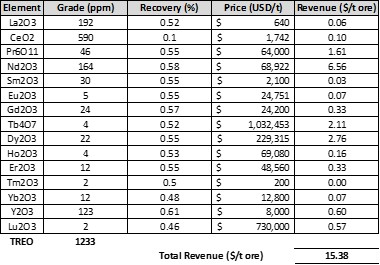
Table 1: Table for total calculated revenue per tonne of ore. Revenue ($t ore = Grade (ppm)/1000000 * Recovery % * Price), as of May 1, 2026
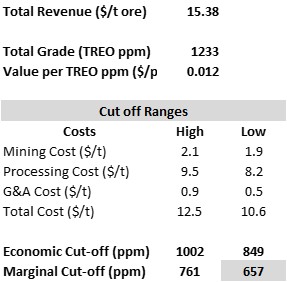
Table 2: Ranges for marginal cutoff calculations.

Table 3: Tonnes and grade calculated for high and low range cutoff calculations from assumed input costs.
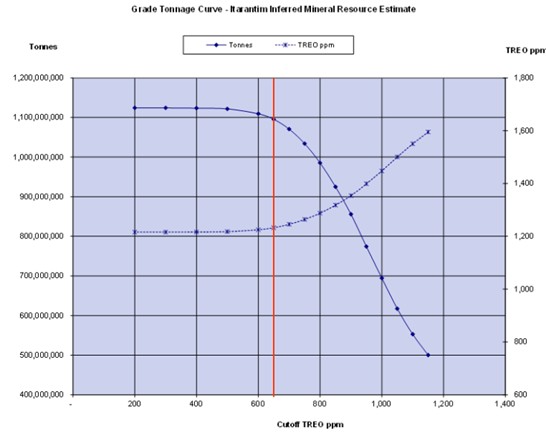
Table 4. Grade tonnage curve.
| 60 |
Internal Controls Related to Exploration and Mineral Resource
We maintain internal controls over our exploration activities and mineral resource estimation processes designed to support the accuracy and integrity of data. These controls include a quality assurance and quality control program governing sampling, preparation, and analytical procedures, including the insertion of certified reference materials, blanks, and duplicates. Samples are analyzed at independent accredited laboratories using industry-standard methods for rare earth element determination, and results are subject to routine validation and verification, including check assays. Geological and analytical data are maintained in controlled databases with established validation protocols, and interpretations and any resulting estimates are reviewed by qualified persons with relevant rare earth element experience using standardized methodologies.
We recognize the inherent uncertainties associated with exploration-stage estimation, including limited sampling density, geological variability, metallurgical characteristics of rare earth mineralization, and assumptions regarding future processing and market conditions. These risks are addressed through ongoing data verification, staged exploration, and periodic updates to geological models. These internal controls support our disclosure under S-K 1300.
Our Corporate Structure
Following the completion of the offering, our corporate structure will not change, except for a reduction in ownership by Mr. Scolaro through Americas Rare Earths Holdings Ltd. Our corporate structure is as follows:
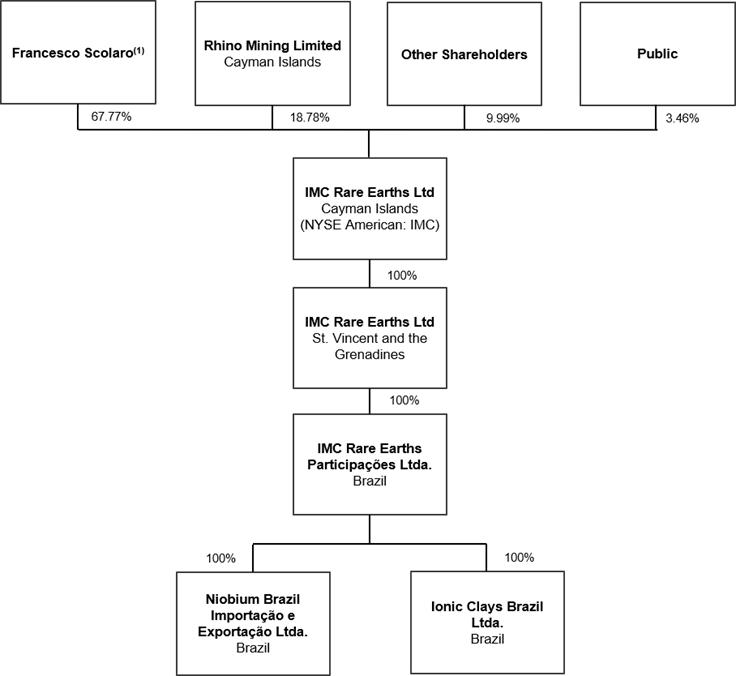
(1) Represents shares held through International Mineral Corporation Holdings Ltd and Americas Rare Earths Holdings Ltd.
The diagram below depicts our organizational structure, including the relevant ownership percentages of various shareholders, following the completion of the offering and assuming the sale of 10,110,000 ordinary shares:
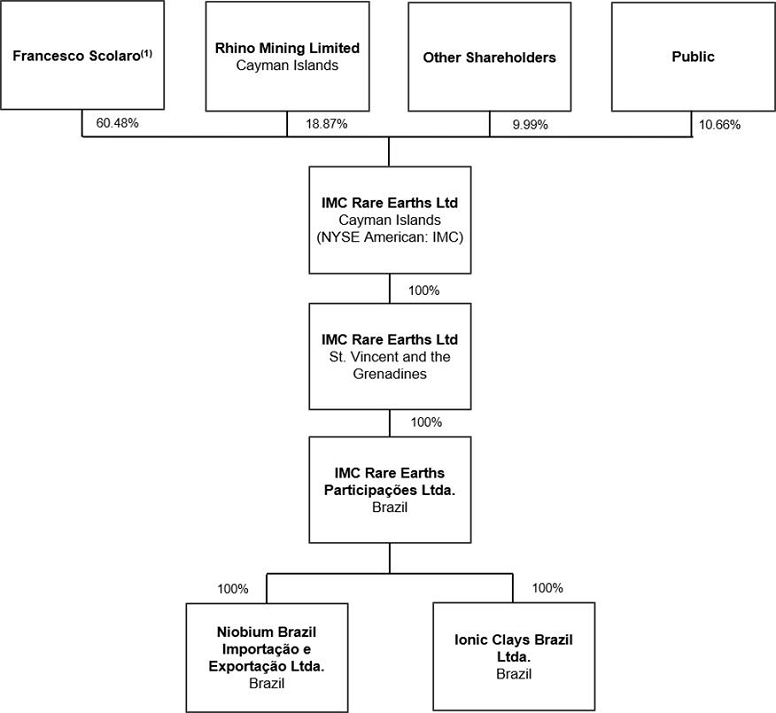
(1) Represents shares held through International Mineral Corporation Holdings Ltd and Americas Rare Earths Holdings Ltd.
| 61 |
Regulatory Overview
Brazilian Mining Regulations
Under the Brazilian Constitution, all mineral resources are the property of the Federal Government of Brazil, provided that ownership of mining products produced as a result of operations under applicable mining concessions granted to qualified and approved mining applicants are held by the concessionaires. The right to explore and exploit mineral resources in Brazil is regulated by the ANM under the Brazilian Mining Code (Decree-Law No. 227/1967, regulated by Brazilian Decree No. 9,406/2018) and applicable policies of the Brazilian Ministry of Mines and Energy.
Only Brazilian citizens, or legal entities incorporated under Brazilian law and having their head offices and management located in Brazil, may be entitled to conduct mining activities, including commercially exploiting mineral resources, in Brazil. Accordingly, we conduct all of our mining activities through Niobium Brazil Importação e Exportação Ltda., our subsidiary in Brazil. Except with respect to certain restrictions in the case of the border zones (which are the areas approximately 93 miles from the Brazilian borders), and with respect to the administrative land regularization proceedings we must conduct with applicable Brazilian governmental agencies in connection with our acquisition of ownership and/or leasing of rural properties in Brazil, there are generally no restrictions on the participation of foreigners in Brazilian mining companies, which can be wholly-owned by foreign individuals or legal entities.
In order to develop, construct, and commence the mining operations of the Itarantim Project, we must undertake a licensing process pursuant to which the applicable federal, state, or municipal environmental authorities in Brazil will license, approve and authorize the location, exploration and development activities, construction, and operation of the Itarantim Project. It is not always clear which environmental authority has jurisdiction over the environmental licensing of mining projects, which may create uncertainties as to whether the Itarantim Project should be licensed by Brazilian federal or state environmental agencies. Therefore, it is not uncommon for public prosecutors or other legally authorized parties to file lawsuits (most commonly public civil actions) challenging the jurisdiction of the authority responsible for environmental licensing.
Research Permits
In order for us to perform exploratory mining activities in Brazil, we first had to obtain our Research Permits from the ANM for an initial minimum period not less than one year, nor more than three years. The maximum area for the permit is 2,000 hectares. It is renewable for a further period equal to the initial period without any relinquishment of land area, however, there is no guarantee that our Research Permits will be renewed. Pursuant to Section 1.2.1 Mineral Rights under the Brazilian Mining Code, to maintain Research Permit tenure, we must ensure that all annual rental fees are paid and up to date. There is no work or financial commitment required. To renew the Research Permits, we must determine in our final Research Report for the reporting period, based on our own work program, that sufficient data has been captured to make an investment decision. If the results are positive, it justifies Research Permit renewal.
Permissible work which can be undertaken on the Research Permits includes geological surveys and mapping, geophysical and geochemical surveys, drilling, opening of visitable excavations and carrying out surveys of the mineral body, tests on the processing of ores or useful mineral substances, to obtain concentrates in accordance with market specifications or for industrial use. The holder of a Research Permit may carry out the respective works, and necessary auxiliary works and services, on land in the public or private domain, covered by the areas to be researched, provided that he pays the respective owners or occupants compensation for damages and losses that may be caused by the research work.
The Research Permit holder pays the annual fee per hectare on the last working day of July, if the permit was published in the first half of the year, and on the last working day of January, if the permit was published in the second half of the previous year. The Research Permit may be assigned or transferred, provided that the assignee meets the required legal requirements, and the act is recorded by the ANM.
Once the final research report has been approved at the end of the Research Permit tenure, the holder will have one year to request a mining concession and, within this period, may negotiate their mining rights. The ANM may extend the term for the same period by means of a justified request from the mining right holder.
| 62 |
Article 11 of the Brazilian Mining Code (the “Mining Code”) outlines the landowners’ right to participate in the results of mining through a negotiated royalty with the Research Permit holder. This shall be a percent of the total amount due to the States, Federal District, Municipalities and bodies of the direct administration of the Union, as financial compensation for the exploration of mineral resources.
Environmental Licenses
There are three general types of environmental licenses that mining companies are required to obtain in order to be fully authorized to construct and operate a mine in Brazil, each of which is described below.
Preliminary Environmental License. The first type of environmental license is called Licença Prévia (which we refer to as our “Preliminary Environmental License”), which we initially requested during the planning phase of the Itarantim Project but that has not yet been granted.
Construction Licenses. We refer to the second type of environmental license, collectively, as the “Construction Licenses”, which are comprised of either (i) licenses called Licença de Instalação (which we refer to collectively as the “Installation Licenses”), (ii) licenses called Licença Ambiental Única (which we refer to collectively as the “Specific Environmental Licenses”), or of (iii) environmental authorizations (which we refer to collectively as the “Fauna Authorizations”). In this phase of the environmental licensing process, the basic environmental plan outlining pollution control and compensatory measures are submitted to the Instituto Brasileiro do Meio Ambiente e dos Recursos Naturais Renováveis or Instituto do Meio Ambiente e Recursos Hídricos for review and approval.
Operational License. The third type of environmental license is called Licença de Operação (which we refer to as the “Operational License”), which is the last phase of the environmental licensing process necessary to operate a mine in Brazil. The Operational License is required for us to be able to perform mining and mineral exploitation activities in our mineral rights area, as well as sell the produced rare earth minerals.
Mining Concession
At such time when we make the applicable request after the final research report is approved by ANM, and we have received the Operational License, we believe that we will receive the mining concession called Concessão de Lavra (which we refer to as the “Mining Concession”), which is granted by the Brazilian Ministry of Mines and Energy. As the holder of the Mining Concession, we will have exclusive rights to undertake mining operations for the mineral resources specified in the Mining Concession within the authorized mineral rights area. The Mining Concession will be valid until the depletion of the mineral deposit, as long as the holder complies with the obligations and requirements under applicable Brazilian mining regulations. Although mineral deposits in Brazil are federal property, a mining concession holder is the assured owner of the extracted mineral. There is no guarantee that we will be granted the Mining Concession in a timely manner, or at all.
As the holder of the Mining Concession, we will have a range of obligations, including to: (i) start the mining work, in accordance with the development and mining plan approved by the ANM, within six months from the date of publication of the Mining Concession in the Official Gazette of the Brazilian federal executive; (ii) carry out the mining work in accordance with the approved development and mining plan; (iii) extract only the minerals indicated in the Mining Concession or any addendum thereto; (iv) communicate to the ANM the discovery of any mineral substance not included in the Mining Concession; (v) carry out the mining work in accordance with applicable laws, rules and regulations; (vi) appoint a duly qualified person to supervise the mining work; (vii) refrain from intentionally obstructing or hampering the future development of the mineral deposit; (viii) be liable for any loss or damage caused to third parties resulting from the mining work; (ix) not cause air or water pollution as a result of the mining work; (x) protect and preserve water sources, as well as to use them in accordance with applicable technical instructions and requirements; (xi) observe and comply with all instructions and recommendations of applicable regulatory authorities; (xii) refrain from suspending the mining work for more than six months without the prior consent of the ANM; (xiii) keep the mine in good condition during any suspension period; (xiv) rehabilitate the areas degraded by mining; (xv) pay royalties; and (xvi) comply with the provisions of the Brazilian National Dams Safety Policy. Any failure to comply with these requirements could result in the revocation of the Mining Concession.
| 63 |
CFEM
All mining permits in Brazil are subject to state and landowner royalties pursuant to the Mining Code. In Brazil, mining royalties are formally known as Financial Compensation for the Exploration of Mineral Resources (“CFEM”). CFEM is a monetary compensation based on gross revenues less allowable deductions that companies exploiting mineral resources pay to the federal government for the use of a nationally owned resource. CFEM rates vary from 1% to 4%, depending on the substance. CFEM rates for mining rare earth elements are 2%. The landowners’ royalties may be subject to negotiation; however, if there is no agreement to access the land or the contract does not specify the royalties, Article 11 of the Mining Code stipulates that the royalties will correspond to half of the amounts paid as CFEM.
Additionally, the ANM is allowed to grant mining easements (servidões minerárias) in properties of third parties in relation to a given mining title, provided that such mining easement is necessary for the proper exploration and exploitation of the mineral deposit. After the granting of an easement by the ANM, through the issuance of a “Public Utility Statement”, the holder of the mining title to which the Public Utility Statement refers must pay an indemnification amount to the owner of the servient property before entering such property. If such indemnification amount cannot be agreed upon between the holder of the mining title and the property owner, it will be determined by a court.
Once the exploitation of the mineral deposits has been concluded, the corresponding mining area must be rehabilitated in accordance with appropriate environmental and mine closure plans which must be approved by ANM.
Current State of our Licensing Process
Our current near-term goal is to continue the exploration and development of the Itarantim Project. We will not be able to obtain the Operational License until construction of the infrastructure for the Itarantim Project has been completed, and there is no guarantee that we will receive the Operational License in a timely manner, or at all. Additionally, opposition by any governmental or non-governmental organizations to our proposed development or operations of the Itarantim Project, may, among other things, result in delays or a shutdown of our development of the Itarantim Project and require us to spend significant amounts of time and resources to resolve any such issues in order to secure or maintain necessary permits and licenses. See also “Risk Factors—Risks Related to our Company—We may face opposition from organizations that oppose mining which may disrupt or delay the Itarantim Project” and “—Legal Proceedings” below.
Environmental Regulations
Our exploration and development activities are, and our future mining operations will be, subject to environmental laws and regulations in Brazil. We currently, and will continue to, maintain operating policies that seek to comply with all applicable environmental laws and regulations.
To enforce environmental legislation in Brazil, the Federal Government of Brazil has established various administrative, criminal and civil penalties that will be imposed upon violators of environmental laws, rules and regulations, including fines, denial of credit lines from governmental entities, revocation of environmental licenses, and, in extreme cases, suspension of the Company’s activities. The fines are imposed in accordance with the nature and severity of the infraction committed, which primarily depends on the extent of the damage caused or expected to be caused to the environment.
Brazilian environmental legislation adopts a broad concept of liability, which may extend beyond the direct polluter to include indirect polluters. Pursuant to Article 3, item IV, of Law No. 6,938/1981, shareholders, investors, lenders, contractors, and business partners who contribute to, finance, or benefit from polluting activities may be held jointly and severally liable for environmental damage. In this context, foreign shareholders, including new shareholders entering the Company through this offering as indirect shareholders, may, in theory, be exposed to environmental claims in Brazil involving the Itarantim Project, even in the absence of direct operational involvement. In addition, environmental incidents or alleged impacts related to Brazilian operations may give rise to claims and legal proceedings in foreign jurisdictions, as illustrated by the Mariana dam case, in which the English High Court recognized the potential liability of BHP as the controlling shareholder of Samarco. Furthermore, under Article 4 of Law No. 9,605/1998 (Environmental Crimes Law), Brazilian courts may pierce the corporate veil whenever it constitutes an obstacle to full compensation for environmental damage, potentially allowing the assets of shareholders, including foreign shareholders, to be reached if the Brazilian entity lacks sufficient resources to remedy the damage.
| 64 |
Land Access
We have rights of access to or have rights to occupy, through Niobium, the properties on which the facilities and infrastructure for the Itarantim Project will be located. The Research Permits grant the right to access the land for which the permits cover. The right to access the land does not confer control or economic benefits. This includes the land on which our proposed facilities and infrastructure for the Itarantim Project will be located. We intend to conduct administrative land regularization proceedings with applicable Brazilian governmental agencies (such as the Brazilian National Institute of Rural Settlement and Agrarian Reform, the Brazilian Ministry of Industry and Trade, and other agencies), the purpose of which is to acquire ownership, through Niobium, of these properties. The land regularization proceedings will generally be conducted in accordance with Decree No. 74965/1974, Opinion CGU/ AGU dated as of August 23, 2010, issued by the General Counsel of the Federal Government Office of Brazil (which we refer to as “Opinion CGU/AGU”), which governs the acquisition or lease of rural properties in Brazil by foreign individuals or legal entities, as well as Brazilian legal entities controlled by foreign investors or with the majority of their capital stock held by foreign investors, such as in the case of Niobium. Under current Brazilian laws and regulations, we may only acquire or lease rural property in Brazil, in compliance with Opinion CGU/AGU, if certain conditions are met, including, among others, that (i) we obtain approvals from the Brazilian National Institute of Rural Settlement and Agrarian Reform and from the applicable Brazilian Ministries; (ii) the aggregate amount of rural property held by us does not exceed 25% of the total surface area of the municipality in which such property is located; and (iii) the acquisition must be formalized by means of a public deed of sale and purchase. As of the date of this prospectus, we are still in the planning stages and have not yet commenced any land regularization proceedings to acquire ownership of these properties. See also “Risk Factors—Risks Related to Mining—Our mining operations may be impaired due to restrictions on the acquisition or lease of rural properties by foreign investors or by Brazilian entities under foreign control or with the majority of its capital stock held by foreign persons” and “Business—Foreign Investment Restrictions and Control—Foreign Investment Restrictions”. Although we believe that such applicable Brazilian governmental agencies will issue administrative decisions approving our acquisition and ownership of such properties, there is no guarantee that they will do so on a timely basis or at all, as our acquisition of properties in Brazil will depend on us following the applicable legal procedures and meeting the required legal standards, which will be assessed by such applicable Brazilian governmental agencies within an uncertain timeline.
Furthermore, any new acquisitions or leases of rural lands would also be subject to restrictions on foreign-controlled entities, as described in “Risk Factors—Risks Related to Mining—Our mining operations may be impaired due to restrictions on the acquisition or lease of rural properties by foreign investors or by Brazilian entities under foreign control or with the majority of its capital stock held by foreign persons”.
Once commercial production at the Itarantim Project commences, we will be required to pay financial compensation for such mineral exploitation (Compensação Financeira pela Exploração Mineral) in the form of a royalty (which we refer to as the “Mining Royalty”), currently at a rate of up to 3% of our gross revenue, which will be divided among various Brazilian federal, state and municipal governmental offices and agencies, including the ANM and other environmental agencies, as determined by Brazilian law and regulations. Additionally, we will be required to pay a royalty to the owners of any land not owned by us or Niobium.
Foreign Investment Restrictions and Control
Foreign Investment Restrictions
Mining exploration and exploitation activities may only be undertaken by private entities incorporated under Brazilian law and having their head offices and management located in Brazil. Except in the case of the border zones, which are the areas approximately 93 miles from the Brazilian borders, there are no restrictions on the participation of foreigners in Brazilian mining companies, which can be wholly-owned by foreign individuals or legal entities. Mining activities in the border zones may only be carried out with the prior consent of the Brazilian National Defense Council.
According to current interpretation of Brazilian legislation, based on Brazilian Law No. 5.709/1971 regulated by Decree No. 74965/1974, Opinion CGU/AGU dated as of August 23, 2010, issued by the General Counsel of the Federal Government Office of Brazil, there are certain restrictions for the acquisition or lease of rural lands by Brazilian companies organized under the laws of Brazil and domiciled within Brazilian territory, but that are, in fact, an investment vehicle company of a foreign individual or entity, in which the majority of the corporate capital or power to control such company is held, directly or indirectly, by a foreign individual or entity domiciled abroad. In general, a direct or indirect transfer of such rural property to a Brazilian company that is controlled by a foreign individual or entity is subject to certain restrictions and limitations, and must be previously authorized by the Brazilian National Institute of Rural Settlement and Agrarian Reform (which we refer to as the “INCRA”), pursuant to INCRA Normative Instruction number 88, of December 13, 2017. Any acquisition or lease of rural property that violates such restrictions and limitations will be considered null and void, and the INCRA may order the reversal of such acquisition or lease, returning the ownership or possession of such rural property to its previous owner.
| 65 |
Foreign Investment Control
In accordance with Normative Rulings 2,119/2022 and 2,172/2024 issued by the Brazilian Federal Revenue (Receita Federal do Brasil), foreign individuals and legal entities owning equity in Brazilian companies, real estate properties, airplanes, ships, and other assets located in Brazil, which are subject to public registration with the relevant Brazilian authorities, must enroll themselves with the Individual Taxpayers’ Registry of the Ministry of Finance if an individual, or with the Corporate Taxpayers’ Registry of the Ministry of Finance if a legal entity. The same applies to beneficiaries of certain security interests, such as mortgages.
It is also mandatory to enroll such foreign investors with the Declaratory Registration of Non-Residents of the Central Bank of Brazil (Cadastro Declaratório de Não Residente). Such foreign investors must also register their relevant capital contributions in the Brazilian subsidiary in the electronic system of the Central Bank of Brazil (Sistema do Banco Central do Brasil), which will allow such Brazilian subsidiary to remit dividends to its foreign shareholders and repatriate the registered capital.
We believe that we and our affiliates are currently in compliance with such Brazilian rules and regulations with respect to our respective investments and/or businesses in Brazil.
Environmental, Social and Governance
We are guided by the values of ethics, integrity, transparency and compliance with the law, our code of business conduct and ethics (which we refer to as our “Code of Business Conduct and Ethics”), which has been adopted by our Board, as well as by stakeholder expectations. We aim to embed environmental, social, and governance (which we refer to as “ESG”) considerations into our operations and business decisions to create long-term value for our stakeholders and society.
The Itarantim Project has been developed with sustainability at the core of all of its developmental and operational components. Our commitment to ESG causes can be seen through our policies and actions. We continue to review and refine our ESG policies and frameworks to ensure that we can uphold our commitment to the communities we operate in and, more broadly, the global community.
As an organization, we are steered by our Code of Business Conduct and Ethics, as well as our ESG policies. Our ESG policies address our position and approach across ESG categories that impact our business, and cover material topics that are of the highest priority and importance to our internal and external stakeholders.
Significant Subsidiaries
Below is a list of IMC’s significant subsidiaries as of March 31, 2026:
| Name | Country of Incorporation | % of Equity Interest | ||
| IMC Rare Earths Ltd | Saint Vincent and the Grenadines | 100% | ||
| IMC Rare Earths Participações Ltda. | Brazil | 100% | ||
| Niobium Brazil Importação e Exportação Ltda. | Brazil | 100% | ||
| Ionic Clays Brazil Ltda. | Brazil | 100% |
Property, Plants, and Equipment
The Itarantim Project is an IAC REE exploration project located in the States of Bahia and Minas Gerais, northeastern Brazil, approximately 10 km west of the town of Itarantim. The project consists of 27 exploration licenses covering approximately 111,700 acres (452 km²), all held by Niobium Brazil Importação e Exportação Ltda., a wholly owned subsidiary of IMC. All licenses are in good standing with expiry dates between the date of this prospectus and December 2028, provided that several Research Permits due to expire in January 2026 were renewed to December 2028. The Research Permits are renewable for up to the same initial period.
Employees
As of March 31, 2026 we did not have any employees and have previously hired and continue to hire contractors to conduct exploration of the Itarantim Project.
Legal Proceedings
We are not currently subject to any legal proceedings. We may in the future be subject to various claims and legal actions that arise in the ordinary course of our business, including claims resulting from employment-related matters.
| 66 |
MANAGEMENT
Directors and Executive Officers
The following table lists the names, ages and positions of our current directors and executive officers as of the date of this prospectus.
| Name | Age | Position | ||
| Francesco Scolaro | 62 | Chief Executive Officer and Chair of the Board | ||
| Stephen R. Wilson | 79 | Chief Financial Officer and Director | ||
| Simon Rollason | 60 | Director | ||
| Dr. Peter Roy Siegfried | 62 | Independent Director | ||
| Dr. Stanley Veliotis | 64 | Independent Director |
The following is a biographical summary of the business experience of these executive officers and directors:
Executive Officers and Employee Directors
Francesco Scolaro. Mr. Scolaro founded the Company and has served as Chief Executive Officer and Chair of the Board since the Company’s inception. Mr. Scolaro has more than 30 years of experience in the resources and mining sector, and over his career, has created a large portfolio of resource- and mining-industry companies. From April 2016 to July 2017, Mr. Scolaro served on the board of directors of Woodbois Ltd. From 2011 to 2012, Mr. Scolaro served as executive chairman at Paragon Diamonds Ltd. Mr. Scolaro served as non-executive chairman at Kopane Diamond Developments Ltd. from 2009 to 2010, and at African Minerals Ltd., adding broad board-level governance experience in mineral-exploration and development companies. Prior to joining Paragon Diamonds Ltd., from 2007 to 2012, Mr. Scolaro held multiple director positions in the United Kingdom, including at Ansco Petroleum Ltd., Uragold Ltd., Woodbois Services Limited and Obtala Limited, demonstrating his long-standing international operational and corporate leadership in the resources industry.
Stephen R. Wilson. Mr. Wilson is our Chief Financial Officer and has served in senior planning and finance positions in major corporations around the world, including PepsiCo Inc., Cadbury Schweppes PLC, RJR Nabisco, The Reader’s Digest Association, Reckitt & Coleman PLC, and Footstar Inc. He was the President of PepsiCo’s snack food business in Brazil and Cadbury Beverages North America, and the Chief Financial Officer of Pepsi USA, Cadbury Schweppes North America, RJR Nabisco, The Reader’s Digest Association, Reckitt & Coleman, and Footstar. Mr. Wilson has served on a number of boards of directors, including Reckitt & Coleman, Majesco Entertainment, Natwest Bancorp USA, Middlesex Mutual Assurance, LEK Consulting, and the Chase National Advisory Board. He has served as Chairman of the Audit Committee of Newport News Shipbuilding and Huntington Ingalls Shipbuilding.
Simon Rollason. Mr. Rollason, a non-executive employee of the Company, is a highly experienced mining executive with over 30 years of international experience across exploration, mine development and listed company leadership. He has held senior executive and board roles at multiple AIM- and LSE-listed resource companies, including serving as Chief Executive Officer and Director of Aterian PLC since 2020, Managing Director of Obtala Limited, and Chairman and Non-Executive Director of Edenville Energy PLC. Across these roles he has led corporate strategy, capital markets transactions, asset acquisitions, and project development program spanning gold, base metals, critical minerals, energy and industrial minerals, with operational experience across Africa, Central Asia and the Middle East, and a strong track record in value creation, governance and stakeholder engagement.
Non-Employee Directors
Dr. Peter Roy Siegfried. Dr. Siegfried is a highly experienced consulting geologist with 42 years of professional experience in mineral exploration, resource evaluation, and applied geological research, with particular expertise in carbonatite- and alkaline rock–hosted deposits, rare earth elements (REE), and industrial minerals. Since founding and managing GeoAfrica Prospecting Services in 1990, he has led and contributed to major exploration and evaluation projects across southern and central Africa and internationally, consulted to large mining and chemical companies, and acted as an independent Qualified Person for NI 43-101–compliant technical reports. His career spans a broad range of commodities, advanced exploration and analytical techniques (including remote sensing, geophysics, petrography, and geochemistry), mine geology, and geohydrological investigations, supported by extensive publications, professional affiliations, and leadership in international research initiatives. He holds BSc, BSc (Hons), and MSc degrees in Geology from the University of Cape Town and was awarded a PhD in Geology from the University of Exeter in 2025, focused on REE mineralisation in carbonatites.
Dr. Stanley Veliotis. Dr. Veliotis is the Chair of the Accounting Department at Quinnipiac University and previously served as a professor at Fordham University’s Gabelli School of Business from 2007 to 2025, serving as department chair in his final three years. He is an attorney and certified public accountant. Dr. Veliotis spent fifteen years in private practice at New York law firms and CPA firms, including KPMG and E&Y. He is often cited in the press as a financial expert and has published over two dozen articles in accounting and law journals. He holds a BBA from Baruch College, a JD from Fordham University School of Law, an LLM in taxation from New York University School of Law, and a PhD in Business from the University of Connecticut in 2007, focused on accounting and taxation.
| 67 |
Compensation
Executive Officer and Director Compensation
We compensate each of our directors or executive officers with an annual cash fee of $75,000 and annual equity awards with a target grant date value of $100,000. Directors serving as chairs of any of the committees of our Board will receive additional compensation determined by our Board or compensation committee. The form, terms and conditions of such equity awards, including vesting, will be determined by our Board or a committee thereof from time to time. No compensation of any kind was paid to our directors or executive officers for the fiscal year ended March 31, 2025. Except as discussed below with respect to Mr. Scolaro, no compensation of any kind was paid to our directors or executive officers for the fiscal year ended March 31, 2026.
On March 13, 2026, we entered into an executive employment agreement with Francesco Scolaro (the “Employment Agreement”), which includes a base salary, annual bonus, a bonus related to the successful completion of the IPO, and bonuses for certain milestones related to the Itarantim Project. Under the Employment Agreement, Mr. Scolaro will receive annual compensation of $700,000 with an annual performance bonus with a target of 150% of salary and a maximum of 300%, subject to achievement of Board-determined metrics and continued employment through year-end. In connection with an IPO, Mr. Scolaro receives a one-time RSU grant valued at approximately $15 million vesting over three years, plus ongoing annual equity awards post-IPO with a target value of $6 to 8 million (a mix of time-based RSUs, performance awards, and options). Mr. Scolaro is also eligible for milestone awards tied to project development consisting of $10 million (or 1% equity) upon achieving indicated resources, $15 million (or 1.5% equity) upon measured mineral resources, and equity worth 2% of fully diluted shares, or $30 million, upon sustained commercial production. No compensation was paid to Mr. Scolaro for the fiscal year ended March 31, 2025. During the fiscal year ended March 31, 2026, Mr. Scolaro received compensation of $300,000. No other compensation or benefits were paid to Mr. Scolaro.
Equity Incentive Plan
Purpose; Types of Awards.
The purpose of the Equity Incentive Plan (the “Plan”) is (i) to encourage profitability and growth through short-term and long-term incentives that are consistent with our objectives; (ii) to give participants an incentive for individual performance; (iii) to promote teamwork among participants; and (iv) to give IMC an advantage in attracting and retaining key employees, directors, and consultants. To accomplish this purpose, the Plan permits the granting of awards in the form of options, share appreciation rights (“SARs”), restricted shares, restricted share units, performance based awards (including performance shares, performance units and performance bonus awards), and other share-based or cash-based awards.
Shares Subject to the Plan
The aggregate number of shares that are available for issuance pursuant to awards granted under the Plan is equal to 5,400,000 ordinary shares. The maximum number of ordinary shares subject to Plan awards granted during any fiscal year to any non-employee director, when taken together with any cash fees paid to the director during the year in respect of his or her service as a director, may not exceed $200,000 in total value. If an award granted under the Plan is forfeited, canceled, settled, or otherwise terminated without a distribution of shares, the shares underlying that award will again become available for issuance under the Plan. However, none of the following shares will be available for issuance under the Plan: (i) shares delivered to or withheld to pay withholding taxes, (ii) shares used to pay the exercise price of an option, or (iii) shares subject to any exercised share-settled SARs. Any substitute awards shall not reduce the shares authorized for grant under the Plan.
Administration of the Plan
The Plan is administered by our Board or a committee that it designates. The Plan administrator has the power to determine the terms of the awards granted under the Plan, including the exercise price, the number of shares subject to each award, and the exercisability of the awards. The Plan administrator also has the power to determine the persons to whom and the time or times at which awards will be made and to make all other determinations and take all other actions advisable for the administration of the Plan.
Participation
Participation in the Plan will be open to employees, contractors and consultants, who have been selected as an eligible recipient under the Plan by the Plan administrator.
Types of Awards
The types of awards that may be made under the Incentive Plan are described below. All of the awards described below are subject to the conditions, limitations, restrictions, vesting and forfeiture provisions determined by the Plan administrator, subject to certain limitations provided in the Plan.
Performance-Based Awards
We may grant an award conditioned on satisfaction of certain performance criteria. Such performance-based awards include performance-based restricted shares and restricted share units.
If the Plan administrator determines that the performance-based award to an employee is subject to performance goals, then the performance-based criteria upon which the awards will be based shall be by reference to any one or more of the following: earnings before interest and taxes; earnings before interest, taxes, depreciation and amortization; net operating profit after tax; cash flow; revenue; net revenues; sales; days sales outstanding; scrap rates; income; net income; operating income; net operating income, operating margin; earnings; earnings per share; return on equity; return on investment; return on capital; return on assets; return on net assets; total shareholder return; economic profit; market share; appreciation in the fair market value, book value or other measure of value of ordinary shares; expense/cost control; working capital; volume/production; new products; customer satisfaction; brand development; employee retention or employee turnover; employee satisfaction or engagement; environmental, health, or other safety goals; individual performance; strategic objective milestones; days inventory outstanding; or any other performance goals or a combination of performance goals selected by the Plan administrator. Performance goals may be measured either in absolute terms or as compared to any incremental increase or decrease or as compared to results of a peer group or to market performance indicators.
| 68 |
Restricted Shares
A restricted share award is an award of ordinary shares that vests in accordance with the terms and conditions established by the Plan administrator. The Plan administrator will determine in the award agreement whether the participant will be entitled to vote the restricted shares and/or receive dividends on such shares.
Restricted Share Units
A restricted share unit is a right to receive shares or the cash equivalent of ordinary shares at a specified date in the future, subject to forfeiture of such right.
Share Options
A share option entitles the recipient to purchase ordinary shares at a fixed exercise price. The exercise price per share will be determined by the Plan administrator in the applicable award agreement in its sole discretion at the time of the grant. The maximum term of each option shall be fixed by the Plan administrator, but in no event shall an option be exercisable more than (i) ten (10) years after the date such option is granted to an employee of IMC or its affiliates on the date of grant, or (ii) five (5) years after the date such option is granted to a person who is not an employee of IMC or its affiliates on the date of grant.
Share Appreciation Rights (SAR)
A SAR entitles the holder to receive an amount equal to the difference between the fair market value of an ordinary share on the exercise date and the exercise price of the SAR (which may not be less than 100% of the fair market value of an ordinary share on the grant date), multiplied by the number of shares subject to the SAR (as determined by the Plan administrator).
Other Share-Based Awards
We may grant or sell to any participant unrestricted ordinary shares under the Plan or a dividend equivalent. A dividend equivalent is a right to receive payments, based on dividends with respect to ordinary shares.
Other Cash-Based Awards
We may grant cash awards under the Plan, including cash awards as a bonus or upon the attainment of certain performance goals.
Equitable Adjustments
In the event of a merger, consolidation, reclassification, recapitalization, spin-off, spin-out, repurchase or other reorganization or corporate transaction or event, extraordinary dividend, stock/share split or reverse share split, combination or exchange of shares, or other change in corporate structure or payment of any other distribution, the maximum number and kind of shares reserved for issuance or with respect to which awards may be granted under the Plan will be adjusted to reflect such event, and the Plan administrator will make such adjustments as it deems appropriate and equitable in the number, kind and exercise price of ordinary shares covered by outstanding awards made under the Plan, and in any other matters that relate to awards and that are affected by the changes in the shares referred to in this section.
Board Practices
Board Composition
Our business affairs are managed under the direction of our Board. Our Board consists of five members. Our external directors serve a three-year term.
Director Independence
Our Board consists of five members, two of whom qualify as independent within the meaning of the independent director guidelines of the NYSE American. Dr. Siegfried and Dr. Veliotis are “independent directors” as defined in the rules of the NYSE American and applicable SEC rules. The Corporate Governance Rules of the NYSE American generally require that a majority of an issuer’s board of directors must consist of independent directors. However, the Corporate Governance Rules of the NYSE American permit foreign private issuers like us to follow “home country practice” in certain corporate governance matters. We rely on this “home country practice” exception and do not have a majority of independent directors serving on our Board.
Committees of the Board of Directors
The standing committees of our Board consist of an audit committee, a compensation committee and a nominating and governance committee. Members will serve on these committees until their resignation or until otherwise determined by our Board.
| 69 |
Audit Committee and Audit Committee Financial Expert
Our audit committee oversees our corporate accounting and financial reporting process. Among other matters, the audit committee:
| ● | appoints our independent registered public accounting firm; | |
| ● | evaluates the independent registered public accounting firm’s qualifications, independence and performance; | |
| ● | determines the engagement of the independent registered public accounting firm; | |
| ● | reviews and approve the scope of the annual audit and the audit fee; | |
| ● | discusses with management and the independent registered public accounting firm the results of the annual audit and the review of our interim financial statements; | |
| ● | approves the retention of the independent registered public accounting firm to perform any proposed permissible non-audit services; | |
| ● | monitors the rotation of partners of the independent registered public accounting firm on our engagement team in accordance with requirements established by the SEC; | |
| ● | is responsible for reviewing our financial statements and the Company’s management’s discussion and analysis of financial condition and results of operations to be included in the Company’s annual and interim reports to be filed with the SEC; | |
| ● | reviews the Company’s critical accounting policies and estimates; and | |
| ● | reviews and discuss the Company’s practices with respect to risk assessment and risk management; |
The chair of the audit committee is Dr. Veliotis. Dr. Siegfried and Mr. Rollason also are members of the audit committee. We believe Dr. Veliotis qualifies as an “audit committee financial expert,” as such term is defined in Item 401(h) of Regulation S-K. Our Board has adopted a written charter for the audit committee.
Compensation Committee
Our compensation committee is responsible for, among other things:
| ● | reviewing and approving, or recommending to the Board, the compensation of our Chief Executive Officer and other executive officers; | |
| ● | administering any incentive and equity-based compensation; | |
| ● | reviewing and making recommendations to the board of directors regarding director compensation; and | |
| ● | appointing and overseeing any compensation consultants. |
The chair of the Company’s compensation committee is Dr. Veliotis. Dr. Siegfried and Mr. Wilson also are members of the compensation committee. Our Board has adopted a written charter for the compensation committee.
Nominating and Governance Committee
Our nominating and governance committee is responsible for, among other things:
| ● | identifying individuals qualified to become members of our Board, consistent with criteria approved by our Board; | |
| ● | reviewing and recommending to our Board those to serve on the committees of the Board and as chair thereof; and | |
| ● | overseeing the evaluation of the effectiveness of our Board and its committees. |
The chair of the Company’s nominating and governance committee is Dr. Siegfried. Dr. Veliotis and Mr. Wilson are also members of the nominating and governance committee. Our Board has adopted a written charter for the nomination and governance committee.
Foreign Private Issuer Status
As a foreign private issuer, we are exempt from the rules under the Exchange Act, prescribing the furnishing and content of proxy statements. In addition, we are not required under the Exchange Act to file quarterly periodic reports and financial statements with the SEC as frequently or as promptly as U.S. domestic issuers, and are not required to disclose in its periodic reports all of the information that U.S. domestic issuers are required to disclose. As a company incorporated in the Cayman Islands that is listed on the NYSE American, we are subject to the NYSE American’s corporate’s governance listing standards. However, we are permitted to adopt certain home country practices in relation to corporate governance matters that differ significantly from the corporate governance listing requirements of the NYSE American. These practices may afford less protection to shareholders than they would enjoy if we complied fully with corporate governance listing requirements of the NYSE American. We rely on home country practice to be exempted from certain of the corporate governance requirements of the NYSE American, namely: (i) there will not be a necessity to hold meetings of board of directors on at least a quarterly basis, or the requirement for independent directors to have regularly scheduled executive sessions at least annually without the presence of non-independent directors and management; and (ii) there will be no requirement for the Company to obtain shareholder approval with respect to (a) the establishment (or material amendment to) a stock option or purchase plan or other equity compensation arrangement as specified in Section 711 of the NYSE American LLC Company Guide; (b) the issuance of additional shares as sole or partial consideration for an acquisition of the stock or assets of another company in the circumstances specified in Section 712 of the NYSE American LLC Company Guide; and (c) the issuance of additional shares in connection with a transaction specified in Section 713 of the NYSE American LLC Company Guide, or that will result in a change of control of the Company.
To the extent we choose to follow home country practice in the future, our shareholders may be afforded less protection than they otherwise would enjoy under NYSE American corporate governance standards applicable to U.S. domestic issuers.
Controlled Company Status
We are a “controlled company” within the meaning of the NYSE American corporate governance rules. Under the NYSE American corporate governance standards, a company of which more than 50% of the voting power is held by an individual, group or another company is a “controlled company” and may elect not to comply with certain corporate governance standards, including the requirement that (i) a majority of our board of directors consists of independent directors; (ii) a majority of the independent directors select or recommend our director nominees; (iii) the compensation committee be responsible for determining or recommending the compensation of executive officers other than our chief executive officer; and (iv) the compensation committee be composed entirely of independent directors. We have elected to rely on the “controlled company” exemption provided in the NYSE American corporate governance requirements to permit our compensation committee to include a non-independent director, and we could elect to rely on other exemptions in the future. Our status as a controlled company could cause our securities to look less attractive to certain investors or otherwise harm the trading price of our ordinary shares. Even if we cease to be a controlled company, we may still rely on exemptions available to foreign private issuers, including being able to adopt home country practices in relation to corporate governance matters.
| 70 |
DESCRIPTION OF SHARE CAPITAL
The following is a summary of the material terms of our share capital, as well as the other material terms of our memorandum and articles of association and certain provisions of the Companies Act (As Revised) of the Cayman Islands. This summary does not purport to be complete and is qualified in its entirety by the provisions of such memorandum and articles of association, copies of which will be filed with the SEC as exhibits to the registration statement of which this prospectus forms a part (and which is referred to in this section as, respectively, the “memorandum” and the “articles”). We urge you to read our memorandum and articles in its entirety for a complete description of the rights and preferences of share capital.
We were incorporated as an exempted company with limited liability under the Companies Act (As Revised) of the Cayman Islands on September 19, 2025. A Cayman Islands exempted company:
| ● | is a company that conducts its business mainly outside the Cayman Islands; | |
| ● | is prohibited from trading in the Cayman Islands with any person, firm or corporation except in furtherance of the business of the exempted company carried on outside the Cayman Islands (and for this purpose can effect and conclude contracts in the Cayman Islands and exercise in the Cayman Islands all of its powers necessary for the carrying on of its business outside the Cayman Islands); | |
| ● | does not have to hold an annual general meeting; | |
| ● | does not have to make its register of members open to inspection by shareholders of that company; | |
| ● | may obtain an undertaking against the imposition of any future taxation; | |
| ● | may register by way of continuation in another jurisdiction and be deregistered in the Cayman Islands; | |
| ● | may register as an exempted limited duration company; and | |
| ● | may register as a segregated portfolio company. |
Authorized Share Capital
Pursuant to the memorandum, our authorized share capital will remain as US$200,000 divided into 2,000,000,000 shares of US$0.0001 par value each.
Warrants
SJP Warrants
On December 1, 2025, we entered into a warrant agreement with St. James Place Limited (“SJP”), pursuant to which the Company granted SJP 5,000,000 warrants (the “SJP Warrants”) exercisable at $15 per warrant (up to $75 million total) at any time from December 1, 2025 through December 1, 2028. If fully exercised, as amended, the warrants convert into ordinary shares representing 15% of the Company’s fully diluted equity (pro rata for partial exercise), with shares ranking pari passu with existing equity. The warrants are freely transferable (subject to customary mechanics) and include anti-dilution protection through adjustments for share splits, consolidations, and similar events. In a change of control, all unexercised warrants automatically convert into shares on a cashless basis, while in a liquidation the holder can elect to be treated as if exercised. If the warrants are not fully exercised the ordinary shares will be issued on a pro rata basis. The warrants have a maturity date of December 1, 2028.
On May 8, 2026, the Company amended the SJP Warrant Agreement dated December 1, 2025, with SJP to clarify that the SJP Warrants, if exercised in full, shall convert into such number of ordinary shares representing 15% of the fully diluted ordinary shares of the Company outstanding immediately prior to exercise, instead of issued ordinary share capital of the Company outstanding immediately prior to the exercise.
On June 3, 2026, the Company and SJP entered into a second amendment to the SJP Warrant Agreement pursuant to which (i) the SJP Warrants are not exercisable, in whole or in part, at any time prior to the consummation of the IPO; (ii) the SJP Warrants are subject to a beneficial ownership limitation pursuant to which SJP may not exercise the SJP Warrants to the extent that, after giving effect to such exercise, SJP, together with its affiliates and any persons whose beneficial ownership of our ordinary shares would be aggregated with SJP’s for purposes of Section 13(d) of the Securities Exchange Act of 1934, as amended, would beneficially own in excess of 9.99% of our then-outstanding ordinary shares (the “Beneficial Ownership Limitation”), and SJP has covenanted that it will not at any time hold or beneficially own ordinary shares representing more than 9.99% of our outstanding ordinary shares, or take any action that would cause it to become an affiliate of the Company within the meaning of Rule 144 under the Securities Act; and (iii) from and after the consummation of the IPO, SJP has agreed to effect any sale or other disposition of ordinary shares (including ordinary shares issued upon exercise of the SJP Warrants) in an orderly manner. The Beneficial Ownership Limitation may not be amended, waived, increased or terminated by SJP, survives any transfer of the SJP Warrants and applies to any successor or permitted assignee holder. As a result of the Beneficial Ownership Limitation, the number of ordinary shares beneficially owned by SJP that is reflected in the beneficial ownership tables included elsewhere in this prospectus is limited to 9.99% of our outstanding ordinary shares, notwithstanding the number of ordinary shares issuable upon exercise of the SJP Warrants in full.
On June 26, 2026, the Company and SJP entered into a third amendment to the SJP Warrant Agreement. The third amendment amended the existing warrant instrument to fix the number of shares at 15% of the fully diluted shares outstanding at the time of the IPO, and to remove the prior change of control provision, under which unexercised warrants would have been automatically exchanged for ordinary shares upon a change of control without payment of the subscription price.
On June 26, 2026, the Company and SJP entered into a separate warrant instrument (the “2026 SJP Warrants”) which provides SJP with warrants to subscribe for ordinary shares only upon the occurrence of a change of control and only to the extent the warrants under the SJP Warrants have not been exercised. Prior to a change of control, the 2026 SJP Warrants do not become effective, confer no rights on SJP, and do not provide SJP with any right to acquire, subscribe for, vote or dispose of ordinary shares.
If a change of control occurs on or before December 1, 2028, the 2026 SJP Warrants, other than any portion that has become void as a result of the exercise of the existing SJP warrants, will become effective and exercisable in connection with, and conditional upon and with effect immediately prior to, the consummation of such change of control. If exercised in full, the 2026 SJP Warrants would be exercisable for nominal consideration for such number of ordinary shares representing 15% of our fully diluted ordinary shares outstanding immediately prior to exercise.
The 2026 SJP Warrants and the SJP Warrants are separate instruments and mutually exclusive in the aggregate. If the existing SJP warrants are exercised in whole or in part, a corresponding proportion of the 2026 SJP Warrants will automatically and immediately become void and incapable of exercise. If the SJP Warrants are exercised in full, all of the 2026 SJP Warrants will become void and the 2026 SJP Warrants will terminate. Accordingly, the existing SJP warrants and the 2026 SJP Warrants are not intended to provide St. James Place Limited with duplicative rights to acquire ordinary shares.
Offtake Warrants
Upon the successful completion of the IPO, we granted Americas Rare Earths Holdings Ltd (“Americas Holdings”), the parent company of Havilah, our offtake partner, warrants (the “Offtake Warrants”) exercisable from grant through the five-year anniversary of the IPO, representing in aggregate 20% of our fully diluted equity immediately prior to the IPO, structured in four equal 5% tranches with exercise prices equivalent to the IPO offering plus a 10%, 20%, 30% or 40% premium per ordinary share, respectively. The warrants are freely exercisable in whole or part (minimum thresholds apply), may be settled in cash or on a cashless basis, and the underlying shares rank pari passu with existing shares. Americas Holdings receives anti-dilution protection for share adjustments, as well as significant registration rights (four demand registrations and unlimited piggyback rights for five years after the completion of the IPO at our expense). In a liquidation, the holder can elect to be treated as if exercised, and we must maintain sufficient authorized shares and facilitate participation in takeover offers.
Royalty Options
On September 25, 2025, Niobium entered into a royalty agreement with Havilah, which entitles Havilah to 3.5% of the gross proceeds of all minerals produced and sold from IMC’s properties, in perpetuity. On December 1, 2025, we granted Havilah, a Brazilian entity indirectly wholly-owned by Mr. Scolaro, the right to exchange its royalty interest for ordinary shares, cash, or a combination thereof, of IMC (the “Royalty Option”). Upon exercise of the Royalty Option, the number of IMC ordinary shares issuable to Havilah shall be equal to the value of the royalty, discounted at a rate of five percent, divided by the volume-weighted average price per IMC ordinary shares for the thirty trading days immediately preceding, with a value floor of ten (10%) percent of the aggregate market value of IMC at the date of IMC’s IPO.
Ordinary Shares
All of our issued and outstanding ordinary shares are validly issued, fully paid and nonassessable. Our ordinary shares are issued in registered form, and are issued when registered in our register of members. Unless the Board determines otherwise, each holder of our ordinary shares will not receive a certificate in respect of such ordinary shares. Our shareholders who are non-residents of the Cayman Islands may freely hold and vote their ordinary shares. We may not issue shares or warrants to bearer.
Subject to the provisions of the Companies Act and our articles regarding redemption and purchase of the shares and, where applicable, the rules and regulations of the NYSE American, the SEC and/or any other competent regulatory authority or otherwise under applicable law, our directors have general and unconditional authority to allot (with or without confirming rights of renunciation), issue, grant options over or otherwise deal with any unissued shares to such persons, at such times and on such terms and conditions as they may decide. The directors may deal with unissued shares either at a premium or at par, or with or without preferred, deferred or other special rights or restrictions, whether in regard to dividend, voting, return of capital or otherwise. No share may be issued at a discount except in accordance with the provisions of the Companies Act. The directors may refuse to accept any application for shares, and may accept any application in whole or in part, for any reason or for no reason.
| 71 |
Dividends
Subject to the provisions of the Companies Act and any rights attaching to any class or classes of shares under and in accordance with the articles:
| ● | the directors may declare dividends or distributions out of our funds which are lawfully available for that purpose; and | |
| ● | our shareholders may, by ordinary resolution, declare dividends but no such dividend shall exceed the amount recommended by the directors. |
Subject to the requirements of the Companies Act regarding the application of a company’s share premium account and with the sanction of an ordinary resolution, dividends may also be declared and paid out of any share premium account. The directors when paying dividends to shareholders may make such payment either in cash or in specie.
Unless provided by the rights attached to a share, no dividend shall bear interest.
Voting Rights
Subject to any rights or restrictions as to voting attached to any shares, unless any share carries special voting rights, every shareholder who is present in person and every person representing a shareholder by proxy shall have one vote for each share of which he or the person represented by proxy is the holder. A fraction of a share shall entitle its holder to an equivalent fraction of one (1) vote (or a fraction of such number of votes which such Share carries pursuant to its special voting rights). In addition, all shareholders holding shares of a particular class are entitled to vote at a meeting of the holders of that class of shares. Votes may be given either personally or by proxy.
Variation of Rights
Whenever our capital is divided into different classes of shares, unless the terms on which a class of shares was issued state otherwise, the rights attaching to any class of share (unless otherwise provided by the terms of issue of the ordinary shares of that class) may be varied either with the consent in writing of the holders of not less than two-thirds of the issued shares of that class, or with the sanction of a resolution passed by a majority of not less than two-thirds of the holders of shares of the class present in person or by proxy at a separate general meeting of the holders of shares of that class.
Unless the terms on which a class of shares was issued state otherwise, the rights conferred on the shareholder holding shares of any class shall not be deemed to be varied by the creation or issue of further shares ranking pari passu with the existing shares of that class.
Alteration of Share Capital
Subject to the Companies Act, our shareholders may, by ordinary resolution:
| ● | increase our share capital by new shares of the amount fixed by that ordinary resolution and with the attached rights, priorities and privileges set out in that ordinary resolution; | |
| ● | consolidate and divide all or any of our share capital into shares of larger amount than our existing shares; | |
| ● | convert all or any of our paid-up shares into ordinary shares, and reconvert those ordinary shares into paid up shares of any denomination; | |
| ● | sub-divide our ordinary shares or any of them into shares of an amount smaller than that fixed, so, however, that in the sub-division, the proportion between the amount paid and the amount, if any, unpaid on each reduced share shall be the same as it was in case of the share from which the reduced share is derived; and | |
| ● | cancel shares which, at the date of the passing of that ordinary resolution, have not been taken or agreed to be taken by any person and diminish the amount of our share capital by the amount of the ordinary shares so cancelled or, in the case of shares without nominal par value, diminish the number of shares into which our capital is divided. |
Subject to the Companies Act and to any rights for the time being conferred on the shareholders holding a particular class of shares, our shareholders may, by special resolution, reduce its share capital in any way.
| 72 |
Calls on Shares and Forfeiture
Subject to the terms of allotment, the directors may make calls on the shareholders in respect of any monies unpaid on their shares including any premium and each shareholder shall (subject to receiving at least seven clear days’ notice specifying when and where payment is to be made), pay to us the amount called on his shares as required by notice. Shareholders registered as the joint holders of a share shall be jointly and severally liable to pay all calls in respect of the share. If a call remains unpaid after it has become due and payable the person from whom it is due and payable shall pay interest on the amount unpaid from the day it became due and payable until it is paid at the rate fixed by the terms of allotment of the share or in the notice of the call or if no rate is fixed, at the rate of ten percent per annum. The directors may waive payment of the interest wholly or in part.
We have a first and paramount lien on all shares (whether fully paid up or not) registered in the name of a shareholder (whether solely or jointly with others). The lien is for all monies payable to us by the shareholder or the shareholder’s estate:
| ● | either alone or jointly with any other person, whether or not that other person is a shareholder; and | |
| ● | whether or not those monies are presently payable. |
At any time the directors may declare any share to be wholly or partly exempt from the lien on shares provisions of the articles.
We may sell, in such manner as the directors may determine, any share on which the sum in respect of which the lien exists is presently payable, if due notice that such sum is payable has been given (as prescribed by the articles) and, within 14 clear days of the date on which the notice is deemed to be given under the articles, such notice has not been complied with.
Unclaimed Dividend
A dividend that remains unclaimed for a period of six years after it became due for payment shall be forfeited to, and shall cease to remain owing by, the Company.
Forfeiture or Surrender
If a shareholder fails to pay any capital call, the directors may give to such shareholder not less than seven clear days’ notice requiring payment and specifying the amount unpaid including any interest which may have accrued, any expenses which have been incurred by us due to that person’s default and the place where payment is to be made. The notice shall also contain a warning that if the notice is not complied with, the ordinary shares in respect of which the call is made will be liable to be forfeited.
If such notice is not complied with, the directors may, before the payment required by the notice has been received, resolve that any share the subject of that notice be forfeited (which forfeiture shall include all dividends or other monies payable in respect of the forfeited share and not paid before such forfeiture).
A forfeited share may be sold, re-allotted or otherwise disposed of on such terms and in such manner as the directors determine and at any time before a sale, re-allotment or disposition the forfeiture may be cancelled on such terms as the directors think fit.
A person whose shares have been forfeited shall cease to be a shareholder in respect of the forfeited shares, but shall, notwithstanding such forfeiture, remain liable to pay to us all monies which at the date of forfeiture were payable by him to us in respect of the ordinary shares, together with all expenses and interest from the date of forfeiture or surrender until payment.
A declaration, whether statutory or under oath, made by a director or the secretary shall be conclusive evidence that the person making the declaration is our director or secretary and that the particular shares have been forfeited or surrendered on a particular date.
| 73 |
Share Premium Account
The directors shall establish a share premium account in accordance with the Companies Act and shall carry the credit of such account from time to time to a sum equal to the amount or value of the premium paid on the issue of any share or capital contributed or such other amounts required by the Companies Act.
Redemption and Purchase of Own Shares
Subject to the Companies Act and any rights for the time being conferred on the shareholders holding a particular class of shares, we may by action of our directors:
| ● | issue shares that are to be redeemed or liable to be redeemed, at our option or the shareholder holding those redeemable shares, on the terms and in the manner our directors determine before the issue of those shares; | |
| ● | with the consent by special resolution of the shareholders holding shares of a particular class, vary the rights attaching to that class of shares so as to provide that those shares are to be redeemed or are liable to be redeemed at our option on the terms and in the manner which the directors determine at the time of such variation; and | |
| ● | purchase all or any of our own shares of any class including any redeemable shares on the terms and in the manner which the directors determine at the time of such purchase. |
We may make a payment in respect of the redemption or purchase of our own shares in any manner authorized by the Companies Act, including out of any combination of capital, our profits and the proceeds of a fresh issue of shares.
When making a payment in respect of the redemption or purchase of shares, the directors may make the payment in cash or in specie (or partly in one and partly in the other) if so authorized by the terms of the allotment of those shares or by the terms applying to those shares, or otherwise by agreement with the shareholder holding those shares.
Transfer of Shares
Subject to any applicable requirements set forth in the articles and provided that a transfer of shares complies with applicable rules of the NYSE American, a shareholder may transfer shares to another person by completing an instrument of transfer in a usual or common form or in any other form approved by the directors, executed:
| ● | where the ordinary shares are fully paid, by or on behalf of that shareholder; and | |
| ● | where the ordinary shares are nil or partly paid, by or on behalf of that shareholder and the transferee. |
The transferor shall be deemed to remain the holder of a share until the name of the transferee is entered into our register of members.
Where the ordinary shares in question are not listed on or subject to the rules of the NYSE American, our Board may, in its absolute discretion, decline to register any transfer of any share that has not been fully paid up or is subject to a company lien. Our Board may also decline to register any transfer of such share, without giving any reason, unless:
| ● | the instrument of transfer is lodged with us, accompanied by the certificate for the ordinary shares to which it relates and such other evidence as our Board may reasonably require to show the right of the transferor to make the transfer; | |
| ● | the instrument of transfer is in respect of only one class of ordinary shares; | |
| ● | the instrument of transfer is properly stamped, if required; | |
| ● | the share transferred is fully paid and free of any lien in favor of us; | |
| ● | any applicable fee of such maximum sum as the designated stock exchanges may determine to be payable, or such lesser sum as the Board may from time to time require related to the transfer has been paid to us; and | |
| ● | the transfer is not more than four joint holders. |
| 74 |
If our directors refuse to register a transfer of any shares of any class not listed on a designated stock exchange (as defined in our articles), they are required, within one (1) month after the date on which the instrument of transfer was lodged, to send to each of the transferor and the transferee notice of such refusal.
The registration of transfers may, on seven clear days’ notice being given by advertisement in such one or more newspapers or by electronic means, be suspended and our register of members closed at such times and for such periods as our Board may, in their absolute discretion, from time to time determine. The registration of transfers, however, may not be suspended, and the register may not be closed, for more than 30 days in any year.
Inspection of Books and Records
Holders of our ordinary shares will have no general right under the Companies Act to inspect or obtain copies of our register of members or our corporate records (except for the memorandum and articles of association of our Company, any special resolutions passed by our Company and the register of mortgages and charges of our Company).
General Meetings of Shareholders
As a Cayman Islands exempted company, we are not obligated by the Companies Act to call shareholders’ annual general meetings; accordingly, we may, but shall not be obliged to, in each year hold a general meeting as an annual general meeting. Any annual general meeting held shall be held at such time and place as may be determined by our Board in accordance with our memorandum and articles. All general meetings other than annual general meetings shall be called extraordinary general meetings.
The directors may convene general meetings whenever they think fit. General meetings shall also be convened on the written requisition of one or more of the shareholders entitled to attend and vote at our general meetings who (together) hold not less than ten percent of the rights to vote at such general meeting in accordance with the notice provisions in the articles, specifying the purpose of the meeting and signed by each of the shareholders making the requisition. If the directors do not convene such meeting within 21 clear days’ from the date of receipt of the written requisition, those shareholders who requested the meeting or any of them may convene the general meeting themselves within three months after the end of such period of 21 clear days in which case reasonable expenses incurred by them as a result of the directors failing to convene a meeting shall be reimbursed by us.
At least 5 clear days’ notice of any general meeting shall be given to shareholders entitled to attend and vote at such meeting. The notice shall specify the place, the day and the hour of the meeting and the general nature of that business. In addition, if a resolution is proposed as a special resolution, the text of that resolution shall be given to all shareholders. Notice of every general meeting shall also be given to the directors and our auditors.
Subject to the Companies Act and with the consent of the shareholders who, individually or collectively, hold at least 90 percent of the voting rights of all those who have a right to vote at a general meeting, a general meeting may be convened on shorter notice.
A quorum shall consist of the presence (whether in person or represented by proxy) of one or more shareholders holding shares that represent not less than one-third of the outstanding shares carrying the right to vote at such general meeting unless the Company has only one member.
If, within 15 minutes from the time appointed for the general meeting, or at any time during the meeting, a quorum is not present, the meeting, if convened upon the requisition of shareholders, shall be cancelled. In any other case it shall stand adjourned to the same time and place seven days hence, or to such other time or place as is determined by the directors.
The chairman may, with the consent of a meeting at which a quorum is present, adjourn the meeting. When a meeting is adjourned for more than seven clear days, notice of the adjourned meeting shall be given in accordance with the articles.
At any general meeting a resolution put to the vote of the meeting shall be decided on a poll.
| 75 |
A poll shall be taken in such manner as the chairman directs and the result of the poll shall be deemed to be the resolution of the meeting.
In the case of an equality of votes, the chairman of the meeting shall be entitled to a second or casting vote.
Directors
We may by ordinary resolution, from time to time, fix the maximum and minimum number of directors to be appointed. Under the articles, we are required to have a minimum of one director and the maximum number of Directors shall be unlimited.
A director may be appointed by ordinary resolution or by the directors. Any appointment may be to fill a vacancy or as an additional director.
Unless the remuneration of the directors is determined by the shareholders by ordinary resolution, the directors shall be entitled to such remuneration as the directors may determine.
The shareholding qualification for directors may be fixed by our shareholders by ordinary resolution and unless and until so fixed no share qualification shall be required.
A director may be removed by ordinary resolution.
A director may at any time resign from office by giving us notice in writing. Unless the notice specifies a different date, the director shall be deemed to have resigned on the date that the notice is delivered to us.
Subject to the provisions of the articles, the office of a director may be terminated forthwith if:
| ● | he is prohibited by the law of the Cayman Islands from acting as a director; | |
| ● | he is made bankrupt or makes an arrangement or composition with his creditors generally; | |
| ● | he resigns his office by notice to us; | |
| ● | he only held office as a director for a fixed term and such term expires; | |
| ● | in the opinion of a registered medical practitioner by whom he is being treated he becomes physically or mentally incapable of acting as a director; | |
| ● | he is given notice by the majority of the other directors (not being less than two in number) to vacate office (without prejudice to any claim for damages for breach of any agreement relating to the provision of the services of such director); | |
| ● | he is made subject to any law relating to mental health or incompetence, whether by court order or otherwise; or | |
| ● | without the consent of the other directors, he is absent from meetings of directors for continuous period of six months. |
Each of the audit committee, the compensation committee and the nominating and governance committee shall such number of Independent Directors (as defined in the NYSE American listing rules) as required from time to time by the NYSE American listing rules or otherwise required by applicable law, subject to any exemptions permitted thereunder. According to the NYSE American listing rules, within one year of the completion of the IPO, each such committee consist of at least three directors and the majority of the committee members shall be independent within the meaning of the NYSE American listing rules, and the audit committee shall consist of at least three directors, all of whom shall be independent within the meaning of the NYSE American listing rules and will meet the criteria for independence set forth in Rule 10A-3 or Rule 10C-1 of the Exchange Act.
Powers and Duties of Directors
Subject to the provisions of the Companies Act and our articles, our business shall be managed by the directors, who may exercise all our powers. No prior act of the directors shall be invalidated by any subsequent alteration of our memorandum or articles. To the extent allowed by the Companies Act, however, shareholders may by special resolution validate any prior or future act of the directors which would otherwise be in breach of their duties.
| 76 |
The directors may delegate any of their powers to any committee consisting of one or more persons who need not be shareholders and may include non-directors so long as the majority of those persons are directors; any committee so formed shall in the exercise of the powers so delegated conform to any regulations that may be imposed on it by the directors. Our Board has established an audit committee, a compensation committee and a nominating and governance committee.
The Board may establish any local or divisional board of directors or agency and delegate to it its powers and authorities (with power to sub-delegate) for managing any of our affairs whether in the Cayman Islands or elsewhere and may appoint any persons to be members of a local or divisional board of directors, or to be managers or agents, and may fix their remuneration.
The directors may from time to time and at any time by power of attorney or in any other manner they determine appoint any person, either generally or in respect of any specific matter, to be our agent with or without authority for that person to delegate all or any of that person’s powers.
The directors may from time to time and at any time by power of attorney or in any other manner they determine appoint any person, whether nominated directly or indirectly by the directors, to be our attorney or our authorized signatory and for such period and subject to such conditions as they may think fit. The powers, authorities and discretions, however, must not exceed those vested in, or exercisable, by the directors under the articles.
The Board may remove any person so appointed and may revoke or vary the delegation.
The directors may exercise all of our powers to borrow money and to mortgage or charge its undertaking, property and assets both present and future and uncalled capital or any part thereof, to issue debentures and other securities whether outright or as collateral security for any debt, liability or obligation of ours or our parent undertaking (if any) or any subsidiary undertaking of us or of any third party.
Subject to the applicable listing rules and disqualification by the chairman of the relevant Board meeting, a director may vote (and be counted in the quorum) in respect of any contract, transaction, arrangement or proposal in which he has an interest, provided that the nature and extent of any such material interest has been duly declared at a meeting of the directors by a general notice given to the other directors prior to the consideration of the meeting.
Interested Directors
Interested director transactions are governed by the terms of a company’s memorandum and articles of association. The articles provide that a director who is in any way, whether directly or indirectly, interested in a contract or transaction or proposed contract or transaction with the Company shall declare the nature of his interest at a meeting of the directors. A general notice given to the directors by any director to the effect that he is a member of any specified company or firm and is to be regarded as interested in any contract or transaction which may thereafter be made with that company or firm shall be deemed a sufficient declaration of interest in regard to any contract so made or transaction so consummated. Subject to the applicable rules of designated stock exchange and disqualification by the chairman of the relevant Board meeting, a director may vote in respect of any contract or transaction or proposed contract or transaction notwithstanding that he may be interested therein provided such director discloses the nature and extent of any material interests in respect of any contract or transaction or proposed contract or transaction to other directors and if he does so his vote shall be counted and he may be counted in the quorum at any meeting of the directors at which any such contract or transaction or proposed contract or transaction shall come before the meeting for consideration.
Capitalization of Profits
Subject to the Memorandum and Articles, the directors may resolve to capitalize:
| ● | any part of our profits not required for paying any preferential dividend (whether or not those profits are available for distribution); or | |
| ● | any sum standing to the credit of our share premium account or capital redemption reserve, if any. |
| 77 |
The amount resolved to be capitalized must be appropriated to the shareholders who would have been entitled to it had it been distributed by way of dividend and in the same proportions.
Shareholder Proposal Rights
The Companies Act does not provide shareholders any right to bring business before a meeting or requisition a general meeting. However, these rights may be provided in the Company’s memorandum and articles of association.
The shareholders are entitled to requisition a general meeting in accordance with the provisions of the Articles, but the Articles do not expressly provide for any shareholders proposal rights.
Liquidation Rights
If we are wound up, the shareholders may, subject to the articles and any other sanction required by the Companies Act, pass a special resolution allowing the liquidator to do either or both of the following:
| ● | to divide in specie among the shareholders the whole or any part of our assets and, for that purpose, to value any assets and to determine how the division shall be carried out as between the shareholders or different classes of shareholders; and | |
| ● | to vest the whole or any part of the assets in trustees for the benefit of shareholders and those liable to contribute to the winding up. |
The directors have the authority to present a petition for our winding up to the Grand Court of the Cayman Islands on our behalf without the sanction of a resolution passed at a general meeting.
Register of Members
Under the Companies Act, we must keep a register of members and there should be entered therein:
| ● | the names and addresses of our shareholders, and, a statement of the ordinary shares held by each member, which: | |
| ● | distinguishes each share by its number (so long as the share has a number); | |
| ● | confirms the amount paid, or agreed to be considered as paid, on the ordinary shares of each member; | |
| ● | confirms the number and category of shares held by each member; and | |
| ● | confirms whether each relevant category of ordinary shares held by a member carries voting rights under the articles of association of the company, and if so, whether such voting rights are conditional; | |
| ● | the date on which the name of any person was entered on the register as a shareholder; and | |
| ● | the date on which any person ceased to be a shareholder. |
Under the Companies Act, the register of members of our Company is prima facie evidence of the matters set out therein (that is, the register of members will raise a presumption of fact on the matters referred to above unless rebutted) and a shareholder registered in the register of members is deemed as a matter of the Companies Act to have legal title to the ordinary shares as set against its name in the register of members.
If the name of any person is incorrectly entered in or omitted from our register of members, or if there is any default or unnecessary delay in entering on the register the fact of any person having ceased to be a shareholder of our Company, the person or shareholder aggrieved (or any shareholder of our Company or our Company itself) may apply to the Grand Court of the Cayman Islands for an order that the register be rectified, and the Court may either refuse such application or it may, if satisfied of the justice of the case, make an order for the rectification of the register.
| 78 |
Certain Differences in Corporate Law
The Companies Act is derived, to a large extent, from the older Companies Acts of England and Wales but does not follow recent United Kingdom statutory enactments, and accordingly there are significant differences between the Companies Act and the current Companies Act of the UK. In addition, the Companies Act differs from laws applicable to U.S. corporations and their shareholders. Set forth below is a summary of certain significant differences between the provisions of the Companies Act applicable to us and the comparable laws applicable to companies incorporated in the State of Delaware in the United States and companies incorporated in the Cayman Islands.
Delaware |
Cayman Islands | |||
| Title of Organizational Documents | Certificate of Incorporation and Bylaws | Certificate of Incorporation and Memorandum and Articles of Association | ||
| Duties of Directors | Under Delaware law, the business and affairs of a corporation are managed by or under the direction of its board of directors. In exercising their powers, directors are charged with a fiduciary duty of care to protect the interests of the corporation and a fiduciary duty of loyalty to act in the best interests of its shareholders. The duty of care requires that directors act in an informed and deliberative manner and inform themselves, prior to making a business decision, of all material information reasonably available to them. The duty of care also requires that directors exercise care in overseeing and investigating the conduct of the corporation’s employees. The duty of loyalty may be summarized as the duty to act in good faith, not out of self-interest, and in a manner which the director reasonably believes to be in the best interests of the shareholders. | As a matter of Cayman Islands law, a director owes three types of duties to the company: (i) statutory duties, (ii) fiduciary duties, and (iii) common law duties. The Companies Act imposes a number of statutory duties on a director. A Cayman Islands director’s fiduciary duties are not codified, however the courts of the Cayman Islands have held that a director owes the following fiduciary duties (a) a duty to act in what the director bona fide considers to be in the best interests of the company, (b) a duty to exercise their powers for the purposes they were conferred, (c) a duty to avoid fettering his or her discretion in the future and (d) a duty to avoid conflicts of interest and of duty. The common law duties owed by a director are those to act with skill, care and diligence that may reasonably be expected of a person carrying out the same functions as are carried out by that director in relation to the company and, also, to act with the skill, care and diligence in keeping with a standard of care commensurate with any particular skill they have which enables them to meet a higher standard than a director without those skills. In fulfilling their duty of care to us, our directors must ensure compliance with our amended articles of association, as amended and restated from time to time. We have the right to seek damages where certain duties owed by any of our directors are breached. | ||
| Limitations on Personal Liability of Directors | Subject to the limitations described below, a certificate of incorporation may provide for the elimination or limitation of the personal liability of a director to the corporation or its shareholders for monetary damages for a breach of fiduciary duty as a director. Such provision cannot limit liability for breach of loyalty, bad faith, intentional misconduct, unlawful payment of dividends or unlawful share purchase or redemption. In addition, the certificate of incorporation cannot limit liability for any act or omission occurring prior to the date when such provision becomes effective. | The Cayman Islands law does not limit the extent to which a company’s articles of association may provide for indemnification of officers and directors, except to the extent any such provision may be held by the Cayman Islands courts to be contrary to public policy, such as to provide indemnification against the indemnified person’s own fraud, dishonesty, willful default or willful neglect or against the consequences of committing a crime. |
| 79 |
| Delaware | Cayman Islands | |||
| Indemnification of Directors, Officers, Agents, and Others | A corporation has the power to indemnify any director, officer, employee, or agent of corporation who was, is, or is threatened to be made a party who acted in good faith and in a manner he believed to be in the best interests of the corporation, and if with respect to a criminal proceeding, had no reasonable cause to believe his conduct would be unlawful, against amounts actually and reasonably incurred. | Cayman Islands law does not limit the extent to which a company’s memorandum and articles of association may provide for indemnification of directors and officers, except to the extent any such provision may be held by the Cayman Islands courts to be contrary to public policy, such as to provide indemnification against the consequences of committing a crime, or against the indemnified person’s own fraud, dishonesty willful default or willful neglect.
Our articles provide to the extent permitted by law, we shall indemnify each existing or former secretary, director (including alternate director), and any of our other officers (including an investment adviser or an administrator or liquidator) and their personal representatives against: (a) all actions, proceedings, costs, charges, expenses, losses, damages or liabilities incurred or sustained by the existing or former director (including alternate director), secretary or officer in or about the conduct of our business or affairs or in the execution or discharge of the existing or former director (including alternate director), secretary’s or officer’s duties, powers, authorities or discretions; and (b) without limitation to paragraph (a) above, all costs, expenses, losses or liabilities incurred by the existing or former director (including alternate director), secretary or officer in defending (whether successfully or otherwise) any civil, criminal, administrative or investigative proceedings (whether threatened, pending or completed) concerning us or our affairs in any court or tribunal, whether in the Cayman Islands or elsewhere.
No such existing or former director (including alternate director), secretary or officer, however, shall be indemnified in respect of any matter arising out of his own dishonesty, fraud, willful default or willful neglect.
To the extent permitted by law, we may make a payment, or agree to make a payment, whether by way of advance, loan or otherwise, for any legal costs incurred by an existing or former director (including alternate director), secretary or any of our officers in respect of any matter identified in above on condition that the director (including alternate director), secretary or officer must repay the amount paid by us to the extent that it is ultimately found not liable to indemnify the director (including alternate director), the secretary or that officer for those legal costs. |
| 80 |
| Delaware | Cayman Islands | |||
| Interested Directors | Under Delaware law, a transaction in which a director who has an interest in such transaction would not be voidable if (i) the material facts as to such interested director’s relationship or interests are disclosed or are known to the board of directors and the board in good faith authorizes the transaction by the affirmative vote of a majority of the disinterested directors, even though the disinterested directors are less than a quorum, (ii) such material facts are disclosed or are known to the shareholders entitled to vote on such transaction and the transaction is specifically approved in good faith by vote of the shareholders, or (iii) the transaction is fair as to the corporation as of the time it is authorized, approved or ratified. Under Delaware law, a director could be held liable for any transaction in which such director derived an improper personal benefit. | Interested director transactions are governed by the terms of a company’s memorandum and articles of association.
The articles provide that a director who is in any way, whether directly or indirectly, interested in a contract or transaction or proposed contract or transaction with the Company shall declare the nature of his interest at a meeting of the directors. A general notice given to the directors by any director to the effect that he is a member of any specified company or firm and is to be regarded as interested in any contract or transaction which may thereafter be made with that company or firm shall be deemed a sufficient declaration of interest in regard to any contract so made or transaction so consummated. Subject to the applicable rules of designated stock exchange and disqualification by the chairman of the relevant Board meeting, a director may vote in respect of any contract or transaction or proposed contract or transaction notwithstanding that he may be interested therein provided such director discloses the nature and extent of any material interests in respect of any contract or transaction or proposed contract or transaction to other directors and if he does so his vote shall be counted and he may be counted in the quorum at any meeting of the directors at which any such contract or transaction or proposed contract or transaction shall come before the meeting for consideration. | ||
| Voting Requirements | The certificate of incorporation may include a provision requiring supermajority approval by the directors or shareholders for any corporate action.
In addition, under Delaware law, certain business combinations involving interested shareholders require approval by a supermajority of the non-interested shareholders. |
For the protection of shareholders, certain matters must be approved by special resolution of the shareholders as a matter of Cayman Islands law, including alteration of the memorandum or articles of association, appointment of inspectors to examine company affairs, reduction of share capital (subject, in relevant circumstances, to court approval), change of name, authorization of a plan of merger or transfer by way of continuation to another jurisdiction or consolidation or voluntary winding up of the company.
The Companies Act requires that a special resolution be passed by a majority of at least two-thirds or such higher percentage as set forth in the memorandum and articles of association, of shareholders being entitled to vote and do vote in person or by proxy at a general meeting, or by unanimous written consent of shareholders entitled to vote at a general meeting.
The Companies Act defines “special resolutions” only. A company’s memorandum and articles of association can therefore tailor the definition of “ordinary resolutions” as a whole, or with respect to specific provisions. |
| 81 |
| Delaware | Cayman Islands | |||
| Voting for Directors | Under Delaware law, unless otherwise specified in the certificate of incorporation or bylaws of the corporation, directors shall be elected by a plurality of the votes of the shares present in person or represented by proxy at the meeting and entitled to vote on the election of directors. | Director election is governed by the terms of the memorandum and articles of association. | ||
| Cumulative Voting | No cumulative voting for the election of directors unless so provided in the certificate of incorporation. | There are no prohibitions in relation to cumulative voting under the Companies Act but our articles do not provide for cumulative voting. | ||
| Directors’ Powers Regarding Bylaws | The certificate of incorporation may grant the directors the power to adopt, amend or repeal bylaws. | The memorandum and articles of association may only be amended by a special resolution of the shareholders. | ||
| Nomination and Removal of Directors and Filling Vacancies on Board | Shareholders may generally nominate directors if they comply with advance notice provisions and other procedural requirements in company bylaws. Holders of a majority of the shares may remove a director with or without cause, except in certain cases involving a classified board or if the company uses cumulative voting. Unless otherwise provided for in the certificate of incorporation, directorship vacancies are filled by a majority of the directors elected or then in office. | Nomination and removal of directors and filling of board vacancies are governed by the terms of the memorandum and articles of association. |
| Mergers and Similar Arrangements | Under Delaware law, with certain exceptions, a merger, consolidation, or sale of all or substantially all of the assets of a corporation must be approved by the board of directors and by a majority of the outstanding voting power of the shares entitled to vote thereon. Under Delaware law, a shareholder of a corporation participating in certain mergers are entitled to appraisal rights pursuant to which such shareholder may receive cash in the amount of the fair value (as determined by the Delaware Court of Chancery) of the shares held by such shareholder in lieu of the consideration such shareholder would otherwise receive in the transaction. |
The Companies Act provides for the merger or consolidation of two or more companies into a single entity. The legislation makes a distinction between a “consolidation” and a “merger.” In a consolidation, a new entity is formed from the combination of each participating company, and the separate consolidating parties, as a consequence, cease to exist and are each stricken by the Registrar of Companies. In a merger, one company remains as the surviving entity, having in effect absorbed the other merging parties that are then stricken and cease to exist.
Two or more Cayman-registered companies may merge or consolidate. Cayman-registered companies may also merge or consolidate with foreign companies provided that the laws of the foreign jurisdiction permit such merger or consolidation.
| ||||
| Delaware law also provides that a parent entity, by resolution of its board of directors, may merge with any subsidiary corporation, of which it owns at least 90% of each class of capital stock without a vote by shareholders of such subsidiary. Upon any such merger, dissenting shareholders of the subsidiary would have appraisal rights unless the subsidiary is wholly owned. | Under the Companies Act, a plan of merger or consolidation shall be authorized by each constituent company by way of (i) a special resolution of the members of each such constituent company; and (ii) such other authorization, if any, as may be specified in such constituent company’s memorandum and articles of association. | |||||
| A merger between a Cayman parent company and its Cayman subsidiary or subsidiaries does not require authorization by a resolution of shareholders of that Cayman subsidiary if a copy of the plan of merger is given to every member of that Cayman subsidiary to be merged unless that member agrees otherwise. For this purpose a subsidiary is a company of which at least ninety percent (90%) of the votes are owned by the parent company. | ||||||
| The consent of each holder of a fixed or floating security interest over a constituent company is required unless this requirement is waived by a court in the Cayman Islands. | ||||||
| Save in certain circumstances, a dissentient shareholder of a Cayman constituent company is entitled to payment of the fair value of his shares upon dissenting to a merger or consolidation. The exercise of appraisal rights will preclude the exercise of any other rights save for the right to seek relief on the grounds that the merger or consolidation is void or unlawful. | ||||||
| In addition, there are statutory provisions that facilitate the reconstruction and amalgamation of companies, provided that the arrangement is approved by seventy-five percent (75%) in value of the shareholders or class of shareholders, as the case may be, that are present and voting either in person or by proxy at a meeting, or meetings, convened for that purpose. The convening of the meetings and subsequently the arrangement must be sanctioned by the Grand Court of the Cayman Islands. While a dissenting shareholder has the right to express to the court the view that the transaction ought not to be approved, the court can be expected to approve the arrangement if it determines that: | ||||||
| ● | the statutory provisions as to the required majority vote have been met; | |||||
| ● | the shareholders have been fairly represented at the meeting in question; | |||||
| ● | the arrangement is such that may be reasonably approved by an intelligent and honest man of that class acting in respect of his interest; and | |||||
| ● | the arrangement is not one that would more properly be sanctioned under some other provision of the Companies Act or that would amount to a “fraud on the minority”. | |||||
| When a takeover offer is made and accepted by holders of not less than 90.0% of the shares affected within four (4) months, the offeror may, within a two (2) month period commencing on the expiration of such four (4) month period, require the holders of the remaining shares to transfer such shares on the terms of the offer. An objection can be made to the Grand Court of the Cayman Islands, but this is unlikely to succeed in the case of an offer which has been so approved unless there is evidence of fraud, bad faith or collusion. | ||||||
| If an arrangement and reconstruction is thus approved, the dissenting shareholder would have no rights comparable to appraisal rights, which would otherwise ordinarily be available to dissenting shareholders of Delaware corporations, providing rights to receive payment in cash for the judicially determined value of the shares. | ||||||
| 82 |
| Delaware | Cayman Islands | |||||
| Shareholder Suits | Class actions and derivative actions generally are available to shareholders under Delaware law for, among other things, breach of fiduciary duty, corporate waste and actions not taken in accordance with applicable law. |
In principle, we will normally be the proper plaintiff and as a general rule a derivative action may not be brought by a minority shareholder. However, based on English authorities, which would in all likelihood be of persuasive authority in the Cayman Islands, there are exceptions to the foregoing principle, including when: | ||||
| In such actions, the court generally has discretion to permit the winning party to recover attorneys’ fees incurred in connection with such action but such discretion is rarely used. Generally, Delaware follows the American rule under which each party bears its own costs. | ● | a company acts or proposes to act illegally or ultra vires; | ||||
| ● | the act complained of, although not ultra vires, could only be effected duly if authorized by more than a simple majority vote that has not been obtained; and | |||||
| ● | those who control the company are perpetrating a “fraud on the minority.” | |||||
| Inspection of Corporate Records | Under Delaware law, shareholders of a corporation, upon written demand under oath stating the purpose thereof, have the right during normal business hours to inspect for any proper purpose, and to make copies and extracts of list(s) of shareholders and other books and records of the corporation and its subsidiaries, if any, to the extent the books and records of such subsidiaries are available to the corporation. | Shareholders of a Cayman Islands exempted company have no general right under Cayman Islands law to inspect or obtain copies of a list of shareholders or other corporate records (other than copies of our memorandum and articles, the register of mortgages or charges, and any special resolutions passed by our shareholders) of the company. However, these rights may be provided in the company’s memorandum and articles of association. | ||
| Shareholder Proposals | Under Delaware law, a shareholder has the right to put any proposal before the annual meeting of shareholders, provided it complies with the notice provisions in the corporation’s governing documents. A special meeting may be called by the board of directors or any other person authorized to do so in the corporation’s governing documents, but shareholders may be precluded from calling special meetings. | The Companies Act does not provide shareholders any right to bring business before a meeting or requisition a general meeting. However, these rights may be provided in the company’s memorandum and articles of association.
The shareholders are entitled to requisition a general meeting in accordance with the provisions of the Articles, but the Articles do not expressly provide for any shareholders proposal rights. | ||
| Approval of Corporate Matters by Written Consent | Delaware law permits shareholders to take action by written consent signed by the holders of outstanding shares having not less than the minimum number of votes that would be necessary to authorize or take such action at a meeting of shareholders unless otherwise provided in the corporation’s certificate of incorporation. A corporation must send prompt notice of the taking of the corporate action approved by shareholders without a meeting by less than unanimous written consent to those shareholders who have not consented in writing and who would have otherwise been entitled to notice of the meeting at which such action would have been taken. | The Companies Act allows a special resolution to be passed in writing if signed by all the voting shareholders (if authorized by the memorandum and articles of association). | ||
| Calling of Special Shareholders Meetings | Delaware law permits the board of directors or any person who is authorized under a corporation’s certificate of incorporation or bylaws to call a special meeting of shareholders. | The Companies Act does not have provisions governing the proceedings of shareholders meetings which are usually provided in the memorandum and articles of association. |
| 83 |
Anti-money Laundering — Cayman Islands
In order to comply with legislation or regulations aimed at the prevention of money laundering, we are required to adopt and maintain anti-money laundering procedures and may require subscribers to provide evidence to verify their identity and source of funds. Where permitted, and subject to certain conditions, we may also delegate the maintenance of our anti-money laundering procedures (including the acquisition of due diligence information) to a suitable person.
We reserve the right to request such information as is necessary to verify the identity of a subscriber. In some cases the directors may be satisfied that no further information is required since an exemption applies under the Anti-Money Laundering Regulations (Revised) of the Cayman Islands, as amended and revised from time to time (the “Regulations”). Depending on the circumstances of each application, a detailed verification of identity might not be required where:
| ● | the subscriber makes the payment for their investment from an account held in the subscriber’s name at a recognized financial institution; or | |
| ● | the subscriber is regulated by a recognized regulatory authority and is based or incorporated in, or formed under the law of, a recognized jurisdiction; or | |
| ● | the application is made through an intermediary which is regulated by a recognized regulatory authority and is based in or incorporated in, or formed under the law of a recognized jurisdiction and an assurance is provided in relation to the procedures undertaken on the underlying investors. |
For the purposes of these exceptions, recognition of a financial institution, regulatory authority, or jurisdiction will be determined in accordance with the Regulations by reference to those jurisdictions recognized by the Cayman Islands Monetary Authority as having equivalent anti-money laundering regulations.
In the event of delay or failure on the part of the subscriber in producing any information required for verification purposes, we may refuse to accept the application, in which case any funds received will be returned without interest to the account from which they were originally debited.
We also reserve the right to refuse to make any redemption payment to a shareholder if our directors or officers suspect or are advised that the payment of redemption proceeds to such shareholder might result in a breach of applicable anti-money laundering or other laws or regulations by any person in any relevant jurisdiction, or if such refusal is considered necessary or appropriate to ensure our compliance with any such laws or regulations in any applicable jurisdiction.
If any person resident in the Cayman Islands knows or suspects or has reason for knowing or suspecting that another person is engaged in criminal conduct or is involved with terrorism or terrorist property and the information for that knowledge or suspicion came to their attention in the course of their business in the regulated sector, or other trade, profession, business or employment, the person will be required to report such knowledge or suspicion to (i) a nominated officer (appointed in accordance with the Proceeds of Crime Act (Revised) of the Cayman Islands) or the Financial Reporting Authority of the Cayman Islands, pursuant to the Proceeds of Crime Act (Revised), if the disclosure relates to criminal conduct or money laundering or (ii) to a police constable or a nominated officer (pursuant to the Terrorism Act (Revised) of the Cayman Islands) or the Financial Reporting Authority, pursuant to the Terrorism Act (Revised), if the disclosure relates to involvement with terrorism or terrorist financing and terrorist property. Such a report shall not be treated as a breach of confidence or of any restriction upon the disclosure of information imposed by any enactment or otherwise.
| 84 |
Data Protection in the Cayman Islands — Privacy Notice
This privacy notice explains the manner in which we collect, process, and maintain personal data about our investors pursuant to the Data Protection Act (Revised) of the Cayman Islands, as amended from time to time and any regulations, codes of practice, or orders promulgated pursuant thereto (the “DPA”).
We are committed to processing personal data in accordance with the DPA. In our use of personal data, we will be characterized under the DPA as a “data controller,” whilst certain of our service providers, affiliates, and delegates may act as “data processors” under the DPA. These service providers may process personal information for their own lawful purposes in connection with services provided to us.
By virtue of your investment in our Company, we and certain of our service providers may collect, record, store, transfer, and otherwise process personal data by which individuals may be directly or indirectly identified.
Your personal data will be processed fairly and for lawful purposes, including (a) where the processing is necessary for us to perform a contract to which you are a party or for taking pre-contractual steps at your request, (b) where the processing is necessary for compliance with any legal, tax, or regulatory obligation to which we are subject, or (c) where the processing is for the purposes of legitimate interests pursued by us or by a service provider to whom the data are disclosed. As a data controller, we will only use your personal data for the purposes for which we collected it. If we need to use your personal data for an unrelated purpose, we will contact you.
We anticipate that we will share your personal data with our service providers for the purposes set out in this privacy notice. We may also share relevant personal data where it is lawful to do so and necessary to comply with our contractual obligations or your instructions or where it is necessary or desirable to do so in connection with any regulatory reporting obligations. In exceptional circumstances, we will share your personal data with regulatory, prosecuting, and other governmental agencies or departments, and parties to litigation (whether pending or threatened), in any country or territory including to any other person where we have a public or legal duty to do so (e.g. to assist with detecting and preventing fraud, tax evasion, and financial crime or compliance with a court order).
Your personal data shall not be held by our Company for longer than necessary with regard to the purposes of the data processing.
We will not sell your personal data. Any transfer of personal data outside of the Cayman Islands shall be in accordance with the requirements of the DPA. Where necessary, we will ensure that separate and appropriate legal agreements are put in place with the recipient of that data.
We will only transfer personal data in accordance with the requirements of the DPA, and will apply appropriate technical and organizational information security measures designed to protect against unauthorized or unlawful processing of the personal data and against the accidental loss, destruction, or damage to the personal data.
If you are a natural person, this will affect you directly. If you are a corporate investor (including, for these purposes, legal arrangements such as trusts or exempted limited partnerships) that provides us with personal data on individuals connected to you for any reason in relation to your investment into our Company, this will be relevant for those individuals and you should inform such individuals of the content.
| 85 |
You have certain rights under the DPA, including (a) the right to be informed as to how we collect and use your personal data (and this privacy notice fulfils our obligation in this respect), (b) the right to obtain a copy of your personal data, (c) the right to require us to stop direct marketing, (d) the right to have inaccurate or incomplete personal data corrected, (e) the right to withdraw your consent and require us to stop processing or restrict the processing, or not begin the processing of your personal data, (f) the right to be notified of a data breach (unless the breach is unlikely to be prejudicial), (g) the right to obtain information as to any countries or territories outside the Cayman Islands to which we, whether directly or indirectly, transfer, intend to transfer, or wish to transfer your personal data, general measures we take to ensure the security of personal data, and any information available to us as to the source of your personal data, (h) the right to complain to the Office of the Ombudsman of the Cayman Islands, and (i) the right to require us to delete your personal data in some limited circumstances.
If you consider that your personal data has not been handled correctly, or you are not satisfied with our responses to any requests you have made regarding the use of your personal data, you have the right to complain to the Cayman Islands’ Ombudsman. The Ombudsman can be contacted by calling +1 (345) 946-6283 or by email at info@ombudsman.ky.
Legislation of the Cayman Islands
The Cayman Islands, together with several other non-European Union jurisdictions, have recently introduced legislation aimed at addressing concerns raised by the Council of the European Union as to offshore structures engaged in certain activities which attract profits without real economic activity. With effect from January 1, 2019, the International Tax Co-operation (Economic Substance) Act (Revised) (the “Substance Act”) came into force in the Cayman Islands introducing certain economic substance requirements for in-scope Cayman Islands entities which are engaged in certain “relevant activities,” which in the case of exempted companies incorporated before January 1, 2019, applies in respect of financial years commencing July 1, 2019, onwards. However, it is anticipated that our Company may remain out of scope of the legislation or else be subject to more limited substance requirements.
Certain Anti-Takeover Provisions in our Memorandum and Articles
Certain provisions of our memorandum and articles may have an anti-takeover effect and may delay, defer or prevent a merger, acquisition, tender offer, takeover attempt or other change of control transaction that a shareholder might consider in its best interest, including those attempts that might result in a premium over the market price for the ordinary shares held by our shareholders. These provisions provide for, among other things: (i) no cumulative voting with respect to the election of our Board; (ii) ability for the Board to issue further ordinary shares without the need to obtain shareholders’ approval; (iii) limitations on shareholders’ rights to requisition shareholder meetings; (iv) the ability of our Board to fill a vacancy created by the expansion of the Board or the resignation, death, or removal of a director in certain circumstances; (v) that our memorandum and articles may be amended only by the affirmative vote of at least two thirds of the shares entitled to vote in the general meeting.
Transfer Agent and Registrar
The transfer agent and registrar for the ordinary shares is Continental Stock Transfer & Trust, at 1 State Street, 30th Floor, New York, NY 10004-1561.
Listing
Our ordinary shares are listed on the NYSE American under the symbol “IMC”. We may also list our ordinary shares on the Brazilian Stock Exchange (B3 S.A. — Brasil, Bolsa, Balcão), or the “B3”.
| 86 |
THE RESALE SHAREHOLDER
This Resale Prospectus relates to the offering for resale of 10,110,000 ordinary shares by Resale Shareholder. This Resale Prospectus and any prospectus supplement will only permit the Resale Shareholder to sell the number of ordinary shares identified in the column “Ordinary Shares Offered Hereby.” The ordinary shares underlying the warrants issued to the Resale Shareholder are “restricted” securities under applicable U.S. federal and state securities laws and are being registered to provide the Resale Shareholder the opportunity to resell those ordinary shares from time to time.
The Resale Shareholder, Americas Rare Earths Holdings Ltd, is an early-stage processing company wholly owned by Francesco Scolaro. Its principal operating subsidiary is Mineradora Havilah Importação e Exportação Ltda (“Havilah”), our offtake partner. See “Business – Offtake Agreement.” On May 15, 2026, we entered into an amended warrant agreement with the Resale Shareholder, to issue warrants exercisable from grant date through the five-year anniversary of our initial public offering, representing in aggregate 20% of the Company’s fully diluted equity immediately prior to the IPO, structured in four equal 5% tranches with exercise prices equivalent to the IPO offering price plus a 10%, 20%, 30% or 40% premium per ordinary share, respectively. The warrants issued to Americas Rare Earths Holdings Ltd are not being registered for resale in this Resale Prospectus. See “Description of Share Capital – Warrants.”
The following table sets forth the name of the Resale Shareholder, the number of ordinary shares owned by the Resale Shareholder immediately prior to the date of this Resale Prospectus and the number of ordinary shares to be offered by the Resale Shareholder pursuant to this Resale Prospectus. The table also provides information regarding the beneficial ownership of our ordinary shares by the Resale Shareholder as adjusted to reflect the assumed sale of all of the ordinary shares offered under this Resale Prospectus.
Shares Beneficially Owned prior to this Offering(1) | Shares Beneficially Owned after this Offering(1) | |||||||||||||||||||
| Name of Resale Shareholder | Ordinary shares | % of Ordinary shares | Ordinary Shares Offered Hereby | Ordinary Shares | % of Ordinary shares | |||||||||||||||
| Americas Rare Earths Holdings Ltd(2) | 20,220,000 | 15.19 | % | 10,110,000 | 10,110,000 | 7.63 | % | |||||||||||||
| Total | 20,220,000 | 15.19 | % | 10,110,000 | 10,110,000 | 7.63 | % | |||||||||||||
| (1) | Beneficial ownership is determined in accordance with Rule 13d-3 under the Securities Exchange Act of 1934, as amended (the “Exchange Act”). A person is deemed to be the beneficial owner of any ordinary shares if that person has or shares voting power or investment power with respect to those shares or has the right to acquire beneficial ownership at any time within 60 days. |
| (2) | Americas Rare Earths Holdings Ltd (“Americas Holdings”), an exempted company incorporated in the Cayman Islands, is wholly-owned and managed by Francesco Scolaro, who has voting and dispositive control over the ordinary shares held by Americas Holdings. Americas Holdings holds no outstanding ordinary shares. The 20,220,000 ordinary shares shown as beneficially owned by Americas Holdings consist solely of ordinary shares issuable upon exercise of the Offtake Warrants. The business address of Americas Holdings is 18 Forum Lane, Camana Bay, 3rd Floor, Suite 5304, P.O. Box 31230, Grand Cayman, KY1-1205, Cayman Islands. Americas Holdings is the parent company of Havilah. |
As of the date of this Resale Prospectus, none of the Offtake Warrants have been exercised and no ordinary shares have been issued in connection with the exercise of the Offtake Warrants. No ordinary shares may be sold by Americas Holdings pursuant to this Resale Prospectus unless and until Americas Holdings has exercised the Offtake Warrants, in whole or in part, and the corresponding ordinary shares have been issued to it and the lock-up restriction applicable to those ordinary shares has expired or has been waived by our IPO underwriter.
| 87 |
PRINCIPAL SHAREHOLDERS
The following table presents information as of August 14, 2026 relating to the beneficial ownership of our ordinary shares by:
| ● | each person, or group of affiliated persons, known by us to own beneficially 5% or more of our outstanding ordinary shares; and | |
| ● | each of our executive officers and directors and persons nominated to serve in such positions. |
As of August 14, 2026, our issued and outstanding share capital consisted of 105,700,000 ordinary shares.
The number of ordinary shares beneficially owned by each entity, person, executive officer or director is determined in accordance with the rules of the SEC, and the information is not necessarily indicative of beneficial ownership for any other purpose. Under such rules, beneficial ownership includes any ordinary shares over which the individual has sole or shared voting power or investment power as well as any such ordinary shares that the individual has the right to acquire within 60 days of the date set forth above through the exercise of any option or other right. Except as otherwise indicated, and subject to applicable community property laws, we believe that the persons named in the table have sole voting and investment power with respect to all ordinary shares held by that person based on information provided to us by such person.
The percentages shown in the table below are calculated on the basis of 133,118,542 ordinary shares, consisting of (i) the 105,700,000 ordinary shares outstanding as of August 14, 2026, (ii) the 20,220,000 ordinary shares issuable upon exercise of the Offtake Warrants in full and (iii) 7,198,542 ordinary shares issuable upon exercise of the SJP Warrants, being the maximum number of ordinary shares SJP may acquire upon exercise without exceeding the Beneficial Ownership Limitation described in footnote (5) below. We use the same denominator for each person named in the table and for both the “prior to this Offering” and the “after this Offering” columns so that the percentages shown are calculated on a consistent basis and may be compared directly with one another.
The columns captioned “Shares Beneficially Owned after this Offering” assume that the Resale Shareholder exercises the Offtake Warrants with respect to all 10,110,000 ordinary shares registered for resale under this Resale Prospectus and sells all of those ordinary shares, resulting in 118,408,542 ordinary shares outstanding. Those columns assume that no other warrants, options or other rights are exercised, and in particular that the number of ordinary shares issuable to SJP upon exercise of the SJP Warrants remains unchanged; see footnote (5). The 2026 SJP Warrants are exercisable only upon a change of control and are not given effect in the table. The Royalty Option is not given effect in the table. Unless otherwise indicated below, the business address for each beneficial owner is c/o IMC Rare Earths Ltd., 18 Forum Lane, Camana Bay, 3rd Floor, Suite 5304, P.O. Box 31230, Grand Cayman, KY1-1205, Cayman Islands.
| Shares Beneficially Owned prior to this Offering(1) | Shares Beneficially Owned after this Offering(1) | |||||||||||||||
| Ordinary shares | % of Ordinary shares | Ordinary Shares | % of Ordinary shares | |||||||||||||
| 5% or greater Shareholders | ||||||||||||||||
| International Mineral Corporation Holdings Ltd(2) | 70,000,000 | 52.58 | % | 70,000,000 | 52.85 | % | ||||||||||
| Rhino Mining Limited(4) | 25,000,000 | 18.78 | % | 25,000,000 | 18.87 | % | ||||||||||
| Americas Rare Earths Holdings Ltd(3) | 20,220,000 | 15.19 | % | 10,110,000 | 7.63 | % | ||||||||||
| St. James Place Ltd(5) | 13,298,542 | 9.99 | % | 13,298,542 | 9.99 | % | ||||||||||
| Named Executive Officers and Directors | ||||||||||||||||
| Francesco Scolaro(2)(3) | 90,220,000 | 67.77 | % | 80,110,000 | 60.48 | % | ||||||||||
| Stephen R. Wilson | - | - | - | - | ||||||||||||
| Simon Rollason | - | - | - | - | ||||||||||||
| Dr. Peter Roy Siegfried | - | - | - | - | ||||||||||||
| Dr. Stanley Veliotis | - | - | - | - | ||||||||||||
| All Directors and Executive Officers as a Group | 90,220,000 | 67.77 | % | 80,110,000 | 60.48 | % | ||||||||||
| Total | 128,518,542 | 96.54 | % | 118,408,542 | 89.35 | % | ||||||||||
| (1) | Beneficial ownership is determined in accordance with Rule 13d-3 under the Exchange Act. A person is deemed to be the beneficial owner of any ordinary shares if that person has or shares voting power or investment power with respect to those shares or has the right to acquire beneficial ownership at any time within 60 days. |
| (2) | International Mineral Corporation Holdings Ltd (“IMC Holdings”), an exempted company incorporated in the Cayman Islands, is wholly-owned and managed by Francesco Scolaro, who has voting and dispositive control over the ordinary shares held by IMC Holdings. The business address of IMC Holdings is 18 Forum Lane, Camana Bay, 3rd Floor, Suite 5304, P.O. Box 31230, Grand Cayman, KY1-1205, Cayman Islands. |
| (3) | Americas Rare Earths Holdings Ltd (“Americas Holdings”), an exempted company incorporated in the Cayman Islands, is wholly-owned and managed by Francesco Scolaro, who has voting and dispositive control over the ordinary shares held by Americas Holdings. Americas Holdings holds no outstanding ordinary shares. The 20,220,000 ordinary shares shown as beneficially owned by Americas Holdings consist solely of ordinary shares issuable upon exercise of the Offtake Warrants. See “The Resale Shareholder.” The business address of Americas Holdings is 18 Forum Lane, Camana Bay, 3rd Floor, Suite 5304, P.O. Box 31230, Grand Cayman, KY1-1205, Cayman Islands. Americas Holdings is the parent company of Havilah. |
| (4) | Rhino Mining Limited (“Rhino”), whose ultimate beneficiary is Miles Pelham, who holds voting and dispositive power over the ordinary shares owned by Rhino. The business address of Rhino is 90 Fort Street, P.O. Box 2002, George Town, Grand Cayman, KY1-1104, Cayman Islands. |
| (5) | St. James Place Limited (“SJP”), whose ultimate beneficiary is Sarah Henderson, who holds voting and dispositive power over the ordinary shares owned by SJP. Consists of 1,100,000 outstanding ordinary shares and 7,198,542 ordinary shares issuable upon exercise of the SJP Warrants, being the maximum number SJP may acquire without exceeding the Beneficial Ownership Limitation of 9.99% of our outstanding ordinary shares. The SJP Warrants are exercisable for 15,044,706 ordinary shares in the aggregate; the balance may not be acquired by SJP and is not given effect in the table. Because the percentages in the table are calculated on a basis that includes ordinary shares issuable upon exercise of warrants, the percentage shown for SJP is lower than 9.99%. The table does not give effect to the additional ordinary shares SJP would be permitted to acquire following this Offering as a result of the increase in our outstanding ordinary shares. The 2026 SJP Warrants are exercisable only upon a change of control and are not given effect in the table. See “Description of Share Capital—Warrants.” The business address of SJP is Sussex House, Suite 200, 128 Elgin Avenue, George Town, Grand Cayman KY1-1206, Cayman Islands. |
| 88 |
RELATED PARTY TRANSACTIONS
In addition to the director and executive officer compensation and indemnification arrangements discussed above in the section titled “Management,” this section describes transactions or loans, since April 1, 2023, between us and (a) enterprises that directly or indirectly through one or more intermediaries, control or are controlled by, or are under common control with, our company; (b) associates; (c) individuals owning, directly or indirectly, an interest in the voting power of our company that gives them significant influence over our company, and close members of any such individual’s family; (d) key management personnel, that is, those persons having authority and responsibility for planning, directing and controlling our activities, including directors and senior management and close members of such individuals’ families; and (e) enterprises in which a substantial interest in the voting power is owned, directly or indirectly, by any person described in (c) or (d) or over which such a person is able to exercise significant influence. We refer to the entities and persons described in (a) through (e) above as “related parties.”
IMC, individually, or through its subsidiaries, has entered into certain related party transactions with entities beneficially owned by Francesco Scolaro, IMC’s Chairman and Chief Executive Officer.
As of March 31, 2026, we owed related companies, which are controlled by Francesco Scolaro, with a net amount of $320,273. All amounts relate to the payment of invoices by us or on our behalf. The amounts due do not bear an interest charge.
On June 25, 2025, IMC, Niobium, and Havilah, a Brazilian entity indirectly wholly-owned by Francesco Scolaro, entered into an offtake agreement pursuant to which Niobium agreed to sell, and Havilah agreed to purchase, 50% of all rare earth product extracted from the Itarantim Project, with Havilah holding an option to acquire an additional 25% of production not otherwise committed under the agreement. The agreement becomes effective upon commercial operation of the facilities and continues until the later of depletion of sufficient product to meet minimum production thresholds and 30 years from the start date, unless earlier terminated. IMC provided an unconditional guarantee of Niobium’s performance obligations under the agreement, including minimum production and delivery obligations. The agreement also grants Havilah customary step-in rights upon specified trigger events, including significant production shortfalls, operational failures, uncured defaults or insolvency, permitting Havilah to assume operational control of the properties and facilities. The purchase price is based on a formula tied to the quantity of payable rare earth elements delivered, applicable market reference prices, recovery and payable factors, discounts, treatment charges, moisture adjustments and impurity penalties.
On October 1, 2025, we amended our loan agreement with Francesco Scolaro (the “Loan Agreement”) that provides for an unsecured loan that bears no interest (0% per annum) and has no fixed repayment date. Repayment is contingent on the group having sufficient available cash flow and will be called only when management determines that funds are available to repay. The terms reflect a concessionary arrangement to support the group’s liquidity. On January 28, 2026, the Loan Agreement was amended to, among other things, extend the maturity date to the earlier of a successful IPO or February 28, 2027. On April 9, 2026, we entered into an amendment to the Loan Agreement whereby the maturity date is fixed at June 30, 2027. As of March 31, 2026, the outstanding balance of the loan was $2.9 million. We intend to use proceeds from the exercise of outstanding warrants to repay the Loan Agreement. We do not intend to use any proceeds from the IPO to repay the Loan Agreement with Mr. Scolaro.
On September 25, 2025, Niobium entered into a royalty agreement with Havilah, a Brazilian entity indirectly wholly-owned by Francesco Scolaro, which entitles Havilah to 3.5% of the gross proceeds of all minerals produced and sold from IMC’s properties, in perpetuity.
On December 1, 2025, IMC granted Havilah the right to exchange the royalty interest for ordinary shares, cash, or a combination thereof, of IMC (the “Royalty Option”) based on the fair market value of the royalty at the time of exchange with a value floor of ten (10%) percent of the aggregate market value of IMC at the date of the completion of the IPO.
On March 13, 2026, we entered into the Employment Agreement with Francesco Scolaro, which includes a base salary, annual bonus, a bonus related to the successful completion of the IPO, and bonuses for certain milestones related to the Itarantim Project. Under the Employment Agreement, Mr. Scolaro will receive annual compensation of $700,000 with an annual performance bonus with a target of 150% of salary and a maximum of 300%, subject to achievement of Board-determined metrics and continued employment through year-end. In connection with an IPO, Mr. Scolaro receives a one-time RSU grant valued at approximately $15 million vesting over three years, plus ongoing annual equity awards post-IPO with a target value of $6 to 8 million (a mix of time-based RSUs, performance awards, and options). Mr. Scolaro is also eligible for milestone awards tied to project development consisting of $10 million (or 1% equity) upon achieving indicated resources, $15 million (or 1.5% equity) upon measured mineral resources, and equity worth 2% of fully diluted shares, or $30 million, upon sustained commercial production. No compensation was paid to Mr. Scolaro for the fiscal year ended March 31, 2025. During the fiscal year ended March 31, 2026, Mr. Scolaro received compensation of $300,000.
Upon the successful completion of the IPO, we granted Americas Rare Earths Holdings Ltd (“Americas Holdings”), the parent company of Havilah, our offtake partner, warrants exercisable from grant through the five-year anniversary of the IPO, representing in aggregate 20% of our fully diluted equity immediately prior to the IPO, structured in four equal 5% tranches with exercise prices equivalent to the IPO offering price plus a 10%, 20%, 30% or 40% premium per ordinary share, respectively. The warrants are freely exercisable in whole or part (minimum thresholds apply), may be settled in cash or on a cashless basis, and the underlying shares rank pari passu with existing shares. Americas Holdings receives anti-dilution protection for share adjustments, as well as significant registration rights (four demand registrations and unlimited piggyback rights for five years after the completion of the IPO at our expense). In a liquidation, the holder can elect to be treated as if exercised, and we must maintain sufficient authorized shares and facilitate participation in takeover offers.
| 89 |
ORDINARY SHARES ELIGIBLE FOR FUTURE SALE
Future sales of substantial amounts of our ordinary shares in the public market could adversely affect market prices prevailing from time to time. Furthermore, because only a limited number of shares will be available for sale shortly after the IPO due to contractual and legal restrictions on resale as described below, there may be sales of substantial amounts of our ordinary shares in the public market after the restrictions lapse. This may adversely affect the prevailing market price and our ability to raise equity capital in the future.
We have a total of 105,700,000 ordinary shares issued and outstanding. Of these shares, the 4,600,000 ordinary shares sold in the IPO are freely transferable without restriction or registration under the Securities Act, except for any shares purchased by one of our existing “affiliates,” as that term is defined in Rule 144 under the Securities Act. The remaining 101,100,000 ordinary shares are “restricted securities,” as that phrase is defined in Rule 144, and are eligible for public sale only if they are registered under the Securities Act or if they qualify for an exemption from registration under Rules 144 or 701 under the Securities Act, which are summarized below.
Rule 144
In general, a person who has beneficially owned our ordinary shares that are restricted shares for at least six months would be entitled to sell such securities, provided that (i) such person is not deemed to have been one of our affiliates at the time of, or at any time during the 90 days preceding, the sale and (ii) we are subject to, and in compliance with certain of, the Exchange Act periodic reporting requirements for at least 90 days before the sale. If such person has beneficially owned such ordinary shares for at least one year, then the requirement in clause (ii) will not apply to the sale.
Persons who have beneficially owned our ordinary shares that are restricted shares for at least six months but who are our affiliates at the time of, or any time during the 90 days preceding, a sale, would be subject to additional restrictions, by which such person would be entitled to sell within any three-month period only a number of securities that does not exceed the greater of either of the following:
| ● | 1% of the number of our ordinary shares then outstanding, which will equal approximately ordinary shares immediately after this offering; or | |
| ● | the average weekly trading volume of our ordinary shares on the NYSE American during the four calendar weeks preceding the filing of a notice on Form 144 with respect to the sale, |
provided, in each case, that we are subject to, and in compliance with certain of, the Exchange Act periodic reporting requirements for at least 90 days before the sale. Such sales must also comply with the manner of sale and notice provisions of Rule 144.
Lock-up Agreements
In connection with the IPO, we, our directors and executive officers agreed that we and they will not (i) offer, pledge, sell, contract to sell, sell any option or contract to purchase, purchase any option or contract to sell, grant any option, right or warrant to purchase, lend or otherwise transfer or dispose of, directly or indirectly, or file with, the SEC a registration statement under the Securities Act relating to, any of our ordinary shares or securities convertible into or exercisable or exchangeable for any of our ordinary shares, or publicly disclose the intention to make any offer, sale, pledge, disposition or filing or (ii) enter into any swap or other arrangement that transfers all or a portion of the economic consequences associated with the ownership of any ordinary shares or any such other securities (regardless of whether any of these transactions are to be settled by the delivery of ordinary shares or such other securities, in cash or otherwise), in each case without the prior written consent of Roberts & Ryan for a period of three months after the date of this prospectus, other than our ordinary shares to be sold in the IPO. The lock-up agreement is subject to specified exceptions.
Registration Statements on Form S-8
We have filed a registration statement on Form S-8 under the Securities Act to register ordinary shares issued pursuant to our 2026 Incentive Plan. Accordingly, shares registered under such registration statement will be available for sale in the open market following the expiration of the lock-up agreements and arrangements described above, except that ordinary shares held by affiliates will still be subject to the public information, volume limitation, manner of sale and notice requirements of Rule 144 unless otherwise resalable under Rule 701 under the Securities Act.
| 90 |
TAXATION
Material U.S. Federal Income Tax Considerations for U.S. Holders
The following section describes the material U.S. federal income tax consequences to U.S. Holders, as defined below, of owning and disposing of ordinary shares. It does not set forth all tax considerations that may be relevant to a particular person’s decision to acquire ordinary shares.
This section applies only to a U.S. Holder that holds ordinary shares as capital assets for U.S. federal income tax purposes (generally, property held for investment). This section does not include a description of the state, local or non-U.S. tax consequences that may be relevant to U.S. Holders, nor does it address U.S. federal tax consequences (such as gift and estate taxes) other than income taxes. In addition, it does not set forth all of the U.S. federal income tax consequences that may be relevant in light of the U.S. Holder’s particular circumstances, including alternative minimum tax consequences, the potential application of the provisions of the Code known as the Medicare contribution tax and tax consequences applicable to U.S. Holders subject to special rules under U.S. federal income tax laws, including:
| ● | banks and other financial institutions; | |
| ● | insurance companies; | |
| ● | controlled foreign corporations; | |
| ● | passive foreign investment companies (“PFICs”); | |
| ● | regulated investment companies; | |
| ● | governments or agencies or instrumentalities thereof; | |
| ● | dealers or traders in securities who use a mark-to-market method of tax accounting; | |
| ● | persons holding ordinary shares as part of a hedging transaction, straddle, wash sale, conversion transaction or other integrated transaction or persons entering into a constructive sale with respect to the ordinary shares; | |
| ● | persons whose functional currency for U.S. federal income tax purposes is not the U.S. Dollar; | |
| ● | entities classified as partnerships or S corporations for U.S. federal income tax purposes; | |
| ● | persons who acquire our ordinary shares through the exercise of an option or otherwise as compensation; | |
| ● | tax-exempt entities, including an “individual retirement account” or “Roth IRA;” | |
| ● | real estate investment trusts or regulated investment companies; | |
| ● | qualified foreign pension funds; | |
| ● | expatriates or former long-term residents of the United States; | |
| ● | persons that own or are deemed to own 10% or more of our shares (by vote or value); or | |
| ● | persons holding ordinary shares in connection with a trade or business conducted outside of the United States or in connection with a permanent establishment or other fixed place of business outside of the United States. |
If an entity or arrangement that is classified as a partnership for U.S. federal income tax purposes holds ordinary shares, the U.S. federal income tax treatment of a partner generally will depend on the status of the partner, the activities of the partnership and certain determinations made at the partner level. Partnerships holding ordinary shares and partners in such partnerships should consult their tax advisors as to the particular U.S. federal income tax consequences of owning and disposing of the ordinary shares.
This section is based on the current provisions of the Code, administrative pronouncements, judicial decisions and final, temporary and proposed U.S. Treasury regulations, all as of the date hereof, any of which is subject to change or differing interpretations, possibly with retroactive effect. Any change or different interpretation could alter the tax consequences to U.S. Holders described in this section. In addition, there can be no assurance that the IRS, will not challenge one or more of the tax consequences described in this section. We have not sought, and do not expect to seek, a ruling from the IRS as to any U.S. federal income tax consequence described herein. The IRS may disagree with any discussion herein, and its determination may be upheld by a court.
| 91 |
As used in this discussion, a “U.S. Holder” is a beneficial owner of ordinary shares who is, for U.S. federal income tax purposes:
| ● | an individual who is a citizen or resident of the United States; | |
| ● | a corporation created or organized in or under the laws of the United States, any state therein or the District of Columbia; | |
| ● | a trust if (a) a court within the United States is able to exercise primary supervision over the administration of the trust and one or more U.S. persons have the authority to control all substantial decisions of the trust; or (b) it has in effect under applicable U.S. Treasury regulations a valid election to be treated as a U.S. person; or | |
| ● | an estate the income of which is subject to U.S. federal income taxation regardless of its source. |
THE DISCUSSION BELOW IS A GENERAL SUMMARY. IT DOES NOT COVER ALL TAX MATTERS THAT MAY BE IMPORTANT TO U.S. HOLDERS. PROSPECTIVE INVESTORS SHOULD CONSULT THEIR TAX ADVISORS REGARDING THE APPLICATION OF THE U.S. FEDERAL TAX RULES TO THEIR PARTICULAR CIRCUMSTANCES AS WELL AS THE STATE, LOCAL, NON-U.S. AND OTHER TAX CONSEQUENCES TO THEM OF THE OWNERSHIP AND DISPOSITION OF ORDINARY SHARES.
Passive Foreign Investment Company Rules
In general, a corporation organized outside the United States will be treated as a PFIC for any taxable year if (i) at least 75% of its gross income for the taxable year consists of certain types of passive income or (ii) at least 50% of its gross assets during the taxable year, based on a quarterly average and generally determined by value, produce or are held for the production of passive income. Cash generally is a passive asset. Goodwill is active to the extent attributable to activities that produce or are intended to produce active income. Passive income for this purpose generally includes, among other things, dividends, interest, rents, royalties, gains from commodities and securities transactions and gains from the disposition of assets that produce or are held for the production of passive income. In determining whether a non-U.S. corporation is a PFIC, a pro-rata portion of the income and assets of each corporation in which it owns, directly or indirectly, at least a 25% interest (by value) is taken into account. Under this rule, we should be deemed to own the assets and to receive the income of any wholly-owned subsidiaries for purposes of the PFIC determination. If we are classified as a PFIC in any taxable year with respect to which a U.S. Holder owns ordinary shares, we generally will continue to be treated as a PFIC with respect to such U.S. Holder in all succeeding taxable years, regardless of whether we continue to meet the tests described above, unless we cease to be a PFIC and such U.S. Holder makes the “deemed sale election” described below.
As of the date hereof, we have not made a determination of our PFIC status for our fiscal year ended March 31, 2025. Further, based on our operating history and the projected composition of our income and valuation of our assets, including goodwill, it is uncertain whether we will be a PFIC for our current taxable year or in future taxable years. The determination of our PFIC status for any taxable year, however, will not be determinable until after the end of the taxable year, and will depend on, among other things, the composition of our income (including whether we are able to generate gross income from our operations, which depends on a number of factors) and assets (which could change significantly during the course of a taxable year) and the value of our assets for such taxable year. Because we may value our goodwill based on the market price of our ordinary shares (which may be especially volatile), a decrease in the market price of our ordinary shares may also cause us to be classified as a PFIC for the current or any future taxable year. Accordingly, it is possible that we may be or become a PFIC in the current or any future taxable year or the IRS may take such position. If we are a PFIC for any taxable year during which a U.S. Holder holds our ordinary shares, such U.S. Holder will be subject to special rules discussed below. Moreover, the PFIC rules are complex and in some cases their application can be uncertain. In light of the foregoing, and because we must make a separate determination after the close of each taxable year as to whether we were a PFIC for that year, our PFIC status is subject to substantial uncertainty. Accordingly, no assurance can be provided that we will not be a PFIC for our current or any future taxable year. U.S. Holders should consult their own tax advisors regarding our PFIC status.
| 92 |
U.S. Federal Income Tax Treatment of a Shareholder of a PFIC
If we are a PFIC for any taxable year (or a portion thereof) during which a U.S. Holder holds ordinary shares, absent certain elections (including the mark-to-market election or qualified electing fund election described below), a U.S. Holder generally will be subject to adverse rules (regardless of whether we continue to be classified as a PFIC) with respect to (1) any “excess distribution” (generally, any distributions a U.S. Holder receives on the ordinary shares in a taxable year that are greater than 125% of the average annual distributions a U.S. Holder receives in the three preceding taxable years or, if shorter, a U.S. Holder’s holding period) and (2) any gain recognized from a sale, exchange, or other taxable disposition of such ordinary shares. Under these special tax rules:
| ● | the excess distribution or gain will be allocated ratably over a U.S. Holder’s holding period for the ordinary shares; |
| ● | the amount allocated to the current taxable year and any taxable year prior to the first taxable year in which we were classified as a PFIC in a U.S. Holder’s holding period will be treated as ordinary income arising in the current taxable year (and would not be subject to the interest charge discussed below); and |
| ● | the amount allocated to each other taxable year during a U.S. Holder’s holding period in which we were classified as a PFIC (i) will be subject to income tax at the highest rate in effect for that year and applicable to such U.S. Holder and (ii) will be subject to an interest charge generally applicable to underpayments of tax with respect to the resulting tax attributable to each such year. |
In addition, if a U.S. Holder is a non-corporate U.S. Holder, such U.S. Holder will not be eligible for reduced rates of taxation on any dividends that we pay if we are a PFIC for either the taxable year in which the dividend is paid or the preceding year.
If we are a PFIC for any taxable year during which a U.S. Holder holds ordinary shares, the tax liability for amounts allocated to years prior to the year of disposition or excess distribution cannot be offset by any net operating losses, and gains (but not losses) recognized on the transfer of the ordinary shares cannot be treated as capital gains, even if the ordinary shares are held as capital assets. Furthermore, unless otherwise provided by the U.S. Treasury Department, if we are a PFIC for any taxable year during which a U.S. Holder holds the ordinary shares, such U.S. Holder will be required to file an annual report (currently Form 8621) describing such U.S. Holder’s interest in us, making an election on how to report PFIC income, and providing other information about such U.S. Holder’s share of our income.
If we are a PFIC for any taxable year during which any of our non-U.S. subsidiaries is also a PFIC, during such year a U.S. Holder would be treated as owning a proportionate amount (by value) of the shares of the lower-tier PFIC for purposes of the application of these rules to such subsidiary. U.S. Holders should consult their tax advisors regarding the tax consequences if the PFIC rules apply to any of our subsidiaries.
If we are classified as a PFIC and then cease to be so classified, a U.S. Holder may make an election (a “deemed sale election”) to be treated for U.S. federal income tax purposes as having sold such U.S. Holder’s ordinary shares on the last day of our taxable year during which we were a PFIC. A U.S. Holder that makes a deemed sale election would then cease to be treated as owning stock in a PFIC. However, gain recognized as a result of making the deemed sale election would be subject to the adverse rules described above, and loss would not be recognized.
PFIC “Mark-to-market” Election
In certain circumstances, a U.S. Holder of “marketable stock” of a PFIC can avoid certain of the adverse rules described above by making a mark-to-market election with respect to such stock. For purposes of these rules, “marketable stock” is stock which is “regularly traded” (traded in greater than de minimis quantities on at least 15 days during each calendar quarter) on a “qualified exchange” or other market within the meaning of applicable U.S. Treasury Regulations. A “qualified exchange” includes a national securities exchange that is registered with the SEC. A non-U.S. securities exchange is a “qualified exchange” if (1) it is regulated or supervised by a governmental authority of the country in which the market is located, (2) it satisfies certain trading volume, listing, financial disclosure, surveillance, and other requirements, (3) the laws of the country ensure such requirements described in (2) are met, and (4) the rules of the exchange effectively promote active trading of listed stocks.
| 93 |
If a U.S. Holder makes a mark-to-market election, such U.S. Holder generally must include in gross income, as ordinary income, for each taxable year that we are a PFIC an amount equal to the excess, if any, of the fair market value of the ordinary shares that are “marketable stock” at the close of the taxable year over such U.S. Holder’s adjusted tax basis in such ordinary shares. If a U.S. Holder makes such election, such U.S. Holder may also claim a deduction as an ordinary loss in each such year for the excess, if any, of such U.S. Holder’s adjusted tax basis in such ordinary shares over their fair market value at the end of the year, but only to the extent of the net amount previously included in income as a result of the mark-to-market election. The adjusted tax basis of the ordinary shares with respect to which the mark-to-market election applies would be adjusted to reflect amounts included in gross income or allowed as a deduction because of such election. If a U.S. Holder makes an effective mark-to-market election, any gain such U.S. Holder recognizes upon the sale, exchange or other disposition of the ordinary shares in a year that we are a PFIC will be treated as ordinary income and any loss will be treated as ordinary loss, but only to the extent of the net amount previously included in income as a result of the mark-to-market election.
Under current law, the mark-to-market election may be available to U.S. Holders of the ordinary shares if the ordinary shares remain listed on the NYSE American, which constitutes a qualified exchange, although there can be no assurance that the ordinary shares will be “regularly traded” for purposes of the mark-to-market election. Additionally, because a mark-to-market election cannot be made for equity interests in any lower-tier PFIC that we may own, if we are a PFIC and a U.S. Holder makes a mark-to-mark election with respect to us, such U.S. Holder may continue to be subject to the PFIC rules with respect to any indirect investments held by us that are treated as an equity interest in a PFIC for U.S. federal income tax purposes.
If a U.S. Holder makes a mark-to-market election, it will be effective for the taxable year for which the election is made and all subsequent taxable years unless the ordinary shares are no longer regularly traded on a qualified exchange or the IRS consents to the revocation of the election. U.S. Holders are urged to consult their tax advisors about the availability of the mark-to-market election, and whether making the election would be advisable in their particular circumstances.
PFIC “QEF” election
Alternatively, in certain cases, a U.S. Holder can avoid the interest charge and the other adverse PFIC tax consequences described above by obtaining certain information from the PFIC and electing to treat the PFIC as a “qualified electing fund” under Section 1295 of the Code. However, a U.S. Holder may make a QEF election only if we annually provide such U.S. Holder with certain tax information, and we currently have not determined whether we will prepare or provide such information if we determine that we are a PFIC. As a result, a U.S. Holder should assume that a QEF election will not be available.
PFIC Reporting Requirements
If we are a PFIC, each U.S. Holder generally would be required to file an annual information return on IRS Form 8621 containing such information as the U.S. Treasury Department may require. The failure to file IRS Form 8621 could result in the imposition of penalties and the extension of the statute of limitations with respect to U.S. federal income tax.
The U.S. federal income tax rules relating to PFICs, mark-to-market elections, and QEF elections are very complex and are affected by various factors in addition to those described above. U.S. Holders are urged to contact their tax advisors with respect to the impact of PFIC status on the ownership and disposition of our ordinary shares, the consequences to them of an investment in a PFIC, any elections available with respect to our ordinary shares, and the IRS information reporting obligations with respect to the ownership and disposition of the ordinary shares of a PFIC.
Taxation of Distributions
Subject to the PFIC rules described above, distributions paid on ordinary shares, other than certain pro rata distributions of ordinary shares, will be treated as foreign source dividends to the extent paid out of our current or accumulated earnings and profits (as determined under U.S. federal income tax principles). To the extent that the amount of the distribution exceeds our current and accumulated earnings and profits (as determined under U.S. federal income tax principles), such excess amount will be treated first as a tax-free return of a U.S. Holder’s tax basis in the ordinary shares, and then, to the extent such excess amount exceeds such U.S. Holder’s tax basis in the ordinary shares, as capital gain. Because we do not calculate our earnings and profits under U.S. federal income tax principles, a U.S. Holder should expect that any distribution generally will be reported as a dividend for U.S. federal income tax purposes even if that distribution would otherwise be treated as a non-taxable return of capital or as capital gain under the rules described above. Amounts treated as dividends that we pay to a U.S. Holder that is a taxable corporation generally will be taxed at regular tax rates and will not qualify for the dividends received deduction generally allowed to domestic corporations.
| 94 |
Subject to certain holding-period requirements, for so long as our ordinary shares are listed on the NYSE or another established securities market in the United States and in the year prior to the year in which the dividend was paid we were not, and in the year in which the dividend is paid we are not, a PFIC, dividends paid to certain non-corporate U.S. Holders generally will be eligible for taxation as “qualified dividend income,” which, subject to applicable limitations, is taxable at a lower capital gain rate applicable to such U.S. Holders. U.S. Holders should consult their tax advisors regarding the availability of the reduced tax rate on dividends in their particular circumstances.
Sale, Exchange or Other Taxable Disposition of Ordinary Shares
Subject to the PFIC rules described above, a U.S. Holder generally will recognize taxable gain or loss on any sale, exchange or other taxable disposition of an ordinary share in an amount equal to the difference between the amount realized for the ordinary share and the U.S. Holder’s tax basis in the ordinary share. The gain or loss generally will be capital gain or loss, and generally will be a long-term capital gain or loss if the U.S. Holder has held the ordinary share for more than one year at the time of sale, exchange or other taxable disposition. For certain non-corporate taxpayers (including individuals), long-term capital gains are subject to tax at favorable rates. This gain or loss generally will be U.S.-source gain or loss for foreign tax credit purposes. The deductibility of capital losses is subject to various limitations. U.S. Holders should consult their tax advisors regarding the proper treatment of gain or loss in their particular circumstances, including the effects of any applicable income tax treaties.
Information Reporting and Backup Withholding
Payments of dividends and other proceeds from a sale, exchange or other taxable disposition with respect to the ordinary shares by a U.S. paying agent or other U.S. intermediary, or made into the United States, will be reported to the IRS and to the U.S. Holder as may be required under applicable U.S. Treasury regulations. Backup withholding may apply to these payments if the U.S. Holder fails to provide an accurate taxpayer identification number or certification of exempt status. Certain U.S. Holders (including, among others, corporations) are not subject to backup withholding or information reporting.
Backup withholding is not an additional tax. Any amounts withheld under the backup withholding rules from a payment to a U.S. Holder will be refunded (or credited against such U.S. Holder’s U.S. federal income tax liability, if any), provided the required information is timely furnished to the IRS. Prospective investors should consult their tax advisors as to their qualification for exemption from backup withholding and the procedure for establishing an exemption.
Reporting with Respect to Foreign Financial Assets
Certain U.S. Holders may be required to report to the IRS certain information relating to an interest in our ordinary shares by filing a Form 8938 with their U.S. federal income tax return, subject to certain exceptions (including an exception for ordinary shares held in accounts maintained by certain U.S. financial institutions). Failure to file a Form 8938 where required can result in monetary penalties and the extension of the relevant statute of limitations with respect to all or a part of the relevant U.S. tax return. U.S. Holders should consult their tax advisors regarding this reporting requirement, including the significant penalties for noncompliance.
THE U.S. FEDERAL INCOME TAX DISCUSSION SET FORTH ABOVE IS INCLUDED FOR GENERAL INFORMATION ONLY AND MAY NOT BE APPLICABLE TO A U.S. HOLDER DEPENDING UPON SUCH U.S. HOLDER’S PARTICULAR SITUATION. U.S. HOLDERS ARE URGED TO CONSULT THEIR TAX ADVISORS WITH RESPECT TO THE TAX CONSEQUENCES TO THEM OF THE OWNERSHIP AND DISPOSITION OF OUR ORDINARY SHARES INCLUDING THE TAX CONSEQUENCES UNDER STATE, LOCAL, ESTATE, NON-U.S. AND OTHER TAX LAWS AND TAX TREATIES AND THE POSSIBLE EFFECTS OF CHANGES IN U.S. OR OTHER TAX LAWS.
Cayman Islands Tax Considerations
The Cayman Islands currently levies no taxes on individuals or corporations based upon profits, income, gains or appreciations and there is no taxation in the nature of inheritance tax or estate duty. There are no other taxes likely to be material to us or holders levied by the Government of the Cayman Islands except for stamp duties which may be applicable on instruments executed in, or, after execution, brought within the jurisdiction of the Cayman Islands. The Cayman Islands is a party to a double tax treaty entered with the United Kingdom in 2010 but is otherwise not a party to any double tax treaties that are applicable to any payments made to or by our Company. There are no exchange control regulations or currency restrictions in the Cayman Islands.
Payments of dividends and capital in respect of the ordinary shares will not be subject to taxation in the Cayman Islands and no withholding will be required on the payment of a dividend or capital to any holder of the ordinary shares, nor will gains derived from the disposal of the ordinary shares be subject to Cayman Islands income or corporation tax.
The Cayman Islands enacted the International Tax Co-operation (Economic Substance) Act (As Revised) together with the Guidance Notes published by the Cayman Islands Tax Information Authority from time to time. The Company is required to comply with the economic substance requirements from July 1, 2019 and make an annual report in the Cayman Islands as to whether or not it is carrying on any relevant activities and if it is, it must satisfy an economic substance test.
| 95 |
PLAN OF DISTRIBUTION
Any resales of ordinary shares covered by this Resale Prospectus will be made only at prevailing market prices (or at prices related to prevailing market prices) at the time of sale or in privately negotiated transactions. The Resale Shareholder and any of its pledgees, assignees and successors-in-interest may, from time to time, sell any or all of their respective ordinary shares covered hereby on the NYSE American or any other stock exchange, market or trading facility on which the ordinary shares are traded or in private transactions. The Resale Shareholder may use any one or more of the following methods when selling their ordinary shares:
| ● | ordinary brokerage transactions and transactions in which the broker-dealer solicits purchasers, including under a Rule 10b5-1 Plan; | |
| ● | block trades in which the broker-dealer will attempt to sell the securities as agent but may position and resell a portion of the block as principal to facilitate the transaction; | |
| ● | purchases by a broker-dealer as principal and resale by the broker-dealer for its account; | |
| ● | an exchange distribution in accordance with the rules of the applicable exchange; | |
| ● | privately negotiated transactions; | |
| ● | settlement of short sales; | |
| ● | in transactions through broker-dealers that agree with the Resale Shareholder to sell a specified number of such securities at a stipulated price per security; | |
| ● | through the writing or settlement of options or other hedging transactions, whether through an options exchange or otherwise; | |
| ● | a combination of any such methods of sale; or | |
| ● | any other method permitted pursuant to applicable law. |
The Resale Shareholder may also sell its ordinary shares under Rule 144 or any other exemption from registration under the Securities Act of 1933, as amended (the “Securities Act”), if available, rather than under this Resale Prospectus.
Broker-dealers engaged by the Resale Shareholder may arrange for other broker-dealers to participate in sales. Broker-dealers may receive commissions or discounts from the Resale Shareholder (or, if any broker-dealer acts as agent for the purchaser of securities, from the purchaser) in amounts to be negotiated, but, except as set forth in a supplement to this prospectus, in the case of an agency transaction not in excess of a customary brokerage commission in compliance with FINRA Rule 2121; and in the case of a principal transaction a markup or markdown in compliance with FINRA Rule 2121.
In connection with the sale of the ordinary shares or interests therein, the Resale Shareholder may enter into hedging transactions with broker-dealers or other financial institutions, which may in turn engage in short sales of the ordinary shares in the course of hedging the positions they assume. The Resale Shareholder may also sell ordinary shares short and deliver these shares to close out their short positions, or loan or pledge the ordinary shares to broker-dealers that in turn may sell these ordinary shares. The Resale Shareholder may also enter into option or other transactions with broker-dealers or other financial institutions or create one or more derivative securities which require the delivery to such broker-dealer or other financial institution of ordinary shares offered by this Resale Prospectus, which shares such broker-dealer or other financial institution may resell pursuant to this Resale Prospectus (as supplemented or amended to reflect such transaction).
The Resale Shareholder and any broker-dealers or agents that are involved in selling the ordinary shares may be deemed to be an “underwriter” within the meaning of the Securities Act in connection with such sales. In such event, any commissions received by such broker-dealers or agents and any profit on the resale of the ordinary shares purchased by them may be deemed to be underwriting commissions or discounts under the Securities Act. The Resale Shareholder has informed us that it does not have any written or oral agreement or understanding, directly or indirectly, with any person to distribute the ordinary shares. If the Resale Shareholder sells ordinary shares through a broker-dealer acting as principal that purchases the shares and resells them for its own account in a manner constituting a distribution, such an arrangement would constitute a material change to the plan of distribution, and the Company will file a post-effective amendment to identify the broker-dealer as an underwriter and to disclose the terms of the transaction, including any compensation.
Under applicable rules and regulations under the Exchange Act, any person engaged in the distribution of the ordinary shares may not simultaneously engage in market making activities with respect to the ordinary shares for the applicable restricted period, as defined in Regulation M, prior to the commencement of the distribution. In addition, the Resale Shareholder will be subject to applicable provisions of the Exchange Act and the rules and regulations thereunder, including Regulation M, which may limit the timing of purchases and sales of the ordinary shares by the Resale Shareholder or any other person. We will make copies of this Resale Prospectus available to the Resale Shareholder and have informed them of the need to deliver a copy of this prospectus to each purchaser at or prior to the time of the sale (including by compliance with Rule 172 under the Securities Act).
| 96 |
EXPENSES RELATED TO THE OFFERING
We estimate that the expenses payable by us in connection with the registration of the ordinary shares offered by this Resale Prospectus will be approximately $121,200, consisting of an SEC registration fee of approximately $11,200, legal fees and expenses of approximately $50,000, accounting fees and expenses of approximately $50,000, and printing, transfer agent and miscellaneous fees and expenses of approximately $10,000. All amounts other than the SEC registration fee are estimates. We will bear all of the foregoing expenses. The Resale Shareholder will bear all underwriting discounts, brokerage commissions, selling concessions and similar selling expenses, and any transfer taxes, attributable to its sale of ordinary shares under this Resale Prospectus, as well as the fees and expenses of its own counsel, if any. No underwriting discounts or commissions are payable by us in connection with this offering.
| 97 |
LEGAL MATTERS
The validity of the ordinary shares and other certain matters as to Cayman Islands law has been passed upon for us by Ogier. Certain matters of U.S. federal and New York State law will be passed upon for us by Gibson, Dunn & Crutcher LLP, New York, New York.
| 98 |
EXPERTS
The consolidated financial statements of IMC Rare Earths Ltd as of March 31, 2026 and 2025 included in this prospectus have been so included in reliance on the report of UHY LLP, an independent registered public accounting firm, given on the authority of said firm as experts in auditing and accounting.
Certain portions of the description of the Itarantim Project were summarized or extracted from the Technical Report, which was prepared by ERM Australia Consultants Pty Ltd (“ERM”), a qualified person, in accordance with S-K 1300. ERM is an independent qualified person under S-K 1300, and is not affiliated with IMC Rare Earths Ltd or another entity that has an ownership interest in the property that is the subject of the Technical Report. Portions of the Technical Report have been extracted, summarized and disclosed in this prospectus with the consent of ERM.
| 99 |
ENFORCEMENT OF CIVIL LIABILITIES
We are incorporated under the laws of the Cayman Islands as an exempted company with limited liability. We are incorporated in the Cayman Islands in order to enjoy the following benefits: (a) political and economic stability; (b) an effective judicial system; (c) a favorable tax system; (d) the absence of exchange control or currency restrictions; and (e) the availability of professional and support services. However, certain disadvantages accompany incorporation in the Cayman Islands. These disadvantages include:
| ● | the Cayman Islands has a less exhaustive body of securities laws than the United States and these securities laws provide significantly less protection to investors; and | |
| ● | Cayman Islands companies may not have standing to sue before the federal courts of the United States. |
Our constitutional documents do not contain provisions requiring that disputes, including those arising under the securities laws of the United States, among us, our officers, directors and shareholders, be arbitrated.
Substantially all of our assets are located outside the United States. In addition, most of our directors and executive officers are nationals or residents of jurisdictions other than the United States and substantially all of their assets are located outside the United States. As a result, it may be difficult or impossible for you to effect service of process within the United States upon us or these persons, or to enforce judgments obtained in U.S. courts against us or them, including judgments predicated upon the civil liability provisions of the securities laws of the United States or any state in the United States. It may also be difficult for you to enforce judgments obtained in U.S. courts based on the civil liability provisions of the U.S. federal securities laws against us and our executive officers and directors.
We have been advised by our Cayman Islands legal counsel that there is uncertainty as to whether the courts of the Cayman Islands would:
| ● | recognize or enforce against us judgments of courts of the United States based on certain civil liability provisions of U.S. securities laws; and | |
| ● | entertain original actions brought in each respective jurisdiction against us or our directors or officers predicated upon the securities laws of the United States or any state in the United States. |
There is no statutory enforcement in the Cayman Islands of judgments obtained in the United States, although the courts of the Cayman Islands will in certain circumstances recognize and enforce a foreign judgment, without any re-examination or re-litigation of matters adjudicated upon, provided such judgment:
| ● | is given by a foreign court of competent jurisdiction; | |
| ● | imposes on the judgment debtor a liability to pay a liquidated sum for which the judgment has been given; | |
| ● | is final; | |
| ● | is not in respect of taxes, a fine or a penalty; | |
| ● | was not obtained by fraud; and | |
| ● | is not of a kind the enforcement of which is contrary to natural justice or the public policy of the Cayman Islands. |
Subject to the above limitations, in appropriate circumstances, a Cayman Islands court may give effect in the Cayman Islands to other kinds of final foreign judgments such as declaratory orders, orders for performance of contracts and injunctions.
| 100 |
WHERE YOU CAN FIND MORE INFORMATION
We have filed with the SEC a registration statement (including amendments and exhibits to the registration statement) on Form F-1 under the Securities Act. This prospectus, which is part of the registration statement, does not contain all of the information set forth in the registration statement and the exhibits and schedules to the registration statement. For further information, we refer you to the registration statement and the exhibits and schedules filed as part of the registration statement. If a document has been filed as an exhibit to the registration statement, we refer you to the copy of the document that has been filed. Each statement in this prospectus relating to a document filed as an exhibit is qualified in all respects by the filed exhibit.
We are subject to the informational requirements of the Exchange Act. Accordingly, we are required to file reports and other information with the SEC, including annual reports on Form 20-F and reports on Form 6-K. The SEC maintains an Internet site at www.sec.gov that contains reports, proxy and information statements and other information we have filed electronically with the SEC.
As a foreign private issuer, we are exempt under the Exchange Act from, among other things, the rules prescribing the furnishing and content of proxy statements. In addition, we are not required under the Exchange Act to file periodic reports and financial statements with the SEC as frequently or as promptly as U.S. companies whose securities are registered under the Exchange Act.
We maintain a corporate website at imcrareearths.com. The reference to our website is an inactive textual reference only and information contained therein or connected thereto is not incorporated into this prospectus or the registration statement of which it forms a part.
| 101 |
INDEX TO FINANCIAL STATEMENTS
IMC Rare Earths Ltd
Consolidated financial statements for the years ended March 31, 2026 and 2025
| F-1 |
REPORT OF INDEPENDENT REGISTERED PUBLIC ACCOUNTING FIRM
To the Board of Director and Shareholders
of IMC Rare Earths Ltd
Opinion on the Financial Statements
We have audited the accompanying consolidated financial statements of IMC Rare Earths Ltd (the Company), which comprise the consolidated statements of financial position as of March 31, 2026, the related consolidated statements of profit or loss and other comprehensive loss, changes in equity (deficit), and cash flows for the year then ended, the combined statements of financial position as of March 31, 2025, the related combined statements of profit or loss and other comprehensive loss, changes in equity (deficit), and cash flows for the year then ended, and the related notes (collectively referred to as the financial statements). In our opinion, the financial statements present fairly, in all material respects, the financial position of the Company as of March 31, 2026 and 2025, and the results of its operations and its cash flows for each of the years in the two-year period ended March 31, 2026, in conformity with International Financial Reporting Standards issued by the International Accounting Standards Board.
Basis for Opinion
These financial statements are the responsibility of the Company’s management. Our responsibility is to express an opinion on the Company’s financial statements based on our audits. We are a public accounting firm registered with the Public Company Accounting Oversight Board (United States) (PCAOB) and are required to be independent with respect to the Company in accordance with the U.S. federal securities laws and the applicable rules and regulations of the Securities and Exchange Commission and the PCAOB.
We conducted our audits in accordance with the standards of the PCAOB. Those standards require that we plan and perform the audits to obtain reasonable assurance about whether the financial statements are free of material misstatement, whether due to error or fraud. The Company is not required to have, nor were we engaged to perform, an audit of its internal control over financial reporting. As part of our audits, we are required to obtain an understanding of internal control over financial reporting, but not for the purpose of expressing an opinion on the effectiveness of the Company’s internal control over financial reporting. Accordingly, we express no such opinion.
Our audits included performing procedures to assess the risks of material misstatement of the financial statements, whether due to error or fraud, and performing procedures that respond to those risks. Such procedures included examining, on a test basis, evidence regarding the amounts and disclosures in the financial statements. Our audits also included evaluating the accounting principles used and significant estimates made by management, as well as evaluating the overall presentation of the financial statements. We believe that our audits provide a reasonable basis for our opinion.
We have served as the Company’s auditor since 2025.
/s/ UHY LLP
New York, New York
May 18, 2026, except for Note 13 and Note 21 as to which the date is June 30, 2026
| F-2 |
IMC Rare Earths Ltd
Consolidated statements of profit or loss and other comprehensive loss
For the years ended March 31, 2026 and 2025
| Notes | 2026 USD | 2025 USD | ||||||||
| Exploration and evaluation expenses | 4 | ( | ) | ( | ) | |||||
| General and administrative expenses | 5 | ( | ) | ( | ) | |||||
| Operating loss | ( | ) | ( | ) | ||||||
| Finance cost | 6 | ( | ) | ( | ) | |||||
| Gains on fair value changes | 7 | |||||||||
| Loss before tax | ( | ) | ( | ) | ||||||
| Income tax expenses | 8 | |||||||||
| Loss for the year | ( | ) | ( | ) | ||||||
| Total comprehensive loss for the year | ( | ) | ( | ) | ||||||
Loss per share attributable to the ordinary equity holders of the Company: | ||||||||||
| Basic and diluted loss per share | 9 | ) | ) | |||||||
The above consolidated statements of profit or loss and other comprehensive loss should be read in conjunction with the accompanying notes.
| F-3 |
IMC Rare Earths Ltd
Consolidated statements of financial position
As at March 31, 2026 and 2025
| Notes | 2026 USD | 2025 USD | ||||||||
| ASSETS | ||||||||||
| Current assets | ||||||||||
| Prepayments | 10 | |||||||||
| Amounts due from related parties | 18.2 | |||||||||
| Marketable securities | ||||||||||
| Cash | ||||||||||
| Total current assets | ||||||||||
| Total assets | ||||||||||
| LIABILITIES | ||||||||||
| Current liabilities | ||||||||||
| Trade and other payables | 11 | ( | ) | ( | ) | |||||
| Amounts due to related parties | 18.2 | ( | ) | ( | ) | |||||
| Royalty option liability | 18.4 | ( | ) | |||||||
| Warrant liability | 12 | ( | ) | |||||||
| Loan from related party | 18.1 | ( | ) | |||||||
| Total current liabilities | ( | ) | ( | ) | ||||||
| Loan from related party | 18 | ( | ) | |||||||
| Total non-current liabilities | ( | ) | ||||||||
| Net current liabilities | ( | ) | ( | ) | ||||||
| Net liabilities | ( | ) | ( | ) | ||||||
| EQUITY/(DEFICIT) | ||||||||||
| Share capital | 13 | |||||||||
| Share premium | 13 | |||||||||
| Capital reserves | 14.1 | |||||||||
| Accumulated losses | 14.2 | ( | ) | ( | ) | |||||
| Total deficit | ( | ) | ( | ) | ||||||
The above consolidated statements of financial position should be read in conjunction with the accompanying notes.
| F-4 |
IMC Rare Earths Ltd
Consolidated statements of changes in equity (deficit)
For the years ended March 31, 2026 and 2025
| Share capital USD | Share premium USD | Capital reserves | Accumulated losses USD | Total USD | ||||||||||||||||
| Balance at April 1, 2024 | ( | ) | ( | ) | ||||||||||||||||
| Loss for the year | ( | ) | ( | ) | ||||||||||||||||
| Fair value adjustment on loan from related party | ||||||||||||||||||||
| Balance at 31 March 2025 pre-recapitalized | ( | ) | ( | ) | ||||||||||||||||
| Transfer of Ionic to IMC Brazil | ||||||||||||||||||||
| Incorporation of the Company | ( | ) | ||||||||||||||||||
| Balance at March 31, 2025 post-recapitalized | * | ( | ) | ( | ) | |||||||||||||||
| Balance at April 1, 2025 | ( | ) | ( | ) | ||||||||||||||||
| Incorporation of the Company | ( | ) | ||||||||||||||||||
| Transfer of Ionic to IMC Brazil | ||||||||||||||||||||
Balance at April 1, 2025 post-recapitalized | ( | ) | ( | ) | ||||||||||||||||
| Loss for the year | ( | ) | ( | ) | ||||||||||||||||
| Fair value adjustment on loan from related party | ||||||||||||||||||||
| Grant of royalty option to related party | ( | ) | ( | ) | ||||||||||||||||
| Issuance of shares | ||||||||||||||||||||
| Balance at March 31, 2026 | * | ( | ) | ( | ) | |||||||||||||||
| * |
The above consolidated statements of changes in equity (deficit) should be read in conjunction with the accompanying notes.
| F-5 |
IMC Rare Earths Ltd
Consolidated statements of cash flows
For the years ended March 31, 2026 and 2025
| 2026 USD | 2025 USD | |||||||
| Cash flows from operating activities | ||||||||
| Loss for the year | ( | ) | ( | ) | ||||
| Adjustments: | ||||||||
| Finance costs | ||||||||
| Gains on fair value changes | ( | ) | ||||||
| Increase in prepayments | ( | ) | ||||||
| Increase in trade and other payables | ||||||||
| Increase in amounts due to related parties | ( | ) | ||||||
| Net cash outflow from operating activities | ( | ) | ( | ) | ||||
| Cash flows from financing activities | ||||||||
| Loans from related party | ||||||||
| Issue of shares and warrants | ||||||||
| Net cash inflow from financing activities | ||||||||
| Net increase in cash | ||||||||
| Cash and cash equivalent at the beginning of year | ||||||||
| Cash and cash equivalent at the end of year | ||||||||
| Cash and cash equivalent comprised of: | ||||||||
| Cash | ||||||||
| Marketable securities | ||||||||
Except as disclosed below, there were no other material non-cash investing and financing activities during the year ended March 31, 2026 and 2025:
| - | On December 1, 2025, the Company granted a related party the right to exchange the royalty interest for ordinary shares, cash, or a combination thereof, of the Company for no consideration. For details, refer to note 18.4. |
The above consolidated statements of cash flows should be read in conjunction with the accompanying notes.
| F-6 |
IMC Rare Earths Ltd
Notes to the consolidated financial statements
For the years ended March 31, 2026 and 2025
| 1 | General information |
| (a) | General information |
IMC Rare Earths Ltd is an exempted company incorporated in the Cayman Islands with limited liability on September 19, 2025. Its registered office is 18 Forum Lane, Camana Bay, 3rd Floor Suite 5304, P.O. Box 31230, Grand Cayman KY1-1205 and principal place of business is Avenida Paulista, 1765, 7th Floor, São Paulo, São Paulo, 0311-930, Brazil. These consolidated financial statements cover the entities consisting of IMC Rare Earths Ltd (“the Company”) and its subsidiaries (together “the Group”). The principal activities of the Group during the year consisted of the exploration, evaluation and development of minerals and metals in Brazil. A list of subsidiaries is included in note 19. Substantial shareholder of the Company is International Mineral Corporation Holdings Ltd, which is a limited company incorporated in the Cayman Islands and is controlled by Francesco Scolaro (the “Ultimate Beneficial Owner” or “UBO”).
The consolidated financial statements are presented in United States dollars which is the Company’s presentation currency (note 2(c)).
The consolidated financial statements of the Group for the years ended March 31, 2026 and 2025 were authorized for issue in accordance with a resolution of the board of directors on May 17, 2026.
| (b) | Group reorganization |
The
business commenced upon the incorporation of Niobium Brazil Importacao e Exportacao Ltda. (“NBI”) on June 20, 2022 with a
share capital of Brazilian Real
On
March 19, 2024 the ownership of NBI was transferred to IMC Rare Earths Participacoes Ltda. (“IMC Brazil”) a company incorporated
in Brazil on March 18, 2024 with a share capital of Brazilian Real
On April 24, 2024, IMC Rare Earths Ltd, incorporated in Saint Vincent and the Grenadines (“IMC St Vincent”) on January 23, 2024 with issued share with a par value of $, acquired IMC Brazil for US$ (Brazilian Real ) from IMCSVG. The sole shareholder of IMC St Vincent was IMCHL. Prior to the transaction, IMC St Vincent was a newly incorporated entity without material business activities, while IMC Brazil was the parent NBI (collectively, “IMC RE Brazil Group”), which had been operating since June 20, 2022. The transaction resulted in IMC St Vincent becoming the immediate holding company of the IMC Brazil Group.
On September 30, 2025, IMC Rare Earths Ltd, incorporated in the Cayman Islands (“IMC Cayman”) on September 19, 2025 with issued ordinary shares at a par value of $, completed a share exchange transaction with IMC St Vincent. Prior to the share exchange transaction, the IMC Cayman had issued shares to International Mineral Corporation Holdings Ltd (a company incorporated in Cayman Islands with the UBO as the controlling shareholder) with a par value of USD$. The transaction resulted in IMC Cayman becoming the immediate holding company of IMC St Vincent.
On
October 29, 2025, Ionic Clays Brazil Ltda (“Ionic”), a company incorporated in Brazil on April 15, 2024, with issued
shares with a par value of Brazilian Real (US$), was transferred to IMC Brazil for zero consideration. Prior to the transfer, Ionic
had minimal operational activities and was incorporated by International Mining Participacoes Ltda (“IMP”) on March 19, 2024,
where IMP was a company incorporated by IMCSVG on January 22, 2024. ICMSVG was incorporated by the UBO on April 7, 2022 with the
Upon completion of these transactions (the “Group Reorganization”), the Company became the holding company of the companies now comprising the Group, where the Company, NBI, IMC Brazil, IMC St Vincent and Ionic operated under the common control of UBO. The Group comprising of the Company and its subsidiaries resulting from the Group Reorganization is regarded as a continuing entity, accordingly, the consolidated financial statements for the year ended March 31, 2026 and 2025 have been prepared as if the Company had always been the holding company of the Group with the reserves being retrospectively adjusted to reflect the group reorganization.
| F-7 |
IMC Rare Earths Ltd
Notes to the consolidated financial statements
March 31, 2026 and 2025
| 2 | Summary of material accounting policies |
The principal accounting policies adopted in the preparation of these consolidated financial statements are set out below. These policies have been consistently applied throughout the year, unless otherwise stated.
| (a) | Basis of preparation |
| (i) | Compliance with IFRS Accounting Standards |
The consolidated financial statements of the Group comply with International Financial Reporting Standards (IFRS) as issued by the International Accounting Standards Board (IASB).
| (ii) | Historical cost convention |
The consolidated financial statements have been prepared on a historical cost basis, unless otherwise stated.
| (iii) | Going concern |
These consolidated financial statements have been prepared on a going concern basis, which contemplates the realization of assets and the satisfaction of liabilities in the normal course of business. Our ability to continue as a going concern is contingent upon our ability to raise additional capital as required.
The
Company incurred a net loss of approximately $
The
Company will require additional financing for working capital and the continuing development of the Itarantim Project, as well as to
pay trade payables. As a result of our continuing operating losses, our continuance as a going concern is dependent upon our ability
to obtain adequate financing to pay our current obligations, finance our development activities, and reach profitable levels of operation. The Company has been successful in raising the necessary financing to continue the operations in the normal course, and in November 2025,
the Company obtained a $
To date, we have generated no cash from operations and negative cash flows from operating activities. All costs and expenses in connection with our formation, development, professional fees and administrative support have been funded by our borrowings from the UBO and the investment from SJP. We intend to finance our operations through additional equity and debt.
| (iv) | Application of new and amendments to IFRSs |
For the purpose of preparing the consolidated financial statements for the year ended March 31, 2026, the Group has consistently applied the accounting policies which conform with IFRSs, which includes IFRSs, International Accounting Standards (“IAS”) and Interpretations (“IFRIC – Int”) issued by the IASB that are effective for the accounting period beginning on April 1, 2025, throughout the years.
In the current year, the Group has applied the following amendments to IFRSs issued by the IASB for the first time, which are mandatorily effective for the Group’s financial annual periods beginning on or after 1 April 2025 for the preparation of the consolidated financial statements:
| ● | Amendments to IAS 21 “Lack of Exchangeability” |
The application of the amendments to IFRSs in the current year has had no material impact on the Group’s consolidated financial positions and consolidated performance for the current and prior years and/or on the disclosures set out in these consolidated financial statements.
| (v) | New and amendments to IFRSs in issued but not yet effective |
| F-8 |
IMC Rare Earths Ltd
Notes to the consolidated financial statements
March 31, 2026 and 2025
The Group has not early applied the following new and amendments to IFRSs that have been issued but are not yet effective:
| ● | Amendments IFRS 9 and IFRS 7 “Amendments to classification and measurement of financial instruments” |
| (effective for fiscal periods beginning on or after January 1, 2026) | |
| ● | IFRS 18 “Presentation and Disclosures in Financial Statements” |
| (effective for annual periods beginning on or after January 1, 2027) | |
| ● | Amendments to IAS 21 “Translation to a Hyperinflationary Presentation Currency” |
| (effective for fiscal periods beginning on or after January 1, 2027) | |
| ● | IFRS 19 “Subsidiaries without Public Accountability: Disclosures” |
| (effective for fiscal periods beginning on or after January 1, 2027) | |
| ● | Amendments IFRS 9 and IFRS 7 “Contracts Referencing Nature-dependent Electricity” |
| (effective for fiscal periods beginning on or after January 1, 2026) | |
| ● | Amendments to IFRS 10 and IAS 28 “Sale or Contribution of Assets between an Investor and its Associate or Joint Venture” |
| (effective for fiscal periods beginning on or after a date to be determined) | |
| ● | Amendments to IFRS Accounting Standards “Annual Improvements to IFRS Accounting Standards — Volume 11” |
| (effective for fiscal periods beginning on or after January 1, 2026) |
Management anticipates that the application of all the new and amendments to IFRSs will have no material impact on the Group’s consolidated financial statements in the future.
| (b) | Principles of consolidation |
Controlled entities
Subsidiaries are all entities over which the Company has control. The Company controls an entity where the Company is exposed to, or has rights to, variable returns from its involvement with the entity and has the ability to affect those returns through its power to direct the activities of the entity. Subsidiaries are fully consolidated from the date on which control is transferred to the Company. They are deconsolidated from the date that control ceases.
As of March 31, 2025, IMC Cayman, NBI, IMC Brazil, IMC St Vincent and Ionic have been combined in the financial statements to show continuity of entities under common control and present the Group as it would look once the Group Reorganization had been complete with IMC Cayman being incorporated as the parent to the Group and Ionic being transferred from another entity controlled by the UBO. As of March 31, 2026, after the completion of the Group Reorganization, IMC Cayman, NBI, IMC Brazil, IMC St Vincent and Ionic have been consolidated in the financial statements.
| F-9 |
IMC Rare Earths Ltd
Notes to the consolidated financial statements
March 31, 2026 and 2025
| (b) | Principles of consolidation (continued) |
Controlled entities (continued)
Intercompany transactions, balances and unrealized gains on transactions between Group companies are eliminated. Unrealized losses are also eliminated unless the transaction provides evidence of an impairment of the transferred asset. Accounting policies of subsidiaries have been changed where necessary to ensure consistency with the policies adopted by the Group.
| (c) | Functional and presentation currency |
| (i) | Functional and presentation currency |
The functional currency of each of the Group’s entities is measured using the currency of the primary economic environment in which that entity operates. The Company’s functional currency is United States dollars. The Group’s financial statements are presented in United States dollars which is the Group’s presentation currency. United States dollars have been chosen as the Group’s presentation currency over the Brazilian Real to better reflect the Group’s business activities and to enhance comparability with its industry peer group, the majority of which report in United States dollars. Investment into the group is in United States dollars as are many expenses and when revenues are generated in the future, they are expected to be in United States dollars.
| (ii) | Transactions and balances |
Foreign currency transactions are translated into functional currency using the exchange rates prevailing at the date of the transaction. Foreign currency monetary items are translated at the year-end exchange rate. Non-monetary items measured at historical cost continue to be carried at the exchange rate at the date of the transaction. Non-monetary items measured at fair value are reported at the exchange rate at the date when fair values were determined.
| (d) | Research and development |
Research and development expenditure that do not meet the criteria for capitalization are recognized as an expense as incurred.
| (e) | Exploration and evaluation expenditure |
IFRS 6 provides guidance on the accounting of exploration and evaluation expenditures, and in particular if such expenditures should be capitalized or expensed. In order to determine the treatment, IFRS 6 provides the below criteria:
| a) | Expensed as incurred; or | |
| b) | Partially or fully capitalized, and recognized as an exploration and evaluation asset if the below requirements are satisfied: |
| a. | The rights to tenure of the area of interest are current; and | |
| b. | At least one of the following conditions is met: |
| i. | the exploration and evaluation expenditures are expected to be recouped through successful development and exploitation of the area of interest, or alternatively, by its sale; and | |
| ii. | exploration and evaluation activities in the area of interest have not at the end of the reporting period reached a stage which permits a reasonable assessment of the existence or otherwise of economically recoverable reserves, and active and significant operations in, or in relation to, the area of interest are continuing. |
Given the early stages of the business and the uncertainties associated with our success, management has taken the approach to expense all exploration and evaluation costs incurred during the years ended March 31, 2026 and 2025.
| F-10 |
IMC Rare Earths Ltd
Notes to the consolidated financial statements
March 31, 2026 and 2025
| (f) | Income tax |
The income tax expense or credit for the year is the tax payable on the current year’s taxable income based on the applicable income tax rate for each jurisdiction adjusted by changes in deferred tax assets and liabilities attributable to temporary differences and to unused tax losses.
The current income tax charge is calculated on the basis of the tax laws enacted or substantively enacted at the end of the reporting year in the countries where the Group operate and generate taxable income. Management periodically evaluates positions taken in tax returns with respect to situations in which applicable tax regulation is subject to interpretation and considers whether it is probable that a taxation authority will accept an uncertain tax treatment. The Group measures its tax balances either based on the most likely amount or the expected value, depending on which method provides a better prediction of the resolution of the uncertainty.
Deferred income tax is provided in full, using the liability method, on temporary differences arising between the tax bases of assets and liabilities and their carrying amounts in the consolidated financial statements. Deferred income tax is determined using tax rates (and laws) that have been enacted or substantially enacted by the end of the reporting year and are expected to apply when the related deferred income tax asset is realized or the deferred income tax liability is settled.
Deferred tax assets are recognized for deductible temporary differences and unused tax losses only if it is probable that future taxable amounts will be available to utilize those temporary differences and losses.
| (g) | Business combinations under common control |
Business combinations under common control are accounted for in the consolidated accounts retrospectively as if they have always operated as a Group. The financial statements are presented as if the combination has occurred at the beginning of the earliest period presented to ensure comparability and it reflects the continuity of entities under common control. Assets and liabilities are recognized upon combination at their carrying amount in the consolidated financial statements of the ultimate parent entity. Any difference between the fair value of the consideration paid and the amounts at which the assets and liabilities are recorded is recognized directly in equity in a capital reserve.
| (h) | Cash |
Cash includes cash deposits held at different financial institutions
| (i) | Marketable securities |
Marketable securities consist of investments in highly liquid money market funds, which are classified as financial assets at Fair Value Through Profit or Loss (“FVTPL”) under IFRS 9, as they are held for short-term liquidity management and do not meet the criteria for amortized cost or fair value through other comprehensive income. At the same time, given their highly liquid nature, short-term maturity, and insignificant risk of changes in value, marketable securities qualify as cash equivalents under IAS 7 Statement of Cash Flows.
These assets are initially recognized at fair value, with transaction costs expensed immediately in profit or loss. Subsequent measurement is at fair value, with changes recognized in profit or loss within “finance costs”. Fair value is determined using quoted prices in active markets, reflecting the net asset value of the funds at the reporting date.
| (j) | Trade and other payables |
These amounts represent liabilities for goods and services provided to the Group prior to the end of the financial year which are unpaid. The amounts are unsecured and are usually paid within 30 days of recognition. Trade and other payables are presented as current liabilities unless payment is not due within 12 months from the reporting date. They are recognized initially at their fair value and subsequently measured at amortized cost using the effective interest method.
| (k) | Royalty option liability and warrant liability |
Royalty option and warrants that are classified as a financial liability are measured at fair value through profit or loss in accordance with IFRS 9. At initial recognition, the royalty option and warrants are recognized at fair value on the date of issuance. At the end of each reporting period, the royalty option and warrants are remeasured at fair value, with changes in fair value recognized in profit or loss.
| F-11 |
IMC Rare Earths Ltd
Notes to the consolidated financial statements
March 31, 2026 and 2025
| (l) | Loans from related parties |
Loans from related parties are initially recognized at fair value, net of transaction costs incurred. Subsequent to initial recognition, the loans are measured at amortized cost using effective interest method.
Where the transaction price differs from fair value on initial recognition, any difference is recognized in accordance with the substance of the arrangement, for example, as an equity contribution, or in profit or loss where appropriate.
For loans where balances fluctuate frequently during the financial year due to advances and repayments, management applies an average loan balance basis to determine the imputed interest expense. This method is considered a reasonable approximation of the effective interest method, and any resulting differences are not material to the financial statements. The average balance is determined based on the opening and closing loan balances, and a market-based interest rate is applied to calculate the imputed interest expense.
Loans from related parties are derecognized when the related contractual obligations are discharged, cancelled or otherwise expire. Any difference between the carrying amount of the liability derecognized and the consideration paid (including any non-cash assets transferred or liabilities assumed) is recognized in profit or loss as other income or finance costs.
Loans from related parties are classified as current liabilities unless the Group has an unconditional right to defer settlement of the liability for at least 12 months after the reporting date, in which case they are presented as non-current liabilities.
| (m) | Contributed equity |
Ordinary shares are classified as equity.
| (n) | Rounding of amounts |
Amounts in the financial statements have been rounded off to the nearest dollar.
| (o) | Segmental reporting |
Operating segments are defined as components of an entity for which separate financial information is available and that is regularly reviewed by the Chief Operating Decision Maker (the “CODM”) in deciding how to allocate resources to an individual segment and in assessing performance. The Group’s management is considered the Group’s CODM. The CODM reviews financial information presented on a consolidated basis for purposes of making operating decisions, allocating resources, and evaluating financial performance. Given the early stage of operation the overall financial performance of the Group is considered as a whole.
As such, the Group has determined that it operates as one operating segment and one reportable segment. The Group will continue to assess the operating segments reviewed by the CODM and the associated reportable segments per IAS 8.
| 3 | Significant estimates and judgements |
The preparation of consolidated financial statements requires the use of certain significant accounting estimates. It also requires management to exercise its judgement in the process of applying the Group’s accounting policies.
Market interest rate for shareholder loan
In determining the fair value of the loans from related party at initial recognition, management was required to estimate the market interest rate that would apply to an equivalent loan provided by an unrelated lender under similar terms and conditions. This involved the exercise of significant judgement, as there are no directly observable market rates for financing arrangements of this nature, particularly given the related-party relationship and the absence of contractual interest.
Management considered factors such as the Group’s credit risk profile, prevailing market lending rates within the rare earth mineral mining industry, the maturity of the business and the Group’s access to alternative sources of funding. The rate applied represents management’s best estimate of a market-based rate of interest at the reporting date.
| F-12 |
IMC Rare Earths Ltd
Notes to the consolidated financial statements
March 31, 2026 and 2025
SJP Warrants
In the process of classifying SJP Warrants, management has made various judgments. Judgment is needed to determine whether the instrument on initial recognition is classified as a financial liability or an equity instrument in accordance with the substance of the contractual arrangement and the definitions of a financial liability and an equity instrument. In making its judgment, management considered the detailed criteria and related guidance for the classification of financial instruments as set out in IAS 32.
SJP Warrants are classified as a financial liability on the basis that the instruments do not meet the fixed-for-fixed condition due to the contingent settlement provision would be triggered by a change of control event of the Company.
Royalty Options
On December 1, 2025, the Company granted Mineradora Havilah Importação e Exportação Ltda. (“Havilah”), a Brazilian entity indirectly wholly-owned by the UBO, the right to exchange its royalty interest, as discussed in note 18.4, for ordinary shares, cash, or a combination thereof, of the Company. Management has determined that the royalty option agreement meets the definition of a derivative financial instrument under IFRS 9 due to its variable settlement features and dependency on underlying royalty values.
Given the related party nature and nil consideration, the initial recognition is treated as an equity transaction. The fair value at initial recognition and as of March 31, 2026 incorporates significant estimation uncertainty under IFRS 13 due to the project’s early-stage exploration and evaluation phase. The assessment will be reassessed at each reporting date, with potential impacts if mining feasibility advances or exercise occurs.
| 4 | Exploration and evaluation expenses |
| 2026 USD | 2025 USD | |||||||
| Geological consulting services | ||||||||
To date, geological consulting services include geological mapping, geochemical sampling, exploratory drilling, preliminary metallurgical test work, and the estimation of a mineral resource. Given the early stage of the project and the uncertainties of success, management has taken the option to expense all exploration and evaluation costs.
| 5 | General and administrative expenses |
| 2026 USD | 2025 USD | |||||||
| Professional fees | ||||||||
| Management fees | ||||||||
| Travel expenses | ||||||||
| Administrative expenses | ||||||||
| Software subscription | ||||||||
| License rental | ||||||||
| Other expenses | ||||||||
| F-13 |
IMC Rare Earths Ltd
Notes to the consolidated financial statements
March 31, 2026 and 2025
| 6 | Finance cost |
| 2026 USD | 2025 USD | |||||||
| Imputed interest expense on related party loan (note a) | ||||||||
| Fair value gain on marketable securities (note b) | ( | ) | ||||||
| Bank interest expense | ||||||||
| Notes: |
| a. | IMC has a related party loan with the UBO, which is interest-free. In accordance with IFRS 9 Financial Instruments, the loan has been measured initially at fair value and is subsequently measured at amortized cost using the effective interest method. |
To
determine the market-based discount rate appropriate for valuing this interest-free loan, management exercised judgement and estimated
a market interest rate of
| b. | Marketable
securities comprise investments in liquid money market funds, classified as financial assets
at FVTPL under IFRS 9 and
the fair value gain represents the fluctuation in the funds’ net asset values
as determined using quoted price in active market. During the year, fair value gain of
$ |
| 7 | Gains on fair value changes |
| 2026 USD | 2025 USD | |||||||
| Fair value gain on warrant liability (note 12) | ||||||||
| Fair value gain on royalty option liability (note 18.4) | ||||||||
| 8 | Income tax expense |
During
the years ended March 31, 2026 and 2025, there was
| (a) | Current income taxes |
The income tax expense for the year can be reconciled to the loss for the year per the consolidated statement of profit or loss and other comprehensive income as follows:
| 2026 USD | 2025 USD | |||||||
| Loss before income tax expense | ( | ) | ( | ) | ||||
| - | - | |||||||
| Notional tax calculated at rates applicable to profits in the tax jurisdictions concerned | ||||||||
| Unused tax losses for which no deferred tax asset has been recognized | ( | ) | ( | ) | ||||
| Income tax expenses | ||||||||
| (b) | Deferred income tax |
Deferred income tax assets and liabilities are offset when there is a legally enforceable right to offset tax recoverable against current income tax liabilities and when the deferred income taxes relate to the same fiscal authority.
The
Group has accumulated tax losses of $
The ultimate realization of unused tax losses is dependent upon the generation of sufficient future taxable profits during the periods in which those temporary differences become deductible. In determining the recognition of a deferred tax asset, management considered the future profitability of the Group. While management expects the Group to return profits in the future, there is still an element of uncertainty and as such, no deferred tax asset has been recognized.
| F-14 |
IMC Rare Earths Ltd
Notes to the consolidated financial statements
March 31, 2026 and 2025
| 9 | Loss per share |
| 2026 USD | 2025 USD | |||||||
| Loss for the year | ||||||||
| Loss for the year for the purpose of basic and diluted loss per share | ( | ) | ( | ) | ||||
| Number of shares | ||||||||
| Weighted average number of ordinary shares for the purpose of basic and diluted loss per share – post-recapitalization | ||||||||
Due to the losses during the years ended March 31, 2026, anti-dilutive instruments were excluded from the calculation of diluted loss per share. Anti-dilutive instruments include SJP Warrants (as defined in note 12) and royalty option discussed in note 18.4).
On May 12, 2026, the authorized share capital of the Company increased from US$ divided into shares of US$ par value each to US$ divided into shares of US$ each and bonus shares are issued at par value in the ratio of bonus shares to one existing share. The impact of the bonus shares has been incorporated into the weighted average number of ordinary shares for calculating both basic and diluted loss per share.
| 10 | Prepayments |
| 2026 USD | 2025 USD | |||||||
| Prepayments | ||||||||
As
of March 31, 2026, prepayments primarily comprised deferred transaction costs of $
| 11 | Trade and other payables |
| 2026 USD | 2025 USD | |||||||
| Trade payables | ||||||||
| Accrued expenses | ||||||||
| F-15 |
IMC Rare Earths Ltd
Notes to the consolidated financial statements
March 31, 2026 and 2025
| 12 | Warrant Liability |
SJP Warrants
On
November 11, 2025, the Company and SJP entered into a subscription agreement for SJP to acquire % of the issued share capital of the
Company and warrants for $
SJP Warrants are classified as a financial liability on the basis that they do not meet the fixed-for-fixed condition due to the contingent settlement provision triggered by a change of control event. SJP Warrants were initially recognized at their fair value on the date of issuance and subsequently at the end of each reporting period, with changes in fair value recognizing in the profit or loss.
No SJP Warrants had been exercised during the year ended March 31, 2026.
To provide an indication about the reliability of the inputs used in determining fair value, the Group has classified its financial instruments and non-financial assets into the three levels prescribed under the accounting standards. The fair value measurement of SJP Warrants is classified at level 3. Binomial option-pricing model was used to determine the fair value of SJP Warrants with key inputs and assumption set out as follow:
| Grant date | December 1, 2025 | March 31, 2026 | ||||||
| Time to expiry (year) | ||||||||
| Spot price (pre-recapitalization) | $ | $ | ||||||
| Risk-free rate | % | % | ||||||
| Volatility | % | % | ||||||
On date of issuance, the fair value of the
SJP Warrants was $
| 13 | Share Capital and Share Premium |
| 2026 Shares | 2025 Shares | 2026 USD | 2025 USD | |||||||||||||
| Ordinary shares | ||||||||||||||||
| Fully paid | ||||||||||||||||
The
Company had an authorized share capital of ordinary shares and the ordinary shares of the Company have a par value
of USD$. On May 12, 2026, the Company effected a
Ordinary shares entitle the holder to participate in dividends and the proceeds on winding up of the Company in proportion to the number of and amounts paid on the shares held. On a show of hands every holder of ordinary shares present at a meeting in person or by proxy, is entitled to one vote, and on a poll each share is entitled to one vote.
On
November 11, 2025, the Company and St James Place Limited (“SJP”), a company incorporated in the Cayman Islands, entered
into a subscription agreement for SJP to acquire 1% of the issued share capital and warrants of the Company for $
On May 12, 2026, .
| F-16 |
IMC Rare Earths Ltd
Notes to the consolidated financial statements
March 31, 2026 and 2025
| 14 | Other reserves and accumulated losses |
14.1 Capital reserves
| 2026 USD | 2025 USD | |||||||
| Capital reserve | ||||||||
As
of March 31, 2026, capital reserve comprised of capital contribution of $
In
addition, capital reserve of $
14.2 Accumulated losses
Accumulated losses are the cumulative net loss of the Group sustained in the business.
| 15 | Dividends |
| 16 | Contingent liabilities and contingent assets |
The Group had no contingent assets and contingent liabilities as at March 31, 2026 and 2025.
| 17 | Commitments |
The Group had no capital commitments as at March 31, 2026 and 2025.
| F-17 |
IMC Rare Earths Ltd
Notes to the consolidated financial statements
March 31, 2026 and 2025
| 18 | Related party transactions |
18.1 Loan from related party
| 2026 USD | 2025 USD | |||||||
| Loans from shareholder | ||||||||
| Beginning of the year | ||||||||
| Loans advanced, net | ||||||||
| Finance cost | ||||||||
| Fair value adjustment | ( | ) | ( | ) | ||||
| End of year | ||||||||
On
October 23, 2024, the Group entered into a loan agreement (“Loan”) with the UBO, the majority shareholder of International
Mineral Corporation Holdings Ltd, the controlling shareholder of the Group. The loan was for an amount of up to $
On
October 1, 2025, the principal value of the Loan was reduced to $
On January 28, 2026, the repayment terms of the Loan was amended to the earlier of the IPO date or February 28, 2027. The repayment terms were further adjusted on April 9, 2026 to June 30, 2027.
A
market-based interest rate estimate of
18.2 Amounts due from (to) related parties
At March 31, 2026, the amounts due from (to) related parties, which are controlled by the UBO, the majority shareholder of the Company, relate to the payment of invoices by or on behalf of the Group and do not bear an interest charge. These amounts are considered to be repayable on demand and as such have not been measured using the effective interest method in accordance with IFRS 9.
18.3 Material off-balance sheet contracts with related parties
On
June 25, 2025, the Company and NBI entered into an offtake agreement with Havilah, whereby NBI granted Havilah, the Brazilian
entity indirectly wholly-owned by the UBO,
On
September 25, 2025, NBI entered into a royalty agreement with Havilah, which
On May 15, 2026, the Company entered
into an amended warrant agreement with Americas Rare Earths Holdings Ltd (“Americas Holdings”), the parent company of Havilah,
18.4 Grant of royalty option
On
December 1, 2025, IMC granted Havilah the right to exchange the royalty interest for ordinary shares, cash, or a combination thereof,
of IMC (the “Royalty Option”). Upon exercise of the Royalty Option, the number of IMC ordinary shares issuable to
Havilah shall be equal to the value of the royalty, discounted at a rate of five percent, divided by the volume-weighted average price
per IMC ordinary shares for the thirty trading days immediately preceding. Management has determined that the royalty option agreement
meets the definition of a derivative financial instrument under IFRS 9 due to its variable settlement features and dependency on underlying
royalty values. The Royalty Option was initially recognized at its fair value of $
The fair value is categorized as
Level 3 in the fair value hierarchy under IFRS 13, as it relies on unobservable inputs without quoted prices or observable market
data. The fair values of the Royalty Option on date of grant and on March 31, 2026 are determined using a scenario-based
probability-weighted outcomes assessment with a Monte Carlo simulation model to account for variability in underlying variables.
| F-18 |
IMC Rare Earths Ltd
Notes to the consolidated financial statements
March 31, 2026 and 2025
18.5 Other transactions with related parties
During
the year ended March 31, 2026, Francesco Scolaro, the ultimate beneficial owner of the Company, engaged as a contractor to provide management
services in return for a fee of $
At
March 31, 2026, expense reimbursement of $
| 19 | Subsidiaries |
The Group’s subsidiaries on March 31, 2026, from a legal perspective following the group reorganization, are set out below. Unless otherwise stated, they have share capital consisting solely of ordinary shares. The country of incorporation or registration is also their principal business place of business.
| Name of entities | Place of business/ country of incorporation | Registered share capital | Ownership interest held by the group | |||||||||||||||
| 2026 Share issued | 2025 Share issued | 2026% | 2025% | |||||||||||||||
| IMC Rare Earths Ltd | ||||||||||||||||||
| IMC Rare Earths Participacoes Ltda. | ||||||||||||||||||
| Niobium Brazil Importacao e Exportacao Ltda. | ||||||||||||||||||
| Ionic Clays Brazil Ltda | Nil | |||||||||||||||||
| 20 | Financial risk management |
This note presents information about the Group’s exposure to the financial risks, its objectives, policies and procedures for measuring and managing risks, and the management of capital.
The Group’s financial instruments consist mainly of cash, trade and other payables and loans from related party. The Group does not speculate in the trading of derivative instruments.
A summary of the Group’s financial assets and liabilities at amortized cost is shown below:
| 2026 USD | 2025 USD | |||||||
| Financial assets measured at amortized cost | ||||||||
| Amounts due from related parties | ||||||||
| Cash | ||||||||
| Financial liabilities measured at amortized cost - non-interest bearing | ||||||||
| Trade and other payables | ( | ) | ( | ) | ||||
| Amounts due to related parties | ( | ) | ( | ) | ||||
| Loans from related party | ( | ) | ( | ) | ||||
| ( | ) | ( | ) | |||||
| F-19 |
IMC Rare Earths Ltd
Notes to the consolidated financial statements
March 31, 2026 and 2025
20.1 Liquidity risk
Liquidity risk arises from the possibility that the Group might encounter difficulty in settling its debts or otherwise meeting its obligations related to financial liabilities.
The Group monitors its cash position on a regular basis and manages cash to finance the Group’s operations. The Group has been primarily financed via the proceeds from shareholder loans and equity subscriptions.
20.2 Market risk
The Group’s activities expose it to a variety of market risks: foreign currency risk and interest rate risk. The Group’s overall risk management program focuses on the unpredictability of financial markets and seeks to minimize potential adverse effects on the Group’s financial performance.
The risks are minimized by the financial management policies and practices described below.
| (i) | Foreign currency risk |
The Group operates primarily in USD and Brazilian Real. The material balance sheet items are denominated in USD and as such no sensitivity analysis on the impact of foreign exchange movements has been performed. The Group has no material exposure to foreign exchange risk.
| (ii) | Interest rate risk |
The Group has minimal interest rate risk because there are no significant borrowings at variable interest rates. The Group currently does not have an interest rate hedging policy. However, the management monitors interest rate exposure and will consider other necessary actions when significant interest rate exposure is anticipated.
20.3 Credit risk
With respect to the Group’s deposits with banks, the group limits its exposure to credit risk by placing deposits with financial institutions with high credit ratings and no recent history of default. Given the high credit ratings of the current banks, management does not expect it to fail to meet its obligations. Management will continue to monitor the position and will take appropriate action if their ratings are changed. At March 31, 2026, the Group had deposits with two banks.
20.4 Fair value measurement
Marketable securities are categorized within Level 1 of the fair value hierarchy under IFRS 13, as their fair values are determined using quoted prices in active markets for identical assets, specifically the net asset values published by the fund providers. No valuation techniques or significant unobservable inputs were required, as the investments are in widely traded, high-liquidity funds with observable market prices.
For fair value measurement of warrant liability and royalty option liability, please refer to note 12 and 18.4, respectively.
There were no transfers between fair value hierarchy levels during the reporting period.
21 Subsequent events
Apart from those disclosed below, no other subsequent events requiring adjustment or disclosure have occurred up to the date these consolidated financial statements were issued.
| On May 8, 2026, the Company amended the SJP Warrant Agreement dated December 1, 2025, with SJP to clarify that the warrants, if exercised in full, shall convert into such number of ordinary shares representing 15% of the fully diluted ordinary shares of the Company outstanding immediately prior to exercise, instead of issued ordinary share capital of the Company outstanding immediately prior to the exercise. This amendment replaces the prior clause and has no effect on the consolidated financial statements for the year ended March 31, 2026. | ||
| On May 12, 2026, the authorized share capital of the Company increased from US$ divided into shares of US$ par value each to US$ divided into shares of US$ each and bonus shares are issued at par value in the ratio of bonus shares to one existing share. The number of outstanding ordinary shares after the bonus issue was . | ||
On
May 15, 2026, the Company entered into an amended warrant agreement with Americas Rare Earths Holdings Ltd (“Americas Holdings”),
the parent company of Havilah,
On June 3, 2026, the Company and SJP entered into a second amendment to the SJP Warrant Agreement pursuant to which (i) the SJP Warrants are not exercisable, in whole or in part, at any time prior to the consummation of this Offering; (ii) the SJP Warrants are subject to a beneficial ownership limitation pursuant to which SJP may not exercise the SJP Warrants to the extent that, after giving effect to such exercise, SJP, together with its affiliates and any persons whose beneficial ownership of our ordinary shares would be aggregated with SJP’s for purposes of Section 13(d) of the Securities Exchange Act of 1934, as amended, would beneficially own in excess of 9.99% of our then-outstanding ordinary shares (the “Beneficial Ownership Limitation”), and SJP has covenanted that it will not at any time hold or beneficially own ordinary shares representing more than 9.99% of our outstanding ordinary shares, or take any action that would cause it to become an affiliate of the Company within the meaning of Rule 144 under the Securities Act; and (iii) from and after the consummation of this offering, SJP has agreed to effect any sale or other disposition of ordinary shares (including ordinary shares issued upon exercise of the SJP Warrants) in an orderly manner. The Beneficial Ownership Limitation may not be amended, waived, increased or terminated by SJP, survives any transfer of the SJP Warrants and applies to any successor or permitted assignee holder. As a result of the Beneficial Ownership Limitation, the number of ordinary shares beneficially owned by SJP that is reflected in the beneficial ownership tables included elsewhere in this prospectus is limited to 9.99% of our outstanding ordinary shares, notwithstanding the number of ordinary shares issuable upon exercise of the SJP Warrants in full.
On June 26, 2026, the Company and SJP entered into a third amendment to the SJP Warrant Agreement. The third amendment amended the existing warrant instrument to fix the number of shares at 15% of the fully diluted shares outstanding at the time of the IPO, and to remove the prior change of control provision, under which unexercised warrants would have been automatically exchanged for ordinary shares upon a change of control without payment of the subscription price.
On June 26, 2026, the Company and SJP entered into a separate warrant instrument (the “2026 SJP Warrants”) which provides SJP with warrants to subscribe for ordinary shares only upon the occurrence of a change of control and only to the extent the warrants under the SJP Warrants have not been exercised. Prior to a change of control, the 2026 SJP Warrants do not become effective, confer no rights on SJP, and do not provide SJP with any right to acquire, subscribe for, vote or dispose of ordinary shares.
If a change of control occurs on or before December 1, 2028, the 2026 SJP Warrants, other than any portion that has become void as a result of the exercise of the existing SJP warrants, will become effective and exercisable in connection with, and conditional upon and with effect immediately prior to, the consummation of such change of control. If exercised in full, the 2026 SJP Warrants would be exercisable for nominal consideration for such number of ordinary shares representing 15% of our fully diluted ordinary shares outstanding immediately prior to exercise.
The 2026 SJP Warrants and the SJP Warrants are separate instruments and mutually exclusive in the aggregate. If the existing SJP warrants are exercised in whole or in part, a corresponding proportion of the 2026 SJP Warrants will automatically and immediately become void and incapable of exercise. If the SJP Warrants are exercised in full, all of the 2026 SJP Warrants will become void and the 2026 SJP Warrants will terminate. Accordingly, the existing SJP warrants and the 2026 SJP Warrants are not intended to provide St. James Place Limited with duplicative rights to acquire ordinary shares. |
| F-20 |

10,110,000 Ordinary Shares to be sold by the Resale Shareholder
RESALE PROSPECTUS
The date of this Resale Prospectus is , 2026.
PART
II
INFORMATION NOT REQUIRED IN PROSPECTUS
Item 6. Indemnification of Directors and Officers.
Cayman Islands law does not limit the extent to which a company’s memorandum and articles of association may provide for indemnification of officers and directors, except to the extent any such provision may be held by the Cayman Islands courts to be contrary to public policy, such as to provide indemnification against the consequences of committing a crime, or against the indemnified person’s own fraud, dishonesty, willful default or willful neglect. Our Amended and Restated Memorandum and Articles provide to the extent permitted by Cayman Islands law, we shall indemnify each existing or former secretary, director (including alternate director), and any of our other officers (including an investment adviser or an administrator or liquidator) and their personal representatives against: (a) all actions, proceedings, costs, charges, expenses, losses, damages or liabilities incurred or sustained by the existing or former director (including alternate director), secretary or officer in or about the conduct of our business or affairs or in the execution or discharge of the existing or former director (including alternate director), secretary’s or officer’s duties, powers, authorities or discretions; and (b) without limitation to paragraph (a) above, all costs, expenses, losses or liabilities incurred by the existing or former director (including alternate director), secretary or officer in defending (whether successfully or otherwise) any civil, criminal, administrative or investigative proceedings (whether threatened, pending or completed) concerning us or our affairs in any court or tribunal, whether in the Cayman Islands or elsewhere. No such existing or former director (including alternate director), secretary or officer, however, shall be indemnified in respect of any matter arising out of his own dishonesty, fraud, willful default or willful neglect.
To the extent permitted by the Companies Act, we may make a payment, or agree to make a payment, whether by way of advance, loan or otherwise, for any legal costs incurred by an existing or former director (including alternate director), secretary or any of our officers in respect of any matter identified in above on condition that the director (including alternate director), secretary or officer must repay the amount paid by us to the extent that it is ultimately found not liable to indemnify the director (including alternate director), the secretary or that officer for those legal costs. Insofar as indemnification for liabilities arising under the Securities Act may be permitted to directors, officers or persons controlling the registrant pursuant to the foregoing provisions, the registrant has been informed that in the opinion of the SEC such indemnification is against public policy as expressed in the Securities Act and is therefore unenforceable.
Item 7. Recent Sales of Unregistered Securities.
On September 19, 2025, Francesco Scolaro incorporated IMC Rare Earths Ltd in the Cayman Islands and acquired 100% of our ordinary shares for nominal consideration.
On November 11, 2025, we entered into a subscription agreement with St. James Place Limited (“SJP”) that provided for it to acquire 1% of our issued share capital for an aggregate purchase price of $5 million. The subscription was completed on December 1, 2025 and 11 ordinary shares were issued to SJP.
On December 1, 2025, we entered into a warrant agreement with SJP, pursuant to which we granted SJP 5,000,000 warrants exercisable at $15 per share (up to $75 million total) at any time from December 1, 2025 through December 1, 2028. The warrant agreement was amended on June 26, 2026. If fully exercised, as amended, the warrants convert into ordinary shares representing 15% of the Company’s fully diluted equity (pro rata for partial exercise) at the time of the IPO, with shares ranking pari passu with existing equity. On June 26, 2026, the parties entered into a second warrant granting SJP warrants equal to ordinary shares representing 15% of the Company’s fully diluted equity at the time of the IPO for nominal consideration upon a change of control. See “Description of Share Capital-Warrants-SJP Warrants.”
Upon the successful completion of the IPO, we granted Americas Rare Earths Holdings Ltd (“Americas Holdings”), the parent company of Mineradora Havilah Importação e Exportação Ltda., warrants exercisable from grant through the five-year anniversary of this offering, representing in aggregate 20% of our fully diluted equity immediately prior to the offering, structured in four equal 5% tranches with exercise prices equivalent to the IPO offering price plus a 10%, 20%, 30% or 40% premium per ordinary share, respectively. The warrants are freely exercisable in whole or part (minimum thresholds apply), may be settled in cash or on a cashless basis, and the underlying shares rank pari passu with existing shares. Americas Holdings receives anti-dilution protection for share adjustments, as well as significant registration rights (four demand registrations and unlimited piggyback rights for five years after the completion of this offering at our expense). In a liquidation, the holder can elect to be treated as if exercised, and we must maintain sufficient authorized shares and facilitate participation in takeover offers.
| II-1 |
Item 8. Exhibits and Financial Statement Schedules.
(a) The following exhibits are included or incorporated by reference in this registration statement on Form F-1:
| † | Indicates a compensatory plan or arrangement. |
(b) See the Index to the consolidated financial statements on page F-1 for a list of the financial statements included in this registration statement. All schedules not identified above have been omitted because they are not required, are inapplicable or the information is included in the consolidated financial statements or notes contained in this registration statement.
| II-2 |
(b) Financial Statement Schedules.
All schedules have been omitted because they are not required, are not applicable or the information is otherwise set forth in the financial statements or notes thereto.
Item 9. Undertakings.
The undersigned hereby undertakes:
(1) To file, during any period in which offers or sales are being made, a post-effective amendment to this registration statement:
(i) to include any prospectus required by Section 10(a)(3) of the Securities Act;
(ii) to reflect in the prospectus any facts or events arising after the effective date of the registration statement (or the most recent post-effective amendment thereof) which, individually or in the aggregate, represent a fundamental change in the information set forth in the registration statement. Notwithstanding the foregoing, any increase or decrease in volume of securities offered (if the total dollar value of securities offered would not exceed that which was registered) and any deviation from the low or high end of the estimated maximum offering range may be reflected in the form of prospectus filed with the SEC pursuant to Rule 424(b) if, in the aggregate, the changes in volume and price represent no more than 20 percent change in the maximum aggregate offering price set forth in the “Calculation of Registration Fee” table in the effective registration statement; and
(iii) to include any material information with respect to the plan of distribution not previously disclosed in the registration statement or any material change to such information in the registration statement;
provided, however, that:
Paragraphs (i), (ii) and (iii) do not apply if the information required to be included in a post-effective amendment by those paragraphs is contained in reports filed with or furnished to the SEC by the Registrant pursuant to Section 13 or Section 15(d) of the Securities and Exchange Act of 1934, as amended (the “Exchange Act”), that are incorporated by reference in the registration statement, or is contained in a form of prospectus filed pursuant to Rule 424(b) that is part of the registration statement.
(2) That, for the purpose of determining any liability under the Securities Act, each such post-effective amendment shall be deemed to be a new registration statement relating to the securities offered therein, and the offering of such securities at that time shall be deemed to be the initial bona fide offering thereof.
(3) To remove from registration by means of a post-effective amendment any of the securities being registered which remain unsold at the termination of the offering.
(4) To file a post-effective amendment to the registration statement to include any financial statements required by Item 8.A of Form 20-F at the start of any delayed offering or throughout a continuous offering. Financial statements and information otherwise required by Section 10(a)(3) of the Securities Act of 1933 need not be furnished, provided that the Registrant includes in the prospectus, by means of a post-effective amendment, financial statements required pursuant to this paragraph (a)(4) and other information necessary to ensure that all other information in the prospectus is at least as current as the date of those financial statements. Notwithstanding the foregoing, a post-effective amendment need not be filed to include financial statements and information required by Section 10(a)(3) of the Securities Act of 1933 or Item 8.A of Form 20-F if such financial statements and information are contained in periodic reports filed with or furnished to the SEC by the Registrant pursuant to Section 13 or Section 15(d) of the Securities Exchange Act of 1934 that are incorporated by reference in the registration statement.
(5) That, for the purpose of determining liability under the Securities Act to any purchaser:
(i) Each prospectus filed by a Registrant pursuant to Rule 424(b)(3) shall be deemed to be part of the registration statement as of the date the filed prospectus was deemed part of and included in the registration statement; and
(ii) Each prospectus required to be filed pursuant to Rule 424(b)(2), (b)(5) or (b)(7) as part of a registration statement in reliance on Rule 430B relating to an offering made pursuant to Rule 415(a)(1)(i), (vii) or (x) for the purpose of providing the information required by Section 10(a) of the Securities Act shall be deemed to be part of and included in the registration statement as of the earlier of the date such form of prospectus is first used after effectiveness or the date of the first contract of sale of securities in the offering described in the prospectus. As provided in Rule 430B, for liability purposes of the issuer and any person that is at that date an underwriter, such date shall be deemed to be a new effective date of the registration statement relating to the securities in the registration statement to which that prospectus relates, and the offering of such securities at that time shall be deemed to be the initial bona fide offering thereof. Provided, however, that no statement made in a registration statement or prospectus that is part of the registration statement or made in a document incorporated or deemed incorporated by reference into the registration statement or prospectus that is part of the registration statement will, as to a purchaser with a time of contract of sale prior to such effective date, supersede or modify any statement that was made in the registration statement or prospectus that was part of the registration statement or made in any such document immediately prior to such effective date.
(b) Insofar as indemnification for liabilities arising under the Securities Act may be permitted to directors, officers and controlling persons of the Registrant pursuant to the foregoing provisions, or otherwise, the Registrant has been advised that in the opinion of the SEC such indemnification is against public policy as expressed in the Securities Act and is, therefore, unenforceable. In the event that a claim for indemnification against such liabilities (other than the payment by the Registrant of expenses incurred or paid by a director, officer or controlling person of the Registrant in the successful defense of any action, suit or proceeding) is asserted by such director, officer or controlling person in connection with the securities being registered, the Registrant will, unless in the opinion of its counsel the matter has been settled by controlling precedent, submit to a court of appropriate jurisdiction the question whether such indemnification by it is against public policy as expressed in the Securities Act and will be governed by the final adjudication of such issue.
(c) The undersigned registrant hereby undertakes:
(i) That for purposes of determining any liability under the Securities Act, the information omitted from the form of prospectus filed as part of this registration statement in reliance upon Rule 430A and contained in a form of prospectus filed by the registrant pursuant to Rule 424(b)(1) or (4) or 497(h) under the Securities Act shall be deemed to be part of this registration statement as of the time it was declared effective.
(ii) For the purpose of determining any liability under the Securities Act, each post-effective amendment that contains a form of prospectus shall be deemed to be a new registration statement relating to the securities offered therein, and the offering of such securities at that time shall be deemed to be the initial bona fide offering thereof.
| II-3 |
SIGNATURES
Pursuant to the requirements of the Securities Act of 1933, the registrant certifies that it has reasonable grounds to believe that it meets all of the requirements for filing this Form F-1 and has duly caused this registration statement to be signed on its behalf by the undersigned, thereunto duly authorized, in the Cayman Islands on August 14, 2026.
| IMC Rare Earths Ltd | ||
/s/ Francesco Scolaro | ||
| Name: | Francesco Scolaro | |
| Title: | Chairman & Chief Executive Officer | |
POWER OF ATTORNEY
KNOW ALL PERSONS BY THESE PRESENT, that each person whose signature appears below hereby constitutes and appoints each of Francesco Scolaro and Stephen R. Wilson, and each of them acting individually, as his or her true and lawful attorneys-in-fact and agents, each with full power of substitution and resubstitution in each of them singly, for such person and in such person’s name, place and stead, and in any and all capacities, to sign any and all amendments (including post-effective amendments) to this Registration Statement, and to file the same, with all exhibits thereto, and other documents in connection therewith, with the SEC, granting to the attorneys-in-fact and agents, and each of them, full power and authority to do and perform each and every act and thing requisite or necessary to be done in or about the premises, as fully to all intents and purposes as such person might, or could do in person, hereby ratifying and confirming all that the attorneys-in-fact and agents or any of each of them or their substitutes may lawfully do or cause to be done by virtue hereof.
Pursuant to the requirements of the Securities Act of 1933, this registration statement has been signed below by the following persons in the capacities and on the date indicated.
| Signature | Title | Date | ||
/s/ Francesco Scolaro |
Chief Executive Officer and Director | August 14, 2026 | ||
| Francesco Scolaro | (Principal Executive Officer) | |||
| /s/ Steven R. Wilson | Chief Financial Officer and Director | August 14, 2026 | ||
| Steven R. Wilson | (Principal Accounting Officer and Principal Financial Officer) | |||
| /s/ Simon Rollason | Director | August 14, 2026 | ||
| Simon Rollason | ||||
| /s/ Peter Roy Siegfried | Director | August 14, 2026 | ||
| Peter Roy Siegfried | ||||
| /s/ Stanley Veliotis | Director | August 14, 2026 | ||
| Stanley Veliotis |
| II-4 |
SIGNATURE OF AUTHORIZED REPRESENTATIVE
Pursuant to the requirements of the Securities Act of 1933, as amended, the undersigned has signed this registration statement, solely in its capacity as the duly authorized representative in the United States of IMC Rare Earths Ltd, on August 14, 2026.
| IMC Rare Earths Ltd | ||
| By: | /s/ Donald J. Puglisi | |
| Name: | Donald J. Puglisi | |
| Title: | Authorized Representative | |
| II-5 |
Exhibit 3.1
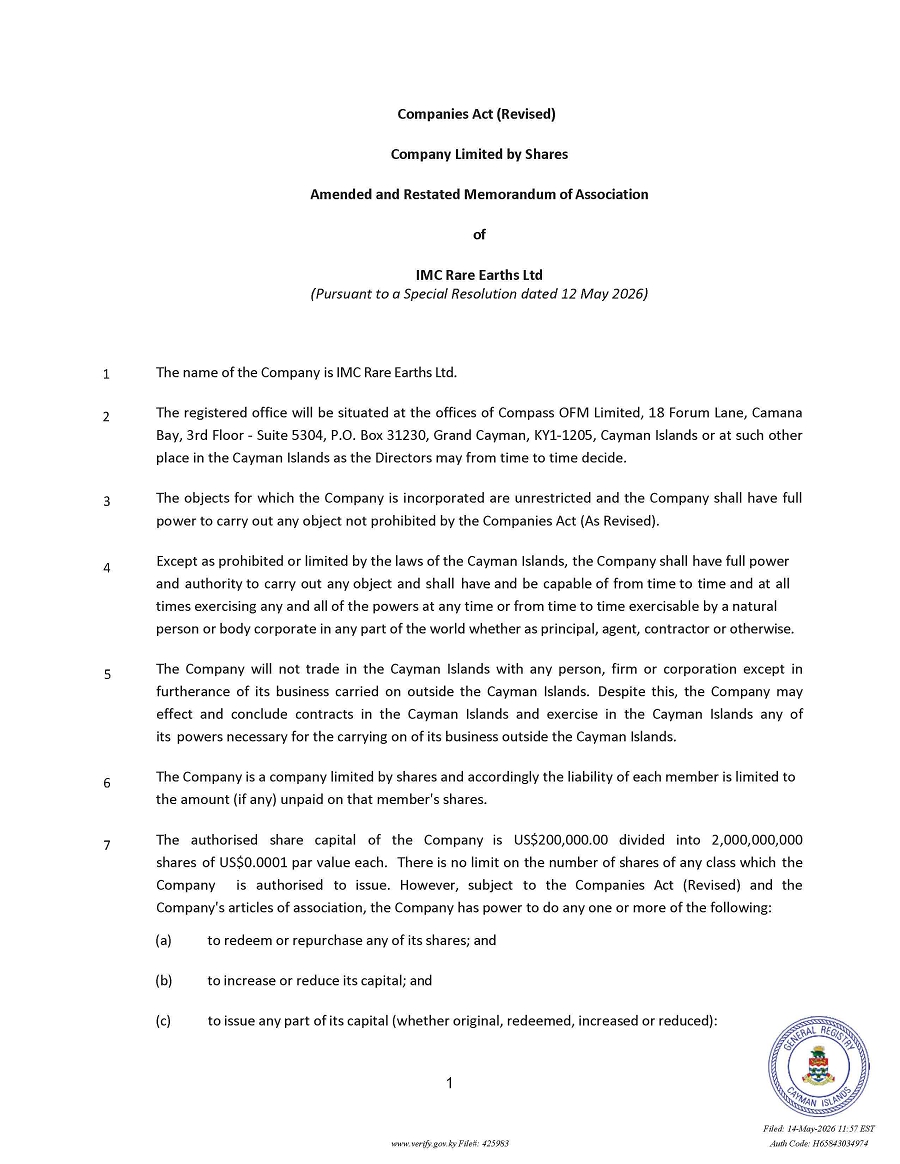

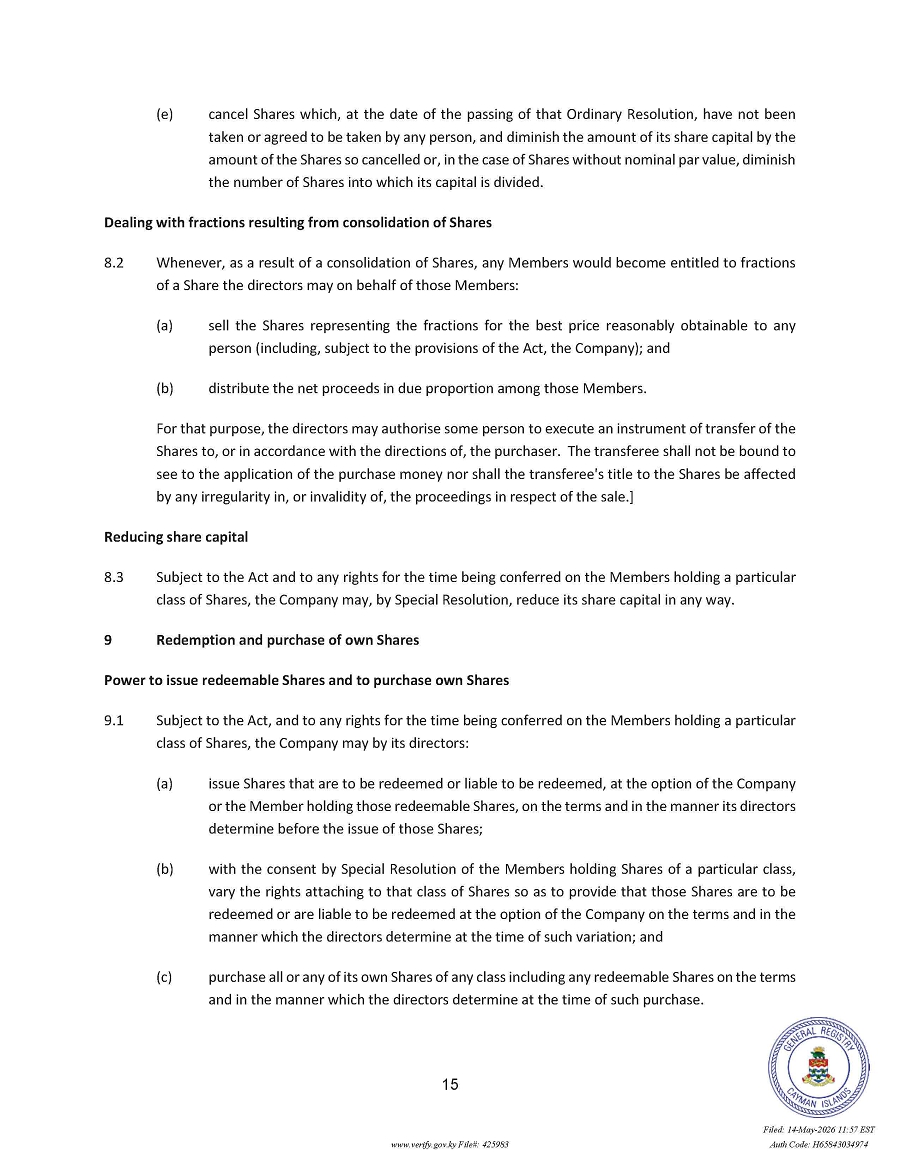
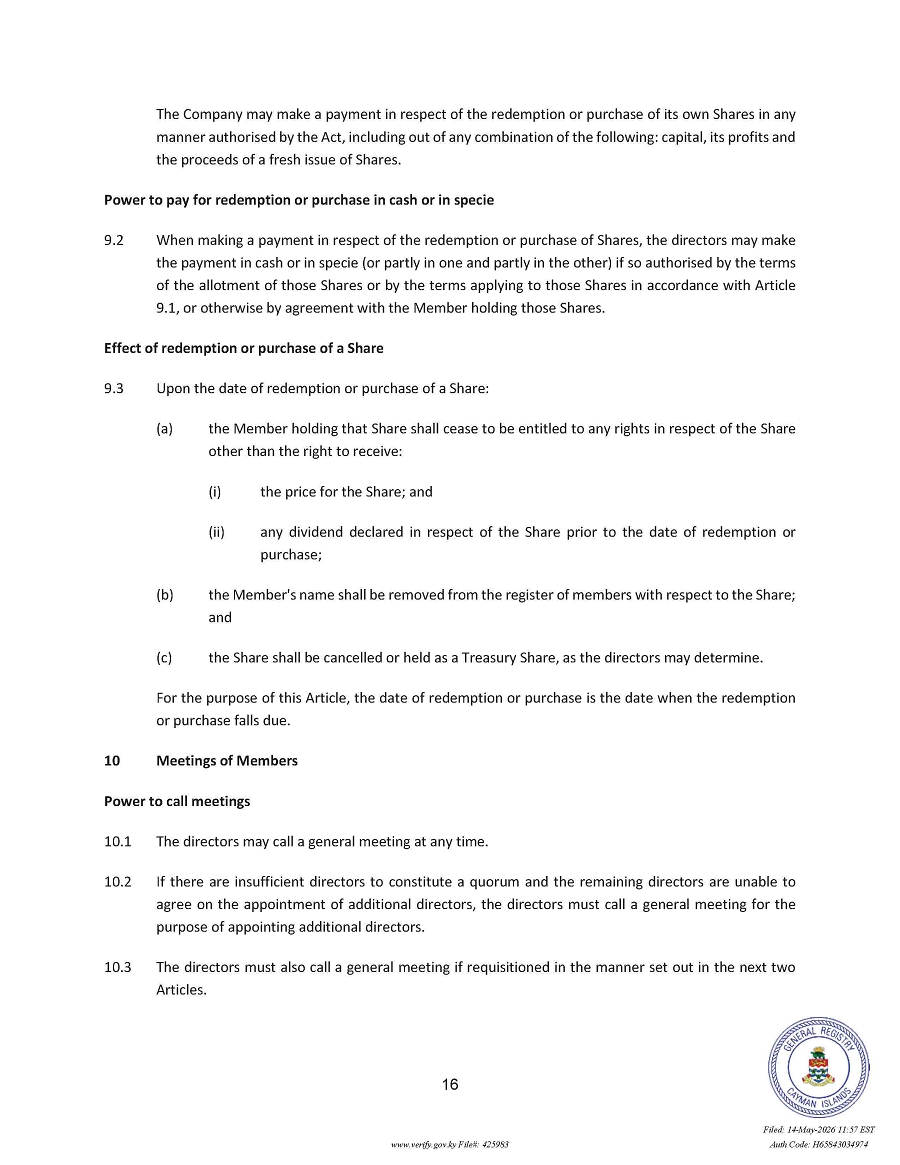

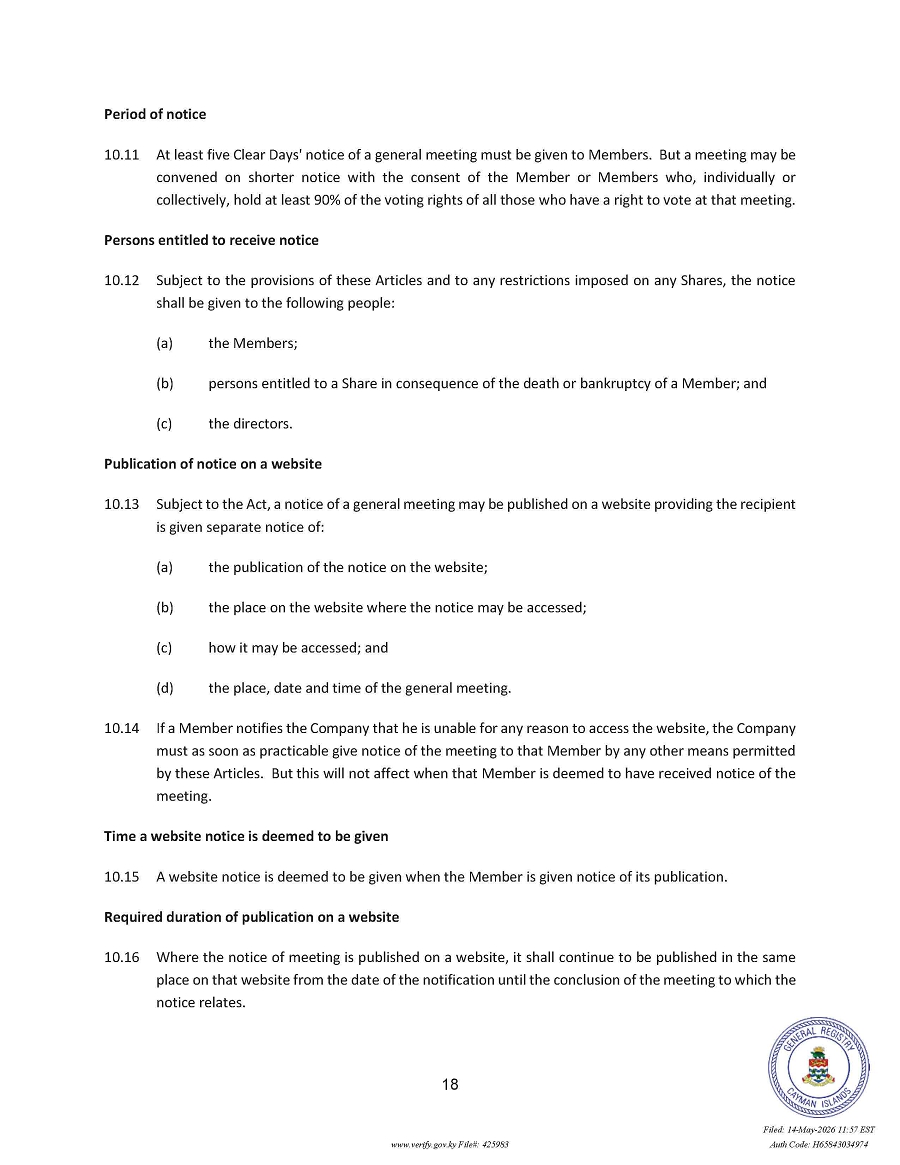
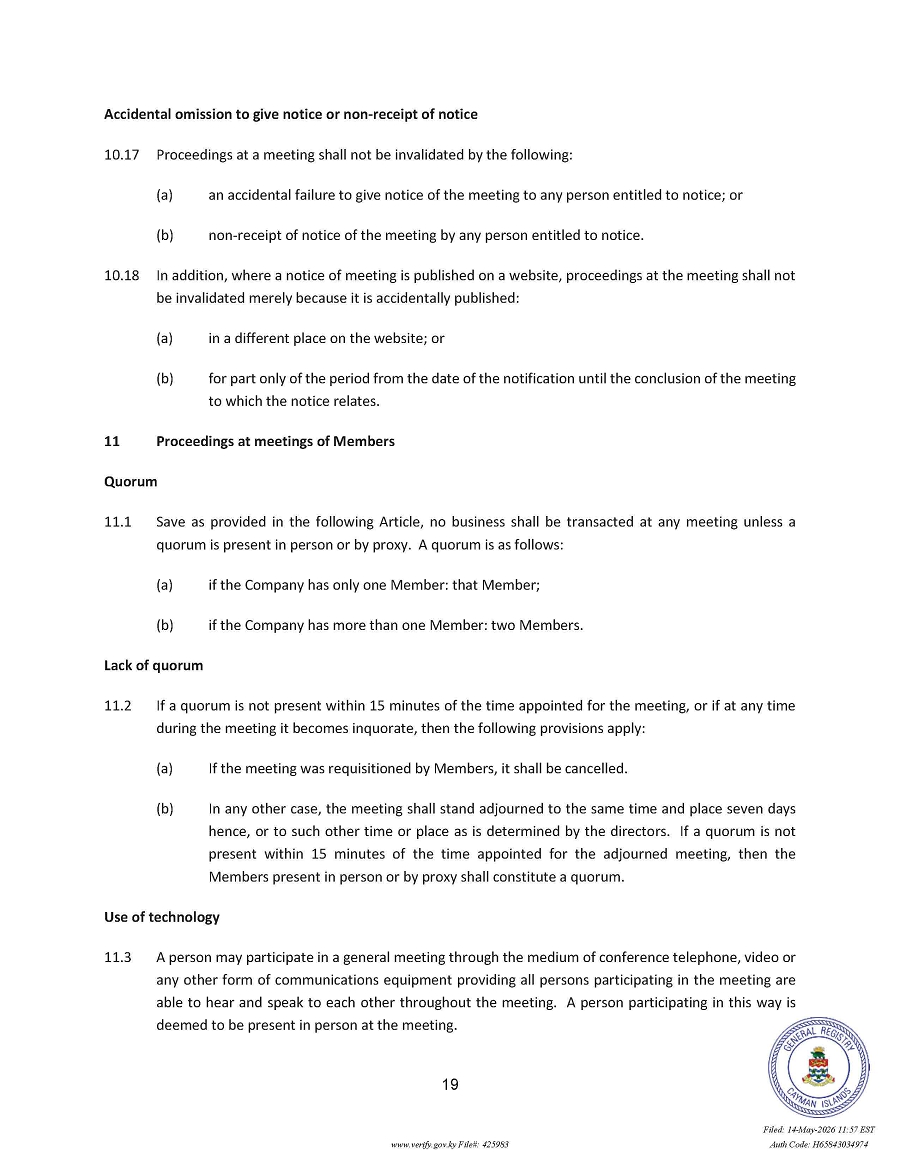

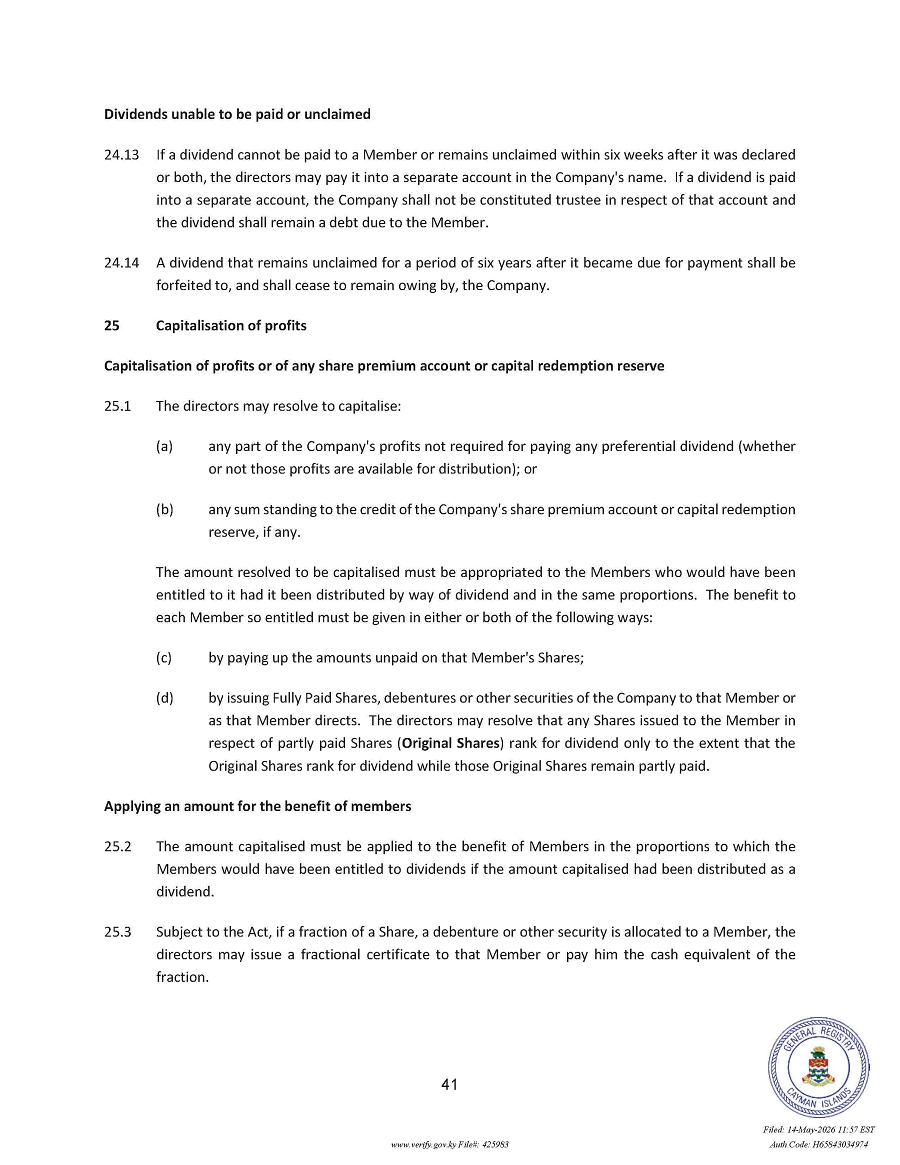
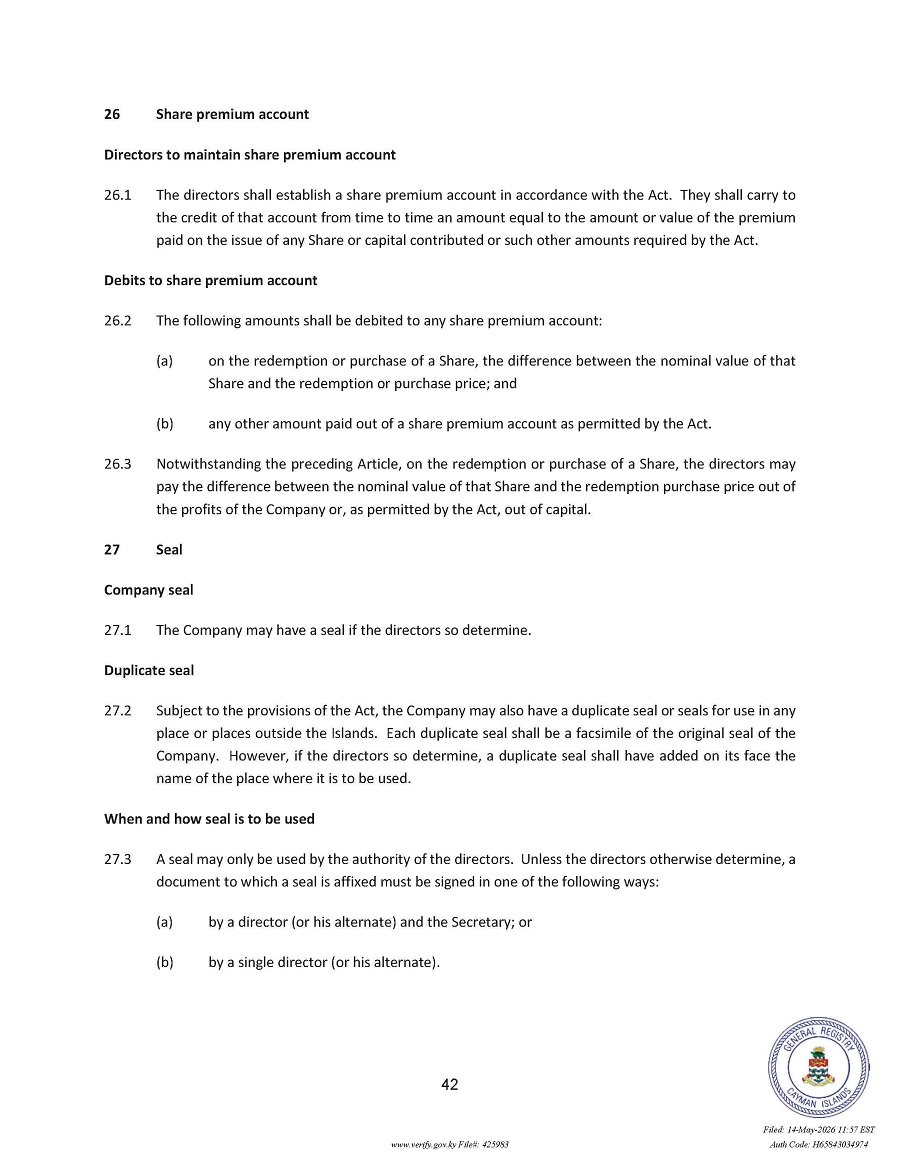
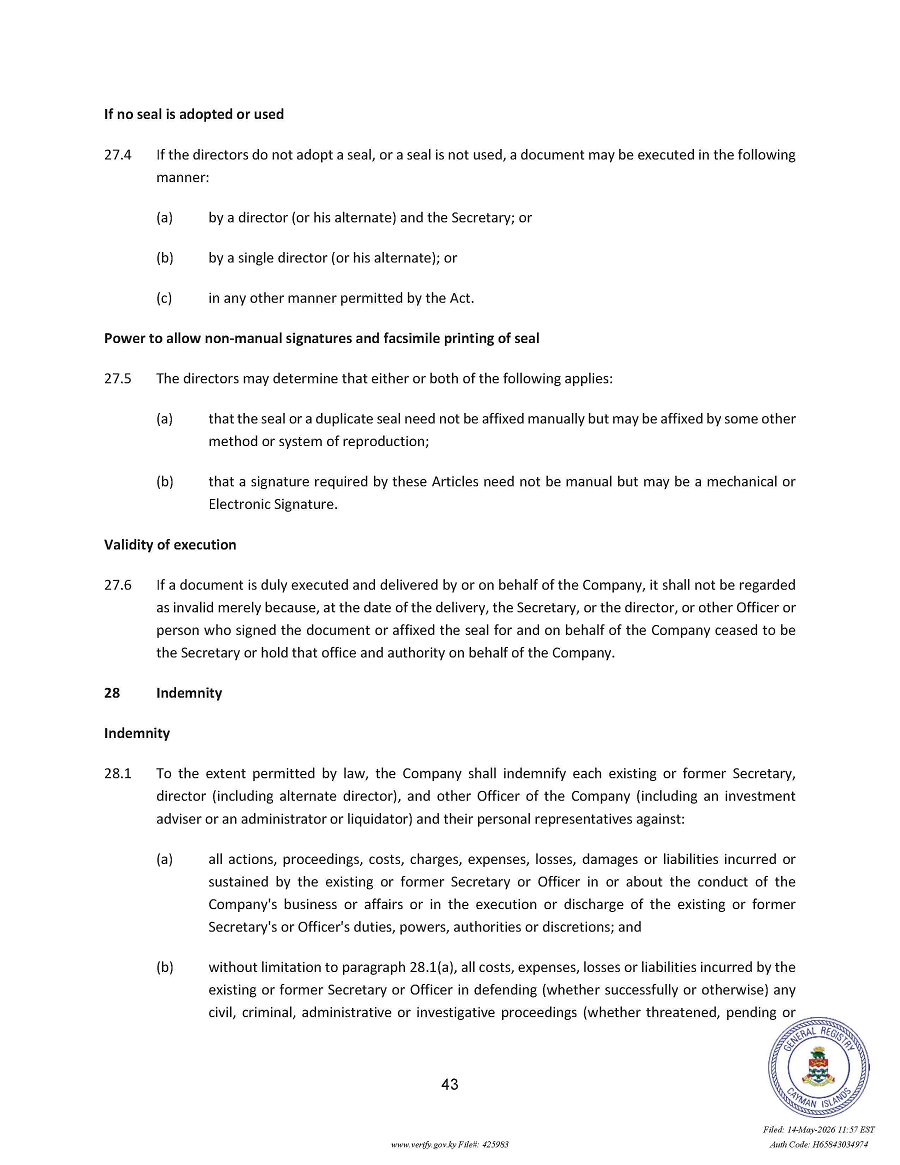
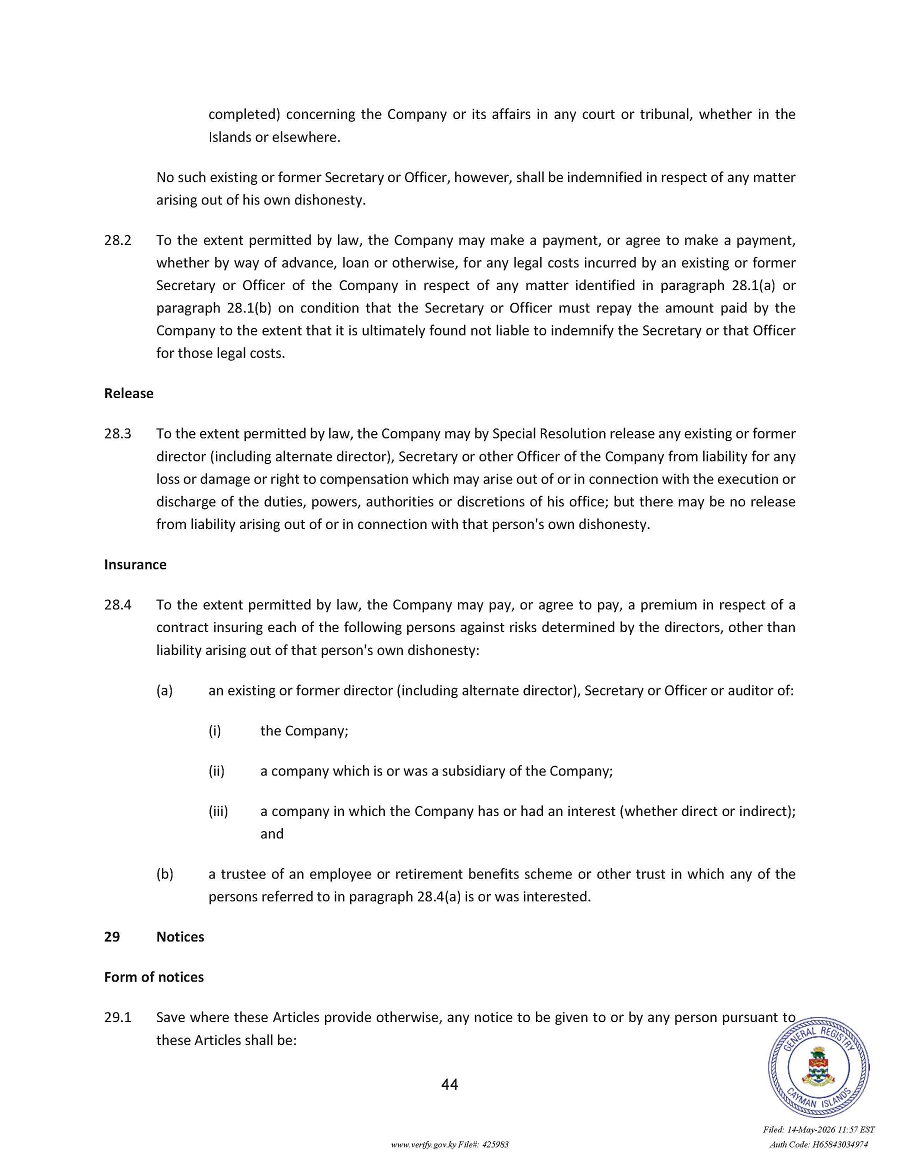
Exhibit 5.1

IMC Rare Earths Ltd 18 Forum Lane, Camana Bay |
D: E: |
+852 3656 6054 nathan.powell@ogier.com | |
3rd Floor - Suite 5304 P.O. Box 31230 |
D: E: |
+852 3656 6061 florence.chan@ogier.com | |
Grand Cayman, KY1-1205 Cayman Islands |
|||
| Ref: | FYC/AGC/515826.00002 |
13 August 2026
Dear Sirs
IMC Rare Earths Ltd (the Company)
We have acted as the Cayman Islands counsel to the Company in connection with the Company’s registration statement on Form F-1, including all amendments or supplements thereto (the Registration Statement), as filed with the United States Securities and Exchange Commission (the Commission) under the United States Securities Act of 1933, as amended (the Securities Act), on or about the date hereof.
The Registration Statement relates to, among other things, the resale by Americas Rare Earths Holdings Ltd. (the Resale Shareholder) of up to 10,110,000 ordinary shares of par value US$0.0001 each in the Company (the Warrant Shares) issuable upon exercise of warrants (the Warrants) pursuant to the Warrant Agreement (as defined below) from time to time in accordance with the terms thereof.
Unless a contrary intention appears, all capitalised terms used in this opinion have the respective meanings set forth in the Registration Statement. A reference to a Schedule is a reference to a schedule to this opinion and the headings herein are for convenience only and do not affect the construction of this opinion.
| 1 | Documents Examined |
For the purposes of giving this opinion, we have examined originals, copies, or drafts of the following documents:
| (a) | the certificate of incorporation of the Company dated 19 September 2025 issued by the Registrar of Companies of the Cayman Islands (the Registrar); |
| (b) | the third amended and restated memorandum and articles of association of the Company as adopted by special resolution passed on 28 July 2026 with effect from 28 July 2026 (the Memorandum and Articles); |
Ogier Providing advice on British Virgin Islands, Cayman Islands and Guernsey laws
Floor 11 Central Tower 28 Queen’s Road Central Central Hong Kong
T +852 3656 6000 F +852 3656 6001 ogier.com |
Partners Nicholas Plowman Nathan Powell Anthony Oakes Oliver Payne Kate Hodson David Nelson Joanne Collett Dennis Li Cecilia Li |
Yuki Yan David Lin Alan Wong Janice Chu Zhao Rong Ooi Rachel Huang** Florence Chan*‡ Richard Bennett**‡ James Bergstrom‡ |
* admitted in New Zealand ** admitted in England and Wales ‡ not ordinarily resident in Hong Kong |
| Page 2 of 4 |
| (c) | the certificate of good standing dated 23 July 2026 issued by the Registrar in respect of the Company (the Good Standing Certificate); |
| (d) | the register of directors and officers of the Company filed with the Registrar on 30 July 2026 (the ROD); |
| (e) | the listed register of members of the Company provided to us on 13 August 2026 (the ROM, and together with the ROD, the Registers); |
| (f) | the warrant instrument dated 15 May 2026 issued by the Company to Americas Rare Earths Holdings Ltd (the Warrant Agreement), a copy of which is exhibited to the Registration Statement; |
| (g) | the written resolutions of all of the directors of the Company dated 25 June 2026 approving, among other things, the issuance of the Warrants and Warrants Shares (collectively, the Reviewed Resolutions); |
| (h) | the certificate from a director of the Company dated 13 August 2026 as to certain matters of fact (the Director’s Certificate); and |
| (i) | the Registration Statement. |
| 2 | Assumptions |
In giving this opinion we have relied upon the assumptions set forth in this paragraph 2 without having carried out any independent investigation or verification in respect of those assumptions:
| (a) | all original documents examined by us are authentic and complete; |
| (b) | all copy documents examined by us (whether in facsimile, electronic or other form) conform to the originals and those originals are authentic and complete; |
| (c) | all signatures, seals, dates, stamps and markings (whether on original or copy documents) are genuine; |
| (d) | each of the Registers, the Good Standing Certificate and the Director’s Certificate is accurate and complete as at the date of this opinion; |
| (e) | the Memorandum and Articles are in full force and effect and have not been amended, varied, supplemented or revoked in any respect; |
| (f) | all copies of the Registration Statement is true and correct copies and the Registration Statement conforms in every material respect to the latest drafts of the same produced to us and, where we have been provided with successive drafts of the Registration Statement marked to show changes from a previous draft, all such changes have been accurately marked; |
| (g) | all parties to the Warrant Agreement, other than the Company, have the legal capacity, power and authority to enter into and perform their obligations under the Warrant Agreement, sign and delivery such documents and give such information; |
| Page 3 of 4 |
| (h) | the Warrant Agreement has been duly executed by all parties thereto and is legal, valid, binding and enforceable against all relevant parties in accordance with its terms under its governing law and all other relevant laws (other than, in the case of the Company, the laws of the Cayman Islands); |
| (i) | the Reviewed Resolutions remain in full force and effect and have not been, and will not be, rescinded or amended, and each of the directors of the Company has acted in good faith with a view to the best interests of the Company and has exercised the standard of care, diligence and skill that is required of him or her in approving the transactions set out in the Reviewed Resolutions and no director has a financial interest in or other relationship to a party of the transactions contemplated therein which has not been properly disclosed in the Reviewed Resolutions; |
| (j) | neither the directors and shareholders of the Company have taken any steps to wind up the Company or to appoint a liquidator or restructuring officer of the Company and no receiver has been appointed over any of the Company’s property or assets; |
| (k) | no invitation has been or will be made by or on behalf of the Company to the public in the Cayman Islands to subscribe for any Warrant Shares and none of the Warrant Shares have been offered or issued to residents of the Cayman Islands; |
| (l) | the Company will have sufficient authorised but unissued share capital to effect the issue of any Warrant Shares at the time of issuance on the exercise of any Warrants; |
| (m) | the Company has received or will have receive consideration for the full exercise price of the Warrant Shares, which shall be equal to at least the par value thereof; |
| (n) | the Company is, and after the allotment (where applicable) and issuance of any Warrant Share will be, able to pay its liabilities as they fall due; and |
| (o) | there is no provision of the law of any jurisdiction, other than the Cayman Islands, which would have any implication in relation to the opinions expressed herein. |
| 3 | Opinions |
On the basis of the examinations and assumptions referred to above and subject to the limitations and qualifications set forth in paragraph 4 below, we are of the opinion that:
Corporate Status
| (a) | The Company has been duly incorporated as an exempted company with limited liability and is validly existing and in good standing with the Registrar. |
Authorised Share capital
| (b) | The authorised share capital of the Company is US$200,000 divided into 2,000,000,000 shares of par value US$0.0001 each. |
| Page 4 of 4 |
Valid Issuance of Warrant Shares
| (c) | The Warrant Shares to be issued pursuant to the Warrants have been duly authorised for issuance, and when: |
| (i) | issued by the Company upon due exercise of the Warrants in accordance with the terms thereof, the Warrant Agreement, the Registration Statement, the Reviewed Resolutions and the provisions of the memorandum and articles of association of the Company then in effect, and once consideration as stated in the Warrants, which shall not be less than the par value per Warrant Share, is paid; and |
| (ii) | such issuance of Warrant Shares has been duly registered in the Company’s register of members as fully paid shares, |
will be validly issued, fully paid and non-assessable.
| 4 | Limitations and Qualifications |
| 4.1 | We offer no opinion: |
| (a) | as to any laws other than the laws of the Cayman Islands, and we have not, for the purposes of this opinion, made any investigation of the laws of any other jurisdiction, and we express no opinion as to the meaning, validity, or effect of references in the Registration Statement to statutes, rules, regulations, codes or judicial authority of any jurisdiction other than the Cayman Islands; |
| (b) | except to the extent that this opinion expressly provides otherwise, as to the commercial terms of, or the validity, enforceability or effect of the Registration Statement, the accuracy of representations, the fulfilment of warranties or conditions, the occurrence of events of default or terminating events or the existence of any conflicts or inconsistencies among the Registration Statement and any other agreements into which the Company may have entered or any other documents; or |
| (c) | as to whether the acceptance, execution or performance of the Company’s obligations under the Registration Statement or the Warrant Agreement will result in the breach of or infringe any other agreement, deed or document (other than the Memorandum and Articles) entered into by or binding on the Company. |
| 4.2 | Under the Companies Act (Revised) (Companies Act) of the Cayman Islands annual returns in respect of the Company must be filed with the Registrar, together with payment of annual filing fees. A failure to file annual returns and pay annual filing fees may result in the Company being struck off the Register of Companies, following which its assets will vest in the Financial Secretary of the Cayman Islands and will be subject to disposition or retention for the benefit of the public of the Cayman Islands. |
| 4.3 | In good standing means only that as of the date of the Good Standing Certificate the Company is up-to-date with the filing of its annual returns and payment of annual fees with the Registrar. We have made no enquiries into the Company’s good standing with respect to any filings or payment of fees, or both, that it may be required to make under the laws of the Cayman Islands other than the Companies Act. |
| 4.4 | In this opinion, the phrase “non-assessable” means, with respect to the Warrant Shares subject to resale, that a shareholder shall not, solely by virtue of its status as a shareholder, be liable for additional assessments or calls on the Warrant Shares subject to resale by the Company or its creditors (except in exceptional circumstances, such as involving fraud, the establishment of an agency relationship or an illegal or improper purpose or other circumstance in which a court may be prepared to pierce or lift the corporate veil). |
| 5 | Governing Law of This Opinion |
| 5.1 | This opinion is: |
| (a) | governed by, and shall be construed in accordance with, the laws of the Cayman Islands; |
| (b) | limited to the matters expressly stated in it; and |
| (c) | confined to, and given on the basis of, the laws and practice in the Cayman Islands at the date of this opinion. |
| 5.2 | Unless otherwise indicated, a reference to any specific Cayman Islands legislation is a reference to that legislation as amended to, and as in force at, the date of this opinion. |
| 6 | Consent |
| 6.1 | We hereby consent to the filing of this opinion as an exhibit to the Registration Statement and also consent to the reference to our firm under the headings “Enforcement of Civil Liabilities” and “Legal Matters” of the Registration Statement. In the giving of our consent, we do not thereby admit that we are “experts” within the meaning of such term used in them Securities Act or the rules and regulations of the Commission issued thereunder with respect to any part of the Registration Statement, including this opinion as an exhibit or otherwise. |
| 6.2 | This opinion may be used only in connection with the resale of the Warrant Shares and while the Registration Statement is effective. |
Yours faithfully
Ogier
Exhibit 10.1
IMC RARE EARTHS LTD
2026 OMNIBUS INCENTIVE PLAN
(Adopted by shareholders resolution passed on ____ June 2026)
Section 1. General.
The name of the Plan is the IMC Rare Earths Ltd 2026 Omnibus Incentive Plan (the “Plan”). The Plan intends to: (i) encourage the profitability and growth of the Company through short-term and long-term incentives that are consistent with the Company’s objectives; (ii) give Participants an incentive for individual performance; (iii) promote teamwork among Participants; and (iv) give the Company an advantage in attracting and retaining key Employees, Directors, and Consultants. To accomplish such purposes, the Plan provides that the Company may grant Options, Share Appreciation Rights, Restricted Shares, Restricted Share Units, Performance-Based Awards (including performance-based Restricted Shares and Restricted Share Units), Other Share-Based Awards, Other Cash-Based Awards or any combination of the foregoing.
WARNING: THE CONTENTS OF THIS PLAN HAVE NOT BEEN REVIEWED BY ANY REGUALTORY AUTHORITY. YOU ARE ADVISED TO EXERCISE CAUTION IN RELATION TO THE OFFER. IF YOU ARE IN ANY DOUBT ABOUT ANY OF THE CONTENTS OF THIS PLAN, YOU SHOULD OBTAIN INDEPENDENT PROFESSIONAL ADVICE.
Section 2. Definitions.
For purposes of the Plan, the following terms shall be defined as set forth below:
a) “Administrator” means the Board, or, if and to the extent the Board does not administer the Plan, the Committee appointed by the Board to administer the Plan in accordance with Section 3 of the Plan.
b) “Affiliate” means a Person that directly, or indirectly through one or more intermediaries, controls, or is controlled by, or is under common control with, the Person specified. An entity shall be deemed an Affiliate of the Company for purposes of this definition only for such periods as the requisite ownership or control relationship is maintained.
c) “Automatic Exercise Date” means, with respect to an Option or a Share Appreciation Right, the last business day of the applicable term of the Option or such right pursuant to Section 7(c) or the Share Appreciation Right pursuant to Section 8(g).
d) “Award” means any Option, Share Appreciation Right, Restricted Share, Restricted Share Unit, Performance-Based Award, Other Share-Based Award, or Other Cash-Based Award granted under the Plan.
e) “Award Agreement” means any agreement, contract, or other instrument or document evidencing an Award. Evidence of an Award may be in written or electronic form, may be limited to notation on the books and records of the Company and, with the approval of the Administrator. Any Shares that become deliverable to the Participant pursuant to the Plan will be registered in the register of members or listed share register of the Company in the name of the Participant and may be issued in certificate form in the name of the Participant.
f) “Bylaws” means the memorandum and articles of association of the Company, as may be amended and/or restated from time to time.
g) “Beneficial Owner” (or any variant thereof) has the meaning defined in Rule 13d-3 under the Exchange Act.
h) “Board” means the board of Directors.
i) “Cause” shall have the meaning assigned to such term in any Company or Affiliate employment, severance, or similar agreement or Award Agreement with the Participant or, if no such agreement exists or the agreement does not define “Cause,” Cause means (i) any conduct, action or behavior by a Participant, whether or not in connection with the Participant’s employment, including, without limitation, the commission of any felony or a lesser crime involving dishonesty, fraud, misappropriation, theft wrongful taking of property, embezzlement, bribery, forgery, extortion or other crime of moral turpitude, that has or may reasonably be expected to have a material adverse effect on the reputation or business of the Company, its Subsidiaries and Affiliates or which results in gain or personal enrichment of the Participant to the detriment of the Company, its Subsidiaries and Affiliates; (ii) a governmental authority has prohibited the Participant from working or being affiliated with the Company, its Subsidiaries and Affiliates or the business conducted thereby; (iii) the commission of any act by the Participant of gross negligence or malfeasance, or any willful violation of law, in each case, in connection with the Participant’s performance of his or her duties with the Company or any Affiliate thereof; (iv) performance of the Participant’s duties in an unsatisfactory manner after a written warning and a ten (10) day opportunity to cure or failure to observe material policies generally applicable to employees after a written warning and a ten (10) day opportunity to cure; (v) a breach of the Participant’s fiduciary duty to the Company which constitutes a willful failure to deal fairly with the Company or its shareholders in connection with a transaction in which the Participant has a material undisclosed personal conflict of interest; (vi) the Participant’s chronic absenteeism (i.e., the Participant’s absence of ten percent (10%) or more of total work-days in a calendar year; (vii) the Participant’s substance abuse, illegal drug use, or habitual insobriety; or (viii) the Participant’s violation of obligations of confidentiality to any third party in the course of providing services to the Company, its Subsidiaries and Affiliates.
j) “Change in Capitalization” means any (0 merger, consolidation, reclassification, recapitalization, spinoff, spin-out, repurchase or other reorganization or corporate transaction or event, (ii) dividend (whether in the form of cash, Ordinary Shares or other property), share split or reverse share split, (iii) combination or exchange of shares, (iv) other change in corporate structure, or (v) payment of any other distribution, which, in any such case, the Administrator determines, in its sole discretion, affects the Shares such that an adjustment pursuant to Section 5 of the Plan is appropriate.
k) “Committee” means any committee or subcommittee the Board may appoint to administer the Plan. Subject to the discretion of the Board, the Committee shall be composed entirely of individuals who meet the qualifications of a “non-employee director” within the meaning of Rule 16b-3 under the Exchange Act and any other qualifications required by the applicable stock/share exchange on which the Ordinary Shares are traded. If at any time or to any extent the Board shall not administer the Plan, then the functions of the Administrator specified in the Plan shall be exercised by the Committee. Except as otherwise provided in the Bylaws, or any charter establishing the Committee, any action of the Committee with respect to the administration of the Plan shall be taken by a majority vote at a meeting at which a quorum is duly constituted or unanimous written consent of the Committee’s members.
l) “Company” means IMC Rare Earths Ltd , an exempted company incorporated in the Cayman Islands with limited liability.
m) “Consultant” means any consultant or independent contractor of the Company or an Affiliate thereof, in each case, who is not an Employee, Executive Officer, or non-employee Director.
n) “Disability” shall have the meaning assigned to such term in any individual employment, severance or similar agreement or Award Agreement with the Participant or, if no such agreement exists or the agreement does not define “Disability,” Disability means, with respect to any Participant, that such Participant (0 is unable to engage in any substantial gainful activity by reason of any medically determinable physical or mental impairment which can be expected to result in death or can be expected to last for a continuous period of not less than twelve (12) months, or (ii) is, by reason of any medically determinable physical or mental impairment which can be expected to result in death or can be expected to last for a continuous period of not less than twelve (12) months, receiving income replacement benefits for a period of not less than three (3) months under an accident and health plan covering Employees of the Company or an Affiliate thereof.
o) “Director” means any director of the Company on or after the Effective Date. “Effective Date” shall have the meaning set forth in Section 17 of the Plan.
p) “Eligible Recipient” means: (i) an Employee; (ii) a non-employee Director; or (iii) a Consultant, in each case, who has been selected as an Eligible Recipient under the Plan by the Administrator.
q) “Employee” shall mean an employee of the Company or an Affiliate thereof, including an Executive
r) Officer or Director who is also treated as an employee.
s) “Exchange Act” means the United States Securities Exchange Act of 1934, as amended from time to time.
t) “Executive Officer” means each Participant who is an executive officer (within the meaning of Rule 3b-7 under the Exchange Act) of the Company.
u) “Exercise Price” means, with respect to any Award under which the holder may purchase Shares, the price per share at which a holder of such Award granted hereunder may purchase Shares issuable upon exercise of such Award.
v) “Fair Market Value” as of a particular date shall mean: (i) if the Ordinary Shares are admitted to trading on a national securities exchange, the fair market value of a Share on any date shall be the closing sale price reported for such share on such exchange on such date or, if no sale was reported on such date, on the last day preceding such date on which a sale was reported; or (ii) if the Shares are not then listed on a national securities exchange or traded in an over-the-counter market or the value of such Shares is not otherwise determinable, such value as determined by the Committee in good faith (such determination to be conclusive and binding on all persons).
w) “Free Standing Rights” shall have the meaning set forth in Section 8(a) of the Plan.
x) “Option” means an option to purchase Shares granted pursuant to Section 7 of the Plan.
y) “Ordinary Shares” means the ordinary shares of par value US$0.0001 each of the Company.
z) “Other Cash-Based Award” means a cash Award granted to a Participant under Section 11 of the Plan, including cash awarded as a bonus or upon the attainment of Performance Goals or otherwise as permitted under the Plan.
aa) “Other Share-Based Award” means a right or other interest granted to a Participant under Section 11 of the Plan that may be denominated or payable in, valued in whole or in part by reference to, or otherwise based on or related to, Ordinary Shares, including, but not limited to, unrestricted Shares or dividend equivalents, each of which may be subject to the attainment of Perfonnance Goals or a period of continued employment or other terms or conditions as permitted under the
bb) “Participant” means any Eligible Recipient selected by the Administrator, pursuant to the Administrator’s authority provided for in Section 3 of the Plan, to receive grants of Options, Share Appreciation Rights, Restricted Shares, Restricted Share Units, Performance-Based Awards, Other Share-Based Awards, Other Cash-Based Awards or any combination of the foregoing, and, upon his or her death, his or her successors, heirs, executors and administrators, as the case may be, solely with respect to any Awards outstanding at the date of the Eligible Recipient’s death.
cc) “Performance-Based Award” means any Award granted under the Plan that is subject to one or more Perfonnance Goals. Any dividends or dividend equivalents payable or credited to a Participant with respect to any unvested Perfonnance-Based Award shall be subject to the same Performance Goals as the Shares or units underlying the Performance-Based Award.
dd) “Performance Goals” means performance goals based on one or more of the following criteria: (i) earnings before interest and taxes; (ii) earnings before interest, taxes, depreciation and amortization; (iii) net operating profit after tax; (iv) cash flow; (v) revenue; (vi) net revenues; (vii) sales; (viii) days sales outstanding; (ix) income; (x) net income; (xi) operating income; (xii) net operating income; (xiii) operating margin; (xi’) earnings; (xv) earnings per share; (xvi) return on equity; (xvii) return on investment: (xviii) return on capital; (xix) return on assets; (xx) return on net assets; (xx0 total shareholder return; (xxii) economic profit; (xviii) market share; (xxiv) appreciation in the fair market value, book value or other measure of value of the Company’s Ordinary Shares; (xxv) expense or cost control; (xxvi) working capital; (xxvii) volume or production; (xviii) new products; (xxix) customer satisfaction; (xxx) brand development; (xxxi) employee retention or employee turnover; (xxxii) employee satisfaction or engagement; (xxxiii) environmental, health or other safety goals; (xxxiv) individual performance; (xxxv) strategic objective milestones; (xxxvi) days inventory outstanding; and (xxxvii) any other performance goal or a combination of performance goals selected by the Administrator. Where applicable, the Performance Goals may be expressed in terms of attaining a specified level of the particular criteria or the attainment of a percentage increase or decrease in the particular criteria, and may be applied to one or more of the Company or an Affiliate thereof, or a division or strategic business unit of the Company, or may be applied to the performance of the Company relative to a market index, a group of other companies or a combination thereof, all as determined by the Administrator. The Performance Goals may include a threshold level of performance below which no payment shall be made (or no vesting shall occur), levels of performance at which specified payments shall be made (or specified vesting shall occur), and a maximum level of performance above which no additional payment shall be made (or at which full vesting shall occur).
ee) “Person” shall have the meaning given in Section 3(a)(9) of the Exchange Act, as modified and used in Sections 13(d) and 14(d) thereof, except that such term shall not include (i) the Company or any Affiliate thereof, (ii) a trustee or other fiduciary holding securities under an employee benefit plan of the Company or any Affiliate thereof, (iii) an underwriter temporarily holding securities pursuant to an offering of such securities, or (iv) a corporation owned, directly or indirectly, by the shareholders of the Company in substantially the same proportions as their ownership of shares of the Company.
ii) “Related Rights” shall have the meaning set forth in Section 8(a) of the Plan.
jj) “Restricted Shares” means an Award of Shares granted pursuant to Section 9 of the Plan subject to certain restrictions that lapse at the end of a specified period or periods or the attainment of certain Performance Goals.
kk) “Restricted Share Unit” means a notional account established pursuant to an Award granted to a Participant, as described in Section 10 of the Plan, that is (i) valued solely by reference to Shares, (ii) subject to restrictions specified in the Award Agreement, and (iii) payable in cash or in Shares (as specified in the Award Agreement). The Restricted Share Units awarded to the Participant will vest according to the time-based criteria or Performance Goals criteria specified in the Award Agreement.
ll) “Restricted Period” means the period of time determined by the Administrator during which an Award or a portion thereof is subject to restrictions or, as applicable, the period of time within which performance is measured for purposes of determining whether an Award has been earned.
mm) “Retirement” means a termination of a Participant’s employment, other than for Cause and other than by reason of death or Disability, on or after the attainment of age 65 or legal retirement age under applicable laws in the country of employment, whichever earlier.
nn) “Rule 16b-3” shall have the meaning set forth in Section 3(a) of the Plan.
oo) “Shares” means Ordinary Shares issued or to be issued under the Plan, as adjusted pursuant to the Plan.
pp) “Share Appreciation Right” means the right pursuant to an Award granted under Section 8 of the Plan to receive an amount equal to the excess, if any, of (i) the aggregate Fair Market Value, as of the date such Award or portion thereof is surrendered, of the Shares covered by such Award or such portion thereof, over (ii) the aggregate Exercise Price of such Award or such portion thereof.
qq) “Subsidiaries” has the meaning as ascribed under the Companies Act (As Revised) of the Cayman Islands.
rr) “Substitute Award” shall mean an Award granted under the Plan upon the assumption of, or in substitution for, outstanding equity awards granted by a company or other entity in connection with a corporate transaction, such as a merger, combination, consolidation, or acquisition of property or stock/shares; provided, however, that in no event shall the term “Substitute Award” be construed to refer to an award made in connection with the cancellation and repricing of an Option or Share Appreciation Right.
Section 3. Administration.
(a) The Plan shall be administered by the Administrator and shall be administered in accordance with, to the extent applicable, Rule 16b-3 under the Exchange Act (“Rule 16b-3”).
(b) Pursuant to the terms of the Plan, the Administrator, subject, in the case of any Committee, to any restrictions on the authority delegated to it by the Board, shall have the power and authority, without limitation:
(i) to select those Eligible Recipients who shall be Participants;
(ii) to determine whether and the extent to which Options, Share Appreciation Rights, Restricted Shares, Restricted Share Units, Performance-Based Awards, Other Share-Based Awards, Other Cash-Based Awards or a combination of any of the foregoing, arc to be granted hereunder to Participants;
(iii) to determine the number of Shares to be covered by each Award granted hereunder;
(iv) to determine the terms and conditions of each Award, not inconsistent with the terms of the Plan, of each Award granted hereunder, including, but not limited to, (A) the restrictions applicable to Restricted Shares and Restricted Share Units and the conditions under which restrictions applicable to such Restricted Shares and Restricted Share Units shall lapse, (B) the Performance Goals and periods applicable to Awards, if any, (C) the Exercise Price of each Award, (D) the vesting schedule applicable to each Award, and (E) any amendments to the terms and conditions of outstanding Awards, including, but not limited to, extending the exercise period of such Awards and accelerating the vesting schedule of such Awards;
(v) to determine the terms and conditions of each Award, not inconsistent with the terms of the Plan, which shall govern all written instruments evidencing Options, Share Appreciation Rights, Restricted Shares, Restricted Share Units or Other Share-Based Awards, Other Cash-Based Awards or any combination of the foregoing granted hereunder;
(vi) to determine the Fair Market Value;
(vii) to determine the duration and purpose of leaves of absence which may be granted to a Participant without constituting termination of the Participant’s employment for purposes of Awards granted under the Plan;
(viii) to adopt, alter and repeal such administrative rules, guidelines and practices governing the Plan as it shall from time to time deem advisable;
(ix) to reconcile any inconsistency in, correct any defect in and/or supply any omission in the Plan, any Award Agreement or other instrument or agreement relating to the Plan or an Award granted under the Plan; and
(x) to construe and interpret the terms and provisions of the Plan and any Award issued under the Plan (and any Award Agreement relating thereto), and to otherwise supervise the administration of the Plan and to exercise all powers and authorities either specifically granted under the Plan or necessary and advisable in the administration of the Plan.
(c) The Administrator shall have the right, from time to time, to delegate to one or more officers of the Company the authority of the Administrator to grant and determine the terms and conditions of Awards granted under the Plan, subject to the requirements of any applicable laws and regulations and such other limitations as the Administrator shall determine. In no event shall any such delegation of authority be permitted with respect to Awards to any members of the Board or to any Eligible Recipient who is subject to Rule 16b-3 under the Exchange Act. The Administrator shall also be permitted to delegate, to any appropriate officer or employee of the Company, responsibility for performing certain ministerial functions under the Plan. If the Administrator’s authority is delegated to officers or employees in accordance with the foregoing, all provisions of the Plan relating to the Administrator shall be interpreted in a manner consistent with the foregoing by treating any such reference as a reference to such officer or employee for such purpose. Any action undertaken in accordance with the Administrator’s delegation of authority hereunder shall have the same force and effect as if such action was undertaken directly by the Administrator and shall be deemed for all purposes of the Plan to have been taken by the Administrator.
(d) All decisions made by the Administrator pursuant to the provisions of the Plan shall be final, conclusive, and binding on all persons, including the Company and the Participants. No member of the Board or the Committee, or any officer or employee of the Company or any Affiliate thereof acting on behalf of the Board or the Committee, shall be personally liable for any action, omission, determination, or interpretation taken or made in good faith with respect to the Plan, and all members of the Board or the Committee and each and any officer or employee of the Company and of any Affiliate thereof acting on their behalf shall, to the maximum extent permitted by law, be fully indemnified and protected by the Company in respect of any such action, omission, determination or interpretation.
Section 4. Shares Subject to the Plan.
(a) Subject to Section 5 of the Plan, the aggregate number of Shares that are available for issuance pursuant to Awards granted under the Plan (the “Maximum Cap”) is equal to 5,400,000 Ordinary Shares.
(b) Notwithstanding the foregoing, the maximum number of Shares subject to Awards granted during any fiscal year to any non-employee Director, when taken together with any cash fees paid to such non-employee Director during the fiscal year in respect of his or her service as a Director, shall not exceed US$200,000 in total value (calculating the value of any such Awards based on the grant date Fair Market Value of such Awards for financial reporting purposes).
(c) Shares issued under the Plan may, in whole or in part, be authorized but unissued Shares or Shares that have been or may be reacquired by the Company in the open market, in private transactions or otherwise. Any Shares subject to an Award under the Plan that, after the Effective Date, are forfeited, canceled, settled or otherwise terminated without a distribution of Shares to a Participant will thereafter be deemed to be available for Awards. In applying the immediately preceding sentence, if (I) Shares otherwise issuable or issued in respect of, or as part of, any Award are withheld to cover taxes, such Shares shall be treated as having been issued under the Plan and shall not again be available for issuance under the Plan, (ii) Shares otherwise issuable or issued in respect of, or as part of, any Award of Options or Share Appreciation Rights are withheld to cover the Exercise Price, such Shares shall he treated as having been issued under the Plan and shall not be available for issuance under the Plan, and (iii) any Share-settled Share Appreciation Rights are exercised, the aggregate number of Shares subject to such Share Appreciation Rights shall be deemed issued under the Plan and shall not be available for issuance under the Plan.
Substitute Awards shall not reduce the Shares authorized for issuance pursuant to exercise or conversion of Awards to be granted under the Plan. In the event that a company acquired by the Company or any Affiliate or with which the Company or any Affiliate combines has shares available for issuance pursuant to award of securities under a pre-existing incentive plan approved by its shareholders and not adopted in contemplation of such acquisition or combination, its remaining shares available for issuance pursuant to exercise or conversion of award of securities to be granted under such pre-existing plan (as adjusted, to the extent appropriate, using the exchange ratio or other adjustment or valuation ratio or formula used in such acquisition or combination to determine the consideration payable to the holders of ordinary shares of the entities party to such acquisition or combination) may be used for Awards under the Plan and shall not reduce the Shares authorized for issuance pursuant to exercise or conversion of Awards to be granted under the Plan; provided that Awards using such available Shares shall not be granted after the date awards could have been granted under the terms of the said pre-existing plan, absent the acquisition or combination, and shall only be granted to individuals who were not employed by or providing services to the Company or its Affiliates immediately prior to such acquisition or combination.
Section 5. Equitable Adjustments.
In the event of any Change in Capitalization, an equitable substitution or proportionate adjustment shall be made, in each case, as may be determined by the Administrator, in its sole discretion, in (I) the Maximum Cap and the maximum number of Shares that may be subject to Awards granted to any Participant in any calendar or fiscal year, (ii) the kind, number and Exercise Price subject to outstanding Options and Share Appreciation Rights granted under the Plan, and (iii) the kind, number and purchase price of Shares subject to outstanding Restricted Shares or Other Share-Based Awards granted under the Plan, in each case as may be determined by the Administrator, in its sole discretion; provided, however, that any fractional Shares resulting from the adjustment shall be eliminated or rounded to the nearest whole number, and the Exercise Price per Share for the Shares to be issued pursuant to the exercise of an Option shall be no less than the par value of such Share. Such other equitable substitutions or adjustments shall be made as may be determined by the Administrator, in its sole discretion. Without limiting the generality of the foregoing, in connection with a Change in Capitalization, the Administrator may provide, in its sole discretion, for the cancellation of any outstanding Award granted hereunder in exchange for payment in cash or other property having an aggregate Fair Market Value of the Shares covered by such Award, reduced by the aggregate Exercise Price or purchase price thereof, if any. The Administrator’s determinations pursuant to this Section 5 shall be final, binding and conclusive.
Section 6. Eligibility.
The Participants under the Plan shall be selected from time to time by the Administrator, in its sole discretion, from among Eligible Recipients.
Section 7. Options.
(a) General. The Committee may, in its sole discretion, grant Options to Participants. Each Participant who is granted an Option shall enter into an Award Agreement with the Company, containing such terms and conditions as the Administrator shall determine, in its sole discretion, which Award Agreement shall set forth, among other things, the Exercise Price of the Option, the term of the Option and provisions regarding exercisability of the Option granted thereunder. The provisions of each Option need not be the same with respect to each Participant. More than one Option may be granted to the same Participant and be outstanding concurrently hereunder. Options granted under the Plan shall be subject to the terms and conditions set forth in this Section 7 and shall contain such additional terms and conditions, not inconsistent with the terms of the Plan, as the Administrator shall deem desirable and set forth in the applicable Award Agreement. The prospective recipient of an Option shall not have any rights with respect to such Award, unless and until such recipient has received an Award Agreement and, if required by the Administrator in the Award Agreement, executed and delivered a fully executed copy thereof to the Company, within a period of sixty (60) days (or such other period as the Administrator may specify) after the award date.
(b) Exercise Price. The Exercise Price of Shares purchasable under an Option shall be determined by the Administrator in the applicable Award Agreement in its sole discretion at the time of grant, provided that the Exercise Price per Share for the Shares to be issued pursuant to the exercise of an Option shall be no less than the par value of such Share. Notwithstanding the foregoing, the Exercise Price per Share for the Shares underlying an Option granted to a United States tax payer shall be no less than the Fair Market Value of a Share on the date of grant of the Option.
(c) Option Term. The maximum term of each Option shall be fixed by the Administrator, but in no event shall an Option be exercisable more than (i) ten (10) years after the date such Option is granted to an Employee or (ii) five (5) years after the date such Option is granted to a non-employee Director or a Consultant. Each Option’s term is subject to earlier expiration pursuant to the applicable provisions in the Plan (including section 7(g)) and the Award Agreement. Notwithstanding the foregoing, the Administrator shall have the authority to accelerate the vesting schedule of any outstanding Option at such time and under such circumstances as the Administrator, in its sole discretion, deems appropriate. Notwithstanding any contrary provision herein, if, on the date an outstanding Option would expire, the exercise of the Option, including by a “net exercise” or “cashless” exercise, would violate applicable securities laws or any insider trading policy maintained by the Company from time to time, the expiration date applicable to the Option will be extended, to a date that is thirty (30) calendar days after the date the exercise of the Option would no longer violate applicable securities laws or any such insider trading policy.
In particular, as far as the Options granted before the listing of shares of the Company on NYSE or any other share exchange are concerned, each Option shall be exercised within twelve (12) calendar months after the vesting date as mentioned in the subparagraph (d) below, or otherwise lapse upon expiration of such period.
(d) Vesting Schedule and Exercisability. Each Option shall be vested and exercisable at such time or times and subject to such terms and conditions, including the attainment of pre-established Performance Goals (if applicable), as shall be determined by the Administrator in the applicable Award Agreement. The Administrator may also provide that any Option shall he exercisable only in installments, and the Administrator may waive such installment exercise provisions at any time, in whole or in part, based on such factors as the Administrator may determine in its sole discretion. Notwithstanding anything to the contrary contained herein, an Option may not be exercised for a fraction of a share.
In particular, as far as the Options granted before the listing of shares of the Company on NYSE or any other share exchange are concerned, such Options shall be vested on either (i) the date(s) specified in the Award Agreement, (ii) after thirty-six (36) calendar months of the grantee’s continuous employment with, or service to, the Company or of any of its affiliates, or (iii) such earlier date as otherwise determined by the Board upon exercising its discretion to accelerate the vesting schedule of the Options.
(e) Method of Exercise. Options may be exercised in whole or in part by giving written notice of exercise to the Company specifying the number of Shares to be purchased, accompanied by payment in full of the aggregate Exercise Price of the Shares so purchased in cash or its equivalent, as determined by the Administrator. As determined by the Administrator, in its sole discretion, with respect to any Option or category of Options, payment in whole or in part may also be made (i) by means of consideration received under any cashless exercise procedure approved by the Administrator (including the withholding of Shares otherwise issuable upon exercise), (ii) in the form of unrestricted Shares already owned by the Participant which have a Fair Market Value on the date of surrender equal to the aggregate Exercise Price of the Shares as to which such Option shall be exercised, (iii) any other form of consideration approved by the Administrator and permitted by applicable law or (iv) any combination of the foregoing. In determining which methods a Participant may utilize to pay the Exercise Price, the Administrator may consider such factors as it determines are appropriate.
(f) Rights as Shareholder. A Participant shall have no rights to dividends or any other rights of a shareholder with respect to the Shares subject to an Option until the Participant has given written notice of the exercise thereof, has paid in full for such Shares and has satisfied the requirements of Section 15 of the Plan and the Shares have been issued to the Participant and such Participant has been registered as a shareholder of the Company in the Company’s register of members.
(g) Termination of Employment or Service.
(i) Unless the applicable Award Agreement provides otherwise, in the event that the employment or service of a Participant with the Company and all Affiliates thereof shall terminate for any reason other than Cause, Retirement, Disability, or death, (A) Options granted to such Participant, to the extent that they have been vested at the time of such termination, shall remain exercisable until the date that is ninety (90) days after such termination, on which date they shall expire, and (B) Options granted to such Participant, to the extent that they have not been vested at the time of such termination, shall be cancelled and lapsed at the commencement of business on the date of such termination. The ninety (90) day period described in this Section 7(g)(i) shall be extended to one (1) year after the date of such termination in the event of the Participant’s death during such ninety (90) day period. Notwithstanding the foregoing, no Option shall be exercisable after the expiration of its Term or its cancellation.
(ii) Unless the applicable Award Agreement provides otherwise, in the event that the employment or service of a Participant with the Company and all Affiliates thereof shall terminate on account of Retirement, Disability or the death of the Participant, (A) Options granted to such Participant, to the extent that they have been vested at the time of such termination, shall remain exercisable until the date that is one (1) year after such termination, on which date they shall expire and (B) Options granted to such Participant, to the extent that they have not been vested at the time of such termination, shall be cancelled and lapsed at the commencement of business on the date of such termination. Notwithstanding the foregoing, no Option shall be exercisable after the expiration of its term.
(iii) In the event of the termination of a Participant’s employment or service for Cause, all outstanding Options (whether or not vested) granted to such Participant shall expire at the commencement of business on the date of such termination or its cancellation.
(iv) For purposes of this Section 7(g), Options that are not exercisable solely due to a blackout period under the applicable securities law and regulations shall be considered exercisable.
(h) Other Change in Employment Status. An Option may be affected, both with regard to vesting schedule and termination, by leaves of absence, changes from full-time to part-time employment, partial disability or other changes in the employment status or service of a Participant, as evidenced in a Participant’s Award Agreement.
(i) Automatic Exercise. Unless otherwise provided by the Administrator in an Award Agreement or otherwise, or as otherwise directed by the Participant in writing to the Company, each vested and exercisable Option outstanding on the Automatic Exercise Date with an Exercise Price per Share that is less than the Fair Market Value per Share as of such date and not less than the par value of each Share shall automatically and without further action by the Participant or the Company be exercised on the Automatic Exercise Date. In the sole discretion of the Administrator, payment of the Exercise Price of any such Option shall be made pursuant to Section 7(e) and the Company or any Affiliate shall deduct or withhold an amount sufficient to satisfy all taxes associated with such exercise in accordance with Section 15. Unless otherwise determined by the Administrator, this Section 7(j) shall not apply to an Option if the Participant’s employment or service has terminated on or before the Automatic Exercise Date. For the avoidance of doubt, no Option with an Exercise Price per Share that is equal to or greater the Fair Market Value per Share on the Automatic Exercise Date shall be exercised pursuant to this Section 7(j). This clause (i) will not apply to Options granted before the listing of shares of the Company on NYSE or any other share exchange.
Section 8. Share Appreciation Rights.
(a) General. Share Appreciation Rights may be granted either alone (“Free Standing Fights”) or in conjunction with all or part of any Option granted under the Plan (“Related Rights”). Related Rights may be granted either at or after the time of the grant of such Option. The Administrator shall determine the Eligible Recipients to whom, and the time or times at which, grants of Share Appreciation Rights shall be made, the number of Shares to be awarded (subject to the Maximum Cap), the price per Share which shall be no less than the par value of such Share, and all other conditions of Share Appreciation Rights. Notwithstanding the foregoing, no Related Right may be granted for more Shares than are subject to the Option to which it relates and any Share Appreciation Right must be granted with an Exercise Price not less than the Fair Market Value of an Ordinary Share on the date of grant. The provisions of Share Appreciation Rights need not be the same with respect to each Participant. Share Appreciation Rights granted under the Plan shall be subject to the following terms and conditions set forth in this Section 8 and shall contain such additional terms and conditions, not inconsistent with the terms of the Plan, as the Administrator shall deem desirable, as set forth in the applicable Award Agreement.
(b) Awards; Rights as Shareholder. The prospective recipient of a Share Appreciation Right shall not have any rights with respect to such Award, unless and until such recipient has received an Award Agreement and, if required by the Administrator in the Award Agreement, executed and delivered a fully executed copy thereof to the Company, within a period of sixty (60) days (or such other period as the Administrator may specify) after the award date. Participants who are granted Share Appreciation Rights shall have no rights as shareholders of the Company with respect to the grant or exercise of such rights.
(c) Exercisability.
(i) Share Appreciation Rights that are Free Standing Rights shall be exercisable at such time or times and subject to such terms and conditions as shall be determined by the Administrator M the applicable Award Agreement.
(ii) Share Appreciation Rights that are Related Rights shall be exercisable only at such time or times and to the extent that the Options to which they relate shall be exercisable in accordance with the provisions of Section 7 above and this Section 8 of the Plan.
(d) Payment Upon Exercise.
(i) Upon the exercise of a Free Standing Right, the Participant shall be entitled to receive up to, but not more than, that number of Shares, determined using the Fair Market Value, equal in value to the excess of the Fair Market Value as of the date of exercise over the price per share specified in the Free Standing Right multiplied by the number of Shares in respect of which the Free Standing Right is being exercised.
(ii) A Related Right may be exercised by a Participant by surrendering the applicable portion of the related Option. Upon such exercise and surrender, the Participant shall be entitled to receive up to, but not more than, that number of Shares, determined using the Fair Market Value, equal in value to the excess of the Fair Market Value as of the date of exercise over the Exercise Price specified in the related Option multiplied by the number of Shares in respect of which the Related Right is being exercised. Options which have been so surrendered, in whole or in part, shall no longer be exercisable to the extent the Related Rights have been so exercised.
(iii) Notwithstanding the foregoing, the Administrator may determine to settle the exercise of a Share Appreciation Right in cash (or in any combination of Shares and cash).
(e) Rights as Shareholder A Participant shall have no rights to dividends or any other rights of a shareholder with respect to the Shares subject to a Share Appreciation Right until the Participant has given written notice of the exercise thereof, has satisfied the requirements of Section 15 of the Plan and the Shares have been issued to the Participant.
(f) Termination of Employment or Service.
(i) In the event of the termination of employment or service with the Company and all Affiliates thereof of a Participant who has been granted one or more Free Standing Rights, such rights shall be exercisable at such time or times and subject to such terms and conditions as shall be determined by he Administrator in the applicable Award Agreement.
(ii) In the event of the termination of employment or service with the Company and all Affiliates thereof of a Participant who has been granted one or more Related Rights, such rights shall be exercisable at such time or times and subject to such terms and conditions as set forth in the related Options.
(g) Term.
(i) The term of each Free Standing Right shall be fixed by the Administrator, but no Free Standing Right shall be exercisable more than (i) ten (10) years after the date such Free Standing Right is granted to an Employee or (ii) five (5) years after the date such Free Standing Right is granted to a non-employee Director or a Consultant.
(ii) The term of each Related Right shall be the term of the Option to which it relates, but no Related Right shall be exercisable more than (i) ten (10) years after the date such Related Right is granted to an Employee or (ii) five (5) years after the date such Related Right is granted to a non-employee Director or a Consultant.
(h) Automatic Exercise. Unless otherwise provided by the Administrator in an Award Agreement or otherwise, or as otherwise directed by the Participant in writing to the Company, each vested and exercisable Share Appreciation Right outstanding on the Automatic Exercise Date with an Exercise Price per Share that is less than the Fair Market Value per Share as of such date shall automatically and without further action by the Participant or the Company be exercised on the Automatic Exercise Date. The Company or any Affiliate shall deduct or withhold an amount sufficient to satisfy all taxes associated with such exercise in accordance with Section 15. Unless otherwise determined by the Administrator, this Section 8(i) shall not apply to a Share Appreciation Right if the Participant’s employment or service has terminated on or before the Automatic Exercise Date. For the avoidance of doubt, no Share Appreciation Right with an Exercise Price per Share that is equal to or greater the Fair Market Value per Share on the Automatic Exercise Date shall be exercised pursuant to this Section 8(i).
Section 9. Restricted Shares.
(a) General. Restricted Shares may be issued either alone or in addition to other Awards granted under the Plan. The Administrator shall determine the Eligible Recipients to whom, and the time or times at which, grants of Restricted Shares shall be made; the number of Shares to be awarded subject to the Maximum Cap; the price, if any, to be paid by the Participant for the acquisition of Restricted Shares; the Restricted Period, if any, applicable to Restricted Shares; the Performance Goals (if any) applicable to Restricted Shares; and all other conditions of the Restricted Shares. If the restrictions, Performance Goals and/or conditions established by the Administrator are not attained, a Participant shall forfeit his or her Restricted Shares in accordance with the terms of the grant. The provisions of the Restricted Shares need not be the same with respect to each Participant.
(b) Awards and Certificates. The prospective recipient of Restricted Shares shall not have any rights with respect to any such Award, unless and until such recipient has received an Award Agreement and, if required by the Administrator in the Award Agreement, executed and delivered a fully executed copy thereof to the Company, along with a share power or share transfer form, endorsed in blank covering the Shares covered by such Award, within a period of sixty (60) days (or such other period as the Administrator may specify) after the award date. Except as otherwise provided in Section 9(c) of the Plan, (i) each Participant who is granted an award of Restricted Shares may, in the Company’s sole discretion, be issued a share certificate in respect of such Restricted Shares; and (ii) any such certificate so issued shall be registered in the name of the Participant, and shall bear an appropriate legend referring to the terms, conditions, and restrictions applicable to any such Award.
The Company may require that the share certificates, if any, evidencing Restricted Shares granted hereunder be held in the custody of the Company until the restrictions thereon shall have lapsed, and that, as a condition of any award of Restricted Shares, the Participant shall have delivered a share power or share transfer form, endorsed in blank, relating to the Shares covered by such Award.
Notwithstanding anything in the Plan to the contrary, any Restricted Shares (whether before or after any vesting conditions have been satisfied) may, in the Company’s sole discretion, be issued in uncertificated form pursuant to the customary arrangements for issuing shares in such form.
(c) Restrictions and Conditions. The Restricted Shares granted pursuant to this Section 9 shall be subject to the following restrictions and conditions and any additional restrictions or conditions as determined by the Administrator at the time of grant or thereafter:
(i) The Administrator may, in its sole discretion, provide for the lapse of restrictions in installments and may accelerate or waive such restrictions in whole or in part based on such factors and such circumstances as the Administrator may determine, in its sole discretion, including, but not limited to, the attainment of certain Performance Goals, the Participant’s termination of employment or service as a non-employee Director or Consultant of the Company or an Affiliate thereof, or the Participant’s death or Disability.
(ii) Except as provided in the Award Agreement, the Participant shall generally have the rights of a shareholder of the Company with respect to Restricted Shares during the Restricted Period. In the Administrator’s discretion and as provided in the applicable Award Agreement, a Participant may be entitled to dividends or dividend equivalents on an Award of Restricted Shares, which will be payable in accordance with the terms of such grant as determined by the Administrator. Certificates for unrestricted Ordinary Shares may, in the Company’s sole discretion, be delivered to the Participant only after the Restricted Period has expired without forfeiture in respect of such Restricted Shares, except as the Administrator, in its sole discretion, shall otherwise determine. The Restricted Shares shall be subject to forfeiture to the extent provided in the applicable Award Agreement and to the extent such Shares are forfeited, the share certificates shall be returned to the Company, and all rights of the Participant to such Shares and as a shareholder with respect to such Shares shall terminate without further obligation on the part of the Company.
(iii) The rights of Participants granted Restricted Shares upon termination of employment or service as a non-employee Director or Consultant of the Company or an Affiliate thereof terminates for any reason during the Restricted Period shall be set forth in the Award Agreement.
Section 10. Restricted Share Units.
(a) General. Restricted Share Units may be issued either alone or in addition to other Awards granted under the Plan. The Administrator shall determine the Eligible Recipients to whom, and the time or times at which, grants of Restricted Share Units shall be made; the number of Restricted Share Units to be awarded; the Restricted Period, if any, applicable to Restricted Share Units; the Performance Goals (if any) applicable to Restricted Share Units; and all other conditions of the Restricted Share Units. If the restrictions, Performance Goals and/or conditions established by the Administrator are not attained, a Participant shall forfeit his or her Restricted Share Units in accordance with the terms of the grant. The provisions of Restricted Share Units need not be the same with respect to each Participant.
(b) Award Agreement. The prospective recipient of Restricted Share Units shall not have any rights with respect to any such Award, unless and until such recipient has received an Award Agreement and, if required by the Administrator in the Award Agreement, executed and delivered a fully executed copy thereof to the Company, within a period of sixty (60) days (or such other period as the Administrator may specify) after the award date. No Ordinary Shares shall be issued at the time a Restricted Share Unit is granted, and the Company will not be required to set aside a fund for the payment of any such Award.
(c) Restrictions and Conditions. The Restricted Share Units granted pursuant to this Section 10 shall be subject to the following restrictions and conditions and any additional restrictions or conditions as determined by the Administrator at the time of grant or thereafter:
(i) The Administrator may, in its sole discretion, provide for the lapse of restrictions in installments and may accelerate or waive such restrictions in whole or in part based on such factors and such circumstances as the Administrator may determine, in its sole discretion, including, but not limited to, the attainment of certain Performance Goals, the Participant’s termination of employment or service as a non-employee Director or Consultant of the Company or an Affiliate thereof, or the Participant’s death or Disability.
(ii) Participants holding Restricted Share Units shall have no voting rights. A Restricted Share Unit may, at the Administrator’s discretion, carry with it a right to dividend equivalents. Such right would entitle the holder to be credited with an amount equal to all cash dividends paid on one Share while the Restricted Share Unit is outstanding. The Administrator, in its discretion, may grant dividend equivalents from the date of grant or only after a Restricted Share Unit is vested.
(iii) The rights of Participants granted Restricted Share Units upon termination of employment or service as a non-employee Director or Consultant of the Company or an Affiliate thereof terminates for any reason during the Restricted Period shall be set forth in the Award Agreement.
(d) Settlement of Restricted Share Units. Settlement of vested Restricted Share Units shall be made to Participants in the form of Shares, unless the Administrator, in its sole discretion, provides for the payment of the Restricted Share Units in cash (or partly in cash and partly in Shares) equal to the Fair Market Value of the Shares that would otherwise be distributed to the Participant.
(e) Rights as Shareholder. Except as provided in the Award Agreement in accordance with Section 10(c)(ii), a Participant shall have no rights to dividends or any other rights of a shareholder with respect to the Shares subject to Restricted Share Units until the Participant has satisfied all conditions of the Award Agreement and the requirements of Section 15 of the Plan and the Shares have been issued to the Participant.
Section 11. Other Share-Based or Cash-Based Awards.
(a) The Administrator is authorized to grant Awards to Participants in the form of Other Share-Based Awards or Other Cash-Based Awards, as deemed by the Administrator to be consistent with the purposes of the Plan and as evidenced by an Award Agreement. The Administrator shall determine the terms and conditions of such Awards, consistent with the terms of the Plan, at the date of grant or thereafter, including any Performance Goals and performance periods. Ordinary Shares or other securities or property delivered pursuant to an Award in the nature of a purchase right granted under this Section 11 shall be purchased for such consideration, paid for at such times, by such methods, and in such forms, including, without limitation, Shares, other Awards, notes or other property, as the Administrator shall determine, subject to any required corporate action.
(b) The prospective recipient of an Other Share-Based Award or Other Cash-Based Award shall not have any rights with respect to such Award, unless and until such recipient has received an Award Agreement and, if required by the Administrator in the Award Agreement, executed and delivered a fully executed copy thereof to the Company, within a period of sixty (60) days (or such other period as the Administrator may specify) after the award date.
(c) Notwithstanding anything herein to the contrary, upon a Change in Control, all outstanding Other Share-Based Awards and Other Cash-Based Awards shall be subject to Section 12 of the Plan.
Section 12. Amendment and Termination.
(a) The Board or the Committee may amend, alter or terminate the Plan, but no amendment, alteration, or termination shall be made that would impair the rights of a Participant under any Award theretofore granted without such Participant’s consent. For the avoidance of doubt, to the extent required by the applicable rules of Nasdaq or any other securities exchange on which the Shares may be listed, no such amendment shall be effective without shareholder approval.
(b) Notwithstanding the foregoing, approval of the Company’s shareholders shall be obtained to increase the Maximum Cap and annual Award limits described in Section 4.
(c) Subject to the terms and conditions of the Plan, the Administrator may modify, extend or renew outstanding Awards under the Plan, or accept the surrender of outstanding Awards (to the extent not already exercised) and grant new Awards in substitution of them (to the extent not already exercised).
(d) Notwithstanding the foregoing, no alteration, modification or termination of an Award will, without the prior written consent of the Participant who has been granted Awards, adversely alter or impair any rights or obligations under any Award already granted under the Plan.
Section 13. Unfunded Status of Plan.
The Plan is intended to constitute an “unfunded” plan for incentive compensation. Neither the Company, the Board nor the Administrator shall be required to establish any special or separate fund or to segregate any assets to assure the performance of its obligations under the Plan. With respect to any payments not yet made or Shares not yet transferred or issued to a Participant by the Company, nothing contained herein shall give any such Participant any rights that are greater than those of a general creditor of the Company.
Section 14. Withholding Taxes.
Each Participant shall, no later than the date as of which the value of an Award first becomes includible in the gross income of such Participant for income tax purposes, pay to the Company, or make arrangements satisfactory to the Administrator regarding payment of, any taxes of any kind, domestic or foreign, required by the applicable law or regulation to be withheld with respect :o the Award. The obligations of the Company under the Plan shall be conditional on the making of such payments or arrangements, and the Company shall, to the extent permitted by law, have the right to deduct any such taxes from any payment of any kind otherwise due to such Participant. Whenever cash is to be paid pursuant to an Award granted hereunder, the Company shall have the right to deduct therefrom an amount sufficient to satisfy any withholding tax requirements related thereto. Whenever Shares are to be delivered pursuant to an Award, the Company shall have the right to require the Participant to remit to the Company in cash an amount sufficient to satisfy any related taxes, domestic or foreign, to be withheld and applied to the tax obligations. With the approval of the Administrator, a Participant may satisfy the foregoing requirement by electing to have the Company withhold from delivery of Shares or by delivering already owned unrestricted Ordinary Shares, in each case, having a value equal to the amount required to be withheld or such other greater amount up to the maximum statutory rate under applicable law, as applicable to such Participant, if such other greater amount would not result in adverse financial accounting treatment, as determined by the Administrator. Such Shares shall be valued at their Fair Market Value on the date of which the amount of tax to be withheld is determined. Such an election may be made with respect to all or any portion of the Shares to be delivered pursuant to an Award. The Company may also use any other method of obtaining the necessary payment or proceeds, as permitted by law, to satisfy its withholding obligation with respect to any Option or other Award.
Section 15. Transfer of Awards.
No purported sale, assignment, mortgage, hypothecation, transfer, charge, pledge, encumbrance, gift, transfer in trust (voting or other) or other disposition of, or creation of a security interest in or lien on, any Award or any agreement or commitment to do any of the foregoing, other than by will or the laws of descent and distribution(each, a “Transfer”) by any holder thereof in violation of the provisions of the Plan or an Award Agreement will be allowed, except with the prior written consent of the Administrator, which consent may be granted or withheld in the sole discretion of the Administrator (provided that such transfer shall comply with applicable law.. Any purported Transfer of an Award or any economic benefit or interest therein in violation of the Plan or an Award Agreement shall be null and void ab initio, and shall not create any obligation or liability of the Company, and any person purportedly acquiring any Award or any economic benefit or interest therein transferred in violation of the Plan or an Award Agreement shall not be entitled to be recognized as a holder of such Shares. Unless otherwise determined by the Administrator in accordance with the provisions of the immediately preceding sentence, an Option may be exercised, during the lifetime of the Participant, only by the Participant or, during any period during which the Participant is under a legal disability, by the Participant’s guardian or legal representative.
Section 16. Continued Employment.
The adoption of the Plan shall not confer upon any Eligible Recipient any right to continued employment or service with the Company or an Affiliate thereof, as the case may be, nor shall it interfere in any way with the right of the Company or an Affiliate thereof to terminate the employment or service of any of its Eligible Recipients at any time.
Section 17. Effective Date and Approval Date.
The Plan will be effective as of the date on which the Plan is approved by the Board, after shareholder approval (the “Effective Date”). The Plan will be unlimited in duration and the Board, after shareholder approval, may at any time amend, alter, suspend or terminate the Plan. In the event of Plan termination, will remain in effect as long as any Shares awarded under it are outstanding and not fully vested; provided, however, that no Awards will be made under the Plan on or after the tenth anniversary or fifth anniversary of the Effective Date, as applicable in accordance with applicable law. Termination of the Plan will not impair the rights of any Participant, unless mutually agreed otherwise between the Participant and the Administrator, which agreement must be in writing and signed by the Participant and the Company and will not affect the Administrator’s ability to exercise the powers granted to it hereunder with respect to Awards granted under the Plan prior to the date of such termination.
Section 18. Compensation Recovery Policy.
The Plan and all Awards issued hereunder shall be subject to any compensation recovery and/or recoupment policy adopted by the Company to comply with applicable law, including, without limitation, the United States Dodd-Frank Wall Street Reform and Consumer Protection Act, or to comport with good corporate governance practices, as such policies may be amended from time to time.
Section 19. Governing Law.
The Plan shall be governed by and construed in accordance with the laws of the Cayman Islands, without giving effect to principles of conflicts of law of the Cayman Islands.
Section 20. Plan Document Controls.
The Plan and each Award Agreement constitute the entire agreement with respect to the subject matter hereof and thereof; provided that in the event of any inconsistency between the Plan and such Award Agreement, the terms and conditions of the Plan shall control.
Section 21. No Fractional Shares.
No fractional Ordinary Shares shall be issued or delivered pursuant to the Plan. The Administrator shall determine whether cash, additional Awards or other securities or property shall be issued or paid in lieu of fractional Ordinary Shares or whether any fractional shares should be rounded, forfeited or otherwise eliminated.
Section 22. Securities Law Compliance.
Each Award Agreement shall provide that no Ordinary Shares shall be purchased or sold thereunder unless and until (a) any then applicable laws have been fully complied with to the satisfaction of the Company and its counsel; and (b) if required to do so by the Company, the Participant has executed and delivered to the Company a letter of investment intent in such form and containing such provisions as the Committee may require. The Company shall use reasonable efforts to seek to obtain from each regulatory commission or agency having jurisdiction over the Plan such authority as may be required to grant Awards and to issue and sell Ordinary Shares upon exercise of the Awards, provided that this undertaking shall not require the Company to register the Ordinary Shares, the Plan or any Award under the United States Securities Act of 1933 (as amended) with the United States Securities and Exchange Commission or with any state securities commission or stock/share exchange or under any other applicable laws. If, after reasonable efforts, the Company is unable to obtain from any such regulatory commission or agency the authority which counsel for the Company deems necessary for the lawful issuance and sale of Ordinary Shares under the Plan, the Company shall be relieved from any liability for failure to issue and sell Ordinary Shares upon exercise of such Awards unless and until such authority is obtained.
Section 23. Severability.
If any of the provisions of the Plan or any Award Agreement is held to be invalid, illegal or unenforceable, whether in whole or in part,
such provision shall be deemed modified to the extent, but only to the extent, of such invalidity, illegality or unenforceability and
the remaining provisions shall not be affected thereby.
Exhibit 10.2
IMC RARE EARTHS LTD
2026 OMNIBUS INCENTIVE PLAN
FORM OF OPTION GRANT NOTICE AND OPTION AGREEMENT
This Option Grant Notice and Option Agreement, including any exhibits hereto, this “Agreement”, is made by and between IMC Rare Earths Ltd, an exempted company incorporated in the Cayman Islands with limited liability, the “Company”, and the individual named below, the “Participant”, pursuant to the IMC Rare Earths Ltd 2026 Omnibus Incentive Plan, as may be amended from time to time, the “Plan”. Capitalized terms used but not defined in this Agreement have the meanings given to them in the Plan.
OPTION GRANT NOTICE
The Company hereby grants to the Participant an Option to purchase Ordinary Shares, subject to the terms and conditions of the Plan and this Agreement, as follows:
| Grant Detail | Terms | |
| Participant | ____________________________ | |
| Date of Grant | ____________________________ | |
| Type of Award | Option | |
| Number of Shares Subject to Option | ____________________________ Ordinary Shares | |
| Exercise Price per Share | US$________________ | |
| Fair Market Value per Share on Date of Grant | US$________________ | |
| Expiration Date | ____________________________ | |
| Vesting Commencement Date | ____________________________ | |
| Vesting Schedule | __________________________________ | |
| Service Provider Status | Employee / Director / Consultant | |
| Option Type / Tax Classification | Non-statutory / non-qualified option / Other | |
| Pre-Listing Option | Yes / No | |
| Exercise Method | As provided in the Plan and this Agreement, and as permitted by the Administrator | |
| Governing Law | Laws of the Cayman Islands |
By signing below, the Participant acknowledges and agrees that:
| ● | the Option is granted under and governed by the Plan and this Agreement; |
| ● | the Participant has received, read and understood the Plan and this Agreement; |
| ● | the Participant accepts the Option subject to all terms, conditions, restrictions and limitations set forth in the Plan and this Agreement; |
| ● | the Plan will control in the event of any inconsistency between the Plan and this Agreement; and |
| ● | unless otherwise determined by the Administrator, this Agreement must be accepted and executed within sixty days after the Date of Grant, or such other period specified by the Administrator. |
IN WITNESS WHEREOF, the Company and the Participant have executed this Option Grant Notice as of the Date of Grant set forth above.
| IMC RARE EARTHS LTD | PARTICIPANT | |
| By: ________________________ | Signature: ____________________ | |
| Name: ______________________ | Name: ________________________ | |
| Title: _______________________ | Date: _________________________ |
OPTION AGREEMENT
1. Grant of Option
The Company hereby grants to the Participant an Option to purchase the number of Ordinary Shares set forth in the Option Grant Notice, at the Exercise Price per Share set forth in the Option Grant Notice, subject to the terms and conditions of the Plan and this Agreement.
The Option is intended to be an Option granted pursuant to Section 7 of the Plan. The Option is not intended to confer any rights other than those expressly provided under the Plan and this Agreement.
2. Incorporation of Plan
The Option is granted pursuant to, and is subject in all respects to, the terms and conditions of the Plan. The Plan is incorporated into this Agreement by reference. The Participant agrees to be bound by all terms of the Plan, as in effect on the Date of Grant and as may be amended in accordance with its terms.
3. Exercise Price
The Exercise Price per Share is set forth in the Option Grant Notice.
The Exercise Price shall not be less than the par value of an Ordinary Share. If the Participant is a United States taxpayer, the Exercise Price per Share shall not be less than the Fair Market Value of an Ordinary Share on the Date of Grant.
4. Vesting and Exercisability
Subject to the Participant’s continued employment or service with the Company or any Affiliate through each applicable vesting date, the Option shall vest and become exercisable in accordance with the Vesting Schedule set forth in the Option Grant Notice.
No portion of the Option shall be exercisable before it has vested. The Option may not be exercised for a fraction of an Ordinary Share.
The Administrator may, in its sole discretion, accelerate the vesting or exercisability of all or any portion of the Option, subject to the Plan and applicable law.
5. Special Rule for Pre-Listing Options
If the Option is granted before the listing of the Company’s shares on the New York Stock Exchange or any other share exchange, then, unless otherwise determined by the Administrator and subject to the Plan:
| ● | the Option shall vest on the date or dates specified in the Option Grant Notice or, if no vesting date is specified, after thirty-six calendar months of the Participant’s continuous employment with, or service to, the Company or any of its Affiliates; and |
| ● | each vested portion of the Option shall be exercised within twelve calendar months after the applicable vesting date, failing which such vested portion shall lapse upon expiration of such period. |
6. Term of Option
Unless earlier terminated under the Plan or this Agreement, the Option shall expire on the Expiration Date set forth in the Option Grant Notice.
In no event shall the Option be exercisable more than:
| ● | ten years after the Date of Grant, if granted to an Employee; or |
| ● | five years after the Date of Grant, if granted to a non-employee Director or Consultant. |
If, on the date the Option would otherwise expire, exercise of the Option, including by net exercise or cashless exercise, would violate applicable securities laws or any insider trading policy maintained by the Company, the expiration date shall be extended to the date that is thirty calendar days after the date on which exercise would no longer violate such securities laws or insider trading policy, subject in all cases to the terms of the Plan.
7. Method of Exercise
The Participant may exercise the vested portion of the Option by delivering to the Company a written or electronic notice of exercise, in such form and manner as the Administrator may prescribe, specifying the number of Ordinary Shares to be purchased.
The notice of exercise must be accompanied by payment in full of the aggregate Exercise Price for the Ordinary Shares being purchased and payment or satisfactory arrangement for any applicable taxes, withholding obligations, fees or other amounts required by the Company.
Subject to approval by the Administrator, payment of the Exercise Price may be made by one or more of the following methods:
| ● | cash or cash equivalent; |
| ● | a cashless exercise procedure approved by the Administrator, including withholding of Ordinary Shares otherwise issuable upon exercise; |
| ● | delivery or attestation of unrestricted Ordinary Shares already owned by the Participant having a Fair Market Value equal to the aggregate Exercise Price; |
| ● | any other form of consideration approved by the Administrator and permitted by applicable law; or |
| ● | any combination of the foregoing. |
The Company shall not be required to issue or deliver any Ordinary Shares upon exercise of the Option unless all applicable legal, tax, regulatory, exchange, corporate and administrative requirements have been satisfied.
8. Termination of Employment or Service
Unless otherwise provided in the Option Grant Notice, determined by the Administrator or required by the Plan, the following rules shall apply upon termination of the Participant’s employment or service with the Company and all Affiliates.
8.1 Termination Other Than for Cause, Retirement, Disability or Death
If the Participant’s employment or service terminates for any reason other than Cause, Retirement, Disability or death:
| ● | the portion of the Option that is vested as of the date of termination shall remain exercisable until the date that is ninety days after such termination, and shall expire on such date if not exercised; and |
| ● | the portion of the Option that is unvested as of the date of termination shall be cancelled and shall lapse at the commencement of business on the date of termination. |
If the Participant dies during the ninety-day post-termination exercise period, such period shall be extended to one year after the date of termination.
8.2 Termination Due to Retirement, Disability or Death
If the Participant’s employment or service terminates due to Retirement, Disability or death:
| ● | the portion of the Option that is vested as of the date of termination shall remain exercisable until the date that is one year after such termination, and shall expire on such date if not exercised; and |
| ● | the portion of the Option that is unvested as of the date of termination shall be cancelled and shall lapse at the commencement of business on the date of termination. |
8.3 Termination for Cause
If the Participant’s employment or service is terminated for Cause, all outstanding portions of the Option, whether vested or unvested, shall expire at the commencement of business on the date of such termination.
8.4 No Exercise After Expiration
Notwithstanding anything to the contrary in this Agreement, the Option may not be exercised after the Expiration Date or any earlier cancellation, lapse or termination of the Option under the Plan or this Agreement.
9. Leaves of Absence; Changes in Status
The Administrator shall determine, in its sole discretion and in accordance with the Plan, the effect of any leave of absence, change from full-time to part-time employment, partial disability or other change in the Participant’s employment or service status on the vesting, exercisability or termination of the Option.
10. Automatic Exercise
Unless otherwise provided by the Administrator or directed by the Participant in writing to the Company, each vested and exercisable portion of the Option outstanding on the Automatic Exercise Date with an Exercise Price per Share that is less than the Fair Market Value per Share as of such date, and not less than the par value of an Ordinary Share, shall automatically be exercised on the Automatic Exercise Date in accordance with the Plan.
The Company or any Affiliate may deduct or withhold an amount sufficient to satisfy all taxes associated with such automatic exercise.
This Section shall not apply if the Participant’s employment or service has terminated on or before the Automatic Exercise Date, unless otherwise determined by the Administrator. This Section shall also not apply to Options granted before the listing of the Company’s shares on the New York Stock Exchange or any other share exchange.
11. Rights as Shareholder
The Participant shall have no rights as a shareholder of the Company with respect to any Ordinary Shares subject to the Option unless and until:
| ● | the Participant has validly exercised the Option; |
| ● | the Participant has paid the applicable Exercise Price in full; |
| ● | the Participant has satisfied all applicable tax withholding and other requirements under the Plan and this Agreement; |
| ● | the Ordinary Shares have been issued to the Participant; and |
| ● | the Participant has been registered as a shareholder of the Company in the Company’s register of members. |
No dividends, dividend equivalents, voting rights or other shareholder rights shall apply to Ordinary Shares subject to the Option before such issuance and registration.
12. Tax Withholding
The Participant shall be solely responsible for all taxes, duties, social insurance contributions, payroll taxes, withholding obligations and similar amounts arising in connection with the grant, vesting, exercise, settlement, ownership or disposition of the Option or any Ordinary Shares acquired upon exercise.
No later than the date on which any amount relating to the Option first becomes includible in the Participant’s gross income or otherwise subject to tax or withholding, the Participant shall pay to the Company, or make arrangements satisfactory to the Administrator for payment of, all applicable withholding or similar obligations.
The Company may satisfy any applicable withholding obligation by any method permitted under the Plan and applicable law, including by withholding from cash or other amounts otherwise payable to the Participant, requiring a cash payment from the Participant, withholding Ordinary Shares otherwise deliverable upon exercise, permitting delivery of unrestricted Ordinary Shares already owned by the Participant, or using any other method approved by the Administrator and permitted by law.
The Participant acknowledges that the Company has not provided, and is not providing, tax advice. The Participant should consult the Participant’s own tax adviser regarding the tax consequences of the Option.
13. Securities Law Compliance
No Ordinary Shares shall be issued, transferred, purchased or sold under this Agreement unless and until:
| ● | all applicable securities, exchange control, tax, corporate and other laws, rules and regulations have been complied with to the satisfaction of the Company and its counsel; and |
| ● | if required by the Company, the Participant has executed and delivered to the Company any investment representation letter, lock-up agreement, market standoff agreement, transfer restriction acknowledgement or other document required by the Administrator. |
The Company shall not be required to register the Ordinary Shares, the Plan, the Option or this Agreement under the United States Securities Act of 1933, as amended, or under any other applicable securities laws.
The Participant understands that the Ordinary Shares acquired upon exercise may be subject to restrictions on transfer under applicable securities laws, the Company’s constitutional documents, the Plan, this Agreement, any insider trading policy, any market standoff or lock-up agreement and any other applicable agreement or policy.
14. Transfer Restrictions
The Option may not be sold, assigned, transferred, pledged, charged, hypothecated, mortgaged, encumbered, gifted, transferred in trust or otherwise disposed of, whether voluntarily, involuntarily or by operation of law, other than by will or the laws of descent and distribution, except with the prior written consent of the Administrator, which may be granted or withheld in the Administrator’s sole discretion.
Any purported transfer in violation of the Plan or this Agreement shall be null and void ab initio and shall not create any obligation or liability of the Company.
During the Participant’s lifetime, the Option may be exercised only by the Participant or, during any period in which the Participant is under a legal disability, by the Participant’s guardian or legal representative, unless otherwise determined by the Administrator in accordance with the Plan.
15. Adjustment
The Option and the Ordinary Shares subject to the Option shall be subject to equitable substitution or proportionate adjustment in connection with any Change in Capitalization, as determined by the Administrator in accordance with the Plan.
The Administrator’s determinations with respect to any adjustment shall be final, binding and conclusive.
16. Clawback; Compensation Recovery
The Option, any Ordinary Shares issued upon exercise and any proceeds or benefits related thereto shall be subject to any compensation recovery, recoupment, clawback or similar policy adopted by the Company, as in effect from time to time, including any policy adopted to comply with applicable law, stock exchange rules or corporate governance practices.
17. No Right to Continued Employment or Service
Nothing in the Plan, the Option Grant Notice or this Agreement shall confer upon the Participant any right to continue in the employment or service of the Company or any Affiliate. The Company and its Affiliates reserve the right to terminate the Participant’s employment or service at any time, with or without Cause, subject to applicable law and any separate written agreement between the Participant and the Company or any Affiliate.
18. No Advice; Independent Review
The Participant acknowledges that the Participant has had the opportunity to obtain independent legal, tax, financial and investment advice before accepting the Option. The Participant further acknowledges that the contents of the Plan have not been reviewed by any regulatory authority and that the Participant should obtain independent professional advice if in doubt about any of the contents of the Plan or this Agreement.
19. Notices
Any notice required or permitted under this Agreement shall be given in writing, including by electronic means if permitted by the Administrator, and shall be deemed given when delivered in accordance with procedures established by the Company.
Notices to the Company shall be addressed to:
IMC Rare Earths Ltd
Address: ______________________________________
Attention: __________________________________
Email: ______________________________________
Notices to the Participant shall be addressed to the Participant at the Participant’s address or email address then reflected in the Company’s records.
20. Electronic Delivery and Acceptance
The Company may, in its sole discretion, deliver the Plan, this Agreement, any prospectus, notice, document or other communication relating to the Option by electronic means. The Participant consents to electronic delivery and agrees to participate in the Plan through any online or electronic system established and maintained by the Company or a third-party administrator designated by the Company.
Electronic acceptance of this Agreement shall have the same force and effect as manual execution.
21. Governing Law
This Agreement shall be governed by and construed in accordance with the laws of the Cayman Islands, without giving effect to principles of conflicts of law of the Cayman Islands.
22. Severability
If any provision of this Agreement is held to be invalid, illegal or unenforceable, whether in whole or in part, such provision shall be deemed modified to the extent necessary to make it valid, legal and enforceable, and the remaining provisions of this Agreement shall not be affected.
23. Entire Agreement; Plan Controls
The Plan and this Agreement constitute the entire agreement between the Company and the Participant with respect to the Option and supersede all prior agreements, understandings and communications, whether written or oral, with respect to the Option.
In the event of any inconsistency between the Plan and this Agreement, the terms and conditions of the Plan shall control.
24. Amendments
This Agreement may be amended only in accordance with the Plan. No amendment, modification or termination of this Agreement shall materially and adversely impair the Participant’s rights under the Option without the Participant’s prior written consent, except as otherwise permitted under the Plan or required by applicable law.
25. Counterparts
This Agreement may be executed in counterparts, each of which shall be deemed an original, and all of which together shall constitute one and the same instrument.
EXHIBIT A
FORM OF EXERCISE NOTICE
IMC Rare Earths Ltd
Address: __________________________________________
Attention: ______________________________________
Email: __________________________________________
Re: Exercise of Option
The undersigned participant, the “Participant”, hereby elects to exercise the Option granted to the Participant under the IMC Rare Earths Ltd 2026 Omnibus Incentive Plan and the related Option Grant Notice and Option Agreement, as follows:
| Exercise Detail | Terms | |
| Participant | ____________________________ | |
| Date of Grant | ____________________________ | |
| Number of Ordinary Shares Subject to Option | ____________________________ | |
| Exercise Price per Share | US$________________ | |
| Number of Ordinary Shares Being Exercised | ____________________________ | |
| Aggregate Exercise Price | US$________________ | |
| Payment Method | ____________________________ | |
| Tax Withholding Arrangement | ____________________________ |
The Participant represents, warrants and agrees that:
| ● | the Participant has received, read and understood the Plan and the Option Agreement; |
| ● | the Participant is exercising only the vested and exercisable portion of the Option; |
| ● | the Participant will pay the aggregate Exercise Price and satisfy all applicable tax withholding obligations in a manner acceptable to the Company; |
| ● | the issuance of Ordinary Shares may be subject to applicable legal, regulatory, tax, securities, exchange control, corporate and administrative requirements; and |
| ● | the Ordinary Shares issued upon exercise shall be subject to the Plan, the Option Agreement, the Company’s constitutional documents and all applicable laws and Company policies. |
Date: __________________________________
Participant Signature: _________________________
Name: __________________________________
Exhibit 10.3
EMPLOYMENT AGREEMENT
This EMPLOYMENT AGREEMENT (this “Agreement”) is entered into as of March 13, 2026 (the “Effective Date”), by and between IMC Rare Earths Ltd., an exempted company incorporated under the laws of the Cayman Islands (the “Company”), and Francesco Scolaro (“Executive”).
WHEREAS, the Company wishes to employ Executive as the Chief Executive Officer of the Company and Executive wishes to work as the Chief Executive Officer of the Company; and
WHEREAS, the Company and Executive wish to enter into this Agreement on the terms and conditions set forth below.
NOW, THEREFORE, it is hereby agreed as follows:
1. Employment. The Company agrees to employ Executive, and Executive hereby accepts such employment, upon the terms and subject to the conditions set forth herein, for a period commencing on the Effective Date and ending on the date this Agreement is terminated in accordance with Section 5 (the “Employment Term”).
2. Position; Duties. During the Employment Term, Executive shall serve as the Chief Executive Officer of the Company and Chairman of the Board of Directors of the Company (the “Board”). In such position, Executive shall report to the Board and shall have such duties and authority as are customary to such position and as otherwise determined from time to time by the Company.
3. Compensation.
(a) Base Salary. During the Employment Term, the Company shall pay Executive an annualized base salary of $700,000, payable in regular installments in accordance with the Company’s usual payroll practices. Executive’s base salary will be reviewed by the Company annually and shall be increased on an annual basis commencing in [2027] by at least 7%. Executive’s annual base salary, as in effect from time to time, is hereinafter referred to as the “Base Salary.”
(b) Annual Bonus. During the Employment Term, Executive shall be eligible to receive an annual bonus based on the achievement of performance objectives established each year by the Board (or a committee thereof) (the “Annual Bonus”), which performance objectives may include mineral resource advancement, reserve expansion, production, EBITDA, capital formation, strategic transactions and total shareholder return. Executive’s target Annual Bonus amount will be 150% of the Base Salary then in effect (the “Target Annual Bonus”) and Executive’s maximum Annual Bonus amount will be 300% of the Base Salary then in effect (the “Maximum Annual Bonus”); provided, however, that Executive’s Target Annual Bonus and Maximum Annual Bonus for 2026 will be pro-rated based on the Effective Date. Notwithstanding the foregoing, Executive’s actual Annual Bonus for any year, if any, may be below (including zero), at, or above the Target Annual Bonus based upon the achievement of the performance objectives. Any earned Annual Bonus will be paid to Executive in a single lump sum cash payment by no later than March 15 of the calendar year following the calendar year to which such Annual Bonus relates. Payment of any Annual Bonus is subject to Executive’s continued employment with the Company through the end of the applicable calendar year to which such Annual Bonus relates.
(c) IPO RSU Award. In connection with the closing of the Company’s underwritten public offering of its ordinary shares pursuant to an effective registration statement filed with the U.S. Securities and Exchange Commission that results in the Company’s ordinary shares being listed for trading on a national securities exchange (such event, an “IPO”), subject to approval by the Board (or a committee thereof), Executive shall receive a one-time grant of restricted share units (the “IPO RSUs”) having an aggregate grant date fair value of approximately $15 million, which IPO RSUs shall vest in three substantially equal installments on each of the first three anniversaries of the date of the IPO, subject to Executive’s continued employment with or services to the Company (except as otherwise set forth in Section 5). In the event of a Change in Control, 50% of the then-unvested portion of the IPO RSUs shall automatically vest upon such Change in Control. The IPO RSUs shall be subject to the terms and conditions set forth in the applicable equity plan and award agreement.
(d) Annual Equity Awards. During the Employment Term, commencing in the first fiscal year following the IPO, Executive shall be eligible to receive annual equity or equity-based awards with a target aggregate grant date value between $6,000,000 and $8,000,000, subject to approval by the Board (or a committee thereof) and the terms and conditions of the applicable equity plan and award agreements. In the event of a Change in Control, 100% of the then-unvested portion of each Time-Based Award shall automatically vest upon such Change in Control.
(e) Milestone Awards. During the Employment Term, Executive shall be eligible to receive the following milestone awards, subject to Executive’s continued employment with the Company through the applicable certification of such milestone. Any ordinary shares issued hereunder shall be unrestricted and not subject to vesting.
(i) Within 60 days following the Board’s (or a committee thereof) certification of the achievement of an “Indicated” mineral resource (as defined in accordance with applicable industry reporting standards) with respect to the Company’s Itarantim Project, Executive shall, at Executive’s election, receive (A) a lump sum cash payment of $10 million or (B) a number of ordinary shares of the Company equal to 1% of the Company’s fully diluted outstanding share capital as of the date of such certification, subject to the terms and conditions of the applicable equity plan and award agreement.
(ii) Within 60 days following the Board’s (or a committee thereof) certification of the achievement of an “Measured” mineral resource (as defined in accordance with applicable industry reporting standards) with respect to the Company’s Itarantim Project, Executive shall, at Executive’s election, receive (A) a lump sum cash payment of $15 million or (B) a number of ordinary shares of the Company equal to 1.5% of the Company’s fully diluted outstanding share capital as of the date of such certification, subject to the terms and conditions of the applicable equity plan and award agreement.
| 2 |
(iii) Within 60 days following the Board’s (or a committee thereof) certification of the achievement of substantial commercial production from the Company’s Itarantim Project demonstrated as sustained commercial-scale production for a period of not less than 90 consecutive days at or above design throughput levels, Executive shall, at Executive’s election, receive (A) a lump sum cash payment of $30 million or (b) a number of ordinary shares of the Company equal to 2.0% of the Company’s fully diluted outstanding share capital as of the date of such certification, subject to the terms and conditions of the applicable equity plan and award agreement.
(f) Employee Benefits. During the Employment Term, Executive shall be entitled to participate in the Company’s employee benefit plans as in effect from time to time on the same basis (including premium contribution levels) as those benefits are generally made available to other executive officer of the Company, in each case, to the extent that Executive is eligible under the terms of such plans or programs.
4. Business Expenses. During the Employment Term, reasonable business expenses incurred by Executive in the performance of Executive’s duties hereunder shall be advanced or promptly reimbursed by Company in accordance with the Company’s policies as in effect from time to time.
5. Termination. The Employment Term and Executive’s employment may be terminated (x) by the Company at any time and for any reason upon Notice to Executive, (y) by Executive upon at least 30-days’ advance Notice to the Company, and (z) immediately upon Executive’s death or Disability. Notwithstanding any other provision of this Agreement, the provisions of this Section 5 shall exclusively govern Executive’s rights to payment of compensation, severance, employee benefits and business expenses upon termination of employment with the Company.
(a) By the Company for Cause; By Executive without Good Rood. The Employment Term and Executive’s employment may be terminated by the Company for Cause and shall terminate automatically upon the effective date of Executive’s resignation without Good Reason. If Executive’s employment is terminated by the Company for Cause or if Executive resigns without Good Reason, Executive shall receive:
(i) the Base Salary accrued through the Termination Date, payable as soon as practicable following the Termination Date or as otherwise required by applicable law;
(ii) payment for any accrued but unused vacation as of the Termination Date, payable as soon as practicable following the Termination Date or as otherwise required by applicable law;
(iii) any employee benefits to which Executive may be entitled under the employee benefit plans of the Company, which shall be paid in accordance with the terms of the applicable plans;
(iv) reimbursement for any unreimbursed business expenses incurred through the Termination Date and properly submitted on or prior to the Termination Date, payable in accordance with the Company’s then applicable policies (the amounts described in clauses (i) through (iv) hereof, the “Accrued Rights”).
| 3 |
Following such termination of Executive’s employment by the Company for Cause or resignation by Executive, except as set forth in this Section 5(a), Executive shall have no further rights to any compensation or any other benefits under this Agreement.
(b) Disability. The Employment Term and Executive’s employment may be terminated by the Company upon Executive’s Disability. If Executive’s employment is terminated as a result of Executive’s Disability, Executive shall receive the Accrued Rights. Following termination of Executive’s employment as a result of Executive’s Disability, except as set forth in this Section 5(b), Executive shall have no further rights to any compensation or any other benefits under this Agreement.
(c) Death. The Employment Term and Executive’s employment shall terminate automatically upon Executive’s death. If Executive’s employment is terminated as a result of Executive’s death, Executive’s estate or beneficiaries shall receive the Accrued Rights. Following Executive’s death, except as set forth in this Section 5(c), Executive’s beneficiaries shall have no further rights to any compensation or any other benefits under this Agreement.
(d) By the Company without Cause; By Executive for Good Reason. The Employment Term and Executive’s employment may be terminated by the Company without Cause or by Executive for Good Reason. If Executive’s employment is terminated by the Company without Cause (other than by reason of death or Disability) or by Executive for Good Reason, Executive shall receive the Accrued Rights and the following, subject to Executive’s timely execution and non-revocation of a release of claims in the form provided by the Company (the “Release”) and Executive’s continued compliance with the Restrictive Covenant Agreement (as defined below):
(i) the Company shall pay severance to Executive in a total amount equal to $500,000, payable within 30 days following the date the Release becomes effective and irrevocable; provided, that if the period during which the Release could become effective and irrevocable spans two calendar years, payment shall occur in the second calendar year;
(ii) the Company shall pay to Executive a pro-rata portion of the Target Annual Bonus for the year in which such termination occurs, payable within 30 days following the date the Release becomes effective and irrevocable; provided, that if the period during which the Release could become effective and irrevocable spans two calendar years, payment shall occur in the second calendar year;
(iii) all of Executive’s outstanding Time-Based Awards (including the IPO RSUs) shall be fully vested as of the Termination Date; and
(iv) all of Executive’s outstanding Performance-Based Awards shall be fully vested assuming achievement of the target performance levels as of the Termination Date; provided, however, that if such termination occurs on or within 24 months following the consummation of a Change in Control, such acceleration shall assume achievement of the maximum performance levels.
Following Executive’s termination of employment by the Company without Cause (other than by reason of Executive’s death or Disability) or by Executive for Good Reason, except as set forth in this Section 5(d), Executive shall have no further rights to any compensation or any other benefits under this Agreement.
| 4 |
(e) Notice of Termination. Any termination of employment by the Company or by Executive (other than due to Executive’s death) shall be communicated by Notice of Termination to the other party hereto in accordance with Section 9(k) hereof. For purposes of this Agreement, a “Notice of Termination” shall mean a Notice that indicates the specific termination provision in this Agreement relied upon and sets forth in reasonable detail the facts and circumstances claimed to provide a basis for termination of employment under the provision so indicated.
(f) Termination and Offices Held. Upon termination of Executive’s employment for any reason, Executive shall be deemed to have resigned from all positions that Executive may then hold as an employee, officer or director of the Company or any Affiliate of the Company. Executive shall promptly deliver to the Company any additional documents reasonably required by the Company to confirm such resignations.
6. Restrictive Covenants. As a condition to Executive’s employment with the Company, Executive shall execute and deliver to the Company as of the Effective Date, the Company’s standard restrictive covenant agreement (the “Restrictive Covenants Agreement”), a copy of which has been provided under separate cover.
7. Indemnification; D&O Insurance. The Company The Company shall indemnify, hold harmless and defend Executive from all damages, claims, losses and costs and expenses (including reasonable attorney’s fees) to the maximum extent permitted by law and under the Company’s governing documents with regard to actions or inactions taken in good faith performance of Executive’s duties to the Company. During the Employment Term, Executive shall also be entitled to directors and officers liability insurance coverage in accordance with the Company’s policies that cover officers and directors generally. The Company’s insurance obligations hereunder with respect to actions taken during the Employment Term shall remain in effect for at least 10 years following the Termination Date.
8. Definitions.
(a) “Affiliate” means (i) all Persons directly or indirectly controlling, controlled by or under common control with the Company, (ii) all entities in which the Company directly or indirectly owns an equity interest; and (iii) all predecessors, successors and assigns of those Affiliates identified in (i) and (ii).
(b) “Cause” means the occurrence of any of the following, as reasonably determined in good faith by the Company: (i) Executive’s commission of acts that constitute fraud, gross negligence, willful misconduct or material breach of fiduciary duties with respect to the Company or any Affiliate; (ii) Executive’s material breach of non-competition, non-solicitation or no-hire obligations set forth in any written agreement by and between Executive and the Company or any Affiliate; (iii) Executive’s breach of any other material obligation set forth in any written agreement by and between Executive and the Company or any Affiliate that, if capable of cure, is not cured within 15 days after the Company provides written Notice to Executive (such written Notice shall specify such breach in reasonable detail); (iv) Executive’s commission of acts that result in indictment (or other analogous action in a jurisdiction) for, or pleading guilty to, a misdemeanor involving moral turpitude or fraud or a felony; (v) Executive’s willful continuous failure to perform Executive’s material duties or obligations that, if capable of cure, is not cured within 15 days after the Company provides written Notice to Executive (such written Notice shall specify such failure in reasonable detail); or (vi) Executive’s material nonconformance with any written policies or codes of conduct of the Company or any Affiliate, including with respect to harassment and discrimination that, if capable of cure, is not cured within 15 days after the Company provides written Notice to Executive (such written Notice shall specify such nonconformance in reasonable detail).
| 5 |
(c) “Change in Control” has the meaning set forth in the Company’s equity plan as in effect from time to time.
(d) “Code” means the Internal Revenue Code of 1986.
(e) “Disability” means a physical or mental impairment which (a) as reasonably determined in good faith by the Company, renders Executive unable to perform the essential functions of Executive’s employment with the Company and its Affiliates, as applicable, even with reasonable accommodation that does not impose an undue hardship on the Company and its Affiliates, for more than 180 days in any 365-day period, unless a longer period is required by federal or state law, in which case that longer period would apply or (b) for which Executive is eligible to receive disability income benefits under a long-term disability insurance plan maintained by the Company or its Affiliates.
(f) “Good Reason” means the occurrence of any of the following without the prior consent of Executive: (i) a material diminution in Executive’s authority, duties or responsibilities; (ii) a material diminution in the Base Salary or Target Annual Bonus; (iii) a relocation of Executive’s principal place of employment by more than 50 miles; or (iv) a material breach by the Company of this Agreement. Notwithstanding the foregoing, any assertion by Executive of a termination for Good Reason shall not be effective unless: (A) Executive provides Notice of Termination to the Board of the existence of one or more of the foregoing conditions within 30 days after the initial occurrence of such condition(s); (B) the condition(s) specified in such Notice remain uncorrected for 30 days following the Board’s receipt of such Notice of Termination; and (C) the date of the termination of Executive’s employment with the Company occurs within 90 days after the initial occurrence of the condition(s) specified in such Notice of Termination.
(g) “Performance-Based Awards” means any equity or equity-based award held by Executive that vests based upon achievement of performance measures.
(h) “Person” means an individual, corporation, partnership, limited liability company, limited liability partnership, syndicate, person, trust, association, organization or other entity, including any governmental authority, and including any successor, by merger or otherwise, of any of the foregoing.
(i) “Termination Date” means the date of Executive’s termination of employment with the Company and any Affiliate for any reason.
(j) “Time-Based Awards” means any equity or equity-based award that vests exclusively based on Executive’s continued employment with or service to the Company.
| 6 |
9. Miscellaneous.
(a) Arbitration.
(i) The parties hereto agree to resolve any disputes arising out of this Agreement, Executive’s employment with the Company or the termination thereof through final and binding arbitration before a single arbitrator, in New York, New York pursuant to the JAMS Rules in effect when the dispute is submitted to arbitration (the applicable rules can be found at the JAMS website (www.jamsadr.com)). This Agreement to arbitrate does not apply to government agency proceedings. Notwithstanding the provision in this Agreement with respect to applicable substantive law, any arbitration conducted pursuant to the terms of this Agreement shall be governed by the Federal Arbitration Act (9 U.S.C., Secs. 1-16). This Agreement shall be admissible in any proceeding to enforce its terms. Notwithstanding the mandatory arbitration procedures set forth in this Agreement, the parties hereto may seek emergency, temporary or preliminary injunctive relief from a court of competent jurisdiction to seek enforcement of this Section 9(a) or in aid of arbitration or pending final adjudication of a claim in arbitration where the arbitration award may be rendered ineffectual without such relief. Both parties hereto intend this arbitration provision to be valid, enforceable, irrevocable and construed as broadly as possible.
(ii) The decision of the arbitrator on the points in dispute will be final, unappealable and binding, and judgment on the award may be entered in any court having jurisdiction thereof. The arbitrator shall only be authorized to interpret the provisions of this Agreement, and shall not amend, change or add to any such provisions. The parties agree that this provision has been adopted by the parties to rapidly and inexpensively resolve any disputes between them and that this provision will be grounds for dismissal of any court action commenced by either party with respect to this Agreement, other than post-arbitration actions seeking to enforce an arbitration award or proceedings seeking equitable relief as permitted under this Agreement. In the event that any court determines that this arbitration procedure is not binding, or otherwise allows any litigation regarding a dispute, claim, or controversy covered by this Agreement to proceed, the parties hereto hereby waive any and all right to a trial by jury in or with respect to such litigation.
(iii) Each party will bear its own expenses and the fees of its own attorney. The parties and the arbitrator will keep confidential, and will not disclose to any Person, except the parties’ advisors and legal representatives, or as may be required by law, the existence of any controversy under this Section 9(a), the referral of any such controversy to arbitration or the status or resolution thereof.
(b) Governing Law; Consent to Personal Jurisdiction. THIS AGREEMENT WILL BE GOVERNED BY THE LAWS OF THE STATE OF NEW YORK WITHOUT REGARD FOR CONFLICTS OF LAWS PRINCIPLES. SUBJECT TO SECTION 9(a), EXECUTIVE AND THE COMPANY HEREBY EXPRESSLY CONSENT TO THE PERSONAL JURISDICTION OF THE STATE AND FEDERAL COURTS LOCATED IN NEW YORK FOR ANY LAWSUIT FILED THERE BY EXECUTIVE OR BY THE COMPANY CONCERNING EXECUTIVE’S EMPLOYMENT OR THE TERMINATION OF EXECUTIVE’S EMPLOYMENT OR ARISING FROM OR RELATING TO THIS AGREEMENT.
| 7 |
(c) Entire Agreement/Amendments. This Agreement, the Restrictive Covenant Agreement and any award agreement or other documents governing the terms of any equity or equity-based awards granted to Executive contain the entire understanding of the parties with respect to the employment of Executive by the Company. There are no restrictions, agreements, promises, warranties, covenants or undertakings between the parties with respect to the subject matter herein other than those expressly set forth herein or as may be set forth from time to time in the Company’s employee benefit plans and policies applicable to Executive. This Agreement may not be altered, modified, or amended except by written instrument signed by the parties hereto. In the event of any inconsistency between this Agreement and any other plan, program, practice or agreement of which Executive is a participant or a party, this Agreement shall control unless such other plan, program, practice or agreement specifically refers to the provisions of this sentence.
(d) No Waiver. The failure of a party to insist upon strict adherence to any term of this Agreement on any occasion shall not be considered a waiver of such party’s rights or deprive such party of the right thereafter to insist upon strict adherence to that term or any other term of this Agreement.
(e) Severability. In the event that any one or more of the provisions of this Agreement shall be or become invalid, illegal or unenforceable in any respect, the validity, legality and enforceability of the remaining provisions of this Agreement shall not be affected thereby.
(f) Assignment. This Agreement, and all of Executive’s rights and duties hereunder, shall not be assignable or delegable by Executive. Any purported assignment or delegation by Executive in violation of the foregoing shall be null and void ab initio and of no force and effect. This Agreement may be assigned by the Company to any Affiliate or a successor in interest to substantially all of the business operations of the Company. Upon such assignment, the rights and obligations of the Company hereunder shall become the rights and obligations of such Affiliate or successor Person.
(g) Counterclaim; No Mitigation. The Company’s obligation to pay Executive the amounts provided and to make the arrangements provided hereunder shall be subject to counterclaim and to seek recoupment of amounts owed by Executive to the Company or its Affiliates. Executive shall not be required to mitigate the amount of any payment provided for pursuant to this Agreement by seeking other employment, and such payments shall not be reduced by any compensation or benefits received from any subsequent employer or other endeavor.
(h) Compliance with Code Section 409A. Notwithstanding anything herein to the contrary, (i) if, as of the Termination Date, Executive is a “specified employee” as defined in Section 409A of the Code and the deferral of the commencement of any payments or benefits otherwise payable hereunder as a result of such termination of employment is necessary in order to prevent any accelerated or additional tax under Section 409A of the Code, then the Company will defer the commencement of the payment of any such payments or benefits hereunder (without any reduction in such payments or benefits ultimately paid or provided to Executive) until the date that is six months following Executive’s termination of employment with the Company (or the earliest date as is permitted under Section 409A of the Code) and (ii) if any other payments of money or other benefits due to Executive hereunder could cause the application of an accelerated or additional tax under Section 409A of the Code, such payments or other benefits shall be deferred if deferral will make such payment or other benefits compliant under Section 409A of the Code, or otherwise such payment or other benefits shall be restructured, to the extent possible, in a manner, determined by the Company, that does not cause such an accelerated or additional tax. For purposes of Section 409A of the Code, each payment made under this Agreement shall be designated as a “separate payment” within the meaning of the Section 409A of the Code, and references herein to Executive’s “termination of employment” shall refer to Executive’s separation from service with the Company within the meaning of Section 409A of the Code. To the extent any reimbursements or in-kind benefits due to Executive under this Agreement constitute “deferred compensation” under Section 409A of the Code, any such reimbursements or in-kind benefits shall be paid to Executive in a manner consistent with Treas. Reg. Section 1.409A-3(i)(1)(iv). The Company shall consult with Executive in good faith regarding the implementation of the provisions of this Section 9(h); provided, that neither the Company nor any of its employees or representatives shall have any liability to Executive with respect to thereto or any tax imposed under Section 409A of the Code.
| 8 |
(i) Section 280G.
(i) To the extent that the exemption under Section 280G(b)(5) of the Code is unavailable at the time of a Change in Control because the Company’s ordinary shares are readily tradeable on an established securities market or otherwise, if it is determined by a nationally recognized United States public accounting firm selected by the Company (the “Auditors”) that any payment or benefit in the nature of compensation made or provided to Executive in connection with Executive’s employment with the Company (collectively, a “Payments”), would be subject to the excise tax imposed by Section 4999 of the Code (the “Parachute Tax”), then Executive will be entitled to receive either (A) the full amount of the Payments, or (B) a portion of the Payments having a value equal to $1 less than three times Executive’s “base amount” (as such term is defined in Section 280G(b)(3)(A) of the Code), whichever of clauses (A) and (B), after taking into account applicable federal, state, and local income and employment taxes and the Parachute Tax, results in the receipt by Executive on an after-tax basis, of the greatest portion of the Payments.
(ii) Any determination required under this Section 9(i) shall be made in writing by the Auditor, whose determination, absent manifest error, shall be conclusive and binding for all purposes upon the Company and Executive. For purposes of making the calculations required by this Agreement, the Auditors may make reasonable assumptions and approximations concerning applicable taxes and may rely on reasonable, good faith interpretations concerning the application of Sections 280G and 4999 of the Code; provided that the Auditors’ determinations must be made with substantial authority (within the meaning of Section 6662 of the Code).
(iii) If there is a reduction of the Payments pursuant to this Section 9(i), such reduction shall occur in accordance with Section 409A of the Code and in the following order: (1) any cash severance payable by reference to Executive’s base salary or annual bonus, (2) any other cash amount payable to Executive, (3) any employee benefit valued as a “parachute payment,” and (4) acceleration of vesting of any outstanding equity award.
(iv) For the avoidance of doubt, in the event that additional Payments are made to Executive after the application of the cutback in this Section 9(i), which additional Payments result in the cutback no longer being applicable, the Company shall pay Executive an additional amount equal to the value of the Payments that were originally cut back. The Company shall determine at the end of each calendar year whether any such restoration is necessary based on additional Payments (if any) made during such calendar year, and shall pay such restoration by March 15 of the calendar year following such calendar year. In no event whatsoever shall Executive be entitled to a tax gross-up or other payment in respect of any excise tax, interest or penalties that may be imposed on the Payments by reason of the application of Section 280G or Section 4999 of the Code at any time when the Company’s ordinary shares are readily tradeable on an established securities market or otherwise.
(j) Successors; Binding Agreement. This Agreement shall inure to the benefit of and be binding upon personal or legal representatives, executors, administrators, successors, heirs, distributees, devisees and legatees. In the event of Executive’s death prior to receipt of all amounts payable to Executive (including any unpaid amounts due under Section 5), such amounts shall be paid to Executive’s beneficiary designated in a Notice provided to and accepted by the Company or, in the absence of such designation, to Executive’s estate.
| 9 |
(k) Notice. For the purpose of this Agreement, notices and all other communications provided for in the Agreement shall be in writing and shall be deemed to have been duly given when delivered by hand or overnight courier or three postal delivery days after it has been mailed by United States registered mail, return receipt requested, postage prepaid, addressed to the respective addresses set forth below in this Agreement, or to such other address as either party may have furnished to the other in writing in accordance herewith, except that Notice of change of address shall be effective only upon receipt (each such communication, “Notice”).
If to the Company, addressed to:
IMC Rare Earths Ltd.
18 Forum Lane, Camana Bay
3rd Floor -Suite 5304
P.O. Box 31230, Grand
Cayman, KY1-1205, Cayman Islands.
If to Executive, to the address listed in the Company’s payroll records from time to time.
(l) Executive Representation. Executive hereby represents to the Company that the execution and delivery of this Agreement by Executive and the Company and the performance by Executive of Executive’s duties hereunder shall not constitute a breach of, or otherwise contravene, the terms of any employment agreement or other agreement or policy to which Executive is a party or otherwise bound.
(m) Cooperation. Executive shall provide Executive’s reasonable cooperation in connection with any action or proceeding (or any appeal from any action or proceeding) which relates to events occurring during Executive’s employment hereunder, provided, that, following termination of Executive’s employment, the Company shall pay all reasonable expenses incurred by Executive in providing such cooperation. This provision shall survive any termination of this Agreement.
(n) Withholding Taxes. The Company may withhold from any amounts payable under this Agreement such federal, state and local taxes as may be required to be withheld pursuant to any applicable law or regulation.
(o) Interpretation. Titles and headings to Sections hereof are for the purpose of reference only and shall in no way limit, define or otherwise affect the provisions hereof. Unless the context requires otherwise, all references to laws, regulations, contracts, agreements and instruments refer to such laws, regulations, contracts, agreements and instruments as they may be amended from time to time, and references to particular provisions of laws or regulations include a reference to the corresponding provisions of any succeeding law or regulation. All references to “dollars” or “$” in this Agreement refer to United States dollars. The word “or” is not exclusive. The words “herein”, “hereof”, “hereunder” and other compounds of the word “here” shall refer to the entire Agreement, including all Exhibits attached hereto, and not to any particular provision hereof. Wherever the context so requires, the masculine gender includes the feminine or neuter, and the singular number includes the plural and conversely. All references to “including” shall be construed as meaning “including without limitation.” Neither this Agreement nor any uncertainty or ambiguity herein shall be construed or resolved against any party hereto, whether under any rule of construction or otherwise. On the contrary, this Agreement has been reviewed by each of the parties hereto and shall be construed and interpreted according to the ordinary meaning of the words used so as to fairly accomplish the purposes and intentions of the parties hereto.
(p) Counterparts. This Agreement may be signed in counterparts, each of which shall be an original, with the same effect as if the signatures thereto and hereto were upon the same instrument.
[Signature Page Follows this Page]
| 10 |
IN WITNESS WHEREOF, the parties hereto have duly executed this Employment Agreement as of the Effective Date.
| IMC RARE EARTHS LTD. | ||
| /s/ Joanderson Batista Pereira Araujo | ||
| Name: | Joanderson Batista Pereira Araujo | |
| Title: | Administrator | |
| EXECUTIVE | ||
| /s/ Francesco Scolaro | ||
| Francesco Scolaro | ||
Signature Page to
Employment Agreement
Exhibit 10.4
ROYALTY AGREEMENT
BETWEEN
MINERADORA HAVILAH IMPORTAÇÃO E EXPORTAÇÃO LTDA.
AND
NIOBIUM BRAZIL IMPORTAÇÃO E EXPORTAÇÃO LTDA
Table of Contents
| Article 1 | INTERPRETATION | 1 |
| 1.1 | Definitions | 1 |
| 1.2 | Exhibits | 10 |
| 1.3 | Governing Law | 10 |
| 1.4 | Severability | 10 |
| 1.5 | Calculation of Time | 10 |
| 1.6 | Headings | 10 |
| 1.7 | Other Matters of Interpretation | 10 |
| Article 2 | ROYALTY GRANT | 11 |
| 2.1 | Grant of Royalty | 11 |
| 2.2 | Duration of Royalty | 11 |
| 2.3 | Interest in the Property | 12 |
| Article 3 | ROYALTY PAYMENTS | 13 |
| 3.1 | Commencement | 13 |
| 3.2 | Royalty Due Date | 13 |
| 3.3 | Payment Form | 13 |
| 3.4 | Payment Audit | 14 |
| 3.5 | Costs of Audit | 14 |
| 3.6 | Limitation on Audit | 14 |
| 3.7 | Taxes | 14 |
| 3.8 | Interest and Costs | 15 |
| 3.9 | Disposition of Product and Offtake Agreements | 16 |
| 3.10 | Trading Activities of the Payor | 16 |
| 3.11 | WSMD Procedures | 17 |
| Article 4 | OPERATIONAL MATTERS | 17 |
| 4.1 | Payor to Determine Operations | 17 |
| 4.2 | Compliance with Applicable Laws | 17 |
| 4.3 | Reclamation Obligations | 17 |
| 4.4 | Commingling | 18 |
| 4.5 | Stockpiling | 18 |
| 4.6 | Waste Materials | 18 |
| Article 5 | Maintenance of Existence and PROPERTY MATTERS | 19 |
| 5.1 | Maintenance of Existence | 19 |
| 5.2 | Obligation to Maintain Property | 19 |
| 5.3 | Abandonment | 20 |
| 5.4 | Reacquisition of Property | 21 |
| 5.5 | Insurance Matters | 21 |
| Article 6 | RECORDS, ACCESS AND REPORTING | 21 |
| 6.1 | Records and Access | 21 |
| 6.2 | Royalty Statements | 21 |
| 6.3 | Annual Reports | 22 |
| 6.4 | Annual Forecast | 22 |
| 6.5 | Mineral Resources or Mineral Reserves | 23 |
| 6.6 | Development and Mine Plans | 23 |
| 6.7 | Other Reporting Obligations and Notices | 23 |
| Article 7 | INDEMNITY | 24 |
| 7.1 | Indemnity | 24 |
| 7.2 | Enforcement of Indemnity | 24 |
| 7.3 | Survival of Indemnity | 24 |
| Article 8 | TRANSFER | 25 |
| 8.1 | Transfer by the Royalty Holder | 25 |
| 8.2 | Transfer by the Payor | 25 |
| 8.3 | Grant of Security Interest | 25 |
| Article 9 | Liquidation Option | 26 |
| 9.1 | Royalty Holder Option | 26 |
| Article 10 | CONFIDENTIALITY | 26 |
| 10.1 | Confidentiality | 26 |
| 10.2 | Announcements | 27 |
| Article 11 | MISCELLANEOUS | 27 |
| 11.1 | Whole Agreement | 27 |
| 11.2 | Amendment | 27 |
| 11.3 | Replacement Product Prices | 27 |
| 11.4 | Notice | 27 |
| 11.5 | Dispute | 28 |
| 11.6 | Further Assurances | 29 |
| 11.7 | Compliance with Approved Standards | 29 |
| 11.8 | No Partnership | 30 |
| 11.9 | Consent | 30 |
| 11.10 | No Waivers | 30 |
| 11.11 | Successors and Assigns | 30 |
| 11.12 | Counterparts | 30 |
| 11.13 | Execution - Authorized Officer to Sign | 30 |
| Exhibit I | The Property | 1 |
| Exhibit II | Acknowledgement Agreement | 2 |
THIS ROYALTY AGREEMENT is made effective as of September 25, 2025.
BETWEEN:
MINERADORA HAVILAH IMPORTAÇÃO E EXPORTAÇÃO LTDA., a business company incorporated in Brazil and registered with the CNPJ No. 46.168.638/001-37.
(including its successors and assigns, the “Royalty Holder”)
AND:
NIOBIUM BRAZIL IMPORTAÇÃO E EXPORTAÇÃO LTDA, a sole proprietorship limited company, with registered office at Estrada Caiçara, km. 13, s/nº, Anexo Fazenda Quati, Anexo Santo Antônio, Anexo Pedra Petra; Zona Rural; Itapuranga - GO, CEP 76.680-000, registered with the CNPJ/ME under No. 46.833.764/0001-69;
(including its successors and permitted assigns, the “Payor”)
WHEREAS
| A. | The Payor owns and intends to explore and, if warranted, develop one or more mines on the Property. |
| B. | Pursuant to the terms of a Royalty Purchase Agreement dated September 25, 2025 between the Royalty Holder and the Payor, the Payor has agreed to sell and grant to the Royalty Holder the Royalty on the terms and subject to the conditions set out herein. |
NOW THEREFORE in consideration of the mutual covenants and agreements contained in this Agreement and for other good and valuable consideration (the receipt and adequacy of which are acknowledged), the Parties agree as follows:
Article 1
INTERPRETATION
| 1.1 | Definitions |
In this Agreement, unless otherwise provided:
| (a) | “Abandonment Date” has the meaning given in Section 5.3(a). |
| (b) | “Abandonment Property” has the meaning given in Section 5.3(a) and, for certainty, includes the surrendered mineral titles acquired by the Payor, or an Affiliate of the Payor or their respective Personnel or joint actors as referred to in Section 5.3(d). |
| (c) | “Acceptable Accounting Standards” means International Financial Reporting Standards adopted by the International Accounting Standards Board from time to time. |
| (d) | “Affiliate” means, with respect to a Person, any other Person that directly or indirectly (through one or more intermediaries) Controls, is Controlled by or is under common Control with, the first-mentioned Person. |
| (e) | “Agreement” means this agreement together with its exhibits. |
| - 2 - |
| (f) | “Approved Standard” means any of (i) Subpart 1300 of Regulation S-K under the United States Securities Act of 1933 and the United States Securities Exchange Act of 1934, (ii) the Australasian Code for Reporting of Exploration Results, Mineral Resources and Ore Reserves, (iii) the Canadian Institute of Mining, Metallurgy and Petroleum Definition Standards on Mineral Resources and Mineral Reserves, (iv) National Instrument 43-101 – Standards of Disclosure for Mineral Projects of the Canadian Securities Administrators, (v) the South African Code for the Reporting of Exploration Results, Mineral Resources and Mineral Reserves, (vi) the Pan European Reserves and Resources Reporting Committee Standard for Reporting of Exploration Results, Mineral Resources and Mineral Reserves, (vii) any other classification system for the reporting of mineral reserves and mineral resources, or (viii) or any successor instrument, rule or policy to any of the foregoing. |
| (g) | “Arbitrators” has the meaning given in Section 11.5(b). |
| (h) | “Authorization” means any authorization, approval, consent, concession, exemption, license, lease, grant, permit, franchise, right (including surface rights, access rights, rights of way, privileges, concessions or franchises granted to or held by the Payor by, or required to be obtained from, any Person (including a Governmental Body), for the exploration of the Property or the construction, development and operation of a mine on the Property), privilege or no-action letter from any Governmental Body having jurisdiction with respect to any specified Person, property, transaction or event, or with respect to any of such Person’s property or business and affairs (including any zoning approval, mining permit, development permit or building permit) or from any Person in connection with any easements, contractual rights or other matters, but in each case excludes the Property. |
| (i) | “Average Product Reference Price” means the average Quarterly LME spot or settlement price (or the average of all such prices reported for each such day, if more than one) published by the LME on its website (or, if no Quarterly LME spot or settlement price is available, another similar quotation acceptable to the Parties, acting reasonably or, if they cannot agree or the relevant commodity or Product is not so quoted, then determined by an Independent Expert hereunder), as the context requires. |
| (j) | “Books and Records” means the books, accounts, records and data of every kind or nature maintained by or on behalf of the Payor or an Affiliate of the Payor, including any reports filed with the National Mining Agency in Brazil (ANM), in relation to the Property, or the Payor’s operations and activities on the Property, or the calculation of the Royalty, including books, accounts and records which relate to, contain or which consist of: |
| (i) | the quantity of Product Sold in each Quarter or for which insurance proceeds have been received in the Quarter; |
| (ii) | the calculation of each component of the Royalty for each Quarter; |
| (iii) | the payment of the Royalty in each Quarter; |
| (iv) | where there is any commingling in a Quarter of Product with Other Source Product, the measures, moistures and assays of the minerals and substances in the Product extracted and recovered from the Property prior to the commingling; |
| (v) | Offtake Agreements, settlement sheets, invoices, ledger cards, bills of lading and other shipping evidence, statements, correspondence, memoranda, credit files, electronically stored data and other data; |
| (vi) | geological and metallurgical data, drill hole logs, cross sections and assay results; |
| - 3 - |
| (vii) | the exploration, development and mining of the Property; and |
| (viii) | the stockpiling, treatment, processing, refining and transportation of Product or Waste Materials (as the case may be). |
| (k) | “Business Day” means a day that is not a Saturday, Sunday or any other day which is a statutory holiday or a bank holiday in Sao Paulo, Brazil or Saint Vincent and the Grenadines. |
| (l) | “Change of Control” of a Person (the “Subject Person”) means the consummation of any transaction or event, including any consolidation, business combination, arrangement, amalgamation or merger or any issue, transfer or acquisition of securities, the result of which is that any other Person (other than an Affiliate of the Subject Person) or group of other persons (other than an Affiliate of the Subject Person) acting jointly or in concert for purposes of such transaction or event (a) becomes the beneficial owners, directly or indirectly, of more than 50% of the votes attached to the voting securities of the Subject Person or (b) otherwise acquires control of the Subject Person through the occupation of a majority of the seats (other than the vacant seats) on the board of the Subject Person by individuals who were neither (i) nominated by the board of the Subject Person nor (ii) appointed, approved or endorsed by members of the board of the Subject Person. |
| (m) | “Claim” includes any claim, action, damage, loss, liability, cost, charge, expense, outgoing, payment or demand of any nature and whether present or future, fixed or unascertained, actual or contingent and whether at law, in equity, under statute, contract or otherwise. |
| (n) | “Commingling Plan” has the meaning given in Section 4.4. |
| (o) | “Confidential Information” has the meaning given in Section 10.1. |
| (p) | “Control” or “Controlled” means: |
| (i) | when used as a verb: |
| (A) | with respect to an entity, the ability, directly or indirectly through one or more intermediaries, to direct or cause the direction of the management and policies of the entity through the legal or beneficial ownership of voting securities or the right to appoint managers, directors or corporate management, or by contract, voting trust or otherwise; and |
| (B) | with respect to a natural person, the actual or legal ability to control the actions of another, through family relationship, agency, contract or otherwise, and |
| (ii) | when used as a noun, an interest that gives the holder the ability to exercise any of the powers described in clause (i) above. |
| (q) | “Development and Mine Plan” means, in respect of the Property taken as a whole, the development and/or mine plan adopted by the board of directors of the Payor (or its ultimate parent company) as such plan may be amended, restated, revised or supplemented by the Payor (or its ultimate parent company) from time to time. |
| (r) | “Dispute” has the meaning given in Section 11.5(a). |
| (s) | “Dispute Notice” has the meaning given in Section 11.5(a). |
| - 4 - |
| (t) | “Environment” includes the air, surface water, groundwater, body of water, any land, soil or underground space even if submerged under water or covered by a structure, all living organisms and the interacting natural systems that include components of air, land, water, organic and inorganic matters and living organisms and the environment or natural environment as defined in any Environmental Law and “Environmental” shall have a similar extended meaning. |
| (u) | “Environmental Laws” means all Laws relating in whole or in part to the Environment, including those relating to the storage, generation, use, handling, manufacture, processing, transportation, import, export, treatment, release, disposal, dumping, incineration, spraying, pumping, injecting, depositing or burying of any Hazardous Substance. |
| (v) | “Excluded Taxes” means, with respect to the Royalty Holder, (i) any Taxes that are recoverable by the Royalty Holder or its assignees by way of input tax credit, refund or rebate or which may be applied towards the income tax liability of the Royalty Holder; and (ii) any Taxes imposed or collected by a jurisdiction by reason of the Royalty Holder or its assignees being incorporated or resident in that jurisdiction, or having a permanent establishment in that jurisdiction, in each case determined by application of the Laws of that jurisdiction (other than where such Tax is imposed on or collected by any jurisdiction and such Tax arises in connection with entering into, benefitting from or enforcing rights under this Agreement). |
| (w) | “Good Industry Practice” means, in relation to any decision or undertaking, the exercise of that degree of diligence, skill, care, prudence, oversight, economy and stewardship which is commonly observed or would reasonably be expected to be observed by skilled and experienced professionals in the international mining industry engaged in the same type of undertaking under the same or similar circumstances. |
| (x) | “Governmental Body” means any federal, provincial, state, territorial, regional, municipal, local government or authority, quasi government authority, fiscal or judicial body, government or self-regulatory organisation, commission, board, tribunal, organisation, stock exchange or any regulatory, administrative or other agency, or any political or other subdivision, department, or branch of any of the foregoing including any indigenous or native body (or both, as the case may be) exercising governance powers by right, title or custom. |
| (y) | “Gross Proceeds”, for any given Quarter, means proceeds received or deemed to be received by the Payor from the Sale of Product from the Property, without set-off, whether processed on or off the Property, determined as follows, subject to the provisions of Sections 3.1(b) and 4.4: |
| (i) | if the Product Sold by the Payor or its Affiliates is refined metal, then such refined metal shall be deemed to have been Sold at the Average Product Reference Price for the Quarter in which the refined metal was Sold, and the Gross Proceeds in respect of such refined metal shall be determined by multiplying the number of ounces, tonnes or other unit of refined metal Sold, by commodity, for such Quarter by the Average Product Reference Price for such Quarter; |
| (ii) | if any Product Sold by the Payor or its Affiliates is in the form of raw ore, doré, precipitates, concentrates or other intermediate products and the Product is not sold to a smelter or refinery, then: |
| (A) | for all such Product or any of the commodities contained in such Product for which an Average Product Reference Price is available, the Gross Proceeds shall be the result when: |
| (1) | the number of ounces, tonnes or other unit of contained metal, by commodity, is measured and multiplied by its applicable Average Product Reference Price; and |
| - 5 - |
| (2) | the resulting sums per each commodity are aggregated; |
| (B) | for all such Product or any of the commodities contained in such Product for which an Average Product Reference Price is not available, the Gross Proceeds shall be: |
| (1) | the amount of gross proceeds actually paid to, or at the direction of, the Payor or its Affiliates for the Sale of such Products to arm’s length purchasers; or |
| (2) | the fair market value of all such Product Sold to Persons not dealing at arm’s length with the Payor (including, for greater certainty, the Payor’s Affiliates, a co-venturer, purchasers purchasing Product in connection with Trading Activities), unless such amount is disputed by the Royalty Holder as not being market value in which case the market value shall be determined by an Independent Expert chosen by the Royalty Holder, |
and, for greater certainty and notwithstanding any other provision in this Agreement, in determining quantity of metals in Product to be used in the calculation of “Gross Proceeds”, the aggregate gross quantity of metals in Product, as determined by full and final assays if applicable, shall be used as the basis in determining the amount of each such commodity contained in Product Sold under this Agreement, after giving effect to any payability factors, deductions or penalties applied by any third party; and
| (iii) | if there is a Loss of Product, then the Gross Proceeds shall be equal to the sum of the insurance and/or any other recoverable proceeds (if any) in respect of such Loss and any Gross Proceeds from the Sale of such Product, determined under this definition of “Gross Proceeds”. |
| (z) | “Hazardous Substance” means any pollutant, contaminant, waste, hazardous substance, hazardous material, toxic substance, dangerous substance or dangerous good as defined, judicially interpreted or identified in any Environmental Law. |
| (aa) | “IFRS” means the International Financial Reporting Standards adopted by the International Accounting Standards Board from time to time. |
| (bb) | “Indemnified Party” has the meaning given in Section 7.1. |
| (cc) | “Independent Expert” means: |
| (i) | in respect of the definition of “NPV”, an internationally recognized investment bank with mining and royalty valuation expertise; and |
| (ii) | in respect of all other provisions herein, a Person who has suitable qualifications and experience appropriate to determine market prices of Products, and |
in each case, is independent of the Parties and has no direct or indirect personal interest in the outcome of the decision he or she is requested to make and, unless otherwise agreed between the Parties, shall not (and whose firm shall not) have acted for any Party in any material capacity for a period of at least two (2) years preceding the date of his or her appointment.
| - 6 - |
| (dd) | “Law” includes: |
| (i) | any national, federal, provincial, territorial, regional, municipal, or local statute, law, by law, rule, regulation, code, ordinance; |
| (ii) | any judgment, decree, writ, administrative interpretation, guideline, policy, injunction, order or the like, of any Governmental Body; |
| (iii) | common law or equity; and |
| (iv) | any Governmental Body standard, protocol, order, requirement, registration, certificate, permit, licence, approval or consent (including conditions in respect of any standard, protocol, order, requirement, registration, certificate, permit, licence, approval or consent). |
| (ee) | “Li-Nb-Ta” means Lithium-Niobium-Tantalum. |
| (ff) | “LME” means the London Metal Exchange. |
| (gg) | “Loss” means an insurable or recoverable loss of or damage to Product, whether or not occurring on or off the Property and whether the Product is in the possession of the Payor, its Affiliates or otherwise. |
| (hh) | “NPV” means the net present value of the Royalty based on the NPV Criteria, as determined by an Independent Expert appointed by the Royalty Holder applying a discount rate of 3% and calculated from the time of the Trigger Event. |
| (ii) | “NPV Criteria” means a calculation of net present value of the cash flows generated from the Royalty, using: (a) the future production of Product on the Property as set forth in the life of mine model assumptions contained in either (i) the most recent technical report or (ii) the most recent mine plan (at the Royalty Holder’s sole discretion), and (b) published Selected Commodity Analysts’ consensus estimates of annual future commodity prices, if available, and if not available, the Independent Expert’s estimates of annual future commodity prices using its professional judgment. . |
| (jj) | “Offtake Agreement” means any agreement entered into by the Payor or its Affiliates with an Offtaker for: (a) the Sale of Product to an Offtaker; (b) the delivery of the entitlement to, or the benefit of, Product to an Offtaker; or (c) the smelting, refining or other beneficiation of Product by an Offtaker for the benefit of the Payor or its Affiliates, as the same may be supplemented, amended, restated or superseded from time to time. |
| (kk) | “Offtaker” means any Person (which may include Affiliates or co-venturers of the Payor, provided that if any such Affiliate(s) or co-venturer(s) ultimately Sells Product to any other Person for any additional profit, then that other Person shall be considered the Offtaker): (i) that purchases Product from the Payor or its Affiliates; (ii) that is the recipient or transferee of title to Product or the recipient of the entitlement to or benefit of Product from the Payor or its Affiliates; or (iii) that takes delivery of Product for the purpose of smelting, refining or other beneficiation of such Product for the benefit of the Payor or its Affiliates. |
| (ll) | “Other Source Product” has the meaning given in Section 4.4. |
| - 7 - |
| (mm) | “Parties” means the payor, the Parent and the Royalty Holder and “Party” means either the Payor, the Parent or the Royalty Holder, as the context requires. |
| (nn) | “Person” means and includes any individual, corporation, limited liability company, partnership, firm, joint venture, syndicate, association, trust, governmental agency or board or commission or authority and any other form of entity or organization. |
| (oo) | “Personnel” means, at the relevant time, in relation to a Party, any of its (or any Affiliates’) directors, officers, employees, contractors, representatives, professional advisors and agents. |
| (pp) | “Product” means any and all minerals of every nature and kind (including Li-Nb-Ta and any other rare earth elements and precious and base metals), in whatever form or state which are mined, produced, excavated, extracted, recovered in soluble solution or otherwise recovered or produced from the Property, and including any such material derived from any processing or reprocessing of any Waste Materials, and including ore and any other products resulting from the further milling, processing or other beneficiation of such materials, including concentrate or doré bars. |
| (qq) | “Property” means the mineral rights as set out in Exhibit I hereto located in Brazil, together with any present or future mineral rights, mining claim, license, lease, concession, permit, patent, or other tenure resulting from amendment, relocation, renewal, extension, modification, exchange, substitution, amalgamation, succession, conversion, demise to lease, renaming or variation of any of those mineral rights or any additional rights deriving from those mineral rights (whether granting or conferring the same, similar or any greater rights and whether extending over the same or a greater or lesser domain). |
| (rr) | “Quarter” and “Quarterly” mean the period commencing on the date that the Payor or an Affiliate or designee of the Payor first receives payment for the Sale of Product or the out-turn of refined metals by a refinery to the Payor’s or its Affiliate’s pool account in respect of Product and expiring on the day preceding the next occurring 1st day of January, April, July or October and thereafter each successive period of 3 calendar months. |
| (ss) | “Restricted Person” means any person that: |
| (i) | is named, identified, described in or on or included in or on any of: |
| (A) | the lists issued under the Brazilian Antiterrorism Law (Law N. 13.260/2016), the Brazilian Anti-Money Laundering Act (Law N. 9.613/98), the Brazilian Anticorruption Law (Law N. 12.846/2013) and Decree N. 11.129/2022, and Law N. 13.810/2019 and Decree N. 9.825/2019 about compliance with the sanctions imposed by the United Nations Security Council resolutions |
| (B) | the lists issued under Canadian economic sanctions and terrorism financing legislation, including the Special Economic Measures Act (Canada), the Criminal Code (Canada), the United Nations Act (Canada), the Justice for Victims of Corrupt Foreign Officials Act (Sergei Magnitsky Law) (Canada), and the Freezing Assets of Corrupt Foreign Officials Act (Canada), and any regulations promulgated under the foregoing; |
| (C) | the Denied Persons List, the Entity List or the Unverified List, compiled by the Bureau of Industry and Security, U.S. Department of Commerce; |
| - 8 - |
| (D) | the List of Statutorily Debarred Parties compiled by the U.S. Department of State; |
| (E) | the Specially Designated Nationals And Blocked Persons List compiled by the U.S. Office of Foreign Assets Control; |
| (F) | the Annex to (or any person that is otherwise subject to the provisions of) U.S. Executive Order No. 13324; |
| (G) | the Consolidated List of Financial Sanctions Targets compiled by Her Majesty’s Treasury (United Kingdom); |
| (H) | the Consolidated List of Persons, Groups and Entities Subject to European Union Financial Sanctions as prepared by the European External Action Service and agreed by the Council of the European Union; or |
| (I) | any publicly available lists maintained from time to time under the applicable Laws of Brazil, Canada, the United States, the United Kingdom or the European Union relating to anti-terrorism or anti-money laundering matters; |
| (ii) | is subject to trade restrictions or other government sanctions under any applicable Laws of Canada, the United States, the United Kingdom, Brazil or the European Union from time to time, including: |
| (A) | the Brazilian Anti-Money Laundering Act (Law N. 9.613/98), the Brazilian Anticorruption Law (Law N. 12.846/2013) and Decree N. 11.129/2022, and Law N. 13.810/2019 and Decree N. 9.825/2019 about compliance with the sanctions imposed by the United Nations Security Council resolutions; |
| (B) | the Special Economic Measures Act (Canada), the Criminal Code (Canada), the United Nations Act (Canada), the Justice for Victims of Corrupt Foreign Officials Act (Sergei Magnitsky Law) (Canada) and the Freezing Assets of Corrupt Foreign Officials Act (Canada); |
| (C) | the International Emergency Economic Powers Act, 50 U.S.C.; or |
| (D) | the Trading with the Enemy Act, 50 U.S.C. App. 1 et seq.; or any other enabling legislation or executive order relating thereto, including the Uniting and Strengthening America by Providing Appropriate Tools Required to Intercept and Obstruct Terrorism Act of 2001, Title III of Pub. L. 107-56; or |
| (iii) | is known, after reasonable inquiry, to be an Affiliate of a person referred to in paragraph (i) or (ii) of this definition. |
| (tt) | “Royalty” means 3.5% of the Gross Proceeds to which the Royalty Holder is entitled pursuant to the terms of this Agreement, exclusive of any and all Taxes (withholding or otherwise). |
| (uu) | “Sale” or “Sold” means the earlier of: |
| (i) | Transfer of title to Product from the Payor or its Affiliates to an Offtaker (and includes a Transfer of title to Product transported off the Property that the Payor or its Affiliates elects to have credited to or held for its account by an Offtaker); and |
| - 9 - |
| (ii) | any Loss prior to any Transfer or deemed Transfer of title to Product, |
and for the avoidance of doubt, if Product is Transferred by the Payor (or an Affiliate) to an Affiliate, then Product shall not be deemed to have been sold until it is Sold to an Offtaker.
| (vv) | “SOFR” means the secured overnight financing rate (SOFR) administered by the Federal Reserve Bank of New York (or any other person which takes over the administration of that rate) published by the Federal Reserve Bank of New York (or any other Person which takes over the publication of that rate). |
| (ww) | “Taxes” means all taxes, levies and charges of any kind or nature whatsoever imposed or collected by or on behalf of any Governmental Body including corporation income taxes, capital taxes, realty taxes (including utility charges which are collectible like realty taxes), net proceeds of mines tax, mining taxes and royalties, privilege taxes, excise taxes, business taxes, property transfer taxes, taxes charged on any measure of income or revenue, goods & services tax, harmonized sales tax, turnover, or value added taxes of any nature or kind and any other taxes charged on, or in respect of, the sale or transfer of goods and property of any kind, customs duties, payroll taxes, levies, stamp taxes, royalties, taxes charged on royalties received by royalty recipients, duties, and all fees, including claim fees, deductions, compulsory loans and withholdings imposed, levied, collected, withheld or assessed as at the date hereof or at any time in the future, by or on behalf of any Governmental Body of any jurisdiction whatsoever having power to tax, together with penalties, fines, additions to tax and interest thereon. |
| (xx) | “Trading Activities” means any and all activities by which the Payor or any of its Affiliates: |
| (i) | sells or disposes of Product by entering into Offtake Agreements or engaging in any sales or dispositions of Product, in any case, for other than market-based prices determined in a manner consistent with customary quotational periods in industry standard offtake agreements for similar types of minerals, including selling or disposing of Product pursuant to streaming agreements; |
| (ii) | engages in any commodity futures trading, forward sale or purchase contracts (or both, as the case may be), options trading or metals trading; |
| (iii) | engages in price protection transactions, arrangements and mechanisms or speculative purchases and sales of forward, futures and option contracts; |
| (iv) | engages in any other hedging transactions or arrangements similar to those referred to in Sections 1.1(xx)(i), 1.1(xx)(ii) and 1.1(xx)(iii); or |
| (v) | engages in any combination of the foregoing. |
| (yy) | “Transfer” means to, directly or indirectly, sell, transfer, assign, convey, dispose or otherwise grant a right, title or interest. |
| (zz) | “Trigger Event” means the direct or indirect acquisition by a third Person of Control of the Payor or an Affiliate thereof directly or indirectly holding the Property, where the value paid by such third Person, in the aggregate, for such Control (including prior acquisitions) is $200,000,000 or more; provided, however, that “Trigger Event” shall not include an initial public offering, reverse takeover or any other similar transaction whereby the securities of the Payor or an Affiliate of the Payor are listed on a public securities exchange. |
| (aaa) | “Waste Material” has the meaning given in Section 4.6(a). |
| - 10 - |
| 1.2 | Exhibits |
The Exhibits attached to this Agreement are by reference incorporated into and form part of this Agreement.
| 1.3 | Governing Law |
| (a) | Except for matters of title to the Property or its Transfer, which shall be governed by the Law of its situs, this Agreement is governed by the Law in force in the Province of British Columbia and the federal Laws of Canada applicable therein, without regard to any conflict of Laws or choice of Laws rules or principles that would permit or require the application of the Laws of any other jurisdiction. |
| (b) | Subject to Section 11.5, each Party irrevocably submits to the exclusive jurisdiction of the courts exercising jurisdiction in the Province of British Columbia and any court that may hear appeals from any of those courts for any proceeding in connection with this Agreement, subject only to the right to enforce a judgment obtained in any of those courts in any other jurisdiction. |
| 1.4 | Severability |
If anything in this Agreement is unenforceable, illegal or void then it is severed and the rest of this Agreement remains in force. Where a provision of this Agreement is prohibited or unenforceable, the Parties shall negotiate in good faith to replace the invalid provision by a provision which is in accordance with applicable Law and which shall be as close as possible to the Parties’ original intent and appropriate consequential amendments (if any) shall be made to this Agreement.
| 1.5 | Calculation of Time |
If any time period set forth in this Agreement ends on a day of the week which is not a Business Day, then notwithstanding any other provision of this Agreement such period shall be extended until the end of the next following day which is a Business Day.
| 1.6 | Headings |
The headings to the articles and sections of this Agreement are inserted for convenience only and shall not affect the construction hereof.
| 1.7 | Other Matters of Interpretation |
In this Agreement:
| (a) | the singular includes the plural and vice versa; |
| (b) | the masculine includes the feminine and vice versa; |
| (c) | references to “article” and “section” are to articles and sections of this Agreement, respectively; |
| (d) | all provisions requiring a Party to do or refrain from doing something shall be interpreted as the agreement of that Party with respect to that matter notwithstanding the absence of the words “covenants” or “agrees” or “promises”; |
| (e) | the word “including” means “including without limitation” and “include” and, “includes” shall be construed similarly; |
| - 11 - |
| (f) | any use of the word “metal” includes reference to rare earth elements, including Li-Nb-Ta; |
| (g) | a reference to dollars and $ is to United States currency; |
| (h) | where any reference to a Party must include an Affiliate to avoid an attempt to circumvent the provisions hereof, such reference shall include any such Affiliate; |
| (i) | all provisions requiring a Party to do something shall be interpreted as including the covenant of that Party to cause that thing to be done when the Party cannot directly perform the covenant, but can indirectly cause that covenant to be performed, whether by an Affiliate under its Control or otherwise; |
| (j) | the words “hereto”, “herein”, “hereby”, “hereunder”, “hereof” and similar expressions when used in this Agreement refer to the whole of this Agreement and not to any particular article, part, section, exhibit or portion thereof; |
| (k) | references to any legal terms for any action, remedy, method or judicial proceeding, legal document, legal status, court, official or legal concept or thing shall, in respect of any jurisdiction other than the Province of British Columbia, be deemed to include that which most nearly approximates in that jurisdiction to the British Columbia legal term; and |
| (l) | any express reference to an enactment (which includes any legislation in any jurisdiction) includes reference to: |
| (i) | that enactment as amended, extended or applied by or under any other enactment before or after the date of this agreement; |
| (ii) | any enactment which that enactment re-enacts (with or without modification); and |
| (iii) | any subordinate legislation (including regulations) made (before or after the date of this agreement) under that enactment, as re-enacted, amended, extended or applied as described in paragraph (i) above or under any enactment referred to in paragraph (ii) above. |
Article 2
ROYALTY GRANT
| 2.1 | Grant of Royalty |
The Payor hereby grants for the benefit of the Royalty Holder, and covenants and agrees to pay to the Royalty Holder, the Royalty in respect of all Product Sold or otherwise disposed of on and subject to the terms of this Agreement.
| 2.2 | Duration of Royalty |
The Royalty shall exist in perpetuity. The Royalty shall not be terminated by reason of the suspension of operations or closure of any mine or mining operations on the Property. If a court of competent jurisdiction determines that the term or any other provision of this Agreement violates any statutory or common Law rule against perpetuities, then this Agreement shall not be terminated solely as a result of a violation of the rule against perpetuities and the term of this Agreement shall automatically be revised and reformed as ending on the later of the following:
| (a) | the 99th anniversary hereof; and |
| (b) | the death of the last living heir of King Charles III. |
| - 12 - |
| 2.3 | Interest in the Property |
The Parties intend that the Royalty, to the maximum extent permissible under applicable Law, constitutes an interest in the Property and agree that:
| (a) | to the fullest extent allowed by Applicable Law, the Royalty creates and constitutes the grant of a vested present interest in, and a covenant that runs with and binds the land, including the Property, the minerals in situ and produced therefrom and the title to the Property, and any disposition or Transfer of the Property, or any interest in the Property, shall be subject to the Royalty and without limiting the generality of the foregoing, the Royalty Holder shall have all of the rights and incidents of ownership of a non-participating royalty owner, which incidents are covenants running with the land (including the Property and minerals in situ or produced therefrom) and include: (i) the ownership of the Royalty, which is an interest in land (including minerals, mineral rights and real property); (ii) the right to receive the Royalty payments; (iii) the obligation of the Payor, and its successors and assigns, to make the Royalty payments, which obligation shall run with the land (including the Property and minerals in situ or produced therefrom); and (iv) the right to enter and inspect the Property in accordance with the terms of this Agreement; |
| (b) | to the fullest extent allowed by Applicable Law, the Royalty shall attach to any amendment, relocation, modification, exchange, substitution, amalgamation, succession, conversion, demise to lease, renaming or variation of any mineral right, mining claim, license, lease, concession, permit, patent or other tenure comprising the Property, or to any renewals or extensions thereof and if any applicable Governmental Body establishes a leasing system or other system of tenure for lands or minerals now subject to location under applicable mining Laws, and if the new system gives the Payor an election to acquire rights under the new system in exchange for or in modification of property rights comprising part of the Property, the Royalty and this Agreement shall extend to the lease or other rights granted by the new system in exchange for such property rights included in the Property; |
| (c) | any sale or other disposition by the Payor of any interest in the Property shall be effective only in accordance with Section 8.2; |
| (d) | the Royalty Holder’s entitlement to any payments or credits due on account of the Royalty shall arise at the time of the production of Product, and the Royalty Holder’s interest in all such payments or credits payable in respect of such Product shall be held by the Payor in trust for the benefit of the Royalty Holder until paid or credited to the Royalty Holder in accordance with the provisions of this Agreement; |
| (e) | the Payor shall, upon request by the Royalty Holder, sign and deliver to the Royalty Holder, and the Royalty Holder may register or otherwise record (or require the Payor to register or otherwise record) against the Property, including with the Registry of Titles and Deeds of Goiás and any other applicable jurisdiction in Brazil, this Agreement, a notice of this Agreement, a security agreement, a pledge or fiduciary assignment over rights or assets or a deed, and any other similar document or documents as the Royalty Holder may request that shall have the effect of giving notice of the existence of the Royalty to third Persons, encumbering and granting a security interest in the Property with respect to the Royalty and the obligations under this Agreement and protecting the Royalty Holder’s right to receive the Royalty. The Payor hereby consents to such registering or recording and agree to co-operate with the Royalty Holder to accomplish the same. If the National Mining Agency (ANM) issues new ordinances, resolutions or rules pertaining to annotations or registrations of contracts or similar encumbrances over the Property, the Payor, upon receipt of written request by the Royalty Holder, shall promptly and within no more than thirty (30) days take any action necessary to produce annotations or registrations of this Agreement with the ANM as so permitted; |
| - 13 - |
| (f) | if any Additional Property is acquired by or is granted to the Payor, or if any amendment, relocation, renewal, extension, modification, exchange, substitution, amalgamation, succession, conversion, demise to lease, renaming or variation of any mineral right is granted as contemplated in the definition of Property, the Payor agrees to, at its cost and expense, execute and deliver such document or documents as the Royalty Holder may reasonably request to acknowledge that the Royalty is applicable to the same including any registration or recording document of any nature whatsoever, inclusive of those contemplated in Section 2.3(e); and |
| (g) | in the event that a court of competent jurisdiction makes a determination that the Royalty or any part thereof does not constitute an interest in land in respect of any portion of the Property, the Parties agree that the Royalty shall continue as an interest in land in all of the other Property, and/or any amendment, relocation, renewal, extension, modification, exchange, substitution, amalgamation, succession, conversion, demise to lease, renaming or variation thereof. |
Article 3
ROYALTY PAYMENTS
| 3.1 | Commencement |
| (a) | The Royalty is granted, and the obligation to calculate and pay the Royalty shall commence, as of the date hereof. Within five (5) Business Days after the first Sale by the Payor or its Affiliates of Product, the Payor shall give notice to the Royalty Holder of such Sale. |
| (b) | Where the Sale of Product is made on a provisional basis, the amount of the Royalty payable shall be based upon the quantity of payable metals or other minerals estimated by the Payor to be contained in such Product as determined in accordance with the WSMD Procedures and which forms the basis for such provisional settlement with the Offtaker, but shall be adjusted to account for the actual quantity of payable metals or other minerals contained in such Product as determined in accordance with the WSMD Procedures and which forms the basis for final settlement with the Offtaker. |
| 3.2 | Royalty Due Date |
Royalty payments shall be due and payable Quarterly on the 30th day following the end of the Quarter in respect to which such payment is due. For purposes of clarity, where Product has been Sold prior to production (as a result of a Trading Activity including forward sale, offtake, hedging arrangement, streaming arrangement or otherwise), the Royalty shall be calculated and payable thereon in the Quarter in which such Product is produced.
| 3.3 | Payment Form |
| (a) | Royalty payments made under this Agreement shall be paid in United States dollars without demand, notice, set-off, or reduction, by wire transfer in good, immediately available funds, to such bank account as the Royalty Holder may nominate in writing to the Payor from time to time. Any costs, fees or taxes (including financial transactions taxes or corporate income taxes) for the conversion of Brazilian Reais into United States dollars shall be borne by the Payor. |
| (b) | For the purpose of determining the Gross Proceeds, all receipts and disbursements in a currency other than United States dollars shall be converted into United States dollars on the day of receipt or disbursement, as the case may be using the rate for exchanges between the relevant currencies published on www.federalreserve.gov/releases/h10/current/ for the nearest date for which that rate is published on or before the date of the conversion. |
| - 14 - |
| 3.4 | Payment Audit |
Subject to Section 3.6, a Quarterly Royalty payment shall be considered final (and non-contestable), unless the Royalty Holder gives written notice to the Payor within two (2) years of its receipt of the applicable Quarterly Royalty statement or statements. If the Royalty Holder gives such written notice, then the Royalty Holder shall have the right, upon reasonable notice and at a reasonable time, to have the Payor’s Books and Records relating to the calculation of the Royalty payment or payments in question audited by an independent firm of chartered professional accountants or certified public accountants selected by the Royalty Holder. If such independent firm, who shall act as an expert and not as arbitrator, determines that there has been a deficiency or an excess in such Royalty payment or payments, then, save in the case of fraud, gross negligence or manifest error, the determination shall be final and binding and such deficiency or excess shall be resolved by adjusting the next Quarterly Royalty payment due.
| 3.5 | Costs of Audit |
The Royalty Holder shall pay all costs of any Royalty audit conducted pursuant to Section 3.4, unless a deficiency of 3.5% or more has been established to be owing to the Royalty Holder, in which event the Payor shall pay the costs of such audit.
| 3.6 | Limitation on Audit |
Failure on the part of the Royalty Holder to make Claim on the Payor for adjustment within three (3) years of its receipt of the applicable Quarterly Royalty statement shall preclude the filing of any objection thereto or the making of any future Claim for adjustment thereon (absent fraud, gross negligence or manifest error). Notwithstanding the foregoing, if fraud, gross negligence or manifest error is reasonably determined by the Royalty Holder to exist in respect of any Royalty payment, then no time limit shall preclude audits and adjustments on past Royalty payments.
| 3.7 | Taxes |
| (a) | All payments, deliveries and Transfers of property of any kind made under this Agreement or documents to be delivered hereunder by or on behalf of the Payor shall be made free and clear and without any present or future deduction, withholding, charge, collection, levy or imposition for or on account of any Taxes, and without setoff or counterclaim, except as required by applicable Laws. All Taxes (other than Excluded Taxes), if any, as are required by applicable Laws to be deducted, withheld, charged, levied, collected or imposed on any Person on or with respect to any such payment, delivery or Transfer made by or on behalf of the Payor shall be paid by the Payor by paying to the Royalty Holder, in addition to such payment, delivery or Transfer, such additional payment, delivery or Transfer as is necessary to ensure that the net amount received by the Royalty Holder (net of any such Taxes, including any Taxes (other than Excluded Taxes) required to be deducted, withheld, charged, levied, collected or imposed on any such additional amounts) equals the full amount that the Royalty Holder would have received had no such deduction, withholding, charge, levy, collection or imposition of Taxes (other than Excluded Taxes) been required. |
| (b) | The Royalty Holder shall deliver to the Payor, at the time or times reasonably requested by the Payor, such properly completed and executed documentation reasonably requested by the Payor as shall permit the Payor to determine whether payments to be made under this Agreement may be made without withholding or at a reduced rate of withholding. In addition, the Royalty Holder, if reasonably requested by the Payor, shall deliver such other documentation prescribed by applicable Law or reasonably requested by the Payor as shall enable the Payor to determine whether or not the Royalty Holder is subject to backup withholding or information reporting requirements. |
| - 15 - |
| (c) | If the Royalty Holder becomes liable for any Tax, other than Excluded Taxes, imposed on any payments or deliveries under this Agreement, the Payor shall indemnify the Royalty Holder for such Tax, and the indemnity payment shall be increased by the amount of any Tax (other than Excluded Taxes) imposed on the indemnity payment (including any Tax (other than Excluded Taxes) imposed in respect of any such increases in the indemnity payment). If reasonably requested by the Payor, the Royalty Holder shall use reasonable efforts to dispute the imposition or assertion of such Taxes by the relevant Governmental Body, all at the Payor’s expense. A certificate as to the amount of such payment or liability delivered to the Payor by the Royalty Holder shall be conclusive absent manifest error. |
| (d) | If the Royalty Holder has received a refund of any Taxes as to which it has been indemnified by the Payor or with respect to which the Payor has paid additional amounts pursuant to this Section 3.7 or, because of the payment of such Taxes, has benefited from a reduction in Excluded Taxes otherwise payable by it, it shall pay to the Payor an amount equal to such refund or reduction (but only to the extent of indemnity payments made, or additional amounts paid, by the Payor under this Section 3.7 with respect to the Taxes giving rise to such refund or reduction), net of all reasonable out-of-pocket expenses of the Royalty Holder and without interest (other than any net after-Tax interest paid by the relevant Governmental Body with respect to such refund). The Payor, upon the request of the Royalty Holder, agrees to repay the amount paid over to the Payor (plus any penalties, interest or other charges imposed by the relevant Governmental Body) to the Royalty Holder if the Royalty Holder is required to repay such refund or reduction to such Governmental Body. This Section 3.7(d) shall not be construed to require the Royalty Holder to make available its Tax returns (or any other information relating to its Taxes that it deems confidential) to the Payor or any other Person, to arrange its affairs in any particular manner or to claim any available refund or reduction. |
| (e) | The Parties agree to reasonably cooperate to (i) ensure that no more Taxes, duties or other charges are payable other than as required under applicable Law and (ii) obtain a refund or credit of any Taxes which have been overpaid. |
| 3.8 | Interest and Costs |
Without limiting the rights of the Royalty Holder (at law, equity or otherwise) in relation to any breach of this Agreement by the Payor, if the Payor fails to pay the Royalty due under this Agreement on or before the due date for such payment, then the Payor shall also pay to the Royalty Holder immediately on demand:
| (a) | interest at the rate of eight percent (8%) per annum above SOFR prevailing at 10:00 am (New York time) on the due date for payment on the amount due from the due date up to but excluding the date upon which the moneys are paid, calculated on a daily basis and compounded monthly; and |
| (b) | all costs and expenses (including legal costs and expenses on a full indemnity basis) incurred by the Royalty Holder which are attributable to the Payor’s failure to pay by each due date. |
If the Payor is in default of any payment obligation to the Royalty Holder under this Agreement then the Payor shall automatically, without the Royalty Holder being required to give notice of default, make demand, institute legal or arbitral proceedings or perform any other action, be deemed to be in default of, and in arrears under, this Agreement.
| - 16 - |
| 3.9 | Disposition of Product and Offtake Agreements |
| (a) | The Payor shall not dispose of any Product except pursuant to a Sale by the Payor of Product to an Offtaker pursuant to an Offtake Agreement. |
| (b) | The Payor shall ensure that all Offtake Agreements are entered into on arm’s length commercial terms (except to the extent that an Offtake Agreement is not for the smelting or other processing of Product and is entered into with an Affiliate or co-venturer of the Payor, in which case Sections 3.9(c), 3.9(d) and 3.9(e) will apply), and that all Offtake Agreements (including those to which Sections 3.9(c), 3.9(d) and 3.9(e) apply) shall include commercially reasonable reporting and payment settlement protocols and provisions that require the delivery of Offtaker settlement sheets and appropriate and separate sampling and assaying so that the Royalty Holder and the applicable Offtaker can determine the grade or content of all metals in each delivery to an Offtaker. Without limiting the foregoing or any other provision of this Agreement, the Payor shall ensure that: |
| (i) | an independent third party assay is prepared (and the results of which shall be provided to the Royalty Holder) with respect to Products delivered to Offtakers who are Affiliates or co-venturers in accordance with Good Industry Practice; and |
| (ii) | an assay is prepared (and the results of which shall be provided to the Royalty Holder) with respect to Products delivered to all other Offtakers in accordance with Good Industry Practice. |
| (c) | Subject to compliance with Section 3.9(d), the Payor will be permitted to Sell any form of Product to an Affiliate or co-venturer of the Payor, and such sales will be deemed, for the purposes of this Agreement, to have been Sold at prices and on terms no less favourable to the Payor than those that would be extended by a non-Affiliated third Person in an arm’s length transaction under similar circumstances and will be determined based on the value of the Product as set out under the definition of “Gross Proceeds”. |
| (d) | If the Payor proposes to sell any form of Product to an Affiliate or co-venturer of the Payor or pursuant to Trading Activities, then the Payor must provide reasonable advance notice of the proposed Sale to the Royalty Holder. |
| (e) | The Payor will be permitted to contract with an Affiliate of the Payor or an unaffiliated third Person for the smelting or other processing of Product as long as such contract is on the market terms that would be available if the contract was made or formed on an arm’s length basis. |
| (f) | The Payor shall take, and shall ensure that each of its Affiliates takes, all commercially reasonable steps to enforce its rights and remedies under each Offtake Agreement with respect to any breaches of the terms thereof relating to any metals. The Payor shall notify the Royalty Holder in writing when any dispute in respect of a material matter arising out of or in connection with any Offtake Agreement is commenced and shall provide the Royalty Holder with timely updates of the status of any such dispute and the final decision and award of the court or arbitration panel with respect to such dispute, as the case may be. |
| 3.10 | Trading Activities of the Payor |
| (a) | The Payor and any of its Affiliates shall have the right to market and sell refined metals and other Product in any manner it may elect, and shall have the right to engage in Trading Activities which may involve the possible physical delivery of Product. |
| - 17 - |
| (b) | The calculation of Gross Proceeds shall not be affected by, the Royalty shall not apply to, and the Royalty Holder shall not be entitled or required to participate in, any gain or loss of the Payor or its Affiliates in Trading Activities or in the actual marketing or sale of Product delivered pursuant to Trading Activities. In determining the Royalty payable on any Product delivered pursuant to Trading Activities, the Payor shall not be entitled to deduct from Gross Proceeds any losses suffered by the Payor or its Affiliates in Trading Activities. |
| 3.11 | WSMD Procedures |
The Payor shall ensure that weighing, sampling, moisture determination and assaying procedures are conducted in connection with all shipments of Product Sold, and that all such procedures are conducted in accordance with Good Industry Practice. The Payor shall provide to the Royalty Holder the required information pursuant to Section 6.1, including, upon request from the Royalty Holder, the Books and Records relevant to the weighing, sampling, moisture determination and assaying of the Products subject to such Sale.
Article 4
OPERATIONAL MATTERS
| 4.1 | Payor to Determine Operations |
Except as otherwise provided in this Agreement, any decision concerning methods, the extent, times, procedures and techniques of any:
| (a) | exploration, development and mining related to the Property; |
| (b) | leaching, milling, processing or extraction treatment; |
| (c) | materials to be introduced on or to the Property or produced from the Property and all decisions concerning the sale or disposition of Product from the Property; and |
| (d) | operations or continuance of operations of the Property or any portion thereof, including with respect to suspension, closure and care and maintenance, |
shall be made by the Payor and shall be made by the Payor in accordance with Good Industry Practice in the relevant circumstances. The Payor shall notify the Royalty Holder in writing if it intends to commence (including recommence after suspension), suspend or cease mining on the Property.
| 4.2 | Compliance with Applicable Laws |
The Payor shall ensure that all exploration, construction, development and mining operations and other activities in respect of the Property shall be performed in a commercially reasonable manner in compliance, in all material respects, with applicable Laws, Authorizations and in accordance with Good Industry Practice, and on the same basis as if the Payor retained full economic interest in Product.
| 4.3 | Reclamation Obligations |
The Payor shall timely perform, pay and observe, or cause to be performed, observed and paid, any and all material liabilities and obligations required by any applicable Laws, Authorizations or by any Governmental Body having jurisdiction for the reclamation, restoration or closure of any facility or land used in connection with the Payor’s or its Affiliates operations or activities at, on or in respect of the Property or required under this Agreement.
| - 18 - |
| 4.4 | Commingling |
Commingling of Product with other ores, doré, concentrates, precipitates, or other intermediate products, metals, minerals or mineral by-products produced elsewhere (“Other Source Product”) is permitted, as long as the Payor prepares and complies with a plan (the “Commingling Plan”) which satisfies all of the following criteria:
| (a) | the Commingling Plan must contain reasonable and customary procedures are established (which are consistent with Good Industry Practice) for the weighing, sampling, assaying and other measuring or testing necessary to fairly allocate valuable metals contained in Product and in Other Source Product and to ensure the division of Other Source Product and Product for the purposes of determining the quantum of valuable metals in each; |
| (b) | in preparing the Commingling Plan, the Payor must use its best efforts to limit any disadvantage to the Royalty Holder resulting from the processing of Other Source Product in place of, in priority to, or concurrently with, Product; |
| (c) | prior to any commingling, the Royalty Holder shall be provided a copy of the Commingling Plan and any changes to such plan which may be adopted from time to time shall promptly be provided to the Royalty Holder; |
| (d) | representative samples of the Product shall be retained by the Payor and assays (including moisture and penalty substances) and other appropriate analyses of these samples shall be made before commingling to determine gross metal content of the Product and the Payor shall retain such analyses for a reasonable amount of time, but not less than 48 months, after receipt by the Royalty Holder of the Royalty paid/credited with respect to such commingled Product from the Property; and |
| (e) | the amount of valuable metals contained in such Product and in the Other Source Product must be capable of being accurately verified by audit under Section 3.4. |
| 4.5 | Stockpiling |
The Payor shall be entitled to temporarily stockpile, store or place ores, concentrates or other products derived from the Property in any locations owned, leased or otherwise controlled by the Payor on or off the Property, provided the same are appropriately identified as to ownership and origin and secured from loss, theft, tampering and contamination.
| 4.6 | Waste Materials |
| (a) | All tailings, residues, waste rock, spoiled leach materials, and other waste products derived from the Property (collectively “Waste Materials”) resulting from the Payor’s operations and activities on the Property shall remain subject to the Royalty should the Waste Materials be processed or reprocessed, as the case may be, in the future and result in a Sale of Product. |
| (b) | Notwithstanding the foregoing, the Payor shall have the right to dispose of Waste Materials on or off of the Property and to commingle the same with waste materials from other properties without such Waste Materials being subject to the Royalty, provided that there is no reasonable expectation of such Waste Materials being processed resulting in the production of valuable metals. For any Sale of Waste Materials where there is reasonable prospect of the processing of the valuable metals contained therein, such Waste Materials shall be subject to the Royalty and the Parties shall use commercially reasonable methods in accordance with Good Industry Practices to determine the amount of the valuable metals in such Waste Materials. |
| - 19 - |
Article 5
Maintenance of Existence and PROPERTY MATTERS
| 5.1 | Maintenance of Existence |
The Payor shall at all times do or cause to be done all things necessary to maintain its corporate or other entity existence and to obtain and, once obtained, maintain all Authorizations necessary to carry on its business and own its assets in each jurisdiction in which it carries on business or in which its assets are located.
| 5.2 | Obligation to Maintain Property |
Subject to Section 5.3, the Payor shall:
| (a) | not do or permit to be done, anything that may prejudice the Property or render the Property, or any interest in the Property, liable for forfeiture; |
| (b) | maintain title to the Property, including paying, when due, all Taxes, duties or other payments on or with respect to the Property and doing all things and making any payments required by applicable Law or appropriate and permitted by applicable Law to maintain the right, title and interest of the Payor and the Royalty Holder, respectively, in the Property and under this Agreement; |
| (c) | perform all required assessment work (whether statutory or contractual), pay all maintenance fees and make such filings and recordings on the Property as are necessary to maintain title to the Property in accordance with applicable Law; |
| (d) | comply with all of the conditions and requirements contained in or relating to the mineral rights comprising the Property; |
| (e) | without limiting Sections 5.2(a) to 5.2(d) (inclusive), consistent with Good Industry Practice use its commercially reasonable efforts to obtain, renew, maintain, comply with and keep in good standing all Authorizations required or necessary (whether under applicable Law or otherwise) for: |
| (i) | ownership of the Property; |
| (ii) | access to the Property; |
| (iii) | surface rights and water rights relating to its activities and planned activities at the Property; |
| (iv) | exploration and development of the Property; and |
| (v) | mining and mineral processing operations on the Property; and |
| (f) | except for Abandonment Property notified to the Royalty Holder under Section 5.3(a), do whatever is necessary for procuring the renewal and good standing of each mineral right comprising the Property according to the Law in force in the jurisdiction where the Property is located prior to the date on which each such mineral right lapses or expires including paying, in a timely manner, all fees, submitting all forms and expending any funds or paying any penalties required for the maintenance of the Property in good standing. |
| - 20 - |
| 5.3 | Abandonment |
| (a) | If the Payor intends to relinquish, surrender, abandon or allow to lapse any part or all of the Property (“Abandonment Property”), then the Payor shall give notice of such intention to the Royalty Holder at least thirty (30) Business Days in advance of the proposed date of relinquishment, surrender, abandonment or lapse (“Abandonment Date”), together with details of the Abandonment Date and details of any encumbrance on the Abandonment Property. |
| (b) | The Royalty Holder shall have a period of ten (10) Business Days from receipt of the notice given pursuant to Section 5.3(a) to elect by notice to the Payor to take a Transfer of the Abandonment Property, which Transfer shall be on an “as is” basis for total consideration equal to $10. If the Royalty Holder elects to take a Transfer of the Abandonment Property, then the Payor shall thereafter do all acts and things to Transfer the Abandonment Property to the Royalty Holder (or a nominee Affiliate of the Royalty Holder) and to have the Abandonment Property recorded or registered in the name of the Royalty Holder or a nominee Affiliate of the Royalty Holder. The Payor shall use its commercially reasonable efforts to obtain all approvals and consents required by any third Person or Governmental Body to effect such Transfer and assign all existing Authorizations related to the Abandonment Property. All costs and expenses charged by any third Person or Governmental Body to, and paid by, the Payor in connection with the Transfer of the Abandonment Property under this Section 5.3(b) shall, upon submission to the Royalty Holder of invoices and other documents which record or are evidence of payment by the Payor of such costs and expenses, be reimbursed (without mark up or margin) by the Royalty Holder to the Payor. |
| (c) | If the Royalty Holder does not give notice to the Payor within the period of ten (10) Business Days referred to in Section 5.3(b), electing to take a Transfer of the Abandonment Property, then, the Payor may relinquish, surrender, abandon or allow to lapse the Abandonment Property on the Abandonment Date and shall thereafter have no further obligation to maintain the title to the Abandonment Property. |
| (d) | The Payor shall not relinquish, surrender, abandon or allow to lapse or expire, the Property or any part of the Property for the purpose of permitting any Person to acquire such Property or to otherwise avoid payment of the Royalty and if the Payor, or an Affiliate of the Payor or any of their respective Personnel acquires any Abandonment Property, or any agents or joint actors acting on behalf of, at the direction of, or for the benefit of the Payor, acquires any Abandonment Property then the calculation of the Royalty shall include all Product derived from or relating to such Abandonment Property. |
| (e) | For greater certainty, if, for any reason, the Property or any part of the Property which is proposed to be relinquished, surrendered, abandoned or allowed to lapse by the Payor, is not relinquished, surrendered, abandoned, allowed to lapse or assigned to the Royalty Holder in accordance with this Section 5.3, then the: |
| (i) | Royalty shall continue to be payable in respect of Product produced or otherwise recovered from such Property; and |
| (ii) | the Payor shall not proceed with any relinquishment, surrender, abandonment or lapse of such Property without again complying with the provisions of this Section 5.3 and so on from time to time. |
| - 21 - |
| 5.4 | Reacquisition of Property |
If the Payor or any Affiliate or any successor or assign of the Payor surrenders, allows to lapse or otherwise terminates its interest in the Property or any part of the Property and reacquires a mineral right or a direct or indirect interest in mineral rights in respect of the land covered by the former Property, then the Royalty shall apply to such mineral right or interest so acquired and such right or interest shall thereafter become part of the Property. The Payor shall give written notice to the Royalty Holder within five (5) Business Days of any acquisition of such mineral right or interest, as applicable and on demand of the Royalty Holder, execute and deliver such document or documents as the Royalty Holder may reasonably request to acknowledge that the Royalty is applicable to the same including any registration or recording document of any nature whatsoever, inclusive of those contemplated in Section 2.3(e).
| 5.5 | Insurance Matters |
The Payor shall ensure that insurance is maintained with reputable insurance companies with respect to the Property and the operations conducted at, on and in respect thereof against such casualties and contingencies and of such types and in such amounts as is customary in the case of similar operations in Bahia, Brazil. The Payor shall ensure that each shipment of Product is adequately insured in such amounts and with such coverage as is customary in the mining industry, until the time that risk of loss and damage for such Product is transferred to an Offtaker. All insurances shall be with reputable independent insurance companies or underwriters. Upon request by the Royalty Holder, the Payor shall use its commercially reasonable efforts to cause the Royalty Holder to be named a loss payee (as its interests may appear) on all insurance policies of the Payor and its Affiliates covering loss of or damage to the Product. The Payor shall promptly provide the Royalty Holder with written notice of any material loss or damage suffered to the Property or any Product and whether the Payor or any of its Affiliates plan to make any insurance claim.
Article 6
RECORDS, ACCESS AND REPORTING
| 6.1 | Records and Access |
The Payor shall:
| (a) | keep true, accurate and complete Books and Records in accordance with Acceptable Accounting Standards and as amended, supplemented or replaced from time to time to enable the Royalty to be calculated in accordance with this Agreement; |
| (b) | permit the Royalty Holder, after it has given reasonable notice to the Payor, to inspect at the Payor’s premises at all reasonable times and with access to the Payor’s relevant Personnel and Books and Records and make and take away with it copies of such Books and Records; and |
| (c) | permit the Royalty Holder and its Affiliates (and their respective Personnel and up to twenty additional persons) to enter the Property, and the mine workings and structures on the Property, at their own cost and risk, at reasonable times and upon reasonable advance notice, for the purpose of inspecting the area and operations in it, as long as the Royalty Holder does not unreasonably hinder the Payor’s operations on the Property and complies with the Payor’s instructions and directions, including in relation to health and safety and site inductions. |
| 6.2 | Royalty Statements |
Royalty payments shall be accompanied by a statement showing in reasonable detail for the relevant Quarter:
| (a) | the quantity, type and grade of Product extracted during that Quarter; |
| - 22 - |
| (b) | the quantity, type and grade of Product that has been processed during that Quarter and the location of the relevant facilities; |
| (c) | the quantity, type and grade of all Product that has been Sold during that Quarter; |
| (d) | the quantity and type of Product held or unsold during that Quarter; |
| (e) | the quantity and type of Product that has been processed and is in a form that is saleable without being Sold; |
| (f) | the Royalty for that Quarter and details of the Gross Proceeds (including where the Sale of Product is effected on any basis other than on an arm’s length basis on normal commercial terms, or if Product is disposed of otherwise than by Sale (whether immediate or for future delivery) during the Quarter, details on the Average Product Reference Price determined as provided in this Agreement for refined metals and proceeds of Sale for other Product) and Allowable Deductions underlying the calculation of the Royalty; |
| (g) | refining invoices, weights, assays and other offtake sales documents, including all documentation prepared by or sent to the Offtaker and, as applicable, any umpire, in connection with every shipment of Product to an Offtaker; and |
| (h) | any other pertinent information in sufficient detail to explain the calculation of the Royalty payment. |
The Payor shall also promptly provide such other information as may be reasonably requested by the Royalty Holder.
| 6.3 | Annual Reports |
The Payor shall provide to the Royalty Holder an annual report on or before sixty (60) days after the last day of each financial year, which sets out the following in reasonable detail:
| (a) | types, tonnes and grade of Product produced; |
| (b) | types, tonnes and grade of Product stockpiled; |
| (c) | with respect to the processing facilities, the types, tonnes and grade of Product processed; recoveries and grades for Product; and |
| (d) | the amount of Product, produced or processed during such year, but not delivered to an Offtaker by the end of such year. |
| 6.4 | Annual Forecast |
The Payor shall provide to the Royalty Holder an annual forecast report on or before thirty (30) days prior to the last day of each financial year, including with reasonable detail a forecast, based on the current Development and Mine Plan, as applicable, of the quantity of refined metals and other Product expected to be produced during the following financial year on a month-by-month basis and over the remaining life of the mine on a year-by-year basis and other matters, including:
| (a) | types, tonnes and grade of Product and other material to be mined; |
| (b) | types, tonnes and grade of Product to be stockpiled; and |
| - 23 - |
| (c) | with respect to the processing facilities, the types, tonnes and grade of Product to be processed and expected recoveries as Product. |
| 6.5 | Mineral Resources or Mineral Reserves |
If the Payor establishes a mineral resource or mineral reserve on the Property or any update thereto, the Payor shall provide to the Royalty Holder the reports pertaining to such mineral resource or mineral reserve as soon as practicable.
| 6.6 | Development and Mine Plans |
The Payor shall promptly deliver to the Royalty Holder a copy of the current Development and Mine Plan, as applicable, for the Property taken as a whole. If, at any time, any such Development and Mine Plan is subject to an amendment, within 15 days after such amendment or amendments are approved by the board of directors of the Payor, the amended Development and Mine Plan shall be provided by the Payor to the Royalty Holder.
| 6.7 | Other Reporting Obligations and Notices |
The Payor shall deliver to the Royalty Holder:
| (a) | promptly after the Payor has knowledge or becomes aware thereof, written notice of all material actions, suits and proceedings before any Governmental Body or arbitrator, pending or threatened, against or directly affecting or the Property, including any material actions, suits, Claims, notices of violation, hearings, investigations or proceedings with respect to the ownership, use, maintenance and operation of the Property, including those relating to Environmental Laws; |
| (b) | if there is any change to the Property, an updated list of all real property interests, mineral claims, mineral leases and other mineral rights, concessions and interests, and all surface access rights comprising the Property within 15 days of such change; |
| (c) | promptly after the Payor has knowledge or becomes aware thereof, written notice of any other material condition or event which has resulted, or that could reasonably be expected to result, in a material adverse effect, including any force majeure event, labour or civil disruption, actual or threatened material legal action, actual or threatened withdrawal of any material permit or third-party approval, any material human rights, community, health and safety, other social, animal welfare, conservation, other Environmental, or corporate governance controversies or initiatives or any change in Law materially impacting the Property; |
| (d) | within 90 days of the end of each fiscal year, its unaudited, unconsolidated financial statements and its audited consolidated financial statements; and |
| (e) | such other statements, lists of property and accounts, budgets, forecasts, projections, reports, or other information in respect of the Property or that relate to the Royalty and its calculation as the Royalty Holder may from time to time request. |
| - 24 - |
Article 7
INDEMNITY
| 7.1 | Indemnity |
The Payor agrees to indemnify and keep indemnified the Royalty Holder, its Affiliates, and their respective Personnel and their successors and assigns (each an “Indemnified Party”) for, from and against any Claim by a third Person, that may be made or brought against an Indemnified Party or which an Indemnified Party may sustain, pay or incur that arise out of said Claim for:
| (a) | any breach or inaccuracy of any representation or warranty of the Payor contained in this Agreement or given in respect of this Agreement, as the case may be, or in any document, instrument or agreement delivered pursuant hereto or thereto; |
| (b) | any breach, including breach due to non-performance, by the Payor of any covenant or agreement to be performed by the Payor contained in this Agreement or in any document, instrument or agreement delivered pursuant hereto or thereto; |
| (c) | development or operations conducted on or in respect of the Property including the mining, handling, transportation, smelting or refining of Product, local community relations, security and risk management or permitting; |
| (d) | any actual or threatened withdrawal by any Governmental Body of any Authorization under Environmental Laws which is necessary for the construction or operation of a mine on the Property, or any actual or threatened challenge by any Person to any Authorization under Environmental Laws which is necessary for the development or operation of the Project, in each case arising as a result of the Payor’s failure to comply with terms of such Authorization; |
| (e) | any breach or non-compliance with applicable Law including Environmental Law; |
| (f) | the physical Environmental condition of the Property and matters of health and safety related thereto or any action or Claim brought with respect thereto (including conditions arising before the date of this Agreement); or |
| (g) | any Hazardous Substances on, in or under the Property or the soil, sediment, water or groundwater forming part of the Property, whether in the past, present or future, or any Hazardous Substances on any other lands or areas having originated or migrated from the Property or the soil, sediment, water or groundwater forming part of the Property. |
| 7.2 | Enforcement of Indemnity |
It is not necessary for an Indemnified Party to incur expense or make payment before enforcing a right of indemnity conferred by this Agreement.
| 7.3 | Survival of Indemnity |
The indemnity in Section 7.1 is a continuing obligation, separate and independent from other obligations and shall not be discharged by any one payment or act and shall survive expiration or termination of this Agreement.
| - 25 - |
Article 8
TRANSFER
| 8.1 | Transfer by the Royalty Holder |
| (a) | The Royalty Holder may at any time Transfer all or any part of the Royalty, including for an indefinite period or for a stated term of years or up to a specified dollar amount, but such Transfer shall not be effective against the Payor until the Royalty Holder has delivered to the Payor written notice of the Transfer, including the transferee’s willingness to abide by the terms of the Royalty Agreement. |
| (b) | The Royalty Holder may at any time mortgage, charge or otherwise encumber all or any part of its right, title and interest in this Agreement without notice to, or consent from, the Payor. |
| 8.2 | Transfer by the Payor |
| (a) | The Payor may Transfer all or any interest in the Property (directly or indirectly, including by way of Change of Control) as long as: |
| (i) | if it is a direct Transfer, the assignee, the Royalty Holder and the Payor have entered into a deed or other instrument (on terms mutually satisfactory to the Royalty Holder and Payor) under which the assignee covenants to be bound by the terms and conditions of this Agreement (and if the Transfer is for a partial interest, on a joint and several basis); and |
| (ii) | the assignee (or continuing corporation) acquiring all or any interest in the Property (whether directly or indirectly) is not a Restricted Person. |
| (b) | In the event that the Payor Transfers part, but not all, of the Property to a third Person(s), then the Royalty Holder hereby agrees that it will enter into any assignment, amendment, novation or other agreements as are necessary to reflect the applicable arrangement among the Payor and any assignee(s), provided that (i) the terms of any royalties assigned, amended, novated or created thereunder are on the same terms as those contained herein, and (ii) such Transfer is otherwise in compliance with this Section 8.2. |
If the Payor has complied with this Section 8.2 in relation to an Transfer of all or part of its interest in the Property, then the Payor shall not be liable to the Royalty Holder with respect to the assigned interest. If the Payor has not complied with this Section 8.2 in relation to an Transfer of all or any part of its interest in the Property, then the Payor shall remain liable to the Royalty Holder with respect to the Royalty notwithstanding that, in the case of non-compliance, the Transfer occurred and any such Transfer shall be void and ineffective as between the Royalty Holder and the Payor; provided that the foregoing shall not diminish or preclude any Claim that the Royalty Holder may have against the Payor or any assignee
| 8.3 | Grant of Security Interest |
The Parties agree that the Payor may only grant a mortgage or debenture, encumbrance or other security interest over the Property provided that, in advance of such grant, each of the Payor and the Person to which the mortgage or debenture, encumbrance or other security interest is granted executes and delivers to the Royalty Holder an Acknowledgement Agreement in the form attached hereto as Exhibit II.
| - 26 - |
Article 9
Liquidation Option
| 9.1 | Royalty Holder Option |
Should a Trigger Event occur at any time and from time to time, then the Royalty Holder shall have the right and option to be paid ninety-five percent (95%) of the NPV at any time thereafter. If notice is given to the Payor that the Royalty Holder is electing to be paid ninety-five percent (95%) of the NPV, then:
| (a) | the Payor must pay such sum to the Royalty Holder within 90 days following such election; and |
| (b) | the obligation to make Royalty payments hereunder shall thereafter terminate. |
Article 10
CONFIDENTIALITY
| 10.1 | Confidentiality |
| (a) | Subject to Section 10.1(b), each Party covenants with the other Parties that it shall keep confidential the terms of this Agreement and all information (whether in tangible, electronic or other form) provided or disclosed by another Party by reason of the operation of this Agreement, including any information regarding a Party’s Affiliates (“Confidential Information”). |
| (b) | Each Party undertakes that neither it, its Affiliates or their respective Personnel shall, without the prior written consent of the disclosing Party (or, in the case of disclosure of any of the Royalty Documents, the consent of the other Party), disclose any Confidential Information to any third Person unless: |
| (i) | the disclosure is expressly permitted by this Agreement (including pursuant to Section 2.3(e)); |
| (ii) | subject to Section 10.1(c), the disclosure consists of information required to be disclosed under applicable Laws relating to disclosure by such Party; |
| (iii) | the information is already in the public domain (unless it entered the public domain because of a breach of this Section 10.1 by the Party); |
| (iv) | the disclosure is made on a confidential basis to the Party’s officers, employees, agents, financiers, professional advisers or potential transferees of the Royalty and/or Property, and is necessary for the Party’s business or any potential transaction that such Party wishes to negotiate or complete, provided that in all such cases such Party will be liable to the other Party for any breach of the confidentiality obligations set out herein by any such Person; |
| (v) | the disclosure is necessary to comply with any applicable Law, or an order of a court or tribunal; |
| (vi) | subject to Section 10.1(c), the disclosure is necessary for a Party or its Affiliates to comply with a directive or request of any Governmental Body, securities regulator or stock exchange (whether or not having the force of law) so long as a responsible person in a similar position would comply; |
| - 27 - |
| (vii) | subject to Section 10.1(c), the disclosure is necessary or desirable to obtain an authorization from any Governmental Body, securities regulator or stock exchange; |
| (viii) | the disclosure is necessary in relation to any discovery of documents, or any proceedings before an arbitrator, court, tribunal, other Governmental Body, securities regulator or stock exchange; or |
| (ix) | the disclosure is made on a confidential basis to a prospective assignee, purchaser, acquiror or financier of the Party, or to any other person who proposes to enter into contractual relations with the Party and agrees to keep the disclosure confidential in accordance with this Section 10.1. |
| (c) | Before disclosing any Confidential Information publicly in accordance with Section 10.1(b)(ii) or to a Governmental Body or securities regulator in accordance with Sections 10.1(b)(vi) or 10.1(b)(vii), the disclosing Party shall, to the extent permitted by applicable Law, provide the other Party with a draft of the proposed disclosure for its consideration and comment. The other Party shall provide any comments promptly. |
| 10.2 | Announcements |
The Parties shall jointly plan and co-ordinate, and shall cause their respective Affiliates to jointly plan and coordinate, any public notices, press releases, and any other publicity concerning the entering into of this Agreement and none of the Parties or its Affiliates shall act in this regard without reasonable prior consultation with the other Party, unless such disclosure is required to meet timely disclosure obligations of such Party or their Affiliates under applicable Laws in circumstances where prior consultation with the other Party is not practicable, and a copy of such disclosure shall be provided to the other Party at such time as it is made publicly available.
Article 11
MISCELLANEOUS
| 11.1 | Whole Agreement |
This Agreement constitutes the whole of this Agreement concerning the payment of the Royalty to the Royalty Holder and replaces any prior agreements between the Parties with respect thereto.
| 11.2 | Amendment |
This Agreement may be amended, modified or supplemented only by a written agreement signed by all Parties.
| 11.3 | Replacement Product Prices |
If any Average Product Reference Price ceases to exist, ceases to be published, or should no longer be internationally recognized as the basis for payment for the Product to which it relates, then upon request by either Party, the Parties shall promptly consult together in good faith and do their utmost to come to a fair and reasonable agreement based upon another internationally recognized metal price quotation for use in international trade. If the Parties are unable to come to agreement, the replacement Average Product Reference Price shall be determined by an Independent Expert chosen by the Royalty Holder.
| 11.4 | Notice |
Any notice, demand, consent or other communication (“Notice”) given or made under this Agreement:
| (a) | shall be in writing and signed by a person duly authorised by the sender; |
| - 28 - |
| (b) | shall be delivered to the intended recipient by hand or email to the address or email address last notified by the intended recipient to the sender: |
To Royalty Holder:
MINERADORA HAVILAH IMPORTAÇÃO E EXPORTAÇÃO LTDA.
| Attention: | Francesco Scolaro | |
| Email: | f.scolaro@internationalminingcorporation.com |
with a copy to (which shall not serve as notice):
Paul Smith
| Email: | ps@ccpag.ch |
To Payor:
NIOBIUM BRAZIL IMPORTAÇÃO E EXPORTAÇÃO LTDA
Estrada
Caiçara, km. 13, s/nº
Anexo Fazenda Quati
Anexo Santo Antônio
Anexo Pedra Petra
Zona Rural; Itapuranga - GO
76.680-000
| Attention: | Joanderson Batista Pereira Araujo | |
| Email: | Consultoria.cacto@gmail.com |
| (c) | shall be deemed to be duly given or made: |
| (i) | in the case of delivery in person, when delivered; and |
| (ii) | in the case of email, on the day it is received by the recipient; |
but if the result is that a Notice would be deemed to be given or made on a day which is not a Business Day or is sent or delivered later than 4:00 pm in the time zone where such Notice is to be received it shall be deemed to have been duly given or made at the commencement of business on the next Business Day.
| 11.5 | Dispute |
Any dispute which should arise between the Parties related to this Agreement shall be subject to the following rules:
| (a) | in the event that any dispute, controversy or Claim in relation to this Agreement, including the interpretation, performance or breach of this Agreement or any matter arising under this Agreement, including whether any matter is subject to arbitration or this Section 11.5 (a “Dispute”), a Party may deliver notice to the other Party specifying any particulars related to the Dispute (hereinafter, the “Dispute Notice”). The Parties agree that no Dispute Notice may be given as to the validity, existence or due execution of this Agreement after the second anniversary hereof; |
| - 29 - |
| (b) | if the Dispute is not resolved within a period of 30 Business Days following delivery of the Dispute Notice, such Dispute shall be referred to arbitration, in accordance with the then current Rules of Arbitration of the International Chamber of Commerce. The place of arbitration shall be Vancouver, Canada. Each Party shall nominate an arbitrator and the two selected arbitrators shall then select the third (hereinafter, the “Arbitrators”), who shall act as chair; and |
| (c) | the arbitration award shall be final and binding for the Parties. |
Notwithstanding the foregoing, either Party may apply to a court of competent jurisdiction for an interim measure of protection, or for any order for equitable relief explicitly provided for in this Agreement which the Arbitrators do not have the jurisdiction to grant.
| 11.6 | Further Assurances |
Each Party shall, at the request of the other Party and at the requesting Party’s expense, execute all such documents and take all such actions as may be reasonably required to effect the purposes and intent of this Agreement.
| 11.7 | Compliance with Approved Standards |
The Parties acknowledge that the Royalty Holder or Affiliates of the Royalty Holder are or may become subject to an Approved Standard. Upon written request by the Royalty Holder or an Affiliate of the Royalty Holder, the Payor shall:
| (a) | provide to the Royalty Holder, at the Royalty Holder’s expense, any and all necessary technical data (including in respect of mineral resources and reserves), documents or reports on the Property as are in the Payor’s or its Affiliates’ possession or which are readily available to the Payor or its Affiliates and which may be reasonably required by the Royalty Holder or its Affiliates to comply with the requirements of an Approved Standard; |
| (b) | grant access to the Property to the Royalty Holder, its Affiliates or any representative of the Royalty Holder or its Affiliates for personal inspection of the Property; |
| (c) | if reasonably requested by the Royalty Holder, include in any technical report prepared for the Payor or its Affiliates in accordance with an Approved Standard, scientific and technical information that is material to the Royalty Holder or its Affiliates; |
| (d) | upon the request of the Royalty Holder, use commercially reasonable efforts to convince the author(s) of any report prepared for the Payor or its Affiliates in accordance with an Approved Standard to provide, at the sole cost and expense of the Royalty Holder and subject to such terms and conditions as may be required by such author(s) or their employer(s), (i) a copy of such report to be addressed to the Royalty Holder or any of its Affiliates, (ii) the relevant certificates and consents of the author(s) required in connection with the filing of and reference to such report to be provided to the Royalty Holder or any of its Affiliates, and (iii) such other consents in connection with the use of or reliance upon such report by the Royalty Holder or any of its Affiliates from time to time in its public disclosure as may be required by the Royalty Holder; and |
| (e) | allow any report prepared for the Payor or its Affiliates in accordance with an Approved Standard to be used by the Royalty Holder or its Affiliates in any technical report prepared for the Royalty Holder or its Affiliates, on condition that a “qualified person” (or its equivalent term, in each case as such term is defined in an Approved Standard) engaged by the Royalty Holder is the author of the report prepared for the Royalty Holder or its Affiliates. |
| - 30 - |
| 11.8 | No Partnership |
This Agreement is not intended to, and shall be deemed not to, create any partnership between the Parties including a mining partnership or commercial partnership. Other than as expressly stated herein in respect of the Payor and the Parent, the obligations and liabilities of the Parties shall be several and not joint and neither Party shall have or purport to have any authority to act for or to assume any obligations or responsibility on behalf of the other Party. Nothing in this Agreement shall be deemed to constitute a Party the partner, agent or legal representative of the other Party.
| 11.9 | Consent |
Whenever a provision of this Agreement requires an approval or consent and such approval or consent is not delivered within the applicable time limit, then, unless otherwise specified, the Party whose consent or approval is required shall be conclusively deemed to have withheld its approval or consent.
| 11.10 | No Waivers |
No waiver of or with respect to any term or condition of this Agreement shall be effective unless it is in writing and signed by the waiving Party, and then such waiver shall be effective only in the specific instance and for the purpose of which given. No course of dealing among the Parties, nor any failure to exercise, nor any delay in exercising, any right, power or privilege hereunder shall operate as a waiver thereof, nor shall any single or partial exercise of any specific waiver of any right, power or privilege hereunder preclude any other or further exercise thereof or the exercise of any other right, power or privilege.
| 11.11 | Successors and Assigns |
This Agreement shall enure to the benefit of and be binding on the Parties and their respective successors and permitted assigns.
| 11.12 | Counterparts |
This Agreement may be executed in one or more counterparts, provided that one counterpart shall be executed by both Parties with all required formalities for validity and registration in Brazil, and by the Parties in separate counterparts, each of which when executed shall be deemed to be an original, but all of which taken together shall constitute one and the same agreement. Delivery of an executed counterpart of a signature page to this Agreement by electronic transmission shall be effective as delivery of a manually executed counterpart of this Agreement.
| 11.13 | Execution - Authorized Officer to Sign |
| (a) | Each person signing this Agreement as an authorized officer of a Party hereby represents and warrants that he or she is duly authorized to sign this Agreement for that Party and that this Agreement shall, upon having been so executed, be binding on that Party in accordance with its terms. |
| (b) | This Agreement is an extrajudicial enforcement title (título executivo extrajudicial) in accordance with Article 784 et. seq. of the Brazilian Civil Procedure Code (Law No. 13.105/2015). Seller hereby acknowledges and agrees that each of the obligations assumed or that may be imputed to it hereunder pursuant to this Agreement are, to the fullest extent permitted by Applicable Law, subject to specific performance in accordance with inter alia Article 497, 806 and 815 of the Brazilian Civil Procedure Code. |
[Signature page to follow]
EXECUTED AS AN AGREEMENT on the date first written above.
| MINERADORA HAVILAH IMPORTAÇÃO E EXPORTAÇÃO LTDA. | ||
| By: | /s/ Francesco Scolaro | |
| Name: | Francesco Scolaro | |
| Title: | Director | |
| NIOBIUM BRAZIL IMPORTAÇÃO E EXPORTAÇÃO LTDA | ||
| By: | /s/ Joanderson Batista Pereira Araujo | |
| Name: | Joanderson Batista Pereira Araujo | |
| Title: | Administrator | |
| Witnesses (on counterpart for registration in Brazil): | ||
| 1. | ______________ | |
| Name: | ||
| ID: | ||
| 2. | ______________ | |
| Name: | ||
| ID: |
Signature Page to Royalty Agreement
Exhibit I
The Property
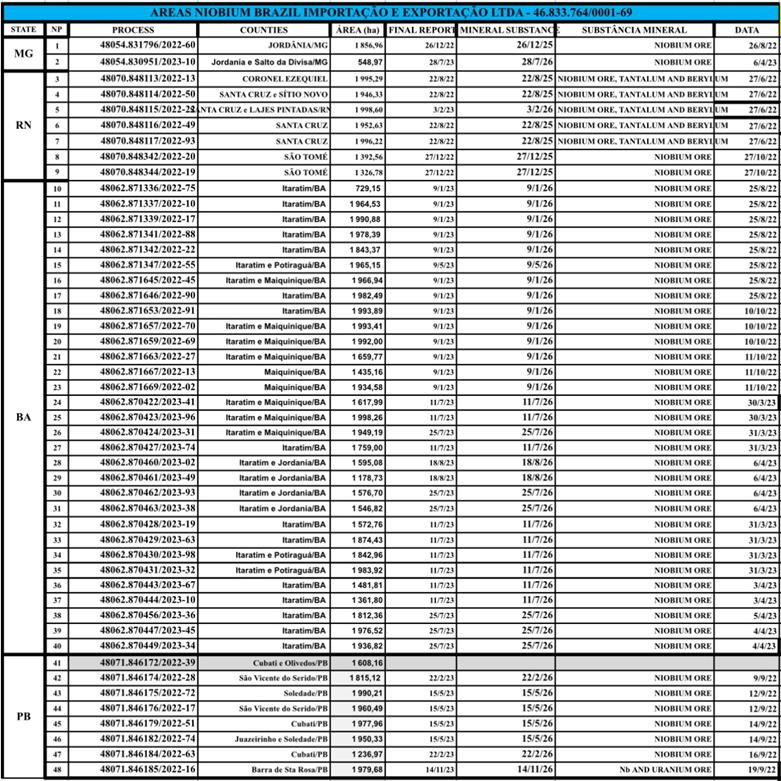
Exhibit II
Acknowledgement Agreement
THIS agreement is made as of , by and between MINERADORA HAVILAH IMPORTAÇÃO E EXPORTAÇÃO LTDA. (the “Royalty Holder”), [Secured Party Name], (the “Secured Party”) and NIOBIUM BRAZIL IMPORTAÇÃO E EXPORTAÇÃO LTDA (the “Company”).
WHEREAS the Company created, granted and conveyed to the Royalty Holder a perpetual royalty in (i) the amount of 3.5% of the Gross Proceeds in respect of the Property, (the “Royalty”), pursuant to a royalty agreement between the Company and the Royalty Holder dated , 2024, a copy of which is attached hereto as Exhibit “A” (as amended, modified, supplemented or restated, the “Royalty Agreement”).
AND WHEREAS the Secured Party, in its capacity as [describe role of the Secured Party and document under which there is indebtedness], as amended, restated, supplemented or replaced from time to time (the “Agreement”), is owed a financial obligation by the Company (the “Obligations”) and is the holder of certain security against the Company (as amended, modified, supplemented, replaced or restated, (the “Security”).
AND WHEREAS the Company has covenanted to provide to the Royalty Holder a letter agreement in substantially the form hereof from any Person to which it grants a mortgage or debenture, encumbrance or other security interest in the Property in favour of the Royalty Holder providing for the acknowledgements and agreements included herein.
NOW THEREFORE for good and valuable consideration, the receipt and sufficiency of which are hereby acknowledged, the parties hereby acknowledge, confirm and agree (knowing that the other parties will be relying upon such acknowledgments, confirmations and agreements) as follows:
| 1. | Capitalized terms used herein which are not otherwise defined herein will have the meanings provided in the Royalty Agreement. In this Agreement, unless something in the subject matter or context is inconsistent therewith: |
“Collateral” means all of the property of the Company and its Affiliates, whether real, personal, or mixed, that is (or is required to be) charged pursuant to the Security to secure the payment and performance of the applicable Obligations; and
“Enforcement Action” means an action under applicable law to:
| (i) | foreclose, execute, levy, or collect on, take possession or control of, sell or otherwise realize upon (judicially or non-judicially), or lease, license, or otherwise dispose of (whether publicly or privately), Collateral, or otherwise exercise or enforce remedial rights with respect to Collateral under any documents related to the Security (including by way of set-off, recoupment notification of a public or private sale or other disposition pursuant to the Personal Property Security Act (British Columbia), appropriation, sale of the assets, realization and any enforcement methods under applicable law, notification to account debtors, notification to depositary banks under deposit account control agreements, or exercise of rights under landlord consents, if applicable); |
| (ii) | receive a transfer of Collateral in satisfaction of indebtedness or any other obligation secured thereby; |
| (iii) | otherwise enforce a security interest or exercise another right or remedy, as a secured creditor or otherwise, pertaining to the Collateral at law, in equity, or pursuant to any documents related to the Security (including the commencement of applicable legal proceedings or other actions with respect to all or any portion of the Collateral to facilitate the actions described in the preceding clauses, and exercising voting rights in respect of equity interests comprising Collateral); or |
| (iv) | effect the disposition of Collateral by any of the Company or its Affiliates after the occurrence and during the continuation of an event of default under any agreement between the Company and the Secured Party with the consent of any senior secured parties; |
“Insolvency Proceeding” means (i) any dissolution, bankruptcy, receivership, winding up, liquidation, reorganization or other similar proceedings in respect of the Company or any of its Affiliates (whether voluntary or involuntary) or its property, assets and undertakings, (ii) any proposal, compromise or arrangement made by the Company or any of its Affiliates under applicable bankruptcy, insolvency and creditors’ arrangement legislation, or (iii) the appointment or making of an application to a court for an order appointing a trustee, receiver or receiver-manager of the Company or any of its Affiliates.
| 2. | The Secured Party: |
| (a) | acknowledges the following, and agrees that in any Enforcement Action or Insolvency Proceeding, or any other proceeding, it will not take any position or action that is inconsistent with the following: |
| (i) | the existence of the Royalty; |
| (ii) | the Royalty is intended to run with the land and constitute the grant of a vested present interest in the Property and a covenant running with the Property and all successions thereof, whether created privately or through government action, and is binding upon the Company and its successors and assigns of the Property, or any portion thereof or interest therein; |
| (iii) | the Royalty will attach to any amendments, relocations or conversions of any mining claim, license, lease, concession, permit, patent or other tenure comprising the applicable Property, or to any extension or renewal thereof or to any replacement or substitution therefor; and |
| (iv) | the Secured Party’s right, title and interest in the Collateral (and the right of any transferee or assignee of such interest) is subject to the Royalty and rights of the Royalty Holder under the Royalty Agreement; |
| (b) | agrees that the Royalty and any property of the Company to the extent comprising the Royalty are not subject to the Security; |
| (c) | acknowledges and agrees that all payments due to the Company on account of the Royalty will become the property of the Royalty Holder at the time of production of the Product on the applicable Property and will be held by the Company in trust for the Royalty Holder until paid to the Royalty Holder; |
| (d) | agrees that the Security will not be sold, assigned, transferred or otherwise disposed of unless the Person to whom the Security is sold, assigned, transferred or otherwise disposed of has executed and delivered to the Royalty Holder an agreement in favour of the Royalty Holder substantially in the form hereof; |
| (e) | agrees not to take any action to prevent the Company or any of its Affiliates from performing its obligations under the Royalty Agreement, including the payment of the Royalty; |
| (f) | agrees, in connection with any enforcement of or realization upon the Security, not to permit, seek to effect or consent to any conveyance of all or any portion of the Property unless the purchaser or transferee (the “Transferee”) of such Property has first entered into an agreement, in form and substance satisfactory to the Royalty Holder, to be bound by the Royalty Agreement (and, if such Transferee is a subsidiary of any Person, the Company, for itself and on behalf of its Affiliates, and the Secured Party shall use their commercially reasonable efforts to cause the Person which ultimately controls such Transferee to provide a guarantee of such Transferee’s obligations in form and substance satisfactory to the Royalty Holder, acting reasonably) or become so bound by operation of law and such interest in the Property shall be otherwise subject to the terms and conditions in this Agreement and the Royalty Agreement; |
| (g) | will not seek nor support any Person in seeking (and will not seek or support the appointment of a receiver that seeks) any conveyance of all or any portion of the Property free and clear of the Royalty; and |
| (h) | will not vote in favour of, seek or support any restructuring plan or proposal, or otherwise make or support any claim in any Insolvency Proceeding or otherwise vote in favour of, initiate, seek or support a position, plan, proposal or claim, that: |
| (i) | purports to eliminate or modify the Royalty or the Royalty Agreement without the express written consent of the Royalty Holder; |
| (ii) | contests, challenges or brings into question the validity or enforceability of the Royalty as an interest in land, and specifically, in and to the Property; |
| (iii) | purports to convey all or any portion of the Property free and clear of the Royalty; or |
| (iv) | contests, challenges or brings into question the validity or enforceability of all of the terms, covenants, and conditions in the Royalty Agreement as running with and binding upon the Property and the estates affected thereby, subject to the terms and conditions of the Royalty Agreement. |
| 3. | The Company, for itself and on behalf of its Affiliates, and the Secured Party acknowledge and agree that the Royalty and the rights under the Royalty Agreement shall survive the repayment in full of the Obligations and the discharge of the Security. |
| 4. | To the extent that all or any part of the Royalty and/or Royalty Agreement is assigned or transferred by the Royalty Holder to another Person that is not a party to this Agreement, the Company, for itself and on behalf of its Affiliates, and the Secured Party agree to provide the assignee or transferee with an agreement in favour of the assignee or transferee that contains substantially the same terms and conditions as set out in this Agreement. |
| 5. | The Royalty Holder agrees not to accept or require any security interest, mortgage, debenture, pledge, hypothec, assignment (as security), deposit arrangement, lien, charge, title retention, consignment, lease or other security agreement or similar arrangement as security for all or any of its royalty obligations under the Royalty respectively, other than in accordance with and as permitted by, the express terms of the Royalty Agreement. For greater certainty, the registration or recordation of any document or agreement evidencing the Royalty, including the Royalty Agreement, respectively, shall not contravene this Section 5. |
| 6. | Each party hereto represents and warrants that it has full authority to deliver this agreement. |
| 7. | This agreement shall be governed by and construed in accordance with the laws of the Province of British Columbia and the federal laws of Canada applicable therein. |
| 8. | This agreement may be executed in any number of counterparts, each of which is deemed an original, but all of which together are deemed to be one and the same agreement. A signed copy of this agreement delivered by e-mail or other means of electronic transmission is deemed to have the same legal effect as delivery of an original signed copy of this agreement. |
| 9. | This agreement constitutes the sole and entire agreement of the parties with respect to the subject matter contained herein, and supersedes all prior and contemporaneous understandings, agreements, representations and warranties, both written and oral, with respect to such subject matter. |
[Remainder of Page Intentionally Left Blank]
DATED this day of ______________, 20___.
| [SECURED PARTY] | ||
| Per: | ||
| Name: | ||
| Title: | ||
| MINERADORA HAVILAH IMPORTAÇÃO E EXPORTAÇÃO LTDA. | ||
| Per: | ||
| Name: |
| |
| Title: | ||
Address for notices hereunder: | ||
| NIOBIUM BRAZIL IMPORTAÇÃO E EXPORTAÇÃO LTDA | ||
| Per: | ||
| Name: | ||
| Title: | ||
Exhibit “A”
ROYALTY PURCHASE AGREEMENT
BETWEEN
MINERADORA HAVILAH IMPORTAÇÃO E EXPORTAÇÃO LTDA.
AND
NIOBIUM BRAZIL IMPORTAÇÃO E EXPORTAÇÃO LTDA
Table of Contents
| Article 1 | Interpretation | 1 |
| 1.1 | Definitions | 1 |
| 1.2 | Interpretation | 4 |
| 1.3 | Schedules | 5 |
| Article 2 | Representations and Warranties | 5 |
| 2.1 | Representations and Warranties of Buyer | 5 |
| 2.2 | Representations and Warranties of Seller | 6 |
| Article 3 | Sale of Royalty | 7 |
| 3.1 | Sale of Royalty | 7 |
| 3.2 | Registration of Royalty | 8 |
| Article 4 | Closing | 8 |
| 4.1 | Date and Place of Closing | 8 |
| 4.2 | Seller Closing Deliveries | 8 |
| 4.3 | Buyer Closing Deliveries | 8 |
| 4.4 | Closing Conditions in Favour of Buyer | 9 |
| 4.5 | Closing Conditions in Favour of Seller | 9 |
| Article 5 | Responsibility for Taxes | 10 |
| 5.1 | Payment of Taxes on Sale and Grant | 10 |
| 5.2 | Indemnity | 10 |
| 5.3 | Cooperation | 10 |
| Article 6 | Confidentiality | 10 |
| 6.1 | Confidentiality | 10 |
| 6.2 | Announcements | 11 |
| Article 7 | Miscellaneous | 12 |
| 7.1 | Legal and Other Fees and Expenses | 12 |
| 7.2 | Notices | 12 |
| 7.3 | Governing Law | 13 |
| 7.4 | Other Activities and Interests | 13 |
| 7.5 | No Partnership | 13 |
| 7.6 | Severability | 13 |
| 7.7 | Entire Agreement | 13 |
| 7.8 | Time of the Essence | 13 |
| 7.9 | Further Assurances | 14 |
| 7.10 | Amendment | 14 |
| 7.11 | Waiver | 14 |
| 7.12 | Assignment | 14 |
| 7.13 | Successors and Assigns | 14 |
| 7.14 | Counterparts | 14 |
| 7.15 | Execution | 14 |
| Schedule A FORM OF ROYALTY AGREEMENT | 1 | |
THIS ROYALTY PURCHASE AGREEMENT
BETWEEN:
MINERADORA HAVILAH IMPORTAÇÃO E EXPORTAÇÃO LTDA., a business company incorporated in Brazil and registered with the CNPJ No. 46.168.638/001-37.;
(“Buyer”)
AND:
NIOBIUM BRAZIL IMPORTAÇÃO E EXPORTAÇÃO LTDA, a sole proprietorship limited company, with registered office at Estrada Caiçara, km. 13, s/nº, Anexo Fazenda Quati, Anexo Santo Antônio, Anexo Pedra Petra; Zona Rural; Itapuranga - GO, CEP 76.680-000, registered with the CNPJ/ME under No. 46.833.764/0001-69;
(“Seller”)
WHEREAS Seller wishes to sell and grant to Buyer, and Buyer wishes to purchase from Seller, the Royalty (as hereinafter defined) on the terms and subject to the conditions set out herein (the “Transaction”).
NOW THEREFORE THIS AGREEMENT WITNESSES that in consideration of the recitals and of the mutual covenants and agreements hereinafter contained, the Parties agree as follows:
Article 2
Interpretation
| 2.1 | Definitions |
Unless the context otherwise requires, in this Agreement:
“Agreement” means this royalty purchase agreement, including the Schedules hereto, as amended or supplemented from time to time.
“Authorization” means any authorization, approval, consent, concession, exemption, license, lease, grant, permit, franchise, right (including surface rights, access rights, rights of way, privileges, concessions or franchises granted to or held by Seller by, or required to be obtained from, any Person (including a Governmental Body), for the exploration of the Property or the construction, development and operation of the Project), privilege or no-action letter from any Governmental Body having jurisdiction with respect to any specified Person, property, transaction or event, or with respect to any of such Person’s property or business and affairs (including any zoning approval, mining permit, development permit or building permit) or from any Person in connection with any easements, contractual rights or other matters, but in each case excludes the Property.
“Business Day” means any day other than a Saturday, Sunday or any statutory holiday in Sao Paulo, Brazil and Saint Vincent and the Grenadines.
“Closing” has the meaning ascribed thereto in Section 4.1.
“Closing Date” has the meaning ascribed thereto in Section 4.1.
“Confidential Information” has the meaning ascribed thereto in Section 6.1(a).
“Effective Date” means the date of this Agreement.
“Encumbrance” means, whether or not registered or registrable or recorded or recordable, and regardless of how created or arising, any mortgage, deed of trust, charge, pledge, hypothecation, security interest, priority or other security agreement, assignment, deposit arrangement, lien (statutory or otherwise), title retention agreement or arrangement, conditional sale, option, license or license fee, royalty, claim, production payment, restrictive covenant, preferential arrangement or other encumbrance of any nature or any agreement to give or create any of the foregoing.
| 2 |
“Governmental Body” means any federal, provincial, state, territorial, regional, municipal, local government or authority, quasi government authority, fiscal or judicial body, government or self-regulatory organization, commission, board, tribunal, organization, securities regulator, stock exchange or any regulatory, administrative or other agency, or any political or other subdivision, department, or branch of any of the foregoing including any indigenous or native body (or both, as the case may be) exercising governance powers by right, title or custom.
“IFRS” means the International Financial Reporting Standards adopted by the International Accounting Standards Board from time to time.
“Insolvent” will have a correlative given in the definition of “Solvent”.
“Law” includes:
| (a) | any national, federal, provincial, territorial, regional, municipal, or local statute, law, by law, rule, regulation, code, ordinance; |
| (b) | any judgment, decree, writ, administrative interpretation, guideline, policy, injunction, order or the like, of any Governmental Body; |
| (c) | common law or equity; and |
| (d) | any Governmental Body standard, protocol, order, requirement, registration, certificate, permit, license, approval or consent (including conditions in respect of any standard, protocol, order, requirement, registration, certificate, permit, license, approval or consent). |
“Mineral Rights” means any fee title, unpatented mining claim, patented mining claim, exploration license, mining lease, mining license, mineral claim, mining concession and other forms of mineral tenure (including any application for the grant or issue of any of the foregoing) or other rights to Minerals, or to work upon lands for the purpose of searching for, developing or extracting Minerals under any form of mineral title recognized under applicable Law, whether contractual, statutory or otherwise.
“Minerals” means all ores, solutions and concentrates or metals derived from them, containing precious, base and industrial minerals which are found in, on or under the Property and may lawfully be explored for, mined and sold under the Mineral Rights and other instruments of title under which the Property is held.
“Notice” has the meaning ascribed thereto in Section 7.2.
“Other Rights” means any interest in real property, whether freehold, leasehold, license, right of way, easement, any other surface or other right in relation to real property, and any right, license or permit in relation to the use or diversion of water, but excluding any Mineral Rights;
“Parties” means Buyer and Seller and “Party” means any one of them.
“Permitted Encumbrance” means:
| (a) | any undetermined or inchoate lien or prior claim or any like lien or right of set-off arising in the ordinary course of business or under Law, securing obligations incurred in connection with the Property which are not yet overdue or which are being contested or litigated in good faith; |
| (b) | any Encumbrance for taxes, assessments or governmental charges not yet due or being contested in good faith (but only so long as such contest does not result in any sale, loss or forfeiture of the Property and, where applicable Law requires such amounts to be paid while being contested, such amounts have been paid); |
| (c) | any Encumbrance incurred or deposit made in the ordinary course of business in connection with workers’ compensation, unemployment insurance or other forms of governmental insurance or benefits; |
| 3 |
| (d) | any builders’, mechanics’, materialman’s, miners’, carriers’, warehousemen’s and landlords’ liens and privileges, in each case, which relate to obligations not yet due or delinquent, or which Seller is contesting in good faith by appropriate proceeding and in respect of which reserves have been established in accordance with IFRS; |
| (e) | any right reserved to or vested in any Governmental Body by the terms of any lease, license, franchise, grant, claim or permit held or acquired by Seller, or by any statutory provision, to terminate the lease, license, franchise, grant, claim or permit to purchase assets used in connection therewith or to require annual or other periodic payments as a condition of the continuance thereof; |
| (f) | any Encumbrance created or assumed by Seller in favor of a public utility or Governmental Body when required by the public utility or Governmental Body in connection with the operations of Seller that do not in the aggregate materially detract from the value of any of the Property or impair their use in the operation of the business of Seller; |
| (g) | any reservations, limitations, provisos and conditions expressed in original grants from any Governmental Body or the term of any lease from any Governmental Body; |
| (h) | any applicable municipal by-laws, official plans, building code requirements or other restrictions by a Governmental Body affecting the use of land or the nature of any structures which may be erected thereon; |
| (i) | any minor encumbrance, such as easements, rights-of-way, servitudes or other similar rights in land granted to or reserved by other Persons, rights-of-way for sewers, electric lines, telegraph and telephone lines, oil and natural gas pipelines and other similar purposes, or zoning or other restrictions applicable to the use of real property by Seller, or title defects, encroachments or irregularities, that do not detract from the operation or development of the Project in any material respect; |
| (j) | any Encumbrance consented to, agreed to or approved by Buyer in writing; and |
| (k) | any Encumbrance in favor of any Governmental Body that relates to securing any reclamation obligation and the reclamation obligation itself. |
“Person” means any individual, legal personal representative, corporation, body corporate, firm, partnership, trust, trustee, syndicate, joint venture, unincorporated organization or Governmental Body.
“Personnel” means, at the relevant time, in relation to a Party, any of its (or any Affiliates’) directors, officers or employees.
“Project” means the Itarantim Project in Brazil, which is owned by Seller and includes the Property, and includes the exploration, mining, development, production, processing, recovery, sale, transportation, storage and delivery operations and assets and infrastructure related thereto.
“Property” has the meaning set out in the Royalty Agreement and listed in Exhibit I thereto.
“Property Rights” has the meaning ascribed thereto in Section 2.2(h).
“Purchase Price” means $500,000.
“Royalty” means the royalty payable under the Royalty Agreement, which shall be granted by Seller to Buyer at Closing.
“Royalty Agreement” means the Royalty Agreement attached hereto as Schedule A.
“Royalty Documents” means this Agreement, the Royalty Agreement and any documents executed and delivered under any of the foregoing.
“Solvent” means, when used with respect to a Person, that:
| (a) | the fair saleable value of the assets of such Person is in excess of the total amount of the current value of its liabilities (including for purposes of this definition all liabilities (including loss reserves), whether or not reflected on a balance sheet prepared in accordance with IFRS and whether direct or indirect, fixed or contingent, secured or unsecured, disputed or undisputed); |
| 4 |
| (b) | such Person is able to pay its debts or obligations in the ordinary course as they mature; |
| (c) | such Person has capital sufficient to carry on its business; and |
| (d) | such Person is not otherwise insolvent as defined by any applicable Law; |
and “Insolvent” will have a correlative meaning.
“Taxes” means all taxes, levies and charges of any kind or nature whatsoever imposed or collected by or on behalf of any Governmental Body including corporation income taxes, capital taxes, realty taxes (including utility charges which are collectible like realty taxes), net proceeds of mines tax, mining taxes and royalties, privilege taxes, excise taxes, business taxes, property transfer taxes, taxes charged on any measure of income or revenue, goods & services tax, harmonized sales tax, turnover, or value added taxes of any nature or kind and any other taxes charged on, or in respect of, the sale or transfer of goods and property of any kind, customs duties, payroll taxes, levies, stamp taxes, royalties, taxes charged on royalties received by royalty recipients, duties, and all fees, including claim fees, deductions, compulsory loans and withholdings imposed, levied, collected, withheld or assessed as of the Effective Date or at any time in the future, by or on behalf of any Governmental Body of any jurisdiction whatsoever having power to tax, together with penalties, fines, additions to tax and interest thereon.
“Transaction” has the meaning ascribed thereto in the recitals.
| 2.2 | Interpretation |
Unless the context otherwise requires, in this Agreement:
| (a) | the singular includes the plural and conversely; |
| (b) | a gender includes all genders; |
| (c) | if a word or phrase is defined, its other grammatical forms have a corresponding meaning; |
| (d) | a reference to an Article, Section, schedule or annexure is a reference to an article, section of or a schedule or annexure to this Agreement; |
| (e) | a reference to an agreement or document (including a reference to this Agreement) is to the agreement or document as amended, varied, supplemented, novated or replaced except to the extent prohibited by this Agreement or that other agreement or document; |
| (f) | a reference to a party to this Agreement or another agreement or document includes the party’s successors and permitted substitutes (including persons taking by novation) or assigns (and, where applicable, the Party’s legal personal representatives); |
| (g) | a reference to legislation or to a provision of legislation includes a modification or re-enactment of it, a legislative provision substituted for it and a regulation, code, by-law, ordinance or statutory instrument issued under it; |
| (h) | a reference to dollars and $ is to United States currency; |
| (i) | the word “including” means “including without limitation” and “include” and, “includes” will be construed similarly; |
| (j) | headings and any table of contents or index are for convenience only and do not form part of this Agreement or affect its interpretation; |
| 5 |
| (k) | a provision of this Agreement must not be construed to the disadvantage of a Party merely because that Party was responsible for the preparation of this Agreement or the inclusion of the provision in this Agreement; |
| (l) | if an act must be done on a specified day which is not a Business Day, it must be done instead on the next Business Day; |
| (m) | reference to a body, other than a Party (including, without limitation, an institute, association or authority), whether statutory or not: |
| (i) | which ceases to exist; or |
| (ii) | whose powers or functions are transferred to another body, |
| (n) | is a reference to the body which replaces it or which substantially succeeds to its powers or functions; |
| (o) | where a phrase “to the knowledge of” or similar expressions are used in this Agreement, it is a requirement that the person in respect of whom the phrase is used must have made the enquiries that are reasonably necessary to enable that person to make the statement or disclosure; and |
| (p) | a reference to any thing (including a right, obligation or concept) includes a part of that thing, but nothing in this Section 1.2(p) implies that performance of part of an obligation constitutes performance of the obligation. |
| 2.3 | Schedules |
The following are the Schedules annexed hereto and incorporated by reference and deemed to be part to this Agreement:
Schedule A − Form of Royalty Agreement
Article 3
Representations and Warranties
| 3.1 | Representations and Warranties of Buyer |
Buyer represents and warrants to Seller that:
| (a) | it is a corporation duly incorporated, validly existing and in good standing under the Laws of its jurisdiction of incorporation; |
| (b) | it has the necessary corporate capacity, power and authority to execute and deliver Royalty Documents and to observe and perform its covenants and obligations under the Royalty Documents; |
| (c) | has taken all necessary corporate action in respect of the Royalty Documents, and this Agreement constitutes, and the Royalty Agreement (when executed) will constitute, a legal, valid and binding agreement of Buyer enforceable against Buyer in accordance with their respective terms, subject to applicable bankruptcy, insolvency, reorganization, and other Laws of general application limiting the enforcement of creditors’ rights generally; |
| (d) | neither this Agreement nor the completion of the transactions contemplated hereby conflicts, or will conflict, or will result in a breach or violation of, any Law of any kind whatsoever applicable to Buyer, any constating documents of Buyer, or any agreement of any kind whatsoever to which Buyer is a party or by which Buyer is bound; and |
| 6 |
| (e) | it is not required to give any notice to, make any filing with or obtain any Authorization of any Person in connection with the execution and delivery of this Agreement or the consummation of the transactions contemplated herein, except, in each case, as would not have a material adverse effect on its ability to perform its obligations under this Agreement. |
The representations and warranties contained in Section 2.1 are provided for the exclusive benefit of Seller, and a breach of any one or more thereof may be waived by Seller in whole or in part at any time without prejudice to its rights in respect of any other breach of the same or any other representation or warranty. Buyer further agrees that, on the Closing Date, it shall be representing and warranting that the foregoing representations and warranties are true and correct as at the Closing Date with the same force and effect as if they had been made by Buyer at Closing and that they shall not merge on the execution of this Agreement and shall continue and survive for a period of two (2) years from the Closing Date.
| 3.2 | Representations and Warranties of Seller |
Seller represents and warrants to Buyer that:
| (a) | it is a corporation duly incorporated, validly existing and in good standing under the Laws of its jurisdiction of incorporation; |
| (b) | it has the necessary corporate capacity, power and authority to execute and deliver Royalty Documents, to observe and perform its covenants and obligations under the Royalty Documents and to own and lease its assets and carry on its business |
| (c) | has taken all necessary corporate action in respect of the Royalty Documents, and this Agreement constitutes, and the Royalty Agreement (when executed) will constitute, a legal, valid and binding agreement of Seller enforceable against Seller in accordance with their respective terms, subject to applicable bankruptcy, insolvency, reorganization, and other Laws of general application limiting the enforcement of creditors’ rights generally; |
| (d) | neither this Agreement nor the completion of the transactions contemplated hereby conflicts, or will conflict, or will result in a breach or violation of, any Law of any kind whatsoever applicable to Seller, any constating documents of Seller, or any agreement of any kind whatsoever to which Seller is a party or by which Seller is bound; |
| (e) | neither Seller nor any of its respective Affiliates is required to give any notice to, make any filing with or obtain any Authorization of any Person in connection with the execution, delivery or performance of the obligations of Seller under this Agreement or the consummation of the transactions contemplated herein; |
| (f) | Seller is Solvent and will not be rendered Insolvent by the execution and delivery of this Agreement or the completion of the Transaction; |
| (g) | there are no material actions, suits, investigations, claims or proceedings pending or, to Seller’s knowledge, threatened against or directly affecting Seller or the Property, by or before any Governmental Body; |
| (h) | Seller: |
| (i) | is the 100% legal and beneficial owner of, and has full and exclusive possession of, good and marketable title to or a valid leasehold interest in all of its Mineral Rights comprising the Property and the material property, Mineral and other rights or interests relating thereto, |
| 7 |
| (ii) | has good and marketable possessory and record title to all unpatented mining claims included within the Property, and |
| (iii) | is the sole registered and beneficial holder of the Other Rights and other Authorizations in respect of the Project |
(collectively, the “Property Rights”), free of all Encumbrances (other than Permitted Encumbrances), and no other material property rights or interests are necessary for the conduct of the exploration business of Seller in respect of the Project, as currently conducted. To Seller’s knowledge, there is no material claim or any basis for a material claim that might or could reasonably be expected to adversely affect its right to use, transfer or otherwise exploit the Property Rights; and Seller has no current responsibility or obligation to pay any outstanding material commission, royalty, license fee or similar payment to any person with respect to the Project and the Property Rights thereof except pursuant to applicable Law and Permitted Encumbrances;
| (i) | all Mineral Rights and Other Rights pursuant to which Seller derives its interests in the Property are in good standing and there has been no material default under any such Mineral Rights or Other Rights and all taxes required to be paid with respect to such properties to the date hereof have been paid. The Property (or any interest therein, or right to earn an interest therein) is not subject to any right of first refusal or purchase or acquisition right; |
| (j) | no other entity or person claims any title to or holds possession of any area covered by the Property or any interest in the Property itself and, to the best of Seller’s knowledge, there is no basis for any such claim or interest; and |
| (k) | Seller has conducted and will continue to conduct its activities on and in respect of the Property in compliance with all applicable Laws in all respects and there are no environmental or community-related aspects that shall restrain the Project from being implemented such as specially protected areas, traditional communities (indigenous or otherwise) and land distribution areas (INCRA). |
The representations and warranties contained in Section 2.2 are provided for the exclusive benefit of Buyer and a breach of any one or more thereof may be waived by Buyer in whole or in part at any time without prejudice to it rights in respect of any other breach of the same or any other representation or warranty. Seller further agree that, on the Closing Date, it shall be representing and warranting that the foregoing representations and warranties are true and correct as at the Closing Date with the same force and effect as if they had been made by Seller at Closing and that they shall not merge on the execution of this Agreement and shall continue and survive for a period of two (2) years from the Closing Date.
Article 4
Sale of Royalty
| 4.1 | Sale of Royalty |
In consideration for the promises and covenants of Seller contained in this Agreement, including the sale and grant of the Royalty and obligation to make the Royalty payments, Buyer hereby agrees, subject to the satisfaction or waiver of the conditions set forth in Section 4.4, as applicable, to pay to Seller the Purchase Price inclusive of all applicable Taxes, in cash by wire transfer of immediately available funds to a bank account in the name of Seller in its country of incorporation notified to Buyer at least three Business Days prior to the date of the applicable payment.
| 8 |
| 4.2 | Registration of Royalty |
To evidence the grant of the Royalty, Seller will, upon request by Buyer, sign and deliver to Buyer, and Buyer may register or otherwise record (or require Seller to register or otherwise record), including with the Registry of Titles and Deeds of Goiás and any other applicable jurisdiction in Brazil against the Property, this Agreement or a notice of this Agreement, and any other similar document or documents as Buyer may request that will have the effect of giving notice of the existence of the Royalty to third Persons and protecting Buyer’s right to receive the Royalty and other amounts that may be payable pursuant to the Royalty Agreement. Seller hereby consents to such registering or recording and agrees to co-operate with Buyer to accomplish the same. If the National Mining Agency (ANM) issues new ordinances, resolutions or rules pertaining to annotations or registrations of contracts or similar encumbrances over the Property, the Seller, upon receipt of written request by the Buyer, shall promptly and within no more than thirty (30) days take any action necessary to produce annotations or registrations of this Agreement with the ANM as so permitted.
Article 5
Closing
| 5.1 | Date and Place of Closing |
The closing for the grant and conveyance of the Royalty and for the payment of the Purchase Price (the “Closing”) will be completed electronically on the third Business Day after the conditions set forth in Sections 4.4 and 4.5 have been satisfied or waived (other than conditions which by their nature can only be satisfied at Closing and are expected to be satisfied at Closing, such as, without limitation, the delivery of the Purchase Price and certificates), unless another place, time or date is agreed to in writing by the Parties (such date, the “Closing Date”).
| 5.2 | Seller Closing Deliveries |
At the Closing, Seller shall deliver to Buyer:
| (a) | a certificate for Seller executed by a senior officer of Seller, confirming the matters set forth in Section 4.4(b); |
| (b) | the Royalty Agreement duly executed by Seller; and |
| (c) | such further and other documents as may be reasonably required by Buyer and its counsel in order to complete the Transaction. |
| 5.3 | Buyer Closing Deliveries |
At the Closing, Buyer shall deliver to Seller:
| (a) | a certificate executed by a senior officer of Buyer, confirming the matters set forth in Section 4.5(b); |
| (b) | the Royalty Agreement duly executed by Buyer; |
| (c) | the Purchase Price, delivered in the manner provided by Section 3.1; and |
| 9 |
| (d) | such further and other documents as may be reasonably required by Seller and its counsel in order to complete the Transaction. |
| 5.4 | Closing Conditions in Favour of Buyer |
The conditions to Closing in favour of Buyer are as follows:
| (a) | delivery of the items in Section 4.2 has occurred; |
| (b) | as of the Closing Date: |
| (i) | all of the representations and warranties made by Seller in this Agreement as of the Effective Date are true and correct in all material respects (or true and correct in all respects in the case of representations and warranties that are qualified by materiality) on and as of the Closing Date as if made on such date; |
| (ii) | Seller has performed in all material respects all of its respective obligations hereunder required to be performed on or prior to the Closing Date; |
| (iii) | Seller obtaining all other necessary third party consents to the dealings with the Property contemplated by this Agreement including any consent or approval that is required under applicable Law, by virtue of a condition or covenant of any mineral rights forming part of the Property or by the terms of any material agreements; and |
| (iv) | Seller will have delivered to Buyer a certificate dated as of the Closing Date of a senior officer confirming the foregoing; and |
| (c) | no provision of any applicable Law or any action by any Governmental Body having competent jurisdiction will prohibit the Closing or adversely affect in any material respect Buyer’s rights, obligations or benefits under this Agreement, and no judgment, injunction, order or decree issued by any Governmental Body having competent jurisdiction will prohibit the Closing or adversely affect in any material respect Buyer’s rights, obligations or benefits under this Agreement. |
The conditions in this Section 4.4 are for the benefit of Buyer and cannot be waived or extended unless agreed in writing by Buyer.
| 5.5 | Closing Conditions in Favour of Seller |
The conditions to Closing in favour of Seller are as follows:
| (a) | delivery of the items in Section 4.3 has occurred; |
| (b) | as of the Closing Date: |
| (i) | all of the representations and warranties made by Buyer in this Agreement as of the Effective Date are true and correct in all material respects (or true and correct in all respects in the case of representations and warranties that are qualified by materiality) on and as of the Closing Date as if made on such date except as would not have a material adverse effect on the ability of Buyer to perform its obligations under this Agreement; |
| (ii) | Buyer has performed in all material respects all of its obligations hereunder required to be performed on or prior to the Closing Date; and |
| 10 |
| (iii) | Buyer will have delivered to Seller a certificate dated as of the Closing Date of a senior officer, in form and substance satisfactory to Seller acting reasonably, confirming the foregoing; |
| (c) | as of the Closing Date, Seller obtaining all other necessary third party consents to the dealings with the Property contemplated by this Agreement including any consent or approval that is required under applicable Law, by virtue of a condition or covenant of any mineral rights forming part of the Property or by the terms of any material agreements; and |
| (d) | no provision of any applicable Law or any action by any Governmental Body having competent jurisdiction will prohibit the Closing or adversely affect in any material respect Seller’s rights, obligations or benefits under this Agreement, and no judgment, injunction, order or decree issued by any Governmental Body having competent jurisdiction will prohibit the Closing or adversely affect in any material respect Seller’s rights, obligations or benefits under this Agreement. |
The conditions in this Section 4.5 are for the benefit of Seller and cannot be waived or extended unless agreed in writing by Seller.
Article 6
Responsibility for Taxes
| 6.1 | Payment of Taxes on Sale and Grant |
Buyer shall be responsible for and shall pay when due:
| (a) | all registration, filing, recording and transfer fees payable in connection with the sale and grant to Buyer of the Royalty; and |
| (b) | all Taxes that may be payable or assessed by any Governmental Body, including any interest and penalty thereon, applicable to or resulting from Transaction or the sale and grant to Buyer of the Royalty, including any Taxes directly or indirectly imposed on Seller (except for any corporate income taxes due by Seller on receiving payment of the Purchase Price). |
| 6.2 | Indemnity |
Buyer hereby indemnifies and saves Seller harmless from any Taxes directly or indirectly imposed on Seller. This Section 5.2 shall survive the expiry or early termination of this Agreement.
| 6.3 | Cooperation |
The Parties agree to reasonably cooperate to (i) ensure that no more Taxes, duties or other charges are payable other than as required under applicable Law, and (ii) obtain a refund or credit of any Taxes which have been overpaid.
Article 7
Confidentiality
| 7.1 | Confidentiality |
| (a) | Subject to Section 3.2 and 6.1(b), each Party covenants with the other Party that it will keep confidential the terms of the Royalty Documents and all information (whether in tangible, electronic or other form) provided or disclosed by another Party by reason of the operation of this Agreement, including any information regarding a Party’s Affiliates (“Confidential Information”). |
| 11 |
| (b) | Each Party undertakes that neither it, its Affiliates nor their respective Personnel will, without the prior written consent of the disclosing Party (or, in the case of disclosure of any of the Royalty Documents, the consent of the other Party), disclose any Confidential Information to any third Person unless: |
| (i) | the disclosure is expressly permitted by this Agreement or another Royalty Document, as applicable; |
| (ii) | subject to Section 6.1(c), the disclosure consists of information required to be disclosed under applicable Laws relating to disclosure by such Party; |
| (iii) | the information is already in the public domain (unless it entered the public domain because of a breach of this Section 6.1 by the Party); |
| (iv) | the disclosure is made on a confidential basis to the Party’s officers, employees, agents, financiers, professional advisers or potential transferees of the Royalty and/or Property, and is necessary for the Party’s business or any potential transaction that such Party wishes to negotiate or complete, provided that in all such cases such Party will be liable to the other Party for any breach of the confidentiality obligations set out herein by any such Person; |
| (v) | the disclosure is necessary to comply with any applicable Law, or an order of a court or tribunal; |
| (vi) | subject to Section 6.1(c), the disclosure is necessary for a Party or its Affiliates to comply with a directive or request of any Governmental Body (whether or not having the force of law) so long as a responsible person in a similar position would comply; |
| (vii) | subject to Section 6.1(c), the disclosure is necessary or desirable to obtain an authorization from any Governmental Body; |
| (viii) | the disclosure is necessary in relation to any discovery of documents, or any proceedings before an arbitrator, court, tribunal, other Governmental Body; or |
| (ix) | the disclosure is made on a confidential basis to a prospective assignee, purchaser, acquiror or financier of the Party, or to any other person who proposes to enter into contractual relations with the Party and agrees to keep the disclosure confidential in accordance with this Section 6.1. |
| (c) | Before disclosing any Confidential Information publicly in accordance with Section 6.1(b)(ii) or to a Governmental Body or securities regulator in accordance with Sections 6.1(b)(vi) or 6.1(b)(vii), the disclosing Party must, to the extent permitted by applicable Law, provide the other Party with a draft of the proposed disclosure for its consideration and comment. The other Party will provide any comments promptly. |
| 7.2 | Announcements |
The Parties shall jointly plan and co-ordinate, and shall cause their respective Affiliates to jointly plan and coordinate, any public notices, press releases, and any other publicity concerning the entering into of this Agreement and none of the Parties or its Affiliates shall act in this regard without reasonable prior consultation with the other Party, unless such disclosure is required to meet timely disclosure obligations of such Party or its Affiliates under applicable Laws in circumstances where prior consultation with the other Party is not practicable, and a copy of such disclosure shall be provided to the other Party at such time as it is made publicly available.
| 12 |
Article 8
Miscellaneous
| 8.1 | Legal and Other Fees and Expenses |
Except as otherwise provided for in this Agreement and subject to the following provisions of this Section 7.1, all costs and expenses incurred by a Party shall be for its own account.
| 8.2 | Notices |
All notices, requests, demands or other communications required or permitted to be given by a Party to another Party pursuant to this Agreement (a “Notice”) shall be given in writing and delivered by personal service, pre-paid registered mail or email, addressed as follows:
To Buyer:
MINERADORA HAVILAH IMPORTAÇÃO E EXPORTAÇÃO LTDA.
| Attention: | Frank Scolaro | |
| Email: | f.scolaro@internationalminingcorporation.com |
with a copy to (which shall not serve as notice):
Paul Smith
| Email: | ps@ccpag.ch |
To Seller:
NIOBIUM BRAZIL IMPORTAÇÃO E EXPORTAÇÃO LTDA
Estrada
Caiçara, km. 13, s/nº
Anexo Fazenda Quati
Anexo Santo Antônio
Anexo Pedra Petra
Zona Rural; Itapuranga - GO
76.680-000
| Attention: | Joanderson Batista Pereira Araujo |
| Email: | Consultoria.cacto@gmail.com |
subject to any Notice of change of address given in accordance herewith. Any Notice shall be deemed to have been given and received:
| (a) | if personally delivered, then on the day of personal service to the recipient Party, provided that if such date is a day other than a Business Day such Notice shall be deemed to have been given and received on the first Business Day following the date of personal service; |
| (b) | if by pre-paid registered mail, then the first Business Day, after the expiration of five calendar days following the date of mailing; or |
| (c) | if sent by email and successfully transmitted or electronically delivered prior to 5:00 p.m. (Mountain Time) on a Business Day of the recipient Party, then on that Business Day, and if successfully transmitted or electronically delivered after 5:00 p.m. (Mountain Time) on a Business Day of a recipient Party then on the first Business Day following the date of transmission. |
| 13 |
| 8.3 | Governing Law |
| (a) | Except for matters of title to the Property or its assignment or transfer, which will be governed by the Law of its situs, this Agreement is governed by the law in force in the Province of British Columbia and the federal laws of Canada applicable therein without regard to any conflict of laws or choice of laws rules or principles that would permit or require the application of the laws of any other jurisdiction. |
| (b) | Each Party irrevocably submits to the exclusive jurisdiction of the courts exercising jurisdiction in the Province of British Columbia and any court that may hear appeals from any of those courts for any proceeding in connection with this Agreement, subject only to the right to enforce a judgment obtained in any of those courts in any other jurisdiction or to obtain injunction or interim measures in Brazil. |
| 8.4 | Other Activities and Interests |
This Agreement and the rights and obligations of the Parties under this Agreement are limited to the Property. Except as expressly provided in any other written agreement between the Parties with respect to the Property (and then only to the extent expressly provided in that other written agreement), each Party will have the free and unrestricted right to enter into, conduct and benefit from any and all business ventures of any kind whatsoever, whether or not competitive with the activities undertaken under this Agreement, without disclosing such activities to any other Party or inviting or allowing another Party to participate in those activities including activities involving Mineral Rights adjoining the Property (except as specifically contemplated in the Royalty Documents).
| 8.5 | No Partnership |
This Agreement is not intended to, and will be deemed not to, create any partnership between the Parties including a mining partnership or commercial partnership. Except as otherwise provided, the obligations and liabilities of the Parties will be several and not joint and no Party will have or purport to have any authority to act for or to assume any obligations or responsibility on behalf of another Party. Nothing in this Agreement will be deemed to constitute a Party the partner, agent or legal representative of any other Party or to create any fiduciary relationship between the Parties.
| 8.6 | Severability |
If anything in this Agreement is unenforceable, illegal or void then it is severed and the rest of this Agreement remains in force. Where a provision of this Agreement is prohibited or unenforceable, the Parties must negotiate in good faith to replace the invalid provision by a provision which is in accordance with applicable Law and which must be as close as possible to the Parties’ original intent and appropriate consequential amendments (if any) will be made to this Agreement.
| 8.7 | Entire Agreement |
This Agreement constitutes the entire agreement between the Parties in respect of its subject matter and supersedes all prior agreements, understandings, representations, warranties, promises, statements, negotiations, letters and documents in respect of its subject matter (if any) made or given prior to the Effective Date.
| 8.8 | Time of the Essence |
Time is of the essence of this Agreement. If the Parties agree to vary a time requirement, then the time requirement so varied is of the essence of this Agreement. An agreement to vary a time requirement must be in writing.
| 14 |
| 8.9 | Further Assurances |
Each of the Parties shall execute and deliver such further documents and do such further acts and things as may be reasonably required from time to time, either before, on or after the Closing Date, to carry out the full intent and meaning of this Agreement.
| 8.10 | Amendment |
An amendment or variation to this Agreement is not effective unless it is in writing and signed by the Parties.
| 8.11 | Waiver |
A Party’s failure or delay to exercise a power or right does not operate as a waiver of that power or right. The exercise of a power or right does not preclude either its exercise in the future or the exercise of any other power or right. A waiver is not effective unless it is in writing. Waiver of a power or right is effective only in respect of the specific instance to which it relates and for the specific purpose for which it is given.
| 8.12 | Assignment |
Neither this Agreement nor any interest herein shall be assigned, conveyed or otherwise transferred, except:
| (a) | by the Buyer in connection with an assignment, conveyance or other transfer of the Royalty; or |
| (b) | by the Seller in connection with an assignment, conveyance or other transfer of the Property with written consent from the Buyer, which shall not be unreasonably withheld. |
| 8.13 | Successors and Assigns |
This Agreement will inure to the benefit of and be binding on the Parties and their respective successors and permitted assigns.
| 8.14 | Counterparts |
This Agreement may be executed in any number of counterparts, provided that one counterpart shall be executed by both Parties with all required formalities for validity and registration in Brazil. Each counterpart is an original but the counterparts together are one and the same agreement. This Agreement is binding on the Parties on the exchange of counterparts. A copy of a counterpart sent by electronic mail:
| (a) | must be treated as an original counterpart; |
| (b) | is sufficient evidence of the execution of the original; and |
| (c) | may be produced in evidence for all purposes in place of the original. |
| 8.15 | Execution |
| (a) | Each person signing this Agreement as an authorized officer of a Party hereby represents and warrants that he or she is duly authorized to sign this Agreement for that Party and that this Agreement will, upon having been so executed, be binding on that Party in accordance with its terms. |
| (b) | This Agreement is an extrajudicial enforcement title (título executivo extrajudicial) in accordance with Article 784 et. seq. of the Brazilian Civil Procedure Code (Law No. 13.105/2015). Seller hereby acknowledges and agrees that each of the obligations assumed or that may be imputed to it hereunder pursuant to this Agreement are, to the fullest extent permitted by Applicable Law, subject to specific performance in accordance with inter alia Article 497, 806 and 815 of the Brazilian Civil Procedure Code. |
[Remainder of page intentionally left blank. Signature page follows.]
IN WITNESS WHEREOF OF THE TERMS SET OUT HEREIN Buyer and Seller have hereunto set their hands and seals effective as of the effective date first written above.
| MINERADORA HAVILAH IMPORTAÇÃO E EXPORTAÇÃO LTDA. | ||
| By: | ||
| Name: | ||
| Title: | ||
| NIOBIUM BRAZIL IMPORTAÇÃO E EXPORTAÇÃO LTDA | ||
| By: | ||
| Name: | ||
| Title: | ||
| Witnesses (on counterpart for registration in Brazil): | ||
| 1. | ______________ | |
| Name: | ||
| ID: | ||
| 2. | ______________ | |
| Name: | ||
| ID: |
Signature page to Royalty Purchase Agreement
Schedule “A”
FORM OF ROYALTY AGREEMENT
Signature page to Royalty Purchase Agreement
Exhibit 10.5
Exhibit
LOAN AGREEMENT
This Loan Agreement (“Agreement”) is made and entered into as of January 23, 2024 by and between:
Name: FRANCESCO SCOLARO
Address: 1 Place des Moulins, Europa Residence, Monaco
(Hereinafter referred to as the “Lender”)
and
Name: IMC RARE EARTHS LTD (AND ITS SUBSIDIARIES)
Address: Trust House, 112 Bonadie Street, Kingstown, St Vincent and the Grenadines
Company Registration Number: 27069 BC 2024
(Hereinafter referred to as the “Borrower”)
1. Loan Amount and Purpose
1.1 The Lender agrees to loan the Borrower the principal amount of Two Million Five Hundred and Forty Two Thousand Eight Hundred and Thirty Eight United States Dollars (US$2,542,838) (the “Loan”).
1.2 The Loan shall be used exclusively to fund exploration, development, and related operational activities on the Itarantim Project (the “Project”), located in Brazil.
2. Disbursement of Funds
2.1 The Loan shall be disbursed in one or more tranches to the Borrower’s designated bank account and or for the settlement of invoices related to the Project, upon satisfaction of any agreed-upon conditions precedent.
2.2 The initial disbursements have occurred starting on January 23, 2024, commencing with the incorporation of IMC Rare Earths Participacoes Ltda (Registration number 54.360.765/0001-61) and transfer of ownership of Niobium Brazil Importacao E Exportacao Ltda (Registration number 46.288.764/0001-69) to IMC Rare Earths Participacoes Ltda, subject to the execution of this Agreement.
3. Interest Rate
3.1 The Loan shall bear no interest (0.0% per annum).
3.2 If interest becomes applicable, it shall accrue from the date of each disbursement and be payable quarterly, commencing on January 1, 2025.
4. Term and Repayment
4.1 This Agreement shall remain in force until either the earlier if an IPO event or January 31, 2026 (the “Maturity Date”), unless extended or terminated earlier in accordance with the terms herein.
4.2 The Borrower shall repay the Loan as follows:
| ● | Repayment of the full principal amount and any outstanding interest on or before the Maturity Date. |
| ● | Optionally, repayment may occur in instalments, as agreed by the parties. |
5. Prepayment
5.1 The Borrower may prepay the Loan, in whole or in part, at any time without penalty, provided all accrued interest to the prepayment date is paid in full.
6. Use of Proceeds
6.1 The Borrower shall use the Loan exclusively for the development of the Itarantim Project in Brazil and shall not divert any portion to unrelated operations or projects without prior written consent of the Lender.
7. Representations and Warranties
The Borrower represents and warrants that:
| ● | It is duly incorporated and validly existing under the laws of its jurisdiction; |
| ● | It has full corporate power and authority to enter into this Agreement; |
| ● | This Agreement constitutes a valid and binding obligation; |
| ● | The funds shall be used solely for the Itarantim Project in Brazil. |
8. Events of Default
The following shall constitute Events of Default:
| ● | Failure to pay principal or interest when due; |
| ● | Breach of any covenant or obligation under this Agreement; |
| ● | Insolvency, liquidation, or bankruptcy of the Borrower; |
| ● | Abandonment or suspension of the Itarantim Project without cause. |
Upon the occurrence of an Event of Default, the Lender may declare the outstanding Loan balance, including accrued interest, immediately due and payable.
10. Governing Law and Dispute Resolution
10.1 This Agreement shall be governed by and construed in accordance with the laws of England and Wales.
10.2 Any dispute arising under or in connection with this Agreement shall be subject to the exclusive jurisdiction of the courts of England and Wales.
11. Miscellaneous
| ● | Notices: All notices under this Agreement shall be in writing and delivered to the addresses stated above. |
| ● | Assignment: Neither party may assign its rights under this Agreement without the written consent of the other. |
| ● | Entire Agreement: This Agreement constitutes the entire understanding between the parties with respect to the subject matter hereof. |
SIGNATURES
IN WITNESS WHEREOF, the parties have executed this Loan Agreement as of the date first written above.
| LENDER: | ||
| Signature: | /s/ Francesco Scolaro | |
| Name: | Francesco Scolaro | |
| Date: | January 23, 2024 | |
| BORROWER: | ||
| IMC Rare Earths Ltd | ||
| By: | /s/ Francesco Scolaro | |
| Name: | Francesco Scolaro | |
| Title: | Chairman | |
| Date: | January 23, 2024 | |
Exhibit
LOAN AGREEMENT
This Loan Agreement (“Agreement”) is made and entered into as of October 1, 2025 and is an amended extension of the loan agreement dated October 23, 2024, by and between:
Name: FRANCESCO SCOLARO
Address: 1 Place des Moulins, Europa Residence, Monaco
(Hereinafter referred to as the “Lender”)
and
Name: IMC RARE EARTHS LTD (AND ITS SUBSIDIARIES)
Address: 18 Forum Lane, Camana Bay, 3rd Floor – Suite 5304, P.O. Box 31230, Grand
Cayman KY1-1205, Cayman Islands
Company Registration Number: CR-425983
(Hereinafter referred to as the “Borrower”)
| 1. | Loan Amount and Purpose |
1.1 The Lender agrees to loan the Borrower the principal amount of Five Million United States Dollars (US$5,000,000) (the “Loan”).
1.2 The Loan shall be used exclusively to fund exploration, development, and related operational activities on the Itarantim Project (the “Project”), located in Brazil.
| 2. | Disbursement of Funds |
2.1 The Loan shall be disbursed in one or more tranches to the Borrower’s designated bank account and or for the settlement of invoices related to the Project, upon satisfaction of any agreed-upon conditions precedent.
2.2 The initial disbursements have occurred starting on 22 June 2022, commencing with the incorporation of Niobium Brazil Importacao E Exportacao Ltda (Registration number 46.288.764/0001-69), subject to the execution of this Agreement.
| 3. | Interest Rate |
| 3.1 | The Loan shall bear no interest (0.0% per annum). |
3.2 If interest becomes applicable, it shall accrue from the date of each disbursement and be payable quarterly, commencing on October 1, 2025.
| 4. | Term and Repayment |
4.1 This Agreement shall remain in force until either the earlier of an IPO event or June 30, 2026 (the “Maturity Date”), unless extended or terminated earlier in accordance with the terms herein.
| 4.2 | The Borrower shall repay the Loan as follows: |
| ● | Repayment of all or part of the outstanding balance on or after the Borrower raised equity of at least Five Million United States Dollars (US$5,000,000). Payment will be made within 5 working days of the Lenders demand. |
| 5. | Prepayment |
5.1 The Borrower may prepay the Loan, in whole or in part, at any time without penalty, provided all accrued interest to the prepayment date is paid in full.
| 6. | Use of Proceeds |
6.1 The Borrower shall use the Loan exclusively for the development of the Itarantim Project in Brazil and shall not divert any portion to unrelated operations or projects without prior written consent of the Lender.
| 7. | Representations and Warranties |
The Borrower represents and warrants that:
| ● | It is duly incorporated and validly existing under the laws of its jurisdiction; |
| ● | It has full corporate power and authority to enter into this Agreement; |
| ● | This Agreement constitutes a valid and binding obligation; |
| ● | The funds shall be used solely for the Itarantim Project in Brazil. |
| 8. | Events of Default |
The following shall constitute Events of Default:
| ● | Failure to pay principal or interest when due; |
| ● | Breach of any covenant or obligation under this Agreement; |
| ● | Insolvency, liquidation, or bankruptcy of the Borrower; |
| ● | Abandonment or suspension of the Itarantim Project without cause. |
Upon the occurrence of an Event of Default, the Lender may declare the outstanding Loan balance, including accrued interest, immediately due and payable.
| 10. | Governing Law and Dispute Resolution |
10.1 This Agreement shall be governed by and construed in accordance with the laws of England and Wales.
10.2 Any dispute arising under or in connection with this Agreement shall be subject to the exclusive jurisdiction of the courts of England and Wales.
| 11. | Miscellaneous |
| ● | Notices: All notices under this Agreement shall be in writing and delivered to the addresses stated above. |
| ● | Assignment: Neither party may assign its rights under this Agreement without the written consent of the other. |
| ● | Entire Agreement: This Agreement constitutes the entire understanding between the parties with respect to the subject matter hereof. |
SIGNATURES
IN WITNESS WHEREOF, the parties have executed this Loan Agreement as of the date first written above.
| LENDER: | ||
| Signature: | /s/ Francesco Scolaro | |
| Name: | Francesco Scolaro | |
| Date: | 1 October 2025 | |
| BORROWER: | ||
| IMC Rare Earths Ltd | ||
| By: | /s/ Francesco Scolaro | |
| Name: | Francesco Scolaro | |
| Title: | Chairman | |
| Date: | 1 October 2025 | |
Exhibit
LOAN AGREEMENT
This Loan Agreement (“Agreement”) is made and entered into as of January 28, 2026 and is an amended extension of the loan agreement dated October 1, 2025, by and between:
Name: FRANCESCO SCOLARO
Address: 1 Place des Moulins, Europa Residence, Monaco
(Hereinafter referred to as the “Lender”)
and
Name: IMC RARE EARTHS LTD (AND ITS SUBSIDIARIES)
Address: 18 Forum Lane, Camana Bay, 3rd Floor – Suite 5304, P.O. Box 31230, Grand
Cayman KY1-1205, Cayman Islands
Company Registration Number: CR-425983
(Hereinafter referred to as the “Borrower”)
| 1. | Loan Amount and Purpose |
1.1 The Lender agrees to loan the Borrower the principal amount of Five Million United States Dollars (US$5,000,000) (the “Loan”).
1.2 The Loan shall be used exclusively to fund exploration, development, and related operational activities on the Itarantim Project (the “Project”), located in Brazil.
| 2. | Disbursement of Funds |
2.1 The Loan shall be disbursed in one or more tranches to the Borrower’s designated bank account and or for the settlement of invoices related to the Project, upon satisfaction of any agreed-upon conditions precedent.
2.2 The initial disbursements have occurred starting on 22 June 2022, commencing with the incorporation of Niobium Brazil Importacao E Exportacao Ltda (Registration number 46.288.764/0001-69), subject to the execution of this Agreement.
| 3. | Interest Rate |
| 3.1 | The Loan shall bear no interest (0.0% per annum). |
3.2 If interest becomes applicable, it shall accrue from the date of each disbursement and be payable quarterly, commencing on October 1, 2025.
| 4. | Term and Repayment |
4.1 This Agreement shall remain in force until either the earlier of an IPO event or February 28, 2027 (the “Maturity Date”), unless extended or terminated earlier in accordance with the terms herein.
| 4.2 | The Borrower shall repay the Loan as follows: |
| ● | Repayment of all or part of the outstanding balance on or after the Borrower raised equity of at least Five Million United States Dollars (US$5,000,000). Payment will be made within 5 working days of the Lenders demand. |
| 5. | Prepayment |
5.1 The Borrower may prepay the Loan, in whole or in part, at any time without penalty, provided all accrued interest to the prepayment date is paid in full.
| 6. | Use of Proceeds |
6.1 The Borrower shall use the Loan exclusively for the development of the Itarantim Project in Brazil and shall not divert any portion to unrelated operations or projects without prior written consent of the Lender.
| 7. | Representations and Warranties |
The Borrower represents and warrants that:
| ● | It is duly incorporated and validly existing under the laws of its jurisdiction; |
| ● | It has full corporate power and authority to enter into this Agreement; |
| ● | This Agreement constitutes a valid and binding obligation; |
| ● | The funds shall be used solely for the Itarantim Project in Brazil. |
| 8. | Events of Default |
The following shall constitute Events of Default:
| ● | Failure to pay principal or interest when due; |
| ● | Breach of any covenant or obligation under this Agreement; |
| ● | Insolvency, liquidation, or bankruptcy of the Borrower; |
| ● | Abandonment or suspension of the Itarantim Project without cause. |
Upon the occurrence of an Event of Default, the Lender may declare the outstanding Loan balance, including accrued interest, immediately due and payable.
| 10. | Governing Law and Dispute Resolution |
10.1 This Agreement shall be governed by and construed in accordance with the laws of England and Wales.
10.2 Any dispute arising under or in connection with this Agreement shall be subject to the exclusive jurisdiction of the courts of England and Wales.
| 11. | Miscellaneous |
| ● | Notices: All notices under this Agreement shall be in writing and delivered to the addresses stated above. |
| ● | Assignment: Neither party may assign its rights under this Agreement without the written consent of the other. |
| ● | Entire Agreement: This Agreement constitutes the entire understanding between the parties with respect to the subject matter hereof. |
SIGNATURES
IN WITNESS WHEREOF, the parties have executed this Loan Agreement as of the date first written above.
| LENDER: | ||
| Signature: | /s/ Francesco Scolaro | |
| Name: | Francesco Scolaro | |
| Date: | 28 January 2026 | |
| BORROWER: | ||
| IMC Rare Earths Ltd | ||
| By: | /s/ Francesco Scolaro | |
| Name: | Francesco Scolaro | |
| Title: | Chairman | |
| Date: | 28 January 2026 | |
Exhibit
AMENDMENT TO LOAN AGREEMENT
This Loan Agreement (“Agreement”) is made and entered into as of April 9, 2026 and is an amended extension of the loan agreement dated January 28, 2026, by and between:
Name:
FRANCESCO SCOLARO
Address: 1 Place des Moulins, Europa Residence, Monaco
(Hereinafter referred to as the “Lender”)
and
Name:
IMC RARE EARTHS LTD (AND ITS SUBSIDIARIES)
Address: 18 Forum Lane, Camana Bay, 3rd Floor – Suite 5304, P.O. Box 31230, Grand Cayman KY1-1205, Cayman Islands
Company
Registration Number: CR-425983
(Hereinafter referred to as the “Borrower”)
1. Loan Amount and Purpose
1.1 The Lender agrees to loan the Borrower the principal amount of Five Million United States Dollars (US$5,000,000) (the “Loan”).
1.2 The Loan shall be used exclusively to fund exploration, development, and related operational activities on the Itarantim Project (the “Project”), located in Brazil.
2. Disbursement of Funds
2.1 The Loan shall be disbursed in one or more tranches to the Borrower’s designated bank account and or for the settlement of invoices related to the Project, upon satisfaction of any agreed-upon conditions precedent.
2.2 The initial disbursements have occurred starting on 22 June 2022, commencing with the incorporation of Niobium Brazil Importacao E Exportacao Ltda (Registration number 46.288.764/0001-69), subject to the execution of this Agreement.
3. Interest Rate
3.1 The Loan shall bear no interest (0.0% per annum).
3.2 If interest becomes applicable, it shall accrue from the date of each disbursement and be payable quarterly, commencing on October 1, 2025.
4. Term and Repayment
4.1 This Agreement shall remain in force until June 30, 2027 (the “Maturity Date”), unless extended or terminated earlier in accordance with the terms herein.
4.2 The Borrower shall repay the Loan in full on June 30 2027 or as otherwise agreed by the board of directors of the Borrower.
5. Prepayment
5.1 The Borrower may prepay the Loan, in whole or in part, at any time without penalty, provided all accrued interest to the prepayment date is paid in full.
6. Use of Proceeds
6.1 The Borrower shall use the Loan exclusively for the development of the Itarantim Project in Brazil and shall not divert any portion to unrelated operations or projects without prior written consent of the Lender.
7. Representations and Warranties
The Borrower represents and warrants that:
| ● | It is duly incorporated and validly existing under the laws of its jurisdiction; | |
| ● | It has full corporate power and authority to enter into this Agreement; | |
| ● | This Agreement constitutes a valid and binding obligation; | |
| ● | The funds shall be used solely for the Itarantim Project in Brazil. |
8. Events of Default
The following shall constitute Events of Default:
| ● | Failure to pay principal or interest when due; | |
| ● | Breach of any covenant or obligation under this Agreement; | |
| ● | Insolvency, liquidation, or bankruptcy of the Borrower; | |
| ● | Abandonment or suspension of the Itarantim Project without cause. |
Upon the occurrence of an Event of Default, the Lender may declare the outstanding Loan balance, including accrued interest, immediately due and payable.
10. Governing Law and Dispute Resolution
10.1 This Agreement shall be governed by and construed in accordance with the laws of England and Wales.
10.2 Any dispute arising under or in connection with this Agreement shall be subject to the exclusive jurisdiction of the courts of England and Wales.
11. Miscellaneous
| ● | Notices: All notices under this Agreement shall be in writing and delivered to the addresses stated above. | |
| ● | Assignment: Neither party may assign its rights under this Agreement without the written consent of the other. | |
| ● | Entire Agreement: This Agreement constitutes the entire understanding between the parties with respect to the subject matter hereof. |
SIGNATURES
IN WITNESS WHEREOF, the parties have executed this Loan Agreement as of the date first written above.
| LENDER: | ||
| Signature: | /s/ Francesco Scolaro | |
| Name: | Francesco Scolaro | |
| Date: | 9 April 2026 | |
| BORROWER: | ||
| IMC Rare Earths Ltd | ||
| By: | /s/ Francesco Scolaro | |
| Name: | Francesco Scolaro | |
| Title: | Chairman | |
| Date: | 9 April 2026 | |
Exhibit
Date 1st December 2025
IMC RARE EARTHS LTD
ST. JAMES PLACE LIMITED
Warrant Issuance
THIS AGREEMENT is executed on 1st December 2025 (the Instrument) by:
IMC RARE EARTHS LTD, an exempted company incorporated under the laws of the Cayman Islands with company number 425983 whose registered address is 3rd Floor - Suite 5304, 18 Forum Lane, Camana Bay, Grand Cayman, KY1-1205, Grand Cayman, Cayman Islands (the “Company”); and
ST. JAMES PLACE LIMITED, an exempted company incorporated under the laws of Cayman Islands with company registration number #410975, and whose address is Suite 303, Sussex House, Suite 200, 128 Elgin Avenue, George Town, Grand Cayman KY1-1206, Cayman Islands (the “Warrantholder”).
BACKGROUND
The Company wishes to grant the Warrantholder (as defined below) the Warrants (as defined below) to subscribe for Ordinary Shares (as defined below) on the terms set out in this Instrument.
This Instrument witnesses as follows:
| 1. | DEFINITIONS AND INTERPRETATION |
| 1.1 | The definitions and rules of interpretation set out in this clause apply to this Instrument: |
| “Articles” | the articles of association of the Company in force from time to time; | |
| “Auditors” | the auditors of the Company from time to time; | |
| “Business Day” | any day (other than a Saturday or Sunday) on which banks in the Cayman Islands and New York are ordinarily open for business; | |
| “Certificate” | in relation to a Warrant, a certificate in the form, or substantially in the form, set out in Schedule 1; | |
| “Change of Control” | (i) the consummation of any direct or indirect sale, consolidation, merger, exchange, scheme of arrangement or any other business combination transaction immediately following which the holders or beneficial owners of the voting stock of the Company immediately prior to the consummation of such transaction do not hold or beneficially own after the same more than fifty percent (50%) of the combined voting power of the outstanding voting stock of the Company or the entity resulting from such transaction, including an entity that as a result of such transaction directly or indirectly owns the Company or all or substantially all of the assets of the Company and its subsidiaries; (ii) the sale, exchange, conveyance, license, transfer or other disposition, in a single transaction or in a related series of transactions, of all or substantially all of the assets of the Company and its subsidiaries, taken as a whole, to any other person or entity which is not, immediately after giving effect thereto, an affiliate of the Company; or (iv) a liquidation or dissolution of the Company. | |
| “Directors” | the directors of the Company from time to time; | |
| “IPO” | The Listing via an initial public offering, including direct listing, SPACs or reverse takeovers. | |
| “Law” | the Companies Act (As Revised) of the Cayman Islands; |
| 2/13 | Page |
| IMC Rare Earths Ltd – SJP Warrant Instrument – 01 December 2025 |
| “Listing” | admission to listing (if applicable) and trading of the shares of the Company on a recognised stock exchange, and the terms “List” and “Listed” shall be construed accordingly; | |
| “Notice of Exercise” | in relation to a Warrant, the duly completed notice of exercise as contained in the Certificate for such Warrant; | |
| “Ordinary Shares” | ordinary shares of US$0.0001 par value each of the Company conferring voting rights to the registered holders thereof; | |
| “Register” | the register of holders of Warrants to be maintained in accordance with clause 8; | |
| “Share Register” | the register of members of the Company; | |
| “Subscription Price” | means US$15 per Ordinary Warrant up to a maximum consideration paid of US$75 million; | |
| “Warrants” | the warrants to subscribe to Ordinary Shares constituted by this Instrument (and each a “Warrant”). |
| 1.2 | In this Instrument, headings are for convenience only and shall not affect its interpretation. |
| 1.3 | References to clauses, paragraphs and Schedules are to be construed as references to the clauses of, Schedules to and paragraphs of Schedules to this Instrument. |
| 1.4 | References to any agreement, deed or document (including, without limitation, this Instrument) shall include any amendment or supplement to, or amendment and restatement, replacement or novation of, such agreement, deed or document, but disregarding any amendment, supplement, amendment and restatement, replacement or novation made in breach of this Instrument. |
| 1.5 | Words denoting the singular number shall include the plural and vice versa. |
| 1.6 | References to persons shall include individuals, corporations (where incorporated), unincorporated associations (including partnerships), trusts, any form of governmental body, agency or authority and any other organisation of any nature. |
| 1.7 | References to any statute or statutory provision shall include references to such statute or statutory provision as in force at the date of this Instrument and as subsequently re-enacted, amended or consolidated. |
| 1.8 | The Schedules form part of this Instrument and shall be construed and shall have the same full force and effect as if expressly set out in the body of this Instrument. |
| 2. | CONSTITUTION AND FORM OF WARRANTS AND CERTIFICATES |
| 2.1 | The Company hereby creates and constitutes Warrants on the terms and subject to the conditions of this Instrument. |
| 2.2 | The Warrants shall be in registered form. |
| 2.3 | The Warrants shall be freely transferable by Warrantholder, subject to the provisions of Schedule 2. |
| 3/13 | Page |
| IMC Rare Earths Ltd – SJP Warrant Instrument – 01 December 2025 |
| 2.4 | The Warrants are issued subject to the memorandum of association of the Company, the Articles and otherwise on the terms of this Instrument which are binding upon the Company and each Warrantholder and all persons claiming through them. |
| 2.5 | This Instrument shall take effect from the date hereof and shall terminate upon the exercise of the Warrants in full. |
| 3. | EXERCISE OF WARRANTS |
| 3.1 | The Warrants shall be exercisable by Warrantholder at any time during the period commencing on the date of grant of the Warrants, 1st December 2025, and expiring on the 1st December 2028 (“Maturity Date”) without any further condition. |
| 3.2 | The Warrants, if all exercised, will be converted into such number of Ordinary Shares representing 15% of the fully diluted shares of the Company immediately prior to the exercise of the Warrants. This will be pro rata if only a partial exercise. |
| 3.3 | A Warrantholder shall be entitled to exercise all or any part of its holding of Warrants and, if a Warrantholder exercises part only of its holding of Warrants, the Warrantholder shall be entitled to exercise the balance of its holding of Warrants on any one or more occasions and in any one or more parts as the Warrantholder determines in its discretion PROVIDED THAT any exercise of Warrants shall be a minimum of 10 Warrants or more. |
| 3.4 | In order to exercise the whole or any part of its holding of Warrants, the Warrantholder must deliver to the Company a Notice of Exercise together with the remittance in cleared funds, within 10 Business Days, of an amount equal to the Subscription Price multiplied by the number of Ordinary Shares to be allotted and issued to the Warrantholder as a result of the exercise of the Warrants which are being exercised. |
| 3.5 | Once delivered to the Company in accordance with clause 4, a Notice of Exercise shall (save with the consent of the Company) be irrevocable. |
| 3.6 | The issue of Ordinary Shares pursuant to the exercise of Warrants shall be made by way of crediting such aggregate number of Ordinary Shares to the Warrantholder’s stock account if the Company has completed a Listing (provided that a stock account with the details provided by the Warrantholder has been opened and remains open), or via paper certificate if the Company has not completed its a Listing. |
| 3.7 | The Company shall ensure the continuity and validity of the Warrants (or otherwise make available to the Warrantholder a suitable alternative means of subscribing for the Ordinary Shares at no detriment to the terms of their relevant Warrant) until Maturity Date should the Company completes a Listing via IPO or otherwise. |
| 3.8 | If only part of a Warrantholder’s holding of Warrants is exercised, a Certificate for the outstanding balance of Warrants that have not been exercised shall be despatched to the Warrantholder referred to in the relevant Notice of Exercise by no later than five Business Days after such Notice of Exercise was delivered to the Company in accordance with clause 4. |
| 3.9 | Ordinary Shares allotted pursuant to the exercise of Warrants shall be entitled to all dividends and distributions paid on any date or by reference to any date on or after the date on which the Notice of Exercise was delivered to the Company in accordance with clause 4 and shall otherwise rank pari passu in all respects from the date of their allotment with the Ordinary Shares of the Company then in issue. |
| 3.10 | Warrants shall be deemed to be exercised on the day upon which the Warrantholder gives to the Company a Notice of Exercise in accordance with clause 11. |
| 4/13 | Page |
| IMC Rare Earths Ltd – SJP Warrant Instrument – 01 December 2025 |
| 4. | ADJUSTMENT OF SUBSCRIPTION RIGHTS |
| 4.1 | Upon the occurrence of a sub-division, bonus issuance or consolidation of the shares of the Company (each an “Adjustment Event”) after the date on which any Warrants are granted, the number of Ordinary Shares which are the subject of the Warrants and the Subscription Price payable on the exercise of Warrants shall be adjusted either in such manner as the Company and the Warrantholder agrees in writing is appropriate or, failing agreement, in such manner as the Auditors shall certify is appropriate. |
| 4.2 | For the purposes of this clause 4, an adjustment to the Warrants and the Subscription Price shall be “appropriate” if, as a consequence of the adjustment, Warrantholder enjoys the same economic effect on the exercise of their Warrants as if the relevant Adjustment Event had not occurred or arisen. The Company and the Warrantholder shall endeavour to agree any adjustment pursuant to this clause 4 within 10 Business Days of the Adjustment Event, failing which the adjustment shall be certified by the Auditors and the Company shall give notice of the adjustment (as certified by the Auditors) to the Warrantholder within 30 Business Days of the relevant Adjustment Event together with a new Certificate in respect of any additional Warrants to which Warrantholder is entitled in consequence of such adjustment. Any such additional Warrants shall confer the same rights and restrictions as are attached to the Warrants which are in issue at the date of the Adjustment Event (subject to any adjustment to the Price which is made pursuant to this clause 4). |
| 4.3 | No exercise of Warrants shall result in the issue of a fraction of an Ordinary Share. Any fractional entitlements to Ordinary Shares arising as a result of an adjustment in accordance with this clause 4 shall be rounded down to the nearest whole Ordinary Share. |
| 5. | WINDING UP OF THE COMPANY |
| 5.1 | If, at any time when any Warrants are exercisable, an order is made or an effective resolution is passed for the winding up or dissolution of the Company or if any other dissolution of the Company by operation of law is to be effected then: |
| (a) | if such winding up or dissolution is for the purpose of a reconstruction or amalgamation pursuant to a scheme of arrangement to which the Warrantholder has consented in writing, the terms of such scheme of arrangement will be binding on the Warrantholder; or |
| (b) | in any other case, the Company shall forthwith notify the Warrantholder stating that such an order has been made or resolution has been passed or other dissolution is to be effected and the Warrantholder shall be entitled at any time within one month after the date such notice is published to elect by notice in writing to the Company to be treated as if it had, immediately before the date of the making of the order or passing of the resolution or other dissolution, exercised all of its Warrants and it shall be entitled to receive out of the assets which would otherwise be available in the liquidation to the holders of Ordinary Shares, such a sum, if any, as it would have received had it been the holder of and paid for the Ordinary Shares to which it would have become entitled by virtue of such exercise, after deducting from such sum an amount equal to the amount which would have been payable by it in respect of such Ordinary Shares if it had exercised all his Warrants, but nothing contained in this Clause shall have the effect of requiring the Warrantholder to make any actual payment to the Company. |
| 5.2 | Subject to compliance with Clause 5.1, the Warrants shall lapse on the liquidation or winding up of the Company. |
| 5/13 | Page |
| IMC Rare Earths Ltd – SJP Warrant Instrument – 01 December 2025 |
| 6. | UNDERTAKINGS |
Unless otherwise authorised in writing by the Warrantholder shall holding the majority of the outstanding Warrants from time to time:
| 6.1 | the Company shall have on the date of grant of the Warrants and shall maintain (including the date of exercise of the Warrants) all necessary authorisations and capacity (or take any necessary action to have the capacity) pursuant to the Law to enable it to lawfully and fully perform its obligations under this Instrument to allot and issue Ordinary Shares upon the exercise of all Warrants issued (including having sufficient number of authorised but unissued Ordinary Shares for issuance of Ordinary Shares) and remaining exercisable from time to time; |
| 6.2 | if at any time an offer is made to all holders of Ordinary Shares (or all such holders other than the offeror and/or any company controlled by the offeror and/or persons acting in concert with the offeror) to acquire the whole or any part of the Ordinary Share capital of the Company, the Company will as soon as possible give notice of such offer to the Warrantholder and use its best endeavours to procure that a full and adequate opportunity is given to the Warrantholder to exercise the Warrants and source funding for such exercise, and that a like offer, being one pari passu with the best terms offered to holders of Ordinary Shares, is extended in respect of any Ordinary Shares issued upon exercise of the Warrants; the publication of a scheme of arrangement providing for the acquisition by any person of the whole or any part of the Ordinary Share capital of the Company shall be deemed to be the making of an offer for the purposes of this clause 6.2 and references herein to such an offer shall be read and construed accordingly; and |
| 6.3 | If at any time an offer or invitation is made by the Company to the holders of Ordinary Shares for the purchase by the Company of any of the Ordinary Shares, the Company shall simultaneously give notice thereof to the Warrantholder who shall be entitled at any time while such offer or invitation is open for acceptance, to exercise their Warrants on the terms (subject to any adjustments pursuant to clause 4 above) on which the same could have been exercised if they had been exercisable and had been exercised on the day immediately preceding the record date for such offer or invitation. |
| 6.4 | If at any time there is a Change of Control, any unexercised Warrants held by the Warrantholder shall be automatically exchanged for a number of Ordinary Shares equal to the number of Ordinary Shares issuable pursuant to the terms hereof had the Warrantholder elected to exercise its unexercised Warrants in full immediately prior to the consummation of such Change of Control. The Company acknowledges and agrees that the Warrantholder shall not be required to pay the Subscription Price or make any other payment (cash or otherwise) for such Ordinary Shares as further consideration for their issuance pursuant to the terms of the preceding sentence. |
| 7. | MODIFICATION OF RIGHTS |
All or any of the rights for the time being attached to the Warrants may from time to time (whether or not the Company is being wound up) be altered or abrogated with the approval of the Company and with the prior written consent of the Warrantholder.
| 8. | REGISTER |
| 8.1 | The Company shall maintain a Register setting out the number of Warrants in issue from time to time and the persons entitled to them. |
| 8.2 | The registered holder of a Warrant shall be treated as its absolute owner for all purposes notwithstanding any notice of ownership or notice of previous loss or theft or of trust or other interest therein (except as ordered by a court of competent jurisdiction or required by law). The Company shall not (except as stated above) be bound to recognise any other claim or interest in any Warrant. |
| 6/13 | Page |
| IMC Rare Earths Ltd – SJP Warrant Instrument – 01 December 2025 |
| 8.3 | There shall be entered in the Register the following: |
| (a) | the names, addresses, phone and email address of the holder(s) for the time being of the Warrants (provided that the Company shall not be obliged to register more than four joint-holders in respect of any Warrant); |
| (b) | the amount of the Warrants held by every registered holder and the Subscription Price; and |
| (c) | the date at which the name of every such registered holder is entered in respect of the Warrants standing in his name. |
| 8.4 | Any change of name or address or phone number of email address on the part of any Warrantholder shall forthwith be notified to the Company in accordance with clause 11 and the Company shall cause the Register to be altered accordingly. The Warrantholder, and any person authorised by any such holder, shall be at liberty at all reasonable times during office hours to inspect the Register and to take copies of or extracts from the same or any part thereof. |
| 9. | REPLACEMENT OF CERTIFICATES |
If a Certificate is mutilated, defaced, lost, stolen or destroyed, it will be replaced at the registered office of the Company for the time and on such terms as to evidence and indemnity as the Company may reasonably require. Mutilated, defaced or expired from partial exercise Certificates must be surrendered before replacements will be issued.
| 10. | PURCHASE |
| 10.1 | The Company may at any time purchase Warrants either by tender (available to all Warrantholder alike or by private treaty, in each case), at any price that is accepted and/or agreed by Warrantholder. |
| 10.2 | All Warrants purchased pursuant to clause 10.1 shall be cancelled forthwith and may not be reissued or sold. |
| 11. | NOTICES |
| 11.1 | Any notice, consent, request, approval or other communication (a “Notice”) to be given or made under this Instrument shall be in writing or email and signed by or on behalf of the person giving it and shall be irrevocable without the written consent of the person or persons on whom it is served. |
| 11.2 | Any Notice may only be served: |
| (a) | personally by giving it either to an individual or to any director or the secretary of any company which is the person to be served; or |
| (b) | by email to: |
Company:
| (c) | by leaving it at, or sending it by pre-paid first class post (or by pre-paid first class airmail if from one country to another country) to the registered office of the Company for the time being (if the Company is to be served) and to the relevant address contained in the Register (if a Warrantholder is to be served). |
| 11.3 | A Notice shall be deemed to be served as follows: |
| (a) | in the case of personal service, at the time of such service; |
| (b) | in the case of leaving the Notice at the relevant address, at the time of leaving it there; |
| 7/13 | Page |
| IMC Rare Earths Ltd – SJP Warrant Instrument – 01 December 2025 |
| (c) | in the case of email, at the time of delivery; |
| (d) | in the case of service by post, on the second Business Day (or the fourth Business Day if sent by airmail) following the day on which it was posted and in proving such service it shall be sufficient to prove that the Notice was properly addressed, stamped and posted. |
| 11.4 | In the case of joint registered holders of any Warrants, a notice given to the Warrantholder whose name stands first in the Register in respect of such Warrants shall be sufficient notice to all joint holders. |
| 11.5 | In the case of a notice or communication to the Company, it shall be marked for the attention of the Directors |
| 12. | AVAILABILITY OF INSTRUMENT |
The Warrantholder shall be entitled to inspect a copy of this Instrument at the principal business office of the Company at Smart-Space Fintech 2, Room 3, Unit 401-404, Core C, Cyberport, Telegraph Bay, Hong Kong during normal business hours (Saturdays, Sundays and public holidays excepted) and shall be entitled to receive a copy of this Instrument against payment of such reasonable copying and postage charges as the Directors may reasonably request.
| 13. | AUDITORS |
Any determination made by the Auditors pursuant to the provisions of this Instrument shall be made by them as experts and not as arbitrators and any such determination or adjustment made by them shall (in the absence of manifest error) be final and binding upon the Company and the Warrantholder.
| 14. | GOVERNING LAW |
The provisions of this Instrument and the Warrants shall be subject to and governed by the laws of the State of New York].
| 15. | ARBITRATION |
By the granting and acceptance of the Warrants, the Company and each Warrantholder irrevocably agrees that:
| 15.1 | any dispute, controversy, difference or claim arising out of or relating to this contract, including the existence, validity, interpretation, performance, breach or termination thereof or any dispute regarding non- contractual obligations arising out of or relating to it shall be referred to and finally resolved by arbitration administered by a tribunal under the Rules of Rules of Arbitration of the International Chamber of Commerce in force when then notice of arbitration is submitted; |
| 15.2 | the law of this clause 15 (Arbitration) shall be law of the State of New York. |
| 15.3 | the seat of arbitration shall be New York, the USA. |
| 15.4 | the number of arbitrators shall be three. |
| 15.5 | the arbitration proceedings shall be conducted in English. |
| 15.6 | they do not intend to deprive any competent court of its jurisdiction to issue a pre-arbitral injunction, pre-arbitral attachment or other order in aid of the arbitration proceedings, or the recognition and/or enforcement of any award. Any interim or provisional relief ordered by any competent court may subsequently be vacated, continued or modified by the arbitral tribunal on the application of the Company or the relevant Warrantholder. |
| 8/13 | Page |
| IMC Rare Earths Ltd – SJP Warrant Instrument – 01 December 2025 |
SCHEDULE 1
Form of Certificate
Certificate No. 1
IMC RARE EARTHS LTD
(Incorporated in the Cayman Islands with registration number 425983)
WARRANT TO SUBSCRIBE FOR ORDINARY SHARES
THIS IS TO CERTIFY that the Warrantholder named below is the registered holder of the right to subscribe in cash for Ordinary Shares at a price per warrant equal to the Subscription Price subject to the memorandum and articles of association of the Company and otherwise on the terms and conditions set out in the Instrument dated 1st December 2025. Words and expressions used in this Certificate and Notice of Exercise shall have the same meanings as in the Instrument.
Name(s) of holder: St. James Place Limited
Number of Ordinary Shares (if exercise the Warrants in full): such number of Ordinary Shares representing 15% of the fully diluted shares of the Company immediately prior to the exercise of the Warrants. This will be pro rata if only a partial exercise.
Subscription Price per Warrant: US$15
Number of Warrants: 5,000,000
IN WITNESS of which this certificate is executed as a Deed on 1st December 2025
| EXECUTED and DELIVERED as a DEED by | ) | |
| IMC RARE EARTHS LTD | ) | |
| acting by FRANCESCO SCOLARO, | ) | |
| who, in accordance with the laws of the | ) | |
| Cayman Islands, is acting under the | ) | /s/ Francesco Scolaro |
| authority of the Company | ) | Director |
| 9/13 | Page |
| IMC Rare Earths Ltd – SJP Warrant Instrument – 01 December 2025 |
SCHEDULE TO THE CERTIFICATE
NOTICE OF EXERCISE
To:
The Board of Directors
IMC RARE EARTHS LTD
Cayman Islands
We hereby exercise our subscription rights conferred by [ ] [INSERT NUMBER OF WARRANTS WHICH ARE TO BE EXERCISED (IN AMOUNTS OF 10 OR MORE)] Warrants held by us entitling us to subscribe for [ ] [INSERT AGGREGATE NUMBER OF ORDINARY SHARES TO BE SUBSCRIBED AS A CONSEQUENCE OF EXERCISE OF WARRANTS] Ordinary Shares. On the basis that the price payable per Ordinary Share for which we are subscribing by the exercise of such Warrants, the aggregate price payable on the exercise of such Warrants is [ ] [INSERT AGGREGATE PRICE PAYABLE ON EXERCISE OF WARRANTS].
| Signed | ||
| Full Name | ||
| Address | ||
| Date |
We hereby direct you to allot the Ordinary Shares to be issued pursuant hereto to us and authorise and request the entry of our name(s) in the Share Register.
We agree that the said Ordinary Shares are allotted and issued subject to the memorandum and articles of association of the Company.
| Signed | ||
| Full Name | ||
| Address | ||
| Date |
| 10/13 | Page |
| IMC Rare Earths Ltd – SJP Warrant Instrument – 01 December 2025 |
SCHEDULE 2
Transfer of Warrants
The Warrants are transferable only in accordance with clause 2.4 and, subject thereto, with the following provisions:
| 1. | Warrants shall be transferable by instrument in writing in the usual common form (or in such other form as the directors of the Company may approve). A Warrantholder’s holding of Warrants may be transferred in whole or in part in accordance with this Schedule 2. |
| 2. | Every instrument of transfer must be duly signed by or on behalf of the transferor and the transferor shall be deemed to remain the holder of the Warrants to be transferred until the transferee’s name is entered in the Register. |
| 3. | Every instrument of transfer must be delivered to the Company at its registered office for the time being for registration by the Company accompanied by the Certificate(s) for the Warrants to be transferred. All instruments of transfer which are registered shall be retained by the Company. No transfer shall be registered of Warrants in respect of which a Notice of Exercise has been given. |
| 4. | No fee shall be charged for the registration of any transfer of Warrants or for making any entry in the Register. |
| 5. | Upon delivery to the Company of an instrument of transfer in accordance with Paragraph 3 above, the Company shall without delay register in the Register both the transfer and the transferee as the holder of the relevant Warrants and shall send (without charge) to: |
| (a) | the transferee a Certificate in respect of the Warrants transferred to it; and |
| (b) | if the transferor has transferred part only of his holding of Warrants, to the transferor a new Certificate in respect of the balance of its holding of Warrants which it has not transferred. |
| 11/13 | Page |
| IMC Rare Earths Ltd – SJP Warrant Instrument – 01 December 2025 |
SCHEDULE 3
Warrantholder
| Name and address of Warrantholder | Number of Warrants | |
ST. JAMES PLACE LIMITED |
5,000,000 | |
| Suite 303, Sussex House, Suite 200, 128 Elgin Avenue, George Town, Grand Cayman KY1-1206, Cayman Islands |
| 12/13 | Page |
| IMC Rare Earths Ltd – SJP Warrant Instrument – 01 December 2025 |
IN WITNESS whereof this Instrument has been duly executed as a deed by the Company and the Warrantholder the day and year first above written.
| EXECUTED and DELIVERED as a DEED by | ) | |
| IMC RARE EARTHS LTD | ) | |
| acting by FRANCESCO SCOLARO | ) | |
| who, in accordance with the laws of the | ) | /s/ Francesco Scolaro |
| Cayman Islands, is acting under the | ) | FRANCESCO SCOLARO |
| authority of the Company | ) | DIRECTOR |
| EXECUTED and DELIVERED as a DEED by | ) | |
| ST. JAMES PLACE LIMITED | ) | |
| acting by SARAH HENDERSON who, in | ) | |
| Accordance with the laws of the Cayman | ) | /s/ Sarah Henderson |
| Islands is acting under the authority of the | ) | SARAH HENDERSON |
| Warrantholder | ) | DIRECTOR |
| 13/13 | Page |
| IMC Rare Earths Ltd – SJP Warrant Instrument – 01 December 2025 |
Exhibit
Dated as of 15 May 2026
Warrant Instrument
issued by
IMC RARE EARTHS LTD
to
americas rare earths holdings ltd
This INSTRUMENT is executed as a deed as of 15 May 2026 (the Instrument) by:
IMC RARE EARTHS LTD, an exempted company incorporated under the laws of the Cayman Islands with company number 425983 whose registered office is located at 3rd Floor – Suite 5304, 18 Forum Lane, Camana Bay, Grand Cayman, KY 1-1205, Grand Cayman, Cayman Islands (the “Company”).
AMERICAS RARE EARTHS HOLDINGS LTD, an exempted company incorporated under the laws of the Cayman Islands with company number 425983 whose registered office is located at 3rd Floor – Suite 5304, 18 Forum Lane, Camana Bay, Grand Cayman, KY 1-1205, Grand Cayman, Cayman Islands (the “Warrantholder”).
BACKGROUND
The Company wishes to grant the Warrantholder the Warrants (as defined below) to subscribe for Ordinary Shares (as defined below) on the terms set out in this Instrument.
This Instrument replaces and supersedes the original warrant instrument dated 12 March 2026.
This Instrument witnesses as follows:
| 1. | Definitions and Interpretation |
| 1.1 | The definitions and rules of interpretation set out in this clause apply to this Instrument: |
| “Articles” | the articles of association of the Company in force from time to time; |
| “Auditors” | the auditors of the Company from time to time; |
| “Business Day” | any day (other than a Saturday or Sunday) on which banks in the Cayman Islands, New York are ordinarily open for business; |
| “Certificate” | in relation to a Warrant, a certificate in the form, or substantially in the form, set out in Schedule 1; |
| “Change of Control” | (i) the consummation of any direct or indirect sale, consolidation, merger, exchange, scheme of arrangement or any other business combination transaction immediately following which the holders or beneficial owners of the voting stock of the Company immediately prior to the consummation of such transaction do not hold or beneficially own after the same more than fifty percent (50%) of the combined voting power of the outstanding voting stock of the Company or the entity resulting from such transaction, including an entity that as a result of such transaction directly or indirectly owns the Company or all or substantially all of the assets of the Company and its subsidiaries; (ii) the sale, exchange, conveyance, license, transfer or other disposition, in a single transaction or in a related series of transactions, of all or substantially all of the assets of the Company and its subsidiaries, taken as a whole, to any other person or entity which is not, immediately after giving effect thereto, an affiliate of the Company; or (iv) a liquidation or dissolution of the Company. |
| “Directors” | the directors of the Company from time to time; |
“Offering” |
initial public offering of Ordinary Shares of IMC Rare Earths Ltd |
| “Offering Price” | The Per Share Price at which the Ordinary Shares of IMC Rare Earths Ltd are sold at the Offering |
| “Law” | the Companies Act (As Revised) of the Cayman Islands; |
| “Listing” | admission to listing (if applicable) and trading of the shares of the Company on a recognised stock exchange, and the terms “List” and “Listed” shall be construed accordingly; |
| “Notice of Exercise” | in relation to a Warrant, the duly completed notice of exercise as contained in the Certificate for such Warrant; |
| “Ordinary Shares” | ordinary shares of US$0.0001 par value each of the Company conferring voting rights to the registered holders thereof; |
| “Register” | the register of holders of Warrants to be maintained in accordance with clause 8; |
| “Share Register” | the register of members of the Company; |
| “Subscription Price” | means price per Ordinary Share as detailed in Section 3.2, and as may be amended by the provisions of this Instrument; |
| “Warrants” | the warrants to subscribe to Ordinary Shares constituted by this Instrument (and each a “Warrant”). |
| 1.2 | In this Instrument, headings are for convenience only and shall not affect its interpretation. |
| 1.3 | References to clauses, paragraphs and Schedules are to be construed as references to the clauses of, Schedules to and paragraphs of Schedules to this Instrument. |
| 1.4 | References to any agreement, deed or document (including, without limitation, this Instrument) shall include any amendment or supplement to, or amendment and restatement, replacement or novation of, such agreement, deed or document, but disregarding any amendment, supplement, amendment and restatement, replacement or novation made in breach of this Instrument. |
| 1.5 | Words denoting the singular number shall include the plural and vice versa. |
| 1.6 | References to persons shall include individuals, corporations (where incorporated), unincorporated associations (including partnerships), trusts, any form of governmental body, agency or authority and any other organisation of any nature. |
| 1.7 | References to any statute or statutory provision shall include references to such statute or statutory provision as in force at the date of this Instrument and as subsequently re-enacted, amended or consolidated. |
| 1.8 | The Schedules form part of this Instrument and shall be construed and shall have the same full force and effect as if expressly set out in the body of this Instrument. |
| 2. | Constitution and form of warrants and certificates |
| 2.1 | The Company hereby creates and constitutes Warrants on the terms and subject to the conditions of this Instrument. |
| 2.2 | The Warrants shall be in registered form. |
| 2.3 | The Warrants shall be freely transferable by Warrantholder, subject to the provisions of Schedule 2. |
| 2.4 | The Warrants are issued subject to the memorandum of association of the Company, the Articles and otherwise on the terms of this Instrument which are binding upon the Company and each Warrantholder and all persons claiming through them. |
| 2.5 | This Instrument shall take effect from the date hereof and shall terminate upon the exercise of the Warrants in full. |
| 3. | Exercise of warrants |
| 3.1 | The Warrants shall be exercisable by Warrantholder at any time during the period commencing on the date of grant of the Warrants and expiring on the five (5) year anniversary of Offering (“Maturity Date”) without any further condition. |
| 3.2 | The Warrants shall be issued in the tranches and subscription prices as follows: |
| (a) | 5% of Company’s Fully Diluted Capitalization as of immediately prior to the consummation of the Offering at a subscription price equal to 110% of the Offering Price; | |
| (b) | 5% of Company’s Fully Diluted Capitalization as of immediately prior to the consummation of the Offering at a subscription price equal to 120% of the Offering Price; | |
| (c) | 5% of Company’s Fully Diluted Capitalization as of immediately prior to the consummation of the Offering at a subscription price equal to 130% of the Offering Price; and | |
| (d) | 5% of Company’s Fully Diluted Capitalization as of immediately prior to the consummation of the Offering at a subscription price equal to 140% of the Offering Price. |
| 3.3 | The Warrants, if all exercised, will be converted into such number of Ordinary Shares representing 20% of Company’s Fully Diluted Capitalization as of immediately prior to the consummation of the Offering. |
| 3.4 | A Warrantholder shall be entitled to exercise all or any part of its holding of Warrants and, if a Warrantholder exercises part only of its holding of Warrants, the Warrantholder shall be entitled to exercise the balance of its holding of Warrants on any one or more occasions and in any one or more parts as the Warrantholder determines in its discretion PROVIDED THAT any exercise of Warrants shall be a minimum of 10 Warrants or more. |
| 3.5 | In order to exercise the whole or any part of its holding of Warrants, the Warrantholder must deliver to the Company a Notice of Exercise together with the remittance in cleared funds, other than pursuant to clause 3.12, within 10 Business Days, of an amount equal to the Subscription Price multiplied by the number of Ordinary Shares to be allotted and issued to the Warrantholder as a result of the exercise of the Warrants which are being exercised. |
| 3.6 | Once delivered to the Company in accordance with clause 3.5, a Notice of Exercise shall (save with the consent of the Company) be irrevocable. |
| 3.7 | The issue of Ordinary Shares pursuant to the exercise of Warrants shall be made by way of crediting such aggregate number of Ordinary Shares to the Warrantholder’s stock account if the Company has completed a Listing (provided that a stock account with the details provided by the Warrantholder has been opened and remains open), or via paper certificate if the Company has not completed its Offering. |
| 3.8 | The date of grant of the Warrants shall be the date that the Company completes its IPO, and the Company shall ensure the continuity and validity of the Warrants (or otherwise make available to the Warrantholder a suitable alternative means of subscribing for the Ordinary Shares at no detriment to the terms of their relevant Warrant) until Maturity Date. |
| 3.9 | If only part of a Warrantholder’s holding of Warrants is exercised, a Certificate for the outstanding balance of Warrants that have not been exercised shall be despatched to the Warrantholder referred to in the relevant Notice of Exercise by no later than five Business Days after such Notice of Exercise was delivered to the Company in accordance with clause 3.5. |
| 3.10 | Ordinary Shares allotted pursuant to the exercise of Warrants shall be entitled to all dividends and distributions paid on any date or by reference to any date on or after the date on which the Notice of Exercise was delivered to the Company in accordance with clause 3.3 and shall otherwise rank pari passu in all respects from the date of their allotment with the Ordinary Shares of the Company then in issue. |
| 3.11 | Warrants shall be deemed to be exercised on the day upon which the Warrantholder gives to the Company a Notice of Exercise in accordance with clause 11. |
| 3.12 | In lieu of exercising this Warrant by payment of cash, the Warrantholder may elect to exercise this Warrant on a cashless basis, in which event the Warrantholder shall receive a number of Warrant Shares equal to the product of (i) the number of Warrant Shares for which this Warrant is then being exercised multiplied by (ii) the excess of the Fair Market Value of one Ordinary Share on the date of exercise over the Exercise Price then in effect, divided by (iii) such Fair Market Value. For purposes of this Section, “Fair Market Value” means the fair market value of one Ordinary Share as of the date of exercise, as determined in good faith by the Board of Directors or, if the Ordinary Shares are then listed or traded on a securities exchange or quotation system, the closing price of one Ordinary Share on the trading day immediately preceding the date of exercise. No fractional Warrant Shares shall be issued in connection with any cashless exercise, and the number of Warrant Shares to be issued shall be rounded down to the nearest whole share. |
| 4. | Adjustment of subscription rights |
| 4.1 | Upon the occurrence of any other sub-division, bonus issue or consolidation of the shares of the Company (each an “Adjustment Event”) after the date on which any Warrants are granted, the number of Ordinary Shares which are the subject of the Warrants and the Subscription Price payable on the exercise of Warrants shall be adjusted either in such manner as the Company and the Warrantholder agree in writing is appropriate or, failing agreement, in such manner as the Auditors shall certify is appropriate. |
| 4.2 | For the purposes of this clause 4, an adjustment to the Warrants and the Subscription Price shall be “appropriate” if, as a consequence of the adjustment, Warrantholder enjoy the same economic effect on the exercise of their Warrants as if the relevant Adjustment Event had not occurred or arisen. The Company and the Warrantholder shall endeavour to agree any adjustment pursuant to this clause 4 within 10 Business Days of the Adjustment Event, failing which the adjustment shall be certified by the Auditors and the Company shall give notice of the adjustment (as certified by the Auditors) to the Warrantholder within 30 Business Days of the relevant Adjustment Event together with a new Certificate in respect of any additional Warrants to which Warrantholder are entitled in consequence of such adjustment. Any such additional Warrants shall confer the same rights and restrictions as are attached to the Warrants which are in issue at the date of the Adjustment Event (subject to any adjustment to the Price which is made pursuant to this clause 4). |
| 4.3 | No exercise of Warrants shall result in the issue of a fraction of an Ordinary Share. Any fractional entitlements to Ordinary Shares arising as a result of an adjustment in accordance with this clause 4 shall be rounded down to the nearest whole Ordinary Share. |
| 5. | REGISTRATION RIGHTS |
| The Company represents, warrants and agrees that with respect to the exercise of warrants, the Ordinary Shares issued after the exercise will have the following registration rights: (i) four demand registration of the sale of the Ordinary Shares at the Company’s expense, and (ii) unlimited “piggyback” registration rights for a period of five (5) years after the closing of the Company’s initial public offering at the Company’s expense. |
| 6. | WINDING UP OF THE COMPANY |
| 6.1 | If, at any time when any Warrants are exercisable, an order is made or an effective resolution is passed for the winding up or dissolution of the Company or if any other dissolution of the Company by operation of law is to be effected then: |
| (a) | if such winding up or dissolution is for the purpose of a reconstruction or amalgamation pursuant to a scheme of arrangement to which the Warrantholder have consented in writing, the terms of such scheme of arrangement will be binding on the Warrantholder; or | |
| (b) | in any other case, the Company shall forthwith notify the Warrantholder stating that such an order has been made or resolution has been passed or other dissolution is to be effected and the Warrantholder shall be entitled at any time within one month after the date such notice is published to elect by notice in writing to the Company to be treated as if it had, immediately before the date of the making of the order or passing of the resolution or other dissolution, exercised all of its Warrants and it shall be entitled to receive out of the assets which would otherwise be available in the liquidation to the holders of Ordinary Shares, such a sum, if any, as it would have received had it been the holder of and paid for the Ordinary Shares to which it would have become entitled by virtue of such exercise, after deducting from such sum an amount equal to the amount which would have been payable by it in respect of such Ordinary Shares if it had exercised all his Warrants, but nothing contained in this Clause shall have the effect of requiring the Warrantholder to make any actual payment to the Company. |
| 6.2 | Subject to compliance with Clause 5.1, the Warrants shall lapse on the liquidation or winding up of the Company. |
| 7. | Undertakings |
| Unless otherwise authorised in writing by the Warrantholder: | |
| 7.1 | the Company shall have on the date of grant of the Warrants and shall maintain all necessary authorisations pursuant to the Law to enable it to lawfully and fully perform its obligations under this Instrument to allot and issue Ordinary Shares upon the exercise of all Warrants issued and remaining exercisable from time to time; |
| 7.2 | if at any time an offer is made to all holders of Ordinary Shares (or all such holders other than the offeror and/or any company controlled by the offeror and/or persons acting in concert with the offeror) to acquire the whole or any part of the Ordinary Share capital of the Company, the Company will as soon as possible give notice of such offer to the Warrantholder and use its best endeavours to procure that a full and adequate opportunity is given to the Warrantholder to exercise the Warrants and source funding for such exercise, and that a like offer, being one pari passu with the best terms offered to holders of Ordinary Shares, is extended in respect of any Ordinary Shares issued upon exercise of the Warrants; the publication of a scheme of arrangement providing for the acquisition by any person of the whole or any part of the Ordinary Share capital of the Company shall be deemed to be the making of an offer for the purposes of this clause 6.2 and references herein to such an offer shall be read and construed accordingly; and |
| 7.3 | if at any time an offer or invitation is made by the Company to the holders of Ordinary Shares for the purchase by the Company of any of the Ordinary Shares, the Company shall simultaneously give notice thereof to the Warrantholder who shall be entitled at any time while such offer or invitation is open for acceptance, to exercise their Warrants on the terms (subject to any adjustments pursuant to clause 4 above) on which the same could have been exercised if they had been exercisable and had been exercised on the day immediately preceding the record date for such offer or invitation. |
| 8. | Modification of rights; ASSIGNMENT |
| All or any of the rights for the time being attached to the Warrants may from time to time (whether or not the Company is being wound up) be altered or abrogated with the approval of the Company and with the prior written consent of the Warrantholder. | |
| 9. | Register |
| 9.1 | The Company shall maintain a Register setting out the number of Warrants in issue from time to time and the persons entitled to them. |
| 9.2 | The registered holder of a Warrant shall be treated as its absolute owner for all purposes notwithstanding any notice of ownership or notice of previous loss or theft or of trust or other interest therein (except as ordered by a court of competent jurisdiction or required by law). The Company shall not (except as stated above) be bound to recognise any other claim or interest in any Warrant. |
| 9.3 | There shall be entered in the Register the following: |
| (a) | the names, addresses, phone and email address of the holder(s) for the time being of the Warrants (provided that the Company shall not be obliged to register more than four joint-holders in respect of any Warrant); | |
| (b) | the amount of the Warrants held by every registered holder and the Subscription Price; and | |
| (c) | the date at which the name of every such registered holder is entered in respect of the Warrants standing in his name. |
| 9.4 | Any change of name or address or phone number of email address on the part of any Warrantholder shall forthwith be notified to the Company in accordance with clause 11 and the Company shall cause the Register to be altered accordingly. The Warrantholder, and any person authorised by any such holder, shall be at liberty at all reasonable times during office hours to inspect the Register and to take copies of or extracts from the same or any part thereof. |
| 10. | Replacement of certificates |
| If a Certificate is mutilated, defaced, lost, stolen or destroyed, it will be replaced at the registered office of the Company for the time and on such terms as to evidence and indemnity as the Company may reasonably require. Mutilated, defaced or expired from partial exercise Certificates must be surrendered before replacements will be issued. | |
| 11. | Purchase |
| 11.1 | The Company may at any time purchase Warrants either by tender (available to all Warrantholder alike or by private treaty, in each case), at any price that is accepted and/or agreed by Warrantholder. |
| 11.2 | All Warrants purchased pursuant to clause 10.1 shall be cancelled forthwith and may not be reissued or sold. |
| 12. | Notices |
| 12.1 | Any notice, consent, request, approval or other communication (a “Notice”) to be given or made under this Instrument shall be in writing or email and signed by or on behalf of the person giving it and shall be irrevocable without the written consent of the person or persons on whom it is served. |
| 12.2 | Any Notice may only be served: |
| (a) | personally by giving it either to an individual or to any director or the secretary of any company which is the person to be served; or | |
| (b) | by email to: | |
| Company: | ||
| (c) | by leaving it at, or sending it by pre-paid first class post (or by pre-paid first class airmail if from one country to another country) to the registered office of the Company for the time being (if the Company is to be served) and to the relevant address contained in the Register (if a Warrantholder is to be served). |
| 12.3 | A Notice shall be deemed to be served as follows: |
| (a) | in the case of personal service, at the time of such service; | |
| (b) | in the case of leaving the Notice at the relevant address, at the time of leaving it there; | |
| (c) | in the case of email, at the time of delivery; | |
| (d) | in the case of service by post, on the second Business Day (or the fourth Business Day if sent by airmail) following the day on which it was posted and in proving such service it shall be sufficient to prove that the Notice was properly addressed, stamped and posted. |
| 12.4 | In the case of joint registered holders of any Warrants, a notice given to the Warrantholder whose name stands first in the Register in respect of such Warrants shall be sufficient notice to all joint holders. |
| 12.5 | In the case of a notice or communication to the Company, it shall be marked for the attention of the Directors |
| 13. | Availability of INSTRUMENT |
| Every Warrantholder shall be entitled to inspect a copy of this Instrument at the principal business office of the Company’s lawyers at CCLA, Av. Ibirapuera, 2033 sala 202 São Paulo, SP 04029-901, BR during normal business hours (Saturdays, Sundays and public holidays excepted) and shall be entitled to receive a copy of this Instrument against payment of such reasonable copying and postage charges as the Directors may reasonably request. | |
| 14. | Auditors |
| Any determination made by the Auditors pursuant to the provisions of this Instrument shall be made by them as experts and not as arbitrators and any such determination or adjustment made by them shall (in the absence of manifest error) be final and binding upon the Company and the Warrantholder. | |
| 15. | Governing law |
| The provisions of this Instrument and the Warrants shall be subject to and governed by the laws of the State of New York. |
| 16. | ARBITRATION |
| By the granting and acceptance of the Warrants, the Company and each Warrantholder irrevocably agrees that: | |
| 16.1 | any dispute, controversy, difference or claim arising out of or relating to this contract, including the existence, validity, interpretation, performance, breach or termination thereof or any dispute regarding non- contractual obligations arising out of or relating to it shall be referred to and finally resolved by arbitration administered by a tribunal under the Rules of Rules of Arbitration of the International Chamber of Commerce in force when then notice of arbitration is submitted; |
| 16.2 | the law of this clause 15 (Arbitration) shall be law of the State of New York. |
| 16.3 | the seat of arbitration shall be New York, the USA. |
| 16.4 | the number of arbitrators shall be three. |
| 16.5 | the arbitration proceedings shall be conducted in English. |
| 16.6 | they do not intend to deprive any competent court of its jurisdiction to issue a pre-arbitral injunction, pre-arbitral attachment or other order in aid of the arbitration proceedings, or the recognition and/or enforcement of any award. Any interim or provisional relief ordered by any competent court may subsequently be vacated, continued or modified by the arbitral tribunal on the application of the Company or the relevant Warrantholder. |
IN WITNESS whereof this Instrument has been duly executed as a deed by the Company the day and year first above written.
SCHEDULE 1
Form of Certificate
Certificate No.[1]
IMC RARE EARTHS LTD
(Incorporated in the Cayman Islands with registration number 425983)
WARRANT TO SUBSCRIBE FOR ORDINARY SHARES
THIS IS TO CERTIFY that the Warrantholder named below is the registered holder of the right to subscribe in cash or on a cashless basis for Ordinary Shares at a price per Ordinary Share equal to the Subscription Price subject to the memorandum and articles of association of the Company and otherwise on the terms and conditions set out in the Instrument dated ______ 2026. Words and expressions used in this Certificate and Notice of Exercise shall have the same meanings as in the Instrument.
Name(s) of holder: Americas Rare Earths Holdings Ltd.
Number of Ordinary Shares (if exercised in full): 20.0% of the Company’s Fully Diluted Capitalization as of immediately prior to the consummation of the Offering.
Subscription Price: [110% / 120% / 130% / 140%] of the Offering Price.
The registered holder is entitled in respect of every 1 (one) Warrant held to subscribe for 1 (one) Ordinary Share in IMC Rare Earths Limited.
IN WITNESS of which this certificate is executed as a Deed on ________, 20__
| EXECUTED and DELIVERED as a DEED by | ) | ||
| IMC RARE EARTHS LTD | ) | ………………………………………. | |
| acting by ___________________ | ) | Director | |
| and __________________, who, in accordance | ) | ||
| with the laws of the Cayman Islands, are acting | ) | ………………………………………. | |
| under the authority of the Company | ) | Director |
SCHEDULE TO THE CERTIFICATE
NOTICE OF EXERCISE
To:
The Board of Directors
IMC Rare Earths Limited
Cayman Islands
We hereby exercise our subscription rights conferred by [ ] [INSERT NUMBER OF WARRANTS WHICH ARE TO BE EXERCISED (IN AMOUNTS OF 10 OR MORE)] Warrants held by us entitling us to subscribe for [ ] [INSERT AGGREGATE NUMBER OF ORDINARY SHARES TO BE SUBSCRIBED AS A CONSEQUENCE OF EXERCISE OF WARRANTS] Ordinary Shares. On the basis that the price payable per Ordinary Share for which we are subscribing by the exercise of such Warrants, the aggregate price payable on the exercise of such Warrants is [ ] [INSERT AGGREGATE PRICE PAYABLE ON EXERCISE OF WARRANTS].
| Signed | …………………………………… | |
| Full Name | …………………………………… | |
| Address | …………………………………… | |
| …………………………………… | ||
| Date | …………………………………… |
We hereby direct you to allot the Ordinary Shares to be issued pursuant hereto to us and authorise and request the entry of our name(s) in the Share Register.
We agree that the said Ordinary Shares are allotted and issued subject to the memorandum and articles of association of the Company.
| Signed | …………………………………… | |
| Full Name | …………………………………… | |
| Address | …………………………………… | |
| …………………………………… | ||
| Date | …………………………………… |
SCHEDULE 2
Transfer of Warrants
The Warrants are transferable only in accordance with clause 2.4 and, subject thereto, with the following provisions:
| 1. | Warrants shall be transferable by instrument in writing in the usual common form (or in such other form as the directors of the Company may approve). A Warrantholder’s holding of Warrants may be transferred in whole or in part in accordance with this Schedule 2. |
| 2. | Every instrument of transfer must be duly signed by or on behalf of the transferor and the transferor shall be deemed to remain the holder of the Warrants to be transferred until the transferee’s name is entered in the Register. |
| 3. | Every instrument of transfer must be delivered to the Company at its registered office for the time being for registration by the Company accompanied by the Certificate(s) for the Warrants to be transferred. All instruments of transfer which are registered shall be retained by the Company. No transfer shall be registered of Warrants in respect of which a Notice of Exercise has been given. |
| 4. | No fee shall be charged for the registration of any transfer of Warrants or for making any entry in the Register. |
| 5. | Upon delivery to the Company of an instrument of transfer in accordance with Paragraph 3 above, the Company shall without delay register in the Register both the transfer and the transferee as the holder of the relevant Warrants and shall send (without charge) to: |
| (a) | the transferee a Certificate in respect of the Warrants transferred to it; and | |
| (b) | if the transferor has transferred part only of his holding of Warrants, to the transferor a new Certificate in respect of the balance of its holding of Warrants which it has not transferred. |
| EXECUTED and DELIVERED as a DEED by | ) | ||
| IMC RARE EARTHS LTD | ) | /s/ Joanderson Batista Pereira Araujo | |
| acting by JOANDERSON BATISTA PEREIRA | ) | Administrator | |
| ARAUJO who, in accordance | ) | ||
| with the laws of the Cayman Islands, are acting | ) | ||
| under the authority of the Company | ) | ||
| EXECUTED and DELIVERED as a DEED by | ) | ||
| AMERICAS RARE EARTHS HOLDING LTD | ) | /s/ Francesco Scolaro | |
| acting by FRANCESCO SCOLARO | ) | Director | |
| who, in accordance | ) | ||
| with the laws of the Cayman Islands, are acting | ) | ||
| under the authority of the Company | ) |
Exhibit
FIRST AMENDMENT TO WARRANT INSTRUMENT
This FIRST AMENDMENT TO WARRANT INSTRUMENT (this “Amendment”), dated as of May 8, 2026, is entered into by and between IMC RARE EARTHS LTD, an exempted company incorporated under the laws of the Cayman Islands (the “Company”), and ST. JAMES PLACE LIMITED, an exempted company incorporated under the laws of the Cayman Islands (the “Warrantholder”).
RECITALS
WHEREAS, the Company and the Warrantholder are parties to that certain Warrant Instrument, dated December 1, 2025 (the “Warrant Instrument”); and
WHEREAS, the parties desire to amend the Warrant Instrument solely to clarify that the applicable percentage referenced therein is calculated on a fully diluted basis at the time of exercise.
NOW, THEREFORE, in consideration of the mutual covenants and agreements contained herein, the parties hereby agree as follows:
1. Amendment to Clause 3.2
Clause 3.2 of the Warrant Instrument is hereby deleted in its entirety and replaced with the following:
“3.2 The Warrants, if exercised in full, shall be converted into such number of Ordinary Shares representing fifteen percent (15%) of the fully diluted Ordinary Shares of the Company outstanding immediately prior to the exercise of the Warrants. Any partial exercise shall be effected on a pro rata basis.”
2. Amendment to Schedule 1
The reference in Schedule 1 under the heading “Number of Ordinary Shares (if exercise the Warrants in full)” is hereby deleted in its entirety and replaced with the following:
“such number of Ordinary Shares representing fifteen percent (15%) of the fully diluted Ordinary Shares of the Company outstanding immediately prior to the exercise of the Warrants. This will be pro rata if only a partial exercise.”
3. No Other Amendments
Except as expressly amended by this Amendment, the Warrant Instrument remains in full force and effect in accordance with its terms.
4. Governing Law
This Amendment shall be governed by, and construed in accordance with, the laws of the State of New York.
IN WITNESS WHEREOF, the parties have executed this Amendment as of the date first written above.
| IMC RARE EARTHS LTD | ||
| /s/ Francesco Scolaro | ||
| Name: | Francesco Scolaro | |
| Title: | CEO | |
| ST. JAMES PLACE LIMITED | ||
| /s/ Sarah Henderson | ||
| Name: | Sarah Henderson | |
| Title: | Authorized Representative | |
Exhibit
SECOND AMENDMENT TO WARRANT INSTRUMENT
This SECOND AMENDMENT TO WARRANT INSTRUMENT (this “Amendment”), dated as of June 3, 2026, is entered into by and between IMC RARE EARTHS LTD, an exempted company incorporated under the laws of the Cayman Islands (the “Company”), and ST. JAMES PLACE LIMITED, an exempted company incorporated under the laws of the Cayman Islands (the “Warrantholder”).
RECITALS
WHEREAS, the Company and the Warrantholder are parties to that certain Warrant Instrument, dated December 1, 2025, as amended by the First Amendment to Warrant Instrument, dated as of May 8, 2026 (as so amended, the “Warrant Instrument”);
WHEREAS, the parties desire to further amend the Warrant Instrument to (i) provide that the Warrants shall not be exercisable prior to the consummation of the IPO, (ii) impose a beneficial ownership limitation pursuant to which the Warrantholder shall at no time beneficially own more than 9.99% of the outstanding Ordinary Shares, so that the Warrantholder does not become an affiliate of the Company, and (iii) provide for the orderly disposition by the Warrantholder of its Ordinary Shares; and
WHEREAS, capitalized terms used but not otherwise defined in this Amendment shall have the meanings ascribed to them in the Warrant Instrument.
NOW, THEREFORE, in consideration of the mutual covenants and agreements contained herein, and for other good and valuable consideration, the receipt and sufficiency of which are hereby acknowledged, the parties hereby agree as follows:
1. Definitions
Clause 1.1 (Definitions) of the Warrant Instrument is hereby amended by inserting the following definitions in appropriate alphabetical order:
“Affiliate” means, with respect to any person, any other person that, directly or indirectly, controls, is controlled by, or is under common control with, such person, where ‘control’ (including the terms “controlling,” “controlled by” and ‘under common control with’) has the meaning given to such term in Rule 144 under the Securities Act.
“Exchange Act” means the U.S. Securities Exchange Act of 1934, as amended, and the rules and regulations promulgated thereunder.
“IPO” means the first to occur of (i) the initial underwritten public offering of the Ordinary Shares (or of securities representing the Ordinary Shares, including depositary shares or depositary receipts) pursuant to an effective registration statement under the Securities Act, and (ii) the listing and admission to trading of the Ordinary Shares (or securities representing the Ordinary Shares) on a national securities exchange, in each case whether effected directly or by means of a direct listing or a merger, amalgamation, share exchange or other business combination with or into a special purpose acquisition company or other publicly traded entity.
“Second Amendment Effective Date” means the date of this Amendment.
“Securities Act” means the U.S. Securities Act of 1933, as amended, and the rules and regulations promulgated thereunder.”
2. No Exercise Prior to IPO
The Warrant Instrument is hereby amended by inserting the following as a new Clause 3.3:
“3.3 No Exercise Prior to IPO. Notwithstanding anything to the contrary in this Instrument, the Warrants shall not be exercisable, in whole or in part, and the Warrantholder shall have no right to exercise the Warrants, at any time prior to the consummation of the IPO. Any purported exercise or attempted exercise of the Warrants prior to the consummation of the IPO shall be null and void ab initio and of no force or effect, and the Company shall have no obligation to issue any Ordinary Shares in respect thereof. From and after the consummation of the IPO, the Warrants shall be exercisable in accordance with, and subject to, the terms and conditions of this Instrument (including Clause 3.4).”
3. Beneficial Ownership Limitation; Affiliate Blocker
The Warrant Instrument is hereby amended by inserting the following as a new Clause 3.4:
“3.4 Beneficial Ownership Limitation.
(a) Notwithstanding anything to the contrary in this Instrument, the Company shall not effect the exercise of any portion of the Warrants, and the Warrantholder shall have no right to exercise any portion of the Warrants, and any such exercise shall be void and of no effect, to the extent that, after giving effect to such exercise, the Warrantholder, together with its Affiliates and any other persons whose beneficial ownership of Ordinary Shares would be aggregated with the Warrantholder’s for purposes of Section 13(d) of the Exchange Act (including any persons acting as a group together with the Warrantholder or any of its Affiliates), would beneficially own a number of Ordinary Shares in excess of 9.99% of the total number of Ordinary Shares then outstanding immediately after giving effect to such exercise (the “Beneficial Ownership Limitation”).
(b) For purposes of this Clause 3.4, beneficial ownership and the number of Ordinary Shares outstanding shall be determined in accordance with Section 13(d) of the Exchange Act. To the extent any exercise of the Warrants would otherwise result in beneficial ownership in excess of the Beneficial Ownership Limitation, such exercise shall be automatically reduced to the maximum number of Ordinary Shares that may be issued without exceeding the Beneficial Ownership Limitation, and the portion of the Warrants not so exercised shall remain outstanding and be held in abeyance, exercisable (subject to this Clause 3.4) only at such later time, and only to the extent, that such exercise would not cause the Beneficial Ownership Limitation to be exceeded.
(c) The Warrantholder covenants and agrees that at no time shall it, together with its Affiliates and any persons acting as a group together with the Warrantholder or any of its Affiliates, acquire, hold or beneficially own Ordinary Shares representing more than 9.99% of the total number of Ordinary Shares then outstanding, and the Warrantholder shall not take any action, or acquire any securities of the Company, that would cause it to become an ‘affiliate’ of the Company within the meaning of Rule 144 under the Securities Act.
(d) The Beneficial Ownership Limitation set forth in this Clause 3.4 may not be amended, waived, increased or terminated by the Warrantholder, shall survive any assignment or transfer of the Warrants, and shall apply to any successor or permitted assignee holder of the Warrants. The provisions of this Clause 3.4 shall be construed and implemented in all respects to give effect to the intent that the Warrantholder shall not at any time beneficially own more than 9.99% of the outstanding Ordinary Shares. Notwithstanding the foregoing, nothing in this Amendment shall limit the Warrantholder’s rights described in Section 6 of the Warrant Instrument.”
4. Orderly Disposition of Ordinary Shares
The Warrant Instrument is hereby amended by inserting the following as a new Clause 3.5:
“3.5 Orderly Disposition.
(a) The Warrantholder covenants and agrees that, from and after the consummation of the IPO, any sale, transfer or other disposition by the Warrantholder of Ordinary Shares (including both Ordinary Shares held by the Warrantholder as of the Second Amendment Effective Date and any Ordinary Shares issued to the Warrantholder upon exercise of the Warrants) shall be effected in an orderly manner through ordinary brokerage transactions on the open market, and the Warrantholder shall not engage in any sale or disposition of Ordinary Shares that is designed to, or would reasonably be expected to, cause a disorderly market in, or a material decline in the trading price of, the Ordinary Shares.
(b) Notwithstanding the foregoing, nothing in this Clause 3.5 shall prohibit or restrict (i) any block trades or similar dispositions (ii) any transfer to an Affiliate of the Warrantholder that agrees in writing to be bound by the provisions of this Clause 3.5, (iii) any sale or tender of Ordinary Shares pursuant to a bona fide tender offer, merger, amalgamation, scheme of arrangement or similar transaction approved or recommended by the board of directors of the Company, or (iv) any bona fide pledge of Ordinary Shares to a financial institution as security for indebtedness, provided that each transferee under clause (i) shall remain subject to this Clause 3.5.
5. No Other Amendments
Except as expressly amended by this Amendment, the Warrant Instrument remains in full force and effect in accordance with its terms. This Amendment shall form part of, and be read and construed as one with, the Warrant Instrument. From and after the date hereof, each reference in the Warrant Instrument to “this Instrument,” “hereof,” “herein” or words of like import, and each reference to the Warrant Instrument in any other document, shall mean the Warrant Instrument as amended by this Amendment.
6. Governing Law
This Amendment shall be governed by, and construed in accordance with, the laws of the State of New York.
7. Counterparts
This Amendment may be executed in any number of counterparts, each of which when executed and delivered shall be deemed an original, and all of which together shall constitute one and the same instrument. Delivery of an executed counterpart by electronic transmission (including by PDF or other electronic signature) shall be effective as delivery of a manually executed counterpart.
IN WITNESS WHEREOF, the parties have executed this Amendment as of the date first written above.
| IMC RARE EARTHS LTD | ||
| /s/ Francesco Scolaro | ||
| Name: | Francesco Scolaro | |
| Title: | CEO | |
| ST. JAMES PLACE LIMITED | ||
| /s/ Sarah Henderson | ||
| Name: | Sarah Henderson | |
| Title: | Authorized Representative | |
Exhibit
THIRD AMENDMENT TO WARRANT INSTRUMENT
This THIRD AMENDMENT TO WARRANT INSTRUMENT (this “Amendment”), dated as of June 26, 2026, is entered into by and between IMC RARE EARTHS LTD, an exempted company incorporated under the laws of the Cayman Islands (the “Company”), and ST. JAMES PLACE LIMITED, an exempted company incorporated under the laws of the Cayman Islands (the “Warrantholder”).
RECITALS
WHEREAS, the Company and the Warrantholder are parties to that certain Warrant Instrument, dated December 1, 2025, as amended by the First Amendment to Warrant Instrument, dated as of May 8, 2026, and the Second Amendment to Warrant Instrument, dated as of June 3, 2026 (as so amended, the “Warrant Instrument”);
WHEREAS, concurrently with the execution of this Amendment, the Company and the Warrantholder are entering into a separate warrant instrument of even date herewith (the “Second Warrant Instrument”), constituting warrants to subscribe for Ordinary Shares (the “Second Warrants”), which Second Warrants shall become effective and exercisable only upon the occurrence of a Change of Control and only if the Warrants constituted by the Warrant Instrument have not been exercised;
WHEREAS, the parties desire to further amend the Warrant Instrument to (i) provide that the number of Ordinary Shares issuable upon exercise of the Warrants shall be determined by reference to fifteen percent (15%) of the fully diluted Ordinary Shares of the Company outstanding at the time of the IPO, (ii) remove the existing change of control provision set out in Clause 6.4 of the Warrant Instrument, (iii) provide that the Warrants, if unexercised, shall be cancelled and terminated upon a Change of Control, (iv) confirm that the Warrants and the Second Warrants are mutually exclusive in the aggregate, such that the Second Warrants become void only to the extent the Warrants are exercised, and (v) restrict the transfer of the Warrants otherwise than together with a corresponding proportion of the Second Warrants; and
WHEREAS, capitalized terms used but not otherwise defined in this Amendment shall have the meanings ascribed to them in the Warrant Instrument.
NOW, THEREFORE, in consideration of the mutual covenants and agreements contained herein, and for other good and valuable consideration, the receipt and sufficiency of which are hereby acknowledged, the parties hereby agree as follows:
| 1. | Definitions |
Clause 1.1 (Definitions and Interpretation) of the Warrant Instrument is hereby amended by inserting the following definitions in appropriate alphabetical order:
“IPO Reference Time” means immediately following the consummation of the IPO, after giving effect to the issuance and sale of Ordinary Shares in the IPO and the conversion, exchange or exercise of any securities of the Company that convert into, are exchanged for or are exercised for Ordinary Shares in connection with the IPO, but without giving effect to the exercise of the Warrants constituted by the Warrant Instrument or the Second Warrants.
“Second Warrant Instrument” means the warrant instrument dated June 15, 2026 between the Company and the Warrantholder constituting the Second Warrants, as amended, restated, supplemented or otherwise modified from time to time.
“Second Warrants” means the warrants to subscribe for Ordinary Shares constituted by the Second Warrant Instrument.
| 2. | Amendment to Clause 3.2 and Schedule 1 |
(a) Clause 3.2 of the Warrant Instrument is hereby deleted in its entirety and replaced with the following:
“3.2 The Warrants, if exercised in full, shall be converted into such number of Ordinary Shares representing fifteen percent (15%) of the fully diluted Ordinary Shares of the Company outstanding at the IPO Reference Time. Any partial exercise shall be effected on a pro rata basis.”
(b) The reference in Schedule 1 under the heading “Number of Ordinary Shares (if exercise the Warrants in full)” is hereby deleted in its entirety and replaced with the following:
“such number of Ordinary Shares representing fifteen percent (15%) of the fully diluted Ordinary Shares of the Company outstanding at the IPO Reference Time. This will be pro rata if only a partial exercise.”
| 3. | Deletion of Existing Change of Control Provision; Cancellation upon Change of Control |
Clause 6.4 of the Warrant Instrument is hereby deleted in its entirety and replaced with the following:
“6.4 Cancellation upon Change of Control. If at any time there is a Change of Control, any Warrants that remain unexercised immediately prior to the consummation of such Change of Control shall, with effect from such consummation, automatically be cancelled and terminated, shall cease to be exercisable and shall be of no further force or effect, and the Warrantholder shall have no claim against the Company in respect thereof. For the avoidance of doubt, no payment or other consideration (whether in cash, Ordinary Shares or otherwise) shall be payable or deliverable by the Company to the Warrantholder in respect of any Warrants so cancelled.”
| 4. | Mutual Exclusivity of Warrants and Second Warrants |
Clause 6 of the Warrant Instrument is hereby amended by inserting the following as a new Clause 6.5:
“6.5 Mutual Exclusivity. Notwithstanding anything to the contrary in this Instrument or the Second Warrant Instrument, the Warrants constituted by this Instrument and the Second Warrants are mutually exclusive in the aggregate, such that if and to the extent the Warrants constituted by this Instrument are exercised, a corresponding proportion of the Second Warrants shall automatically and immediately become void and incapable of exercise in accordance with the Second Warrant Instrument. Accordingly, if the Warrants constituted by this Instrument are exercised in full, all of the Second Warrants shall become void; and if such Warrants are exercised in part, the Second Warrants shall become void only to the extent of, and in the same proportion as, the Warrants so exercised, and the balance of the Second Warrants shall remain subject to the terms of the Second Warrant Instrument. In no event shall the Warrants constituted by this Instrument and the Second Warrants together result in the issue of Ordinary Shares exceeding the number that would be issued upon the exercise in full of either the Warrants constituted by this Instrument or the Second Warrants alone. The Warrants constituted by this Instrument may not be exercised on or after their cancellation pursuant to Clause 6.4.”
| 5. | Transfer Restriction; Linked Transfers |
Schedule 2 (Transfer of Warrants) of the Warrant Instrument is hereby amended by inserting the following as a new paragraph 6:
“6. Linked Transfers. Notwithstanding any other provision of this Schedule 2 or this Instrument:
(a) the Warrants constituted by this Instrument may not be sold, transferred, assigned, charged or otherwise disposed of separately from, or otherwise than simultaneously and together with, a corresponding proportion of the Second Warrants then held by the transferor, such that immediately following any such transfer each of the transferor and the transferee holds the same proportion of the outstanding Warrants constituted by this Instrument as it holds of the outstanding Second Warrants;
(b) no transfer of Warrants shall be registered, and the Company shall not be obliged to register any such transfer, unless and until the transferee has executed and delivered to the Company a written undertaking, in form and substance reasonably satisfactory to the Company, agreeing to be bound by (i) the mutual exclusivity provisions set out in Clause 6.5 of this Instrument and Clauses 3.2 and 6.5 of the Second Warrant Instrument, and (ii) the transfer restrictions set out in this paragraph 6; and
(c) the provisions of this paragraph 6 shall be binding on, and enforceable against, each holder of Warrants from time to time and all of their respective successors, assigns and transferees, and any purported transfer in breach of this paragraph 6 shall be void and of no effect and shall not be registered.”
| 6. | No Other Amendments |
Except as expressly amended by this Amendment, the Warrant Instrument remains in full force and effect in accordance with its terms. This Amendment shall form part of, and be read and construed as one with, the Warrant Instrument. From and after the date hereof, each reference in the Warrant Instrument to “this Instrument,” “hereof,” “herein” or words of like import, and each reference to the Warrant Instrument in any other document, shall mean the Warrant Instrument as amended by this Amendment.
| 7. | Governing Law |
This Amendment shall be governed by, and construed in accordance with, the laws of the State of New York.
| 8. | Counterparts |
This Amendment may be executed in any number of counterparts, each of which when executed and delivered shall be deemed an original, and all of which together shall constitute one and the same instrument. Delivery of an executed counterpart by electronic transmission (including by PDF or other electronic signature) shall be effective as delivery of a manually executed counterpart.
IN WITNESS WHEREOF, the parties have executed this Amendment as of the date first written above.
| IMC RARE EARTHS LTD | ||
| By: | /s/ Francesco Scolaro | |
| Name: | Francesco Scolaro | |
| Title: | Director / CEO | |
| ST. JAMES PLACE LIMITED | ||
| By: | /s/ Sarah Henderson | |
| Name: | Sarah Henderson | |
| Title: | Authorized Representative | |
Exhibit
Date 26 June 2026
IMC RARE EARTHS LTD
ST. JAMES PLACE LIMITED
Warrant Instrument
(Second Warrant)
IMC Rare Earths Ltd – SJP Second Warrant Instrument – 26 June 2026 |
| 1 |
THIS AGREEMENT is executed on 26 June 2026 (the Instrument) by:
IMC RARE EARTHS LTD, an exempted company incorporated under the laws of the Cayman Islands with company number 425983 whose registered address is 3rd Floor - Suite 5304, 18 Forum Lane, Camana Bay, Grand Cayman, KY1-1205, Grand Cayman, Cayman Islands (the “Company”); and
ST. JAMES PLACE LIMITED, an exempted company incorporated under the laws of Cayman Islands with company registration number #410975, and whose address is Suite 303, 90 Fort Street, Grand Cayman, Cayman Islands (the “Warrantholder”).
BACKGROUND
| (A) | The Company and the Warrantholder are parties to a warrant instrument dated 1 December 2025, as amended by a First Amendment to Warrant Instrument dated as of 8 May 2026, a Second Amendment to Warrant Instrument dated as of 3 June 2026 and a Third Amendment to Warrant Instrument dated as of 26 June 2026 (as so amended, and as further amended from time to time, the “First Warrant Instrument”), constituting warrants to subscribe for Ordinary Shares (the “First Warrants”). |
| (B) | The Company wishes to grant the Warrantholder the Warrants (as defined below) to subscribe for Ordinary Shares (as defined below) on the terms set out in this Instrument. The Warrants constituted by this Instrument shall not become effective, and shall confer no rights whatsoever on the Warrantholder, unless and until a Change of Control occurs, and then only to the extent the First Warrants have not been exercised, all as more particularly set out in clause 3. |
This Instrument witnesses as follows:
| 1. | DEFINITIONS AND INTERPRETATION |
| 1.1 | The definitions and rules of interpretation set out in this clause apply to this Instrument: |
| “Affiliate” | means, with respect to any person, any other person that, directly or indirectly, controls, is controlled by, or is under common control with, such person, where ‘control’ (including the terms “controlling,” “controlled by” and ‘under common control with’) has the meaning given to such term in Rule 144 under the Securities Act; |
| “Articles” | the articles of association of the Company in force from time to time; |
| “Auditors” | the auditors of the Company from time to time; |
| “Business Day” | any day (other than a Saturday or Sunday) on which banks in the Cayman Islands and New York are ordinarily open for business; |
| “Certificate” | in relation to a Warrant, a certificate in the form, or substantially in the form, set out in Schedule 1; |
| “Change of Control” | (i) the consummation of any direct or indirect sale, consolidation, merger, exchange, scheme of arrangement or any other business combination transaction immediately following which the holders or beneficial owners of the voting stock of the Company immediately prior to the consummation of such transaction do not hold or beneficially own after the same more than fifty percent (50%) of the combined voting power of the outstanding voting stock of the Company or the entity resulting from such transaction, including an entity that as a result of such transaction directly or indirectly owns the Company or all or substantially all of the assets of the Company and its subsidiaries; (ii) the sale, exchange, conveyance, license, transfer or other disposition, in a single transaction or in a related series of transactions, of all or substantially all of the assets of the Company and its subsidiaries, taken as a whole, to any other person or entity which is not, immediately after giving effect thereto, an affiliate of the Company; or (iii) a liquidation or dissolution of the Company; |
IMC Rare Earths Ltd – SJP Second Warrant Instrument – 26 June 2026 |
| 2 |
| “Directors” | the directors of the Company from time to time; |
| “Exchange Act” | the U.S. Securities Exchange Act of 1934, as amended, and the rules and regulations promulgated thereunder; |
| “First Warrant Instrument” | has the meaning given to it in the Background to this Instrument; |
| “First Warrants” | has the meaning given to it in the Background to this Instrument; |
| “IPO” | the first to occur of (i) the initial underwritten public offering of the Ordinary Shares (or of securities representing the Ordinary Shares, including depositary shares or depositary receipts) pursuant to an effective registration statement under the Securities Act, and (ii) the listing and admission to trading of the Ordinary Shares (or securities representing the Ordinary Shares) on a national securities exchange, in each case whether effected directly or by means of a direct listing or a merger, amalgamation, share exchange or other business combination with or into a special purpose acquisition company or other publicly traded entity; |
| “Law” | the Companies Act (As Revised) of the Cayman Islands; |
| “Listing” | admission to listing (if applicable) and trading of the shares of the Company on a recognised stock exchange, and the terms “List” and “Listed” shall be construed accordingly; |
| “Maturity Date” | 1 December 2028; |
| “Notice of Exercise” | in relation to a Warrant, the duly completed notice of exercise as contained in the Certificate for such Warrant; |
| “Ordinary Shares” | ordinary shares of US$0.0001 par value each of the Company conferring voting rights to the registered holders thereof; |
| “Register” | the register of holders of Warrants to be maintained in accordance with clause 8; |
| “Securities Act” | the U.S. Securities Act of 1933, as amended, and the rules and regulations promulgated thereunder; |
| “Share Register” | the register of members of the Company; |
| “Subscription Price” | means an aggregate amount of US$1 for the exercise in full of all Warrants constituted by this Instrument (and, in the case of a partial exercise, a pro rata portion of such aggregate amount), such Subscription Price reflecting the nominal consideration payable on exercise of the Warrants; |
| “Warrants” | the warrants to subscribe to Ordinary Shares constituted by this Instrument (and each a “Warrant”), also referred to as the Second Warrants. |
| 1.2 | In this Instrument, headings are for convenience only and shall not affect its interpretation. |
| 1.3 | References to clauses, paragraphs and Schedules are to be construed as references to the clauses of, Schedules to and paragraphs of Schedules to this Instrument. |
IMC Rare Earths Ltd – SJP Second Warrant Instrument – 26 June 2026 |
| 3 |
| 1.4 | References to any agreement, deed or document (including, without limitation, this Instrument) shall include any amendment or supplement to, or amendment and restatement, replacement or novation of, such agreement, deed or document, but disregarding any amendment, supplement, amendment and restatement, replacement or novation made in breach of this Instrument. |
| 1.5 | Words denoting the singular number shall include the plural and vice versa. |
| 1.6 | References to persons shall include individuals, corporations (where incorporated), unincorporated associations (including partnerships), trusts, any form of governmental body, agency or authority and any other organisation of any nature. |
| 1.7 | References to any statute or statutory provision shall include references to such statute or statutory provision as in force at the date of this Instrument and as subsequently re-enacted, amended or consolidated. |
| 1.8 | The Schedules form part of this Instrument and shall be construed and shall have the same full force and effect as if expressly set out in the body of this Instrument. |
| 2. | CONSTITUTION AND FORM OF WARRANTS AND CERTIFICATES |
| 2.1 | The Company hereby creates and constitutes Warrants on the terms and subject to the conditions of this Instrument. |
| 2.2 | The Warrants shall be in registered form. |
| 2.3 | The Warrants shall be freely transferable by Warrantholder, subject to the provisions of Schedule 2. |
| 2.4 | The Warrants are issued subject to the memorandum of association of the Company, the Articles and otherwise on the terms of this Instrument which are binding upon the Company and each Warrantholder and all persons claiming through them. |
| 2.5 | This Instrument (as a binding deed) shall take effect from the date hereof; provided that the Warrants shall not become effective, and shall confer no rights on the Warrantholder, unless and until they become effective in accordance with clause 3.1, and the Warrants shall become exercisable only as, and to the extent, set out in clause 3. This Instrument shall terminate upon the earliest to occur of (a) the exercise of the Warrants in full, (b) the Warrants becoming void in full pursuant to clause 3.2, and (c) the close of business on the Maturity Date without a Change of Control having occurred. |
| 3. | EXERCISE OF WARRANTS |
| 3.1 | Effectiveness; conditions to exercise. Notwithstanding anything to the contrary in this Instrument, the Warrants shall not become effective, and shall confer no rights whatsoever on the Warrantholder (including any right to subscribe for, acquire, vote or receive any Ordinary Shares), unless and until a Change of Control occurs on or before the Maturity Date. Upon such Change of Control, the Warrants (other than any portion that has become void pursuant to clause 3.2) shall become effective and exercisable, and may be exercised by the Warrantholder in connection with, and conditional upon, and with effect immediately prior to, the consummation of such Change of Control, in each case only to the extent the First Warrants have not been exercised. Any purported exercise of the Warrants other than in accordance with this clause 3.1 shall be null and void ab initio and of no force or effect. |
| 3.2 | Proportional voidance on exercise of First Warrants. The Warrants and the First Warrants are mutually exclusive in the aggregate. If and to the extent the First Warrants are exercised (whether in whole or in part) at any time, a corresponding proportion of the Warrants constituted by this Instrument shall automatically and immediately become void and incapable of exercise, such that the number of Warrants that remain capable of becoming effective and being exercised under this Instrument shall be reduced by a number bearing the same proportion to the total number of Warrants as the number of First Warrants so exercised bears to the total number of First Warrants then constituted by the First Warrant Instrument (in each case as adjusted from time to time). If the First Warrants are exercised in full, all of the Warrants constituted by this Instrument shall become void and this Instrument shall terminate. For the avoidance of doubt, only the proportion (if any) of the Warrants not so voided may become effective and be exercised under this Instrument, and in no event shall the First Warrants and the Warrants together result in the issue of Ordinary Shares exceeding the number that would be issued upon the exercise in full of either the First Warrants or the Warrants alone. |
IMC Rare Earths Ltd – SJP Second Warrant Instrument – 26 June 2026 |
| 4 |
| 3.3 | No beneficial ownership prior to effectiveness. For the avoidance of doubt, prior to the Warrants becoming effective upon a Change of Control in accordance with clause 3.1, the Warrants confer no right to acquire, subscribe for, vote or dispose of any Ordinary Shares, and neither the Warrants nor this Instrument shall constitute, confer, or be deemed to result in, beneficial ownership of any Ordinary Shares by the Warrantholder or any of its Affiliates (including for the purposes of Section 13(d) of the Exchange Act and Rule 144 under the Securities Act). Accordingly, the Warrantholder shall not, by reason of holding the Warrants prior to such effectiveness, be or become an Affiliate of the Company. |
| 3.4 | The Warrants, if all exercised, will be converted into such number of Ordinary Shares representing fifteen percent (15%) of the fully diluted Ordinary Shares of the Company outstanding immediately prior to the exercise of the Warrants. Any partial exercise shall be effected on a pro rata basis. |
| 3.5 | A Warrantholder shall be entitled to exercise all or any part of its holding of Warrants and, if a Warrantholder exercises part only of its holding of Warrants, the Warrantholder shall be entitled to exercise the balance of its holding of Warrants on any one or more occasions and in any one or more parts as the Warrantholder determines in its discretion PROVIDED THAT any exercise of Warrants shall be a minimum of 10 Warrants or more. |
| 3.6 | In order to exercise the whole or any part of its holding of Warrants, the Warrantholder must deliver to the Company a Notice of Exercise together with the remittance in cleared funds, within 10 Business Days, of an amount equal to the applicable portion of the Subscription Price in respect of the Warrants which are being exercised. |
| 3.7 | Once delivered to the Company in accordance with clause 11, a Notice of Exercise shall (save with the consent of the Company) be irrevocable. |
| 3.8 | The issue of Ordinary Shares pursuant to the exercise of Warrants shall be made by way of crediting such aggregate number of Ordinary Shares to the Warrantholder’s stock account if the Company has completed a Listing (provided that a stock account with the details provided by the Warrantholder has been opened and remains open), or via paper certificate if the Company has not completed a Listing. |
| 3.9 | If only part of a Warrantholder’s holding of Warrants is exercised, a Certificate for the outstanding balance of Warrants that have not been exercised shall be despatched to the Warrantholder referred to in the relevant Notice of Exercise by no later than five Business Days after such Notice of Exercise was delivered to the Company in accordance with clause 11. |
| 3.10 | Ordinary Shares allotted pursuant to the exercise of Warrants shall be entitled to all dividends and distributions paid on any date or by reference to any date on or after the date on which the Notice of Exercise was delivered to the Company in accordance with clause 11 and shall otherwise rank pari passu in all respects from the date of their allotment with the Ordinary Shares of the Company then in issue. |
IMC Rare Earths Ltd – SJP Second Warrant Instrument – 26 June 2026 |
| 5 |
| 3.11 | Warrants shall be deemed to be exercised on the day upon which the Warrantholder gives to the Company a Notice of Exercise in accordance with clause 11. |
| 3.12 | Orderly Disposition. The Warrantholder covenants and agrees that, from and after any Listing, any sale, transfer or other disposition by the Warrantholder of Ordinary Shares issued to the Warrantholder upon exercise of the Warrants shall be effected in an orderly manner through ordinary brokerage transactions on the open market, and the Warrantholder shall not engage in any sale or disposition of Ordinary Shares that is designed to, or would reasonably be expected to, cause a disorderly market in, or a material decline in the trading price of, the Ordinary Shares; provided that nothing in this clause 3.12 shall prohibit or restrict (a) any block trades or similar dispositions, (b) any transfer to an Affiliate of the Warrantholder that agrees in writing to be bound by the provisions of this clause 3.12, (c) any sale or tender of Ordinary Shares pursuant to a bona fide tender offer, merger, amalgamation, scheme of arrangement or similar transaction approved or recommended by the board of directors of the Company, or (d) any bona fide pledge of Ordinary Shares to a financial institution as security for indebtedness. |
| 4. | ADJUSTMENT OF SUBSCRIPTION RIGHTS |
| 4.1 | Upon the occurrence of a sub-division, bonus issuance or consolidation of the shares of the Company (each an “Adjustment Event”) after the date on which any Warrants are granted, the number of Ordinary Shares which are the subject of the Warrants and the Subscription Price payable on the exercise of Warrants shall be adjusted either in such manner as the Company and the Warrantholder agrees in writing is appropriate or, failing agreement, in such manner as the Auditors shall certify is appropriate. |
| 4.2 | For the purposes of this clause 4, an adjustment to the Warrants and the Subscription Price shall be “appropriate” if, as a consequence of the adjustment, Warrantholder enjoys the same economic effect on the exercise of their Warrants as if the relevant Adjustment Event had not occurred or arisen. The Company and the Warrantholder shall endeavour to agree any adjustment pursuant to this clause 4 within 10 Business Days of the Adjustment Event, failing which the adjustment shall be certified by the Auditors and the Company shall give notice of the adjustment (as certified by the Auditors) to the Warrantholder within 30 Business Days of the relevant Adjustment Event together with a new Certificate in respect of any additional Warrants to which Warrantholder is entitled in consequence of such adjustment. Any such additional Warrants shall confer the same rights and restrictions as are attached to the Warrants which are in issue at the date of the Adjustment Event (subject to any adjustment to the Subscription Price which is made pursuant to this clause 4). |
| 4.3 | No exercise of Warrants shall result in the issue of a fraction of an Ordinary Share. Any fractional entitlements to Ordinary Shares arising as a result of an adjustment in accordance with this clause 4 shall be rounded down to the nearest whole Ordinary Share. |
IMC Rare Earths Ltd – SJP Second Warrant Instrument – 26 June 2026 |
| 6 |
| 5. | WINDING UP OF THE COMPANY |
| 5.1 | If, at any time when any Warrants are exercisable, an order is made or an effective resolution is passed for the winding up or dissolution of the Company or if any other dissolution of the Company by operation of law is to be effected then, subject always to clause 3 (and, for the avoidance of doubt, only to the extent the Warrants have become exercisable in accordance with clause 3.1): |
| (a) | if such winding up or dissolution is for the purpose of a reconstruction or amalgamation pursuant to a scheme of arrangement to which the Warrantholder has consented in writing, the terms of such scheme of arrangement will be binding on the Warrantholder; or | |
| (b) | in any other case, the Company shall forthwith notify the Warrantholder stating that such an order has been made or resolution has been passed or other dissolution is to be effected and the Warrantholder shall be entitled at any time within one month after the date such notice is published to elect by notice in writing to the Company to be treated as if it had, immediately before the date of the making of the order or passing of the resolution or other dissolution, exercised all of its Warrants and it shall be entitled to receive out of the assets which would otherwise be available in the liquidation to the holders of Ordinary Shares, such a sum, if any, as it would have received had it been the holder of and paid for the Ordinary Shares to which it would have become entitled by virtue of such exercise, after deducting from such sum an amount equal to the amount which would have been payable by it in respect of such Ordinary Shares if it had exercised all its Warrants, but nothing contained in this Clause shall have the effect of requiring the Warrantholder to make any actual payment to the Company. |
| 5.2 | Subject to compliance with Clause 5.1, the Warrants shall lapse on the liquidation or winding up of the Company. |
| 6. | UNDERTAKINGS |
Unless otherwise authorised in writing by the Warrantholder holding the majority of the outstanding Warrants from time to time:
| 6.1 | the Company shall have on the date of grant of the Warrants and shall maintain (including the date of exercise of the Warrants) all necessary authorisations and capacity (or take any necessary action to have the capacity) pursuant to the Law to enable it to lawfully and fully perform its obligations under this Instrument to allot and issue Ordinary Shares upon the exercise of all Warrants issued (including having sufficient number of authorised but unissued Ordinary Shares for issuance of Ordinary Shares) and remaining exercisable from time to time; |
| 6.2 | if at any time an offer is made to all holders of Ordinary Shares (or all such holders other than the offeror and/or any company controlled by the offeror and/or persons acting in concert with the offeror) to acquire the whole or any part of the Ordinary Share capital of the Company, the Company will as soon as possible give notice of such offer to the Warrantholder and use its best endeavours to procure that a full and adequate opportunity is given to the Warrantholder to exercise the Warrants (to the extent they have become exercisable in accordance with clause 3) and source funding for such exercise, and that a like offer, being one pari passu with the best terms offered to holders of Ordinary Shares, is extended in respect of any Ordinary Shares issued upon exercise of the Warrants; the publication of a scheme of arrangement providing for the acquisition by any person of the whole or any part of the Ordinary Share capital of the Company shall be deemed to be the making of an offer for the purposes of this clause 6.2 and references herein to such an offer shall be read and construed accordingly; |
| 6.3 | If at any time an offer or invitation is made by the Company to the holders of Ordinary Shares for the purchase by the Company of any of the Ordinary Shares, the Company shall simultaneously give notice thereof to the Warrantholder who shall be entitled (to the extent the Warrants have become exercisable in accordance with clause 3) at any time while such offer or invitation is open for acceptance, to exercise their Warrants on the terms (subject to any adjustments pursuant to clause 4 above) on which the same could have been exercised if they had been exercisable and had been exercised on the day immediately preceding the record date for such offer or invitation; |
IMC Rare Earths Ltd – SJP Second Warrant Instrument – 26 June 2026 |
| 7 |
| 6.4 | Change of Control notice. The Company shall, as soon as reasonably practicable upon becoming aware of any proposed or prospective Change of Control, give notice thereof to the Warrantholder and use its best endeavours to procure that a full and adequate opportunity is given to the Warrantholder to exercise the Warrants in connection with, and conditional upon and with effect immediately prior to, the consummation of such Change of Control, all in accordance with clause 3; and |
| 6.5 | Mutual exclusivity. Notwithstanding anything to the contrary in this Instrument or the First Warrant Instrument, the First Warrants and the Warrants constituted by this Instrument are mutually exclusive in the aggregate. If and to the extent the First Warrants are exercised (whether in whole or in part), a corresponding proportion of the Warrants constituted by this Instrument shall automatically become void in accordance with clause 3.2, and only the proportion (if any) of the Warrants not so voided may become effective and be exercised. In no event shall the First Warrants and the Warrants together result in the issue of Ordinary Shares exceeding the number that would be issued upon the exercise in full of either alone. |
| 7. | MODIFICATION OF RIGHTS |
All or any of the rights for the time being attached to the Warrants may from time to time (whether or not the Company is being wound up) be altered or abrogated with the approval of the Company and with the prior written consent of the Warrantholder.
| 8. | REGISTER |
| 8.1 | The Company shall maintain a Register setting out the number of Warrants in issue from time to time and the persons entitled to them. |
| 8.2 | The registered holder of a Warrant shall be treated as its absolute owner for all purposes notwithstanding any notice of ownership or notice of previous loss or theft or of trust or other interest therein (except as ordered by a court of competent jurisdiction or required by law). The Company shall not (except as stated above) be bound to recognise any other claim or interest in any Warrant. |
| 8.3 | There shall be entered in the Register the following: |
| (a) | the names, addresses, phone and email address of the holder(s) for the time being of the Warrants (provided that the Company shall not be obliged to register more than four joint-holders in respect of any Warrant); | |
| (b) | the amount of the Warrants held by every registered holder and the Subscription Price; and | |
| (c) | the date at which the name of every such registered holder is entered in respect of the Warrants standing in his name. |
| 8.4 | Any change of name or address or phone number or email address on the part of any Warrantholder shall forthwith be notified to the Company in accordance with clause 11 and the Company shall cause the Register to be altered accordingly. The Warrantholder, and any person authorised by any such holder, shall be at liberty at all reasonable times during office hours to inspect the Register and to take copies of or extracts from the same or any part thereof. |
| 9. | REPLACEMENT OF CERTIFICATES |
If a Certificate is mutilated, defaced, lost, stolen or destroyed, it will be replaced at the registered office of the Company for the time and on such terms as to evidence and indemnity as the Company may reasonably require. Mutilated, defaced or expired from partial exercise Certificates must be surrendered before replacements will be issued.
IMC Rare Earths Ltd – SJP Second Warrant Instrument – 26 June 2026 |
| 8 |
| 10. | PURCHASE |
| 10.1 | The Company may at any time purchase Warrants either by tender (available to all Warrantholder alike or by private treaty, in each case), at any price that is accepted and/or agreed by Warrantholder. |
| 10.2 | All Warrants purchased pursuant to clause 10.1 shall be cancelled forthwith and may not be reissued or sold. |
| 11. | NOTICES |
| 11.1 | Any notice, consent, request, approval or other communication (a “Notice”) to be given or made under this Instrument shall be in writing or email and signed by or on behalf of the person giving it and shall be irrevocable without the written consent of the person or persons on whom it is served. |
| 11.2 | Any Notice may only be served: |
| (a) | personally by giving it either to an individual or to any director or the secretary of any company which is the person to be served; or | |
| (b) | by email to the Company; or | |
| (c) | by leaving it at, or sending it by pre-paid first class post (or by pre-paid first class airmail if from one country to another country) to the registered office of the Company for the time being (if the Company is to be served) and to the relevant address contained in the Register (if a Warrantholder is to be served). |
| 11.3 | A Notice shall be deemed to be served as follows: |
| (a) | in the case of personal service, at the time of such service; | |
| (b) | in the case of leaving the Notice at the relevant address, at the time of leaving it there; | |
| (c) | in the case of email, at the time of delivery; | |
| (d) | in the case of service by post, on the second Business Day (or the fourth Business Day if sent by airmail) following the day on which it was posted and in proving such service it shall be sufficient to prove that the Notice was properly addressed, stamped and posted. |
| 11.4 | In the case of joint registered holders of any Warrants, a notice given to the Warrantholder whose name stands first in the Register in respect of such Warrants shall be sufficient notice to all joint holders. |
| 11.5 | In the case of a notice or communication to the Company, it shall be marked for the attention of the Directors. |
| 12. | AVAILABILITY OF INSTRUMENT |
The Warrantholder shall be entitled to inspect a copy of this Instrument at the principal business office of the Company at Smart-Space Fintech 2, Room 3, Unit 401-404, Core C, Cyberport, Telegraph Bay, Hong Kong during normal business hours (Saturdays, Sundays and public holidays excepted) and shall be entitled to receive a copy of this Instrument against payment of such reasonable copying and postage charges as the Directors may reasonably request.
IMC Rare Earths Ltd – SJP Second Warrant Instrument – 26 June 2026 |
| 9 |
| 13. | AUDITORS |
Any determination made by the Auditors pursuant to the provisions of this Instrument shall be made by them as experts and not as arbitrators and any such determination or adjustment made by them shall (in the absence of manifest error) be final and binding upon the Company and the Warrantholder.
| 14. | GOVERNING LAW |
The provisions of this Instrument and the Warrants shall be subject to and governed by the laws of the State of New York.
| 15. | ARBITRATION |
By the granting and acceptance of the Warrants, the Company and each Warrantholder irrevocably agrees that:
| 15.1 | any dispute, controversy, difference or claim arising out of or relating to this contract, including the existence, validity, interpretation, performance, breach or termination thereof or any dispute regarding non-contractual obligations arising out of or relating to it shall be referred to and finally resolved by arbitration administered by a tribunal under the Rules of Arbitration of the International Chamber of Commerce in force when the notice of arbitration is submitted; |
| 15.2 | the law of this clause 15 (Arbitration) shall be the law of the State of New York; |
| 15.3 | the seat of arbitration shall be New York, the USA; |
| 15.4 | the number of arbitrators shall be three; |
| 15.5 | the arbitration proceedings shall be conducted in English; and |
| 15.6 | they do not intend to deprive any competent court of its jurisdiction to issue a pre-arbitral injunction, pre-arbitral attachment or other order in aid of the arbitration proceedings, or the recognition and/or enforcement of any award. Any interim or provisional relief ordered by any competent court may subsequently be vacated, continued or modified by the arbitral tribunal on the application of the Company or the relevant Warrantholder. |
IMC Rare Earths Ltd – SJP Second Warrant Instrument – 26 June 2026 |
| 10 |
SCHEDULE 1
Form of Certificate
Certificate No. 1
IMC RARE EARTHS LTD
(Incorporated in the Cayman Islands with registration number 425983)
WARRANT TO SUBSCRIBE FOR ORDINARY SHARES (SECOND WARRANT)
THIS IS TO CERTIFY that the Warrantholder named below is the registered holder of the right to subscribe in cash for Ordinary Shares at a price equal to the Subscription Price subject to the memorandum and articles of association of the Company and otherwise on the terms and conditions set out in the Instrument dated 26 June 2026. The Warrants represented by this Certificate shall not become effective, and shall confer no rights on the Warrantholder, unless and until a Change of Control occurs, and shall then become effective and exercisable only to the extent the First Warrants have not been exercised; if and to the extent the First Warrants are exercised, a corresponding proportion of these Warrants shall automatically become void, all as set out in the Instrument. Prior to becoming effective upon a Change of Control, these Warrants do not constitute beneficial ownership of any Ordinary Shares. Words and expressions used in this Certificate and Notice of Exercise shall have the same meanings as in the Instrument.
Name(s) of holder: St. James Place Limited
Number of Ordinary Shares (if exercise the Warrants in full): such number of Ordinary Shares representing fifteen percent (15%) of the fully diluted Ordinary Shares of the Company outstanding immediately following the Company’s Initial Public Offering. This will be pro rata if only a partial exercise.
Subscription Price: US$1.00 in aggregate (nominal) for the exercise in full of all Warrants (pro rata on partial exercise)
Number of Warrants: 5,000,000
IN WITNESS of which this certificate is executed as a Deed on 26 June 2026
EXECUTED and DELIVERED as a DEED by IMC RARE EARTHS LTD acting by FRANCESCO SCOLARO, who, in accordance with the laws of the Cayman Islands, is acting under the authority of the Company | ||
| ___________________________________________ | Director | |
IMC Rare Earths Ltd – SJP Second Warrant Instrument – 26 June 2026 |
| 11 |
SCHEDULE TO THE CERTIFICATE
NOTICE OF EXERCISE
To:
The Board of Directors
IMC RARE EARTHS LTD
Cayman Islands
We hereby exercise our subscription rights conferred by [ ] [INSERT NUMBER OF WARRANTS WHICH ARE TO BE EXERCISED (IN AMOUNTS OF 10 OR MORE)] Warrants held by us entitling us to subscribe for [ ] [INSERT AGGREGATE NUMBER OF ORDINARY SHARES TO BE SUBSCRIBED AS A CONSEQUENCE OF EXERCISE OF WARRANTS] Ordinary Shares. The aggregate Subscription Price payable on the exercise of such Warrants is [ ] [INSERT AGGREGATE PRICE PAYABLE ON EXERCISE OF WARRANTS]. We confirm that a Change of Control has occurred (or is to be consummated immediately following this exercise) and that the First Warrants have not been exercised.
| Signed | ||
| Full Name | ||
| Address | ||
| Date |
We hereby direct you to allot the Ordinary Shares to be issued pursuant hereto to us and authorise and request the entry of our name(s) in the Share Register. We agree that the said Ordinary Shares are allotted and issued subject to the memorandum and articles of association of the Company.
| Signed | ||
| Full Name | ||
| Address | ||
| Date |
IMC Rare Earths Ltd – SJP Second Warrant Instrument – 26 June 2026 |
| 12 |
SCHEDULE 2
Transfer of Warrants
The Warrants are transferable only in accordance with clause 2.4 and, subject thereto, with the following provisions:
| 1 | Warrants shall be transferable by instrument in writing in the usual common form (or in such other form as the directors of the Company may approve). A Warrantholder’s holding of Warrants may be transferred in whole or in part in accordance with this Schedule 2. |
| 2 | Every instrument of transfer must be duly signed by or on behalf of the transferor and the transferor shall be deemed to remain the holder of the Warrants to be transferred until the transferee’s name is entered in the Register. |
| 3 | Every instrument of transfer must be delivered to the Company at its registered office for the time being for registration by the Company accompanied by the Certificate(s) for the Warrants to be transferred. All instruments of transfer which are registered shall be retained by the Company. No transfer shall be registered of Warrants in respect of which a Notice of Exercise has been given. |
| 4 | No fee shall be charged for the registration of any transfer of Warrants or for making any entry in the Register. |
| 5 | Upon delivery to the Company of an instrument of transfer in accordance with Paragraph 3 above, the Company shall without delay register in the Register both the transfer and the transferee as the holder of the relevant Warrants and shall send (without charge) to: |
| (a) | the transferee a Certificate in respect of the Warrants transferred to it; and | |
| (b) | if the transferor has transferred part only of his holding of Warrants, to the transferor a new Certificate in respect of the balance of its holding of Warrants which it has not transferred. |
| 6 | Linked Transfers. Notwithstanding any other provision of this Schedule 2 or this Instrument: |
| (a) | the Warrants constituted by this Instrument may not be sold, transferred, assigned, charged or otherwise disposed of separately from, or otherwise than simultaneously and together with, a corresponding proportion of the First Warrants then held by the transferor, such that immediately following any such transfer each of the transferor and the transferee holds the same proportion of the outstanding Warrants constituted by this Instrument as it holds of the outstanding First Warrants; | |
| (b) | no transfer of Warrants shall be registered, and the Company shall not be obliged to register any such transfer, unless and until the transferee has executed and delivered to the Company a written undertaking, in form and substance reasonably satisfactory to the Company, agreeing to be bound by (i) the mutual exclusivity provisions set out in clauses 3.2 and 6.5 of this Instrument and clause 6.5 of the First Warrant Instrument, and (ii) the transfer restrictions set out in this Paragraph 6; and | |
| (c) | the provisions of this Paragraph 6 shall be binding on, and enforceable against, each holder of Warrants from time to time and all of their respective successors, assigns and transferees, and any purported transfer in breach of this Paragraph 6 shall be void and of no effect and shall not be registered. |
IMC Rare Earths Ltd – SJP Second Warrant Instrument – 26 June 2026 |
| 13 |
SCHEDULE 3
Warrantholder
| Name and address of Warrantholder | Number of Warrants | |||
ST. JAMES PLACE LIMITED Suite 303, 90 Fort Street, Grand Cayman, Cayman Islands | 5,000,000 | |||
IMC Rare Earths Ltd – SJP Second Warrant Instrument – 26 June 2026 |
| 14 |
IN WITNESS whereof this Instrument has been duly executed as a deed by the Company and the Warrantholder the day and year first above written.
EXECUTED and DELIVERED as a DEED by IMC RARE EARTHS LTD acting by FRANCESCO SCOLARO who, in accordance with the laws of the Cayman Islands, is acting under the authority of the Company | ||
| /s/ Francesco Scolaro | ||
| FRANCESCO SCOLARO | ||
| DIRECTOR | ||
|
EXECUTED and DELIVERED as a DEED by ST. JAMES PLACE LIMITED acting by SARAH HENDERSON who, in accordance with the laws of the Cayman Islands is acting under the authority of the Warrantholder | ||
| /s/ Sarah Henderson | ||
| SARAH HENDERSON | ||
| DIRECTOR |
IMC Rare Earths Ltd – SJP Second Warrant Instrument – 26 June 2026 |
Exhibit 21.1
IMC Rare Earths Ltd
List of Subsidiaries
| Entity Name | Jurisdiction of Formation | |
| IMC Rare Earths Ltd | Saint Vincent and the Grenadines | |
| IMC Rare Earths Participações Ltda. | Brazil | |
| Niobium Brazil Importação e Exportação Ltda. | Brazil | |
| Ionic Clays Brazil Ltda. | Brazil |
Exhibit 23.2
CONSENT OF INDEPENDENT REGISTERED PUBLIC ACCOUNTING FIRM
We hereby consent to the inclusion in this Registration Statement of IMC Rare Earths Ltd (the “Company”) on Form F-1 of our report dated May 18, 2026, except for Note 13 and Note 21 as to which the date is June 30, 2026, with respect to our audits of the Company’s consolidated financial statements as of March 31, 2026 and for the year ended, and the combined financial statements as of March 31, 2025 and for the year ended, which appears in the Prospectus of this Registration Statement.
We also consent to the reference to our Firm under the caption “Experts” in such Prospectus.
/s/ UHY LLP
New York, New York
August 14, 2026
Exhibit 23.3
CONSENT OF THIRD-PARTY QUALIFIED PERSON
ERM Australia Consultants Pty Ltd (“ERM”), in connection with the Registration Statement on Form F-1 (and any amendments, supplements and/or exhibits thereto, the “Registration Statement”) of IMC Rare Earths Ltd (the “Company”), hereby consents to:
| ● | The incorporation by reference by the Company and use of the technical report dated March 27, 2026, relating to the Itarantim Project (the “Technical Report “), as referenced in the Registration Statement; |
| ● | The use of and references to ERM’s name, including ERM’s status as an expert or “qualified person” (as defined in Subpart 1300 of Regulation S-K promulgated by the U.S. Securities and Exchange Commission) on the Company’s website, or in connection with the Registration Statement; and |
| ● | Any extracts from or a summary of the Technical Report on the Company’s website and in the Registration Statement and the use of any information derived, summarized, quoted or referenced from the Technical Report, or portions thereof, that was prepared by ERM, that ERM supervised the preparation of and/or that was reviewed and approved by ERM, that is made available on the Company’s website or included in the Registration Statement. |
ERM is responsible for authoring, and this consent pertains to, the Technical Report. ERM certifies that it has read the Registration Statement and that it fairly and accurately represents the information in the sections of the Technical Report for which it is responsible.
Dated: August 14, 2026
For and on behalf of ERM Consultants Australia Pty Ltd:
| /s/ Graham M. Jeffress | ||
| Name: | Graham M. Jeffress | |
| Title: | Partner, Technical Mining Services | |
Exhibit 96.1

Initial Assessment & Technical Report Summary on the Itarantim REE Project, Brazil in accordance with S-K 1300
|
Prepared for
IMC Rare Earths Ltd | |
Effective Date March 31, 2025 | ||
Signature Date April 9, 2026 | ||
report no. R257.2025 | ||
Reference IMCMRE01 | ||
PREPARED BY ERM Australia Consultants Pty Ltd |


DOCUMENT INFORMATION
Report Prepared for
| Document Title | Initial Assessment & Technical Report Summary on the Itarantim REE Project, Brazil |
| Project Number | IMCMRE01 |
| Date | April 9, 2026 |
| Author | ERM Australia Consultants Pty Ltd |
| Client Name | IMC Rare Earths Ltd |
| Client Contact and Title | Francesco Scolaro (Director) |
| Client Office Address | Avenida Paulista, 1765, 7th Floor São Paolo, São Paolo, 0311-930, Brazil |
Report Issued by
| Office | Address |
ERM
Australia ACN 003 687 581 |
Level 3, 1-5 Havelock Street West Perth WA 6005 AUSTRALIA T +61 8 9355 1677 |
| Page i |
Author Details and Signature page
Initial Assessment & Technical Report Summary on the Itarantim REE Project, Brazil, in accordance with S-K 1300
Prepared by Qualified Persons from the following Third-Party Company:
/s/ ERM Australia Consultants Pty Ltd
ERM Australia Consultants Pty Ltd
January 16, 2026
© Copyright 2026 by The ERM International Group Limited and/or its affiliates (‘ERM’). All Rights Reserved.
Except as required pursuant to U.S. federal securities laws or regulations, no part of this work may be reproduced or transmitted in any form or by any means, without prior written permission of ERM.
| Page ii |
ABBREVIATIONS AND UNITS OF MEASUREMENT
| Abbreviation/Unit | Description |
| °C | degrees Celsius |
| °F | degrees Fahrenheit |
| 3D | three-dimensional |
| Aerosat | Aerosat Engenharia e Aerolevantamentos Ltda |
| ALS | ALS Global |
| ANM | Agência Nacional de Mineração |
| Cacto Geologia | Cacto Geologia Mineração e Meio Ambiente Ltda |
| CAGR | compound annual growth rate |
| Ce | Cerium |
| CFEM | Compensação Financeira por Exploração Mineral |
| CIA | Chemical Index of Alteration |
| cm | centimeters |
| CPRM | Companhia de Pesquisa de Recursos Minerais (now Serviço Geológico do Brasil or Geological Survey of Brazil) |
| CRM | certified reference material |
| DTM | digital terrain model |
| Dy | Dysprosium |
| ERM | ERM Australia Consultants Pty Ltd |
| ESG | environmental, social and governance |
| g | grams |
| g/t | grams per tonne |
| GPS | global positioning system |
| ha | hectares |
| HCl | hydrogen chloride |
| HREO | heavy rare earth oxides |
| IAC | ionic adsorption clay |
| ICP | inductively coupled plasma (assay) |
| ICP-AES | inductively coupled plasma-atomic emission spectroscopy |
| ICP-MS | inductively coupled plasma-mass spectrometry |
| IMC | IMC Rare Earths Ltd |
| IMC Holdings | International Mineral Corporation Holdings Ltd |
| kg | kilograms |
| km | kilometers |
| km2 | square kilometers |
| LiDAR | light detection and ranging |
| LREO | light rare earth oxides |
| m | meter(s) |
| M | million(s) |
| Ma | million years before present |
| mm | millimeters |
| MRE | Mineral Resource estimate |
| MREO | magnet MREO |
| Mt | million tonnes |
| NaCl | sodium chloride |
| Page iii |
| ITARANTIM REE PROJECT, BRAZIL, TECHNICAL REPORT SUMMARY | R257,2025 |
| Nd | neodymium |
| Niobium Brazil | Niobium Brazil Importacao e Exportacao Ltda |
| NIR | near infrared spectroscopy |
| OREAS | ORE Research & Exploration Pty Ltd |
| ppm | parts per million |
| Pr | praseodymium |
| QAQC | quality assurance/quality control |
| QP | Qualified Person |
| REE | rare earth element |
| REO | rare earth oxide |
| RPEE | reasonable prospects for economic extraction |
| RTK | real-time kinematic |
| SD | standard deviation |
| SEC | (United States) Securities and Exchange Commission |
| SEM | Scanning Electron Microscope |
| SGS | SGS Laboratory |
| SOP | standard operating procedure |
| SPT | Standard Penetration Test |
| SRTM | Shuttle Radar Topography Mission |
| t | tonnes |
| t/m3 | tonnes per cubic metre |
| Tb | terbium |
| TbDy | heavy MREO |
| TREO | total rare earth oxide(s) |
| TRS | Technical Report Summary |
| US | United States (of America) |
| USD | United States of America dollars |
| XRD | x-ray diffraction |
| Page iv |
| ITARANTIM REE PROJECT, BRAZIL, TECHNICAL REPORT SUMMARY | R257,2025 |
CONTENTS
| DOCUMENT INFORMATION | I | |
| AUTHOR DETAILS AND SIGNATURE PAGE | II | |
| ABBREVIATIONS AND UNITS OF MEASUREMENT | III | |
| 1. | EXECUTIVE SUMMARY | 1 |
| 1.1 | Introduction | 1 |
| 1.2 | Property Description (including Mineral Rights) and Ownership | 1 |
| 1.2.1 Mineral Rights under the Brazilian Mining Code | 1 | |
| 1.3 | Accessibility, Climate and Physiography | 2 |
| 1.4 | History | 3 |
| 1.5 | Geology and Mineralization | 3 |
| 1.5.1 Regional and Local Geology | 3 | |
| 1.5.2 Mineralization and Deposit Style | 3 | |
| 1.6 | Status of Exploration and Drilling | 4 |
| 1.7 | Sampling, Analyses and Security | 5 |
| 1.8 | Data Verification | 5 |
| 1.9 | Mineral Processing and Metallurgical Testing | 5 |
| 1.10 | Mineral Resource Estimate | 6 |
| 1.10.1 Data Inputs, Domain Modeling, and Compositing | 6 | |
| 1.10.2 Statistics, Geostatistics and Density | 6 | |
| 1.10.3 Block Model Parameters, Estimation Methodology and Validation | 7 | |
| 1.11 | Mineral Resource Reporting | 7 |
| 1.11.1 Initial Assessment and Reasonable Prospects for Economic Extraction | 7 | |
| 1.11.2 Mineral Resource Estimate Classification | 7 | |
| 1.11.3 Mineral Resource Statement | 9 | |
| 1.12 | Interpretation and Conclusions | 9 |
| 1.13 | Recommendations | 9 |
| 2. | INTRODUCTION | 11 |
| 2.1 | Registrant and Terms of Reference | 11 |
| 2.2 | Principal Sources of Information | 11 |
| 2.3 | Qualified Persons | 11 |
| 2.4 | Site Visit and Personal Inspection | 11 |
| 3. | PROPERTY DESCRIPTION | 12 |
| 3.1 | Location of Project | 12 |
| 3.2 | Exploration Permits, Mineral Rights and Surface Rights | 13 |
| 3.2.1 Mineral Rights under the Brazilian Mining Code | 14 | |
| 3.3 | Royalties | 15 |
| 3.4 | Environmental Liabilities | 15 |
| 3.5 | Significant Encumbrances to the Property | 15 |
| 3.6 | Other Significant Factors and Risks | 15 |
| Page v |
| ITARANTIM REE PROJECT, BRAZIL, TECHNICAL REPORT SUMMARY | R257,2025 |
| 4. | ACCESSIBILITY, CLIMATE, LOCAL RESOURCES, INFRASTRUCTURE AND PHYSIOGRAPHY | 16 |
| 4.1 | Topography and Physiography | 16 |
| 4.2 | Climate | 16 |
| 4.3 | Accessibility, Vegetation, and Local Industry | 17 |
| 4.4 | Local Resources and Infrastructure | 17 |
| 5. | HISTORY | 18 |
| 5.1 | Project and Exploration History | 18 |
| 5.2 | Historical Production | 18 |
| 6. | GEOLOGICAL SETTING, MINERALIZATION AND DEPOSIT | 19 |
| 6.1 | Regional and Local Geology | 19 |
| 6.1.1 Regional Geology | 19 | |
| 6.1.2 Local Geology | 19 | |
| 6.2 | Property Geology | 19 |
| 6.3 | Deposit Type | 20 |
| 6.4 | Mineralization | 20 |
| 6.4.1 Weathering | 21 | |
| 6.4.2 Factors Affecting Continuity of Grade and Geology | 22 | |
| 7. | EXPLORATION | 23 |
| 7.1 | Exploration History | 23 |
| 7.1.1 Geophysics | 23 | |
| 7.1.2 Soil Sampling | 23 | |
| 7.1.3 Trenching | 25 | |
| 7.1.4 Significant Results and Interpretation | 25 | |
| 7.2 | Drilling | 26 |
| 7.2.1 Drilling Techniques and History | 26 | |
| 7.2.2 Sampling Techniques and Sample Recovery | 29 | |
| 7.3 | Logging | 31 |
| 7.4 | Location of Data Points | 31 |
| 7.4.1 Topography Data | 31 | |
| 7.4.2 Collar Data | 31 | |
| 7.4.3 Downhole Survey Data | 32 | |
| 7.5 | Data Spacing and Orientation | 32 |
| 7.6 | Orientation in Relation to Geological Structure | 32 |
| 7.7 | Material Results and Interpretation | 32 |
| 7.8 | Hydrogeology | 33 |
| 7.9 | Geotechnical | 33 |
| 8. | SAMPLE PREPARATION, ANALYSES AND SECURITY | 34 |
| 8.1 | Subsampling Techniques and Sample Preparation | 34 |
| 8.1.1 Itarantim Sample Yard | 34 | |
| 8.2 | Sample Analyses | 35 |
| 8.2.1 Summary | 35 | |
| 8.2.2 SGS Laboratory | 35 | |
| 8.2.3 ALS Global | 36 |
| Page vi |
| ITARANTIM REE PROJECT, BRAZIL, TECHNICAL REPORT SUMMARY | R257,2025 |
| 8.2.4 Leach Test | 36 | |
| 8.3 | Sample and Data Security | 36 |
| 8.4 | Quality Assurance | 36 |
| 8.4.1 Summary of Procedures | 36 | |
| 8.4.2 Certified Reference Materials | 36 | |
| 8.4.3 Field Duplicates | 37 | |
| 8.4.4 Blanks | 37 | |
| 8.5 | Quality Control Results | 37 |
| 8.5.1 Certified Reference Materials | 37 | |
| 8.5.2 Field Duplicates | 39 | |
| 8.5.3 Blanks | 40 | |
| 8.5.4 Umpire Laboratory Results | 41 | |
| 8.6 | Qualified Person Opinion | 41 |
| 9. | DATA VERIFICATION | 42 |
| 9.1 | Site Visit Details | 42 |
| 9.2 | Database Verification and Validation | 42 |
| 9.3 | Verification of Sampling and Assaying | 42 |
| 9.3.1 Visual Inspection | 42 | |
| 9.3.2 Twin Drilling | 42 | |
| 9.3.3 Data Excluded | 42 | |
| 9.4 | Qualified Person Verification and Opinion | 43 |
| 10. | MINERAL PROCESSING AND METALLURGICAL TESTING | 44 |
| 10.1 | General Summary | 44 |
| 10.1.1 History of Processing Ionic Adsorption Deposits | 44 | |
| 10.1.2 Current Processing and REE Extraction Methods | 44 | |
| 10.1.3 Itarantim Ionic Adsorption Deposit | 46 | |
| 10.2 | Metallurgical Testwork for Itarantim Project | 46 |
| 10.3 | Early Verification Metallurgical Testwork | 48 |
| 10.4 | Progress Monitoring and Selective Sampling | 49 |
| 10.6 | Qualified Person Opinion and Recommendations | 52 |
| 11. | MINERAL RESOURCE ESTIMATE | 65 |
| 11.1 | Data Import and Validation | 53 |
| 11.2 | Geological Modeling | 53 |
| 11.2.1 Software | 53 | |
| 11.2.2 Preliminary Statistical Assessment | 54 | |
| 11.2.3 Lithology, Structure and Alteration | 54 | |
| 11.2.4 Mineralization | 55 | |
| 11.2.5 Weathering | 55 | |
| 11.3 | Statistical and Geostatistical Analysis | 56 |
| 11.3.1 Summary | 56 | |
| 11.3.2 Data Coding and Composite Length Analysis | 56 | |
| 11.4 | Statistical Analysis and Data Handling | 56 |
| 11.4.1 Treatment of Outliers | 59 | |
| 11.4.2 Geostatistical Analysis | 60 | |
| 11.5 | Density | 62 |
| Page vii |
| ITARANTIM REE PROJECT, BRAZIL, TECHNICAL REPORT SUMMARY | R257,2025 |
| 11.6 | Block Modeling | 63 |
| 11.6.1 Block Model Construction | 63 | |
| 11.6.2 Grade Interpolation | 64 | |
| 11.7 | Block Model Validation | 64 |
| 11.7.1 Visual Validation | 64 | |
| 11.7.2 Statistical Validation | 64 | |
| 11.8 | Mineral Resource Reporting | 65 |
| 11.8.1 Initial Assessment and Reasonable Prospects for Economic Extraction | 65 | |
| 11.8.2 Mineral Resource Estimate Classification | 66 | |
| 11.8.3 Mineral Resource Estimate Statement | 68 | |
| 12. | MINERAL RESERVE ESTIMATES | 72 |
| 13. | MINING METHODS | 72 |
| 14. | PROCESSING AND RECOVERY METHODS | 72 |
| 15. | INFRASTRUCTURE | 72 |
| 16. | MARKET STUDIES | 72 |
| 17. | ENVIRONMENTAL STUDIES, PERMITTING, AND PLANS, NEGOTIATIONS, OR AGREEMENTS WITH LOCAL INDIVIDUALS OR GROUPS | 72 |
| 18. | CAPITAL AND OPERATING COSTS | 72 |
| 19. | ECONOMIC ANALYSIS | 72 |
| 20. | ADJACENT PROPERTIES | 72 |
| 21. | OTHER RELEVANT DATA AND INFORMATION | 72 |
| 22. | INTERPRETATION AND CONCLUSIONS | 73 |
| 22.1 | Material Risks and Uncertainties | 73 |
| 23. | RECOMMENDATIONS | 75 |
| 24. | REFERENCES | 76 |
| 25. | RELIANCE ON INFORMATION PROVIDED BY THE REGISTRANT | 77 |
| 26. | FORWARD-LOOKING STATEMENTS | 78 |
Tables
| Table 1-1 | Itarantim Inferred Mineral Resource with cut-off grade of TREO >650 ppm - effective March 31, 2025 | 8 |
| Table 1-2 | Planned expenditure for recommended exploration activities during first two years (USD million) | 10 |
| Table 3-1 | Research Permit Schedule (all permits 100% owned by Niobium Brazil) | 14 |
| Table 7-1 | Summary of drilling supporting Itarantim MRE, by year and block | 26 |
| Table 8-1 | CRMs – selected data | 37 |
| Table 10-1 | Summary of metallurgical sampling undertaken on the Itarantim Project to date | 46 |
| Table 10-2 | Summary of XRD results undertaken at Brighton University | 49 |
| Table 10-3 | Summary of average (Average L%), minimum (Minimum L %) and maximum (Maximum L %) leach % achieved from all leach samples of >40% leach analysed on the Project to date | 49 |
| Table 10-4 | Summarized ranges of channel samples from Block A | 51 |
| Table 11-1 | Drillhole database tables | 53 |
| Table 11-2 | Geology model filenames | 53 |
| Table 11-3 | Grade capping summary | 60 |
| Table 11-4 | Block model parameters and variables (grade variables are ppm) | 63 |
| Page viii |
| ITARANTIM REE PROJECT, BRAZIL, TECHNICAL REPORT SUMMARY | R257,2025 |
| Table 11-5 | Model, naïve grades (ppm) | 64 |
| Table 11-6 | REE commodity prices in USD used for Initial Assessment of Itarantim Inferred Mineral Resource, cut-off grade TREO >650 ppm, pricing effective March 31, 2025 | 66 |
| Table 11-7 | Economic parameter assumptions used for Initial Assessment of Itarantim Inferred Mineral Resource, cut-off grade TREO >650 ppm effective March 31, 2025 | 66 |
| Table 11-8 | Itarantim Inferred Mineral Resource with cut-off grade of TREO >650 ppm - effective March 31, 2025 | 69 |
| Table 11-9 | Summary of leach results, Itarantim | |
| Table 22-1 | Principal risks and mitigation strategies for the Itarantim REE Project | 74 |
| Table 23-1 | Planned expenditure for recommended exploration activities during first two years (USD million) |
Figures
| Figure 3-1 | Location map – Itarantim | 12 |
| Figure 3-2 | Itarantim Research Permit Areas | 13 |
| Figure 4-1 | Photograph of part of the Project area, showing rugged regolith relief with granite “sugarloaf” mountain in background | 16 |
| Figure 4-2 | Climate profile for Itarantim | 17 |
| Figure 5-1 | Syenite quarry, approximately 20 km south of the Project | 18 |
| Figure 6-1 | Geological map of the Itarantim Complex | 20 |
| Figure 6-2 | Schematic cross-section through Itarantim regolith (vertical exaggeration applied) | 21 |
| Figure 6-3 | Stylized cross-section through a regolith hosted IAC deposit, showing cerium and europium anomalies (after Sanematsu and Watanabe, 2016) | 22 |
| Figure 7-1 | Soil geochemistry sample locations, by TREO ppm (block domains shown) | 23 |
| Figure 7-2 | Soil sample locations and gridded TREO content in three permit areas | 24 |
| Figure 7-3 | Trench, with channel sample holes (Block A) | 25 |
| Figure 7-4 | Drilling activity at hole AD-0412 | 27 |
| Figure 7-5 | Auger coring blades (from left, used for soils coring, conventional coring, for harder substrate, for clays, rock breaker) | 28 |
| Figure 7-6 | Drill hole collars (green holes drilled prior to September 2024 MRE, red holes drilled post September 2024 MRE); resource block outlines shown | 29 |
| Figure 7-7 | Sub 1 m samples laid out on plastic sheet (location – hole AD-0412) | 30 |
| Figure 7-8 | LiDAR survey boundary (black polyline) with 2m 3D mesh inside and 25m SRTM mesh outside | 31 |
| Figure 8-1 | Sample preparation at Itarantim sample yard – (1) weighing sample; (2) screening and quartering of sample; (3) quartered sample; (4) sample bags ready for distribution, returned pulps in boxes | 35 |
| Figure 8-2 | CRM performance charts, neodymium (sample assays from 1 September 2024 to June 10 2025) | 38 |
| Figure 8-3 | CRM performance charts OREAS460 and 100a, dysprosium and terbium (sample assays from September 1, 2024 to June 10, 2025) | 39 |
| Figure 8-4 | Scatterplot and quantile-quantile plot, field duplicates, neodymium (ppm) | 40 |
| Figure 8-5 | Performance charts, quality control blanks | 41 |
| Figure 10-1 | Generic flowsheet detailing processes commonly applied in REE mineral extraction and REE concentrate processing (after Verbaan et al., 2015) | 45 |
| Figure 10-2 | The north-facing slope of Block D with exposed mineralized saprolite domains in truncated regolith | 46 |
| Figure 10-3 | Complete map of samples selected for leach data across the resource area | 47 |
| Figure 10-4 | Statistical analysis of leach % data for both LREE and HREE, showing a break at 40 leach % utilized for compositing intersections within the mineralized envelope | 48 |
| Figure 10-5 | REE grade and leach % profile for drillhole AD-00353, representing a low percentage of intersection leaching | 50 |
| Figure 10-6 | REE grade and leach % profile for drillhole AD-00225, representing a moderate percentage of intersection leaching but with high leach % | 50 |
| Figure 10-7 | REE grade and leach % profile for drillhole AD-00237, representing a case of 100% of intersection leaching with high leach % | 51 |
| Figure 10-8 | REE grade and leach % profile for drillhole AD-00498 for representation of moderate leach % and high grade from the recently drilled extension zone of Block B | 51 |
| Figure 10-9 | REE grade and leach % profile for channel 2 | 52 |
| Figure 11-1 | Histogram and log probability plots for TREO ppm utilized for preliminary statistical analysis of assay data | 54 |
| Figure 11-2 | Example of identified regolith units within the mineralized envelope | 55 |
| Figure 11-3 | Representative cross-section of geological models showing mineralized envelope, hanging wall and footwall zones | 55 |
| Figure 11-4 | Log histogram (top) and normal histogram for TREO, from composited sample data in mineralization envelope | 57 |
| Page ix |
| ITARANTIM REE PROJECT, BRAZIL, TECHNICAL REPORT SUMMARY | R257,2025 |
| Figure 11-5 | Log histogram (top) and normal histogram for LREO-CeO2, from composited sample data in mineralization envelope | 58 |
| Figure 11-6 | Log histogram (top) and normal histogram for HREO, from composited sample data in mineralization envelope | 59 |
| Figure 11-7 | Normal scores variogram models, Dy2O3 | 61 |
| Figure 11-8 | Variogram models, Pr6O11 | 61 |
| Figure 11-9 | Specific gravity sample locations (red) and auger drill hole collars (grey) | 62 |
| Figure 11-10 | Swath plots, Pr6O11 | 65 |
| Figure 11-11 | Swath plots, Dy2O3 | 65 |
| Figure 11-12 | Swath plots, CeO2 | 65 |
| Figure 11-13 | Drillhole collar plan, showing drillhole collars (red), TREO mineralization domain (grey), tenure (blue), “blocks” (grey), and region of unclassified resources (dashed green polygon) | 68 |
| Figure 11-14 | Grade-tonnage table by TREO cut-off grades (base case for MRE reporting is TREO >650 ppm) | 68 |
| Figure 11-15 | Grade tonnage table by MREO cut-off grades (base case for MRE reporting is MREO >400 ppm) | 70 |
| Figure 11-16 | REE grade and leach % profile for drillhole AD-00225 | 71 |
| Page x |
| ITARANTIM REE PROJECT, BRAZIL, TECHNICAL REPORT SUMMARY | R257,2025 |
| 1. | Executive Summary |
| 1.1 | Introduction |
IMC Rare Earths Ltd (the “Company”, IMC or the “Registrant”) is completing work to develop a large high-grade magnet rare earth element (REE) Mineral Resource project (the Itarantim REE Project, Itarantim Project or the “Project”) located in the Bahia State of northeast Brazil. This Initial Assessment Technical Report Summary (TRS or the “Report”) was prepared for IMC by the Technical Mining Services Team (TMS) of ERM Australia Consultants Pty Ltd (ERM), an independent third party consulting firm comprising mining experts.
No Mineral Reserve estimate is reported in this Report.
The purpose of this Report is to support IMC’s disclosure of Mineral Resource estimate for the Itarantim REE Project, an exploration stage property, for the fiscal year ended March 31, 2025. This TRS has been prepared in accordance with the U.S. Securities and Exchange Commission’s (SEC) Subpart 1300 of Regulation S-K, Disclosure by Registrants Engaged in Mining Operations (S-K 1300) and Item 601(b)(96) of Regulation S-K, Technical Report Summary.
All currency amounts are in United States dollars (USD) unless otherwise stated.
The interpretations and conclusions reached in this Report are based on current scientific understanding and the best evidence available to the authors at the time of writing. It is the nature of all scientific conclusions that they are founded on an assessment of probabilities and, however high they might be, make no claim for absolute certainty.
The ability of any person to achieve forward-looking production and economic targets depends on numerous factors beyond ERM’s control and that ERM cannot anticipate. These factors include, but are not limited to, site-specific mining, and geological conditions, management, and personnel capabilities, availability of funding to properly operate and capitalize the operation, variations in cost elements, and market conditions, developing and operating the mine efficiently, unforeseen changes in legislation, and new industry developments. Any of these factors may substantially alter the performance of any mining operation.
| 1.2 | Property Description (including Mineral Rights) and Ownership |
The Project is located in the Bahia State, in northeast Brazil, approximately 10 km west of the town of Itarantim. Access is by sealed roads from the city of Vitoria da Conquista to Itarantim, with travel time of approximately two hours.
IMC has 27 Research Authorization Permits (Research Permit or Permit) held by Niobium Brazil Importacao e Exportacao Ltda (Niobium Brazil), which is 100% owned by IMC, and covers 45,224.09 ha (452 km2). All permits are current with expiry dates between December 2025 and July 2026, and all are renewable for the same period. The Project is centred at approximately 15°41′ S latitude and 40°09′ W longitude (WGS 84).
The resource area is covered by seven permits (Alvara de Pesquisa), held by Niobium Brazil, and are valid until 28 July 2026. They include the permits numbered 871657.2022, 871646.2022, 871659.2022, 871653.2022, 871663.2022, 871667.2022, and 871669.2022. All permits are in good standing, and there are no known impediments to the security of tenure.
| 1.2.1 | Mineral Rights under the Brazilian Mining Code |
A Research Authorization or Research Permit (Alvará de Pesquisa) is issued by the Agência Nacional de Mineração (ANM) for an initial three-year period. The maximum area for the permit is 2,000 hectares. It is renewable for a further three-year period without any relinquishment of land area.
| Page 1 |
| ITARANTIM REE PROJECT, BRAZIL, TECHNICAL REPORT SUMMARY | R257,2025 |
Permissible work which can be undertaken on the Research Permits includes geological surveys and mapping, geophysical and geochemical surveys, drilling, opening of visitable excavations and carrying out surveys of the mineral body, tests on the processing of mineralized materials or useful mineral substances, to obtain concentrates in accordance with market specifications or for industrial use (Article 14). The holder of a Research Permit may carry out the respective works, and necessary auxiliary works and services, on land in the public or private domain, covered by the areas to be researched, provided that he pays the respective owners or occupants compensation for damages and losses that may be caused by the research work (Article 27).
The Research Permit holder pays the annual fee per hectare (TAH) on the last working day of July, if the permit was published in the first half of the year, and on the last working day of January, if the permit was published in the second half of the previous year (Article 20).
The Research Permit may be assigned or transferred, provided that the assignee meets the required legal requirements (Article 22).
Once the final research report has been approved at the end of the Research Permit tenure, the holder will have one year to request a mining concession and, within this period, may negotiate their mining rights (Article 28). The ANM may extend the term for the same period by means of a justified request from the holder.
Article 11 outlines the landowner’s right to participate in the results of mining through a negotiated royalty with the Permit holder. This shall be up to fifty percent of the total amount due to the States, Federal District, Municipalities and bodies of the direct administration of the Union, as financial compensation for the exploration of mineral resources, as provided for in the caput of art. 6º of Law nº 7.990, of 12/29/89 and in art. 2º of Law nº 8.001, of 03/13/90.
All mining permits in Brazil are subject to state and landowner royalties, pursuant to article 20, § 1, of the Constitution and article 11, “b”, of the Mining Code. In Brazil, mining royalties are formally known as Financial Compensation for the Exploration of Mineral Resources (CFEM). It is monetary compensation, based on gross revenues and less allowable deductions, that companies exploiting mineral resources pay to the Federal government for the use of a nationally owned resource. CFEM rates vary from 1% to 3.5%, depending on the substance. CFEM rates for mining rare earth elements are 2%. The landowners’ royalties may be subject to negotiation; however, if there’s no agreement to access the land or the contract does not specify the royalties, Article 11, §1, of the Mining Code stipulates that the royalties will correspond to half of the amounts paid as CFEM.
CFEM was established by the 1988 Federal Constitution (Article 20, §1) and regulated by the Mining Code (Decree-Law No. 227/1967) and Law No. 13,540/2017, which contains more detailed current rules.
| 1.3 | Accessibility, Climate and Physiography |
The Project area is topographically rugged with a 4–30 m thick regolith developed upon granitic rocks. The highest point on the Project is 1,100 metres above sea level in the northeast region and lowest point is 160 metres above sea level in the southeast region. The regolith comprises clay-rich lateritized regolith and quartz and mica-rich saprolite soils. The area is in an active state of erosion with common slump features as well as incised drainages. The highest and lowest topographic points are characterized by outcropping granite.
The Project area receives rainfall all through the year but increasingly towards the January to March period. The wet season runs from about late-October to mid-April, and the dry season is approximately mid-April to late-October.
| Page 2 |
| ITARANTIM REE PROJECT, BRAZIL, TECHNICAL REPORT SUMMARY | R257,2025 |
The hottest period is from late-November through early-April, ranging from an average high of 32°C (89°F) to a low of 21°C (69°F). The coolest period is from the end of May to late-August, ranging from an average high of 26°C (79°F) to a low of 16–17°C (61°F). Exploration activities can be carried out year round, with some reduced access to parts of the Project during the wet season.
Access is by sealed roads from the city of Vitoria da Conquista to Itarantim approximately two hours away. The town of Itarantim is reasonably developed with food, fuel and restaurant services. All roads linking the town to the north and south are good quality tarmac. The Project can be accessed from Itarantim by unsealed roads (gravel or dirt), which can become difficult to negotiate after rain.
Cattle ranching is the primary industry in the Project area. Little primary vegetation exists, with most land converted to grassland and oil palms.
The regional infrastructure and services are well developed, and the area is 110 km from the nearest airport (Vitoria da Conquista) and 350 km from the Port of Salvador. Porto Sul, a deepwater sea terminal located 150 km northeast of the Project at Ilheus, is scheduled to become operational in 2027. Electricity supply is available to the Project via the State electrical grid and water supply is readily available via local sources including local storage facilities and water bores. There is a reliable labor source locally in Itarantim and adjacent locales. Bahia State is located adjacent to the State of Minas Gerais, an established mining jurisdiction in Brazil, and therefore experienced mining personnel should be easily sourced for future mining activities from this region.
| 1.4 | History |
No historical exploration activities for any mineral commodity are known to have occurred on the Project prior to IMC acquiring the research permits over the Project area. Limited drilling for water for local farms is believed to have occurred, and a number of small-scale quarries are located south of the Project area.
There has been no prior mining production in the Project area. There have been no previous Mineral Reserves disclosed for the Project.
| 1.5 | Geology and Mineralization |
| 1.5.1 | Regional and Local Geology |
At a regional geological scale, the Project area is underlain by high-grade orthogneisses of the Neoarchean Sao Franciscan terrane, as well as a large multi-phase alkaline intrusion known as the Itarantim Complex, and forms part of the Neoproterozoic Itabuna Intrusive Suite.
At a local geological scale, the rocks comprising the Itarantim Complex consist of a number of phases including alkaline granites, syenites, nepheline syenites, and possible fenite zones. The area is underlain by various deformed alkaline granites belonging to the Itarantim alkaline granite complex.
| 1.5.2 | Mineralization and Deposit Style |
REE mineralization occurs in economic quantities in a number of rock types, namely carbonatites, alkaline granites and related silica undersaturated rocks, as well as certain pegmatites.
The majority of REE minerals in granites are either represented by allanite or monazite, with monazite being particularly important as a source of REEs. REEs may also be hosted in the carbonate mineral bastnaesite. Additionally, REEs may be sequestered onto the surface of certain clay minerals such as kaolinite and this style of REE mineralization allows for the use of in-situ recovery methods to extract the REEs.
| Page 3 |
| ITARANTIM REE PROJECT, BRAZIL, TECHNICAL REPORT SUMMARY | R257,2025 |
The majority of REEs in the alkaline granites of the Project are assumed to be included within the mineral monazite. Monazite is resistant to prolonged weathering and erosion and may be concentrated through eluvial enrichment. During chemical weathering, the monazite breaks down and releases REE ions into solution.
The Itarantim REE Project is an ionic adsorption clay (IAC) REE deposit hosted in clays within a regolith above an alkali granite. The REE mineralization is adsorbed onto clay minerals, typically kaolinite and halloysite. In regolith grading between 500 ppm and 3,000 ppm REE, 60–90% of the REE mineralization is adsorbed onto these clay minerals. The REEs are recoverable using simple inorganic salt solutions in a leaching process, with the REEs readily transferred into solutions such as sulfates or chlorides, depending on whether the lixiviant (the salt solution) is sodium chloride (NaCl) or ammonium sulfate ((NH4)2SO4).
The IAC-style of REE deposit at Itarantim is hosted in the regolith (weathered rock) profile formed above an alkaline granite. The regolith profile is extensive in area, and IMC has only investigated a portion of the regolith present in their tenure so far. The potential area of REE mineralization is therefore also potentially widespread in lateral extent. Note, however, that the extent of the regolith profile is sometimes curtailed by shallow subcropping and outcropping granite, and the regolith can have a shallow depth in the valley floors.
| 1.6 | Status of Exploration and Drilling |
There has been no previous exploration on the Project prior to IMC’s activities.
Airborne radiometric geophysical were completed by CPRM (Companhia de Pesquisa de Recursos Minerais – now Serviço Geológico do Brasil) to map prospective geology and identify thorium anomalies potentially associated with elevated REEs in the regolith. Detailed soil geochemistry was completed to assist in the initial drillhole targeting. Trenching, with channel sampling, was completed to verify drill results.
Auger drilling commenced on the Project in 2023. As at June 2025, 532 holes totaling 7,080 m have been completed. Drilling is ongoing at the effective date of the TRS. Typically, a drillhole is terminated when it can no longer penetrate through saprock, on rare occasions reaching bedrock. Samples are extracted from the coring tube at 0.2 m intervals to obtain 1.0 m composite sample with a mass of approximately 10–12 kg. Geological logging is carried out at the drill rig and photographs of the chip trays are done at the sample process facility.
A LiDAR (light detection and ranging) survey was flown in August 2024 and used to generate a three-dimensional (3D) topographic surface at a 0.1 m resolution. Drill collar locations are picked up by the global positioning system (GPS) and registered with the LiDAR surface. Downhole surveys are not required, as all holes are vertical and relatively shallow.
Drillhole spacing is approximately 320 m both along drill lines and between lines. A tighter grid of holes was drilled in 2025, spaced at approximately 90 m (X) by 80 m (Y), with drillhole IDs of AD-00470 to AD-00488.
IMC recently engaged the services of WSP Brasil Consultoria e Projetos Ltda (WSP) to provide hydrogeological services. The work has only recently started and is currently in progress. WSP has completed the compilation and analysis of existing geological and hydrogeological data in the area, and plans are underway for drilling and installation of a network of groundwater monitoring wells in and around the area, with the objective of advancing the understanding of the hydrogeological conditions at the Project.
No geotechnical work or studies have been conducted on the Project.
| Page 4 |
| ITARANTIM REE PROJECT, BRAZIL, TECHNICAL REPORT SUMMARY | R257,2025 |
| 1.7 | Sampling, Analyses and Security |
The Itarantim sample preparation facility is a locked secure compound which is used to receive, prepare and store samples, and undertake other geological related tasks such as chip photography and data entry. Samples are weighed, screen quarter sampled twice to generate a primary sample for assay and a field duplicate. Samples are weighed again, ticketed and dispatched to the laboratory for assay. Samples are transported to ALS once a week by IMC contract employees, where the samples then come under the ALS security protocols upon delivery.
Early samples (2023) were sent to SGS Belo Horizonte. Due to poor turnaround time, samples from AD-00141 onwards were sent to ALS Global Belo Horizonte. SGS samples were dried, crushed, pulverized and subsampled to 250 g, then analyzed using lithium metaborate fusion determination (ICP-MS). ALS samples were split, pulverized, and subsampled to 250 g, then analyzed for a whole rock package analysis ICP–atomic emission spectroscopy (AES), and lithium borate fusion (ICP-MS) methodology. A subset of samples were submitted to ALS for leaching tests using a weak acidified ammonium sulfate as the lixiviant.
IMC includes regular, industry-compliant quality assurance/quality control (QAQC) processes as part of the sampling procedure, incorporating certified reference material (CRM) standards, blanks, field duplicates, laboratory replicate assaying (pulps), and umpire analyses into the sampling stream. The ratio of sample insertion is 5% CRM, 5% duplicates, and 5% blanks. CRMs were sourced from ORE Research & Exploration Pty Ltd (OREAS) and are certified for rare earths. Quality control results are monitored by the database management consultancy Earth SQL, reporting any potential errors in the analytical process or deviations from the required processes.
| 1.8 | Data Verification |
A site visit (personal inspection) was undertaken by an employee of ERM between August 20 and 22, 2024 and all key aspects of the Project including drill locations, data collection procedures, verification of a selection of drill samples, and all key aspects that inform the Mineral Resource estimate (MRE) were inspected. No issues were identified during his personal inspection.
ERM also independently verified the exploration, sampling, and analytical data supporting the Itarantim MRE through review of field records, laboratory certificates, and database validation checks. Collar positions and assay data were confirmed for accuracy and completeness, and QAQC results from CRMs, blanks and duplicates were found to be within acceptable industry limits. No material errors or inconsistencies were identified. ERM concludes that the data are accurate, reliable, and suitable for use in mineral resource estimation in accordance with the requirements under S-K 1300.
ERM is fully independent of the Registrant (IMC).
| 1.9 | Mineral Processing and Metallurgical Testing |
Several phases of metallurgical testwork have been carried out during the Project investigation. These phases can be broken down by: (i) early verification; (ii) progress monitoring and selective sampling; and (iii) channel sampling. The total amount of leach testwork completed on the Project includes 142 auger holes and 3 channel samples for a combined total of 1,917 samples spanning the resource area.
The early verification testwork was done to determine the nature of the REE mineralization and if it was amenable to leaching by standard lixiviants. A total of 114 samples from 9 auger holes (AD-00001 to AD-00009) were submitted for elution leach testing at the laboratory of the CDTN in Belo Horizonte.
| Page 5 |
| ITARANTIM REE PROJECT, BRAZIL, TECHNICAL REPORT SUMMARY | R257,2025 |
A composite of the results obtaining TREE-Ce >40% leach demonstrated a mean leach percentage of 60%, with a minimum leach percentage of 45% and maximum leach percentage of 74%. These results demonstrate that the REE mineralization encountered in the drilling may be classified as ionically adsorbed, and the mineral system classified as an ionic adsorption deposit, with the leach percentage achieved in line with current producers such as Longnan in China (Li et al., 2017).
A further 21 duplicate samples were sent to the University of Brighton (UK) for additional testing and verification, including x-ray diffraction (XRD) and near infrared spectroscopy (NIR) for clay mineral identification.
The results of this work were positive, with the shallow parts of the regolith largely composed of kaolinite and/or halloysite, being the most important clay minerals which host adsorbed REEs.
All further leaching work was undertaken by ALS Global utilizing their ME-MS19 ammonium sulfate leach and analysis package.
| 1.10 | Mineral Resource Estimate |
| 1.10.1 | Data Inputs, Domain Modeling, and Compositing |
Drill data is the key data input informing the grade estimation of the MRE. The drill database was verified for errors such as:
| ● | Missing data | |
| ● | Multiple entries | |
| ● | Overlapping intervals | |
| ● | Incorrect intervals. |
The elemental assay fields were converted to oxides using an appropriate stoichiometric equation. IMC used the drillhole files for geological modeling and as a basis for grade interpolation.
Univariate statistical analysis was carried out on the assay data to determine an appropriate cut-off for modeling the mineralization (TREO) envelope, which was determined to be 630 ppm TREO (total rare earth oxides).
Five lithological domains were defined from whole rock elemental analysis along with the TREO geochemical profiles. These were subsequently combined into three domains due to the large drillhole spacing not supporting detailed sub-domaining at this stage. The boundaries used for modeling were simplified into Hanging Wall (Depleted Zone), Min 630 (630 cut + Upper Transition Zone + Lower Transition Zone) and Footwall (Fresh).
TREO 3 m composites were generated and then used to generate a 630 ppm footwall surface. The hanging wall surface was defined by either the topography, if mineralization persisted to the top of hole, or to the top of 630 ppm cut interval if the mineralization is intersected lower than the top of the hole. Both surfaces were combined to make a solid representing the >630 ppm TREO mineralized domain. No weathering surfaces were modeled due to the lack of detailed information between the large space drilling.
| 1.10.2 | Statistics, Geostatistics and Density |
Statistical analysis of the composite data was carried out for all rare earth oxides, including histogram and probability plots. Grade capping analysis was carried out and applied where deemed necessary. Variography was completed determining kriging parameters and to guide the choice of grade estimation search radii. Data were adjusted to normal scores prior to variography
to assist with modeling the moderate to high positive skew sometimes displayed by the variables. Variograms were generated from 1 m top cut composited data.
| Page 6 |
| ITARANTIM REE PROJECT, BRAZIL, TECHNICAL REPORT SUMMARY | R257,2025 |
Density data was collected from 59 samples collected from 10 sites in Blocks A and C and tested using the Standard Penetration Test (SPT) method. Samples were then sent to ALS for density determination using method GRA09as. A density value of 1.8 t/m3 was assigned to all blocks in the resource model.
| 1.10.3 | Block Model Parameters, Estimation Methodology and Validation |
A parent block size of 100 m(X) by 100 m(Y) by 4 m(RL) was set up with sub-blocking down to 10 m(X) by 10 m(Y) by 2 m(RL) to honor the relatively flat geometry of the mineralized domain. Parent block sizes were approximately half to one-third of the typical drill spacing.
Top cut composited samples were used to interpolate the grade variables into the block model using ordinary kriging. Grade estimation was constrained by the >630 ppm mineralization domain and was a hard boundary. A search ellipse of 1,000 m(X) by 1,000 m(Y) by 600 m(Z) was used to select samples for grade interpolation, with a minimum of 8 and a maximum of 16 samples used per block estimate. A maximum of 4 samples per drillhole were permitted for each block estimate. Grades were interpolated into the parent cell and the grades assigned to all sub-cells.
Validation of the block model and grade estimates was completed by: visual checks of the drill composite grades vs the block model estimates; statistical comparison of sample and block grades; swath plot analysis to compare input and output grades by easting, northing and elevation; and check for negative or absent block grades. Validation results showed the mean block grades compared favorably with the mean sample grades. Swath plots showed some smoothing of the interpolated block grades compared to the input sample data, which is to be expected by ordinary kriging methodology, however, the sample data trends can still be observed in the block grade distribution.
| 1.11 | Mineral Resource Reporting |
| 1.11.1 | Initial Assessment and Reasonable Prospects for Economic Extraction |
ERM has completed an Initial Assessment and believes there are reasonable prospects for economic extraction (RPEE) of the Mineral Resource due to the deposit demonstrating sufficient grade, quantity and continuity to support RPEE. Additionally, the deposit is supported by nearby infrastructure including: close proximity to large population centers; located within 150 km of a planned maritime port facility at Ilheus and 350 km from the port at Salvador; close to power and water infrastructure; and access to a local workforce to support future operations.
The leachability of the rare earth mineralization from the clay host minerals is favorable for extraction by either in-situ leaching or open pit mining, followed by heap leaching or alternative extraction methods. Leachability and recovery work, completed by IMC, supports this.
A cut-off 650 ppm TREO has been determined to be appropriate for reporting the Inferred MRE and meeting RPEE. The cut-off basis reflects an Initial Assessment using: individual REE metal prices; REE oxide recoveries; proportions of the individual REE oxides as a percentage of the total rare earths; and reasonable economic assumptions, based on an assumed open pit mining method.
The cut-off grade has been derived as the optimal grade where revenue from processing one tonne of already-mined material equals the processing cost. A marginal (processing-based) cut-off grade was determined using a revenue-to-cost methodology because it reflects a strategy focused on optimizing processing activities within a laterally continuous, near-surface ionic clay mineralized system.
The QP considered the lower confidence level for the estimated rare earth grades for an Inferred MRE and then also considered a range of grades within a reasonable tolerance limit to determine the marginal cut-off grade. The calculated value was then compared with the grade tonnage table and a value of 650 ppm TREO was determined to be reasonable for reporting the MRE.
| 1.11.2 | Mineral Resource Estimate Classification |
The MRE has been prepared and reported in accordance with Item 1300 of Regulation S-K (Subpart 229.1300) under the United States Securities and Exchange Commission (SEC). The Mineral Resource category of Inferred Mineral Resource used in this Report follows the definitions set out in §229.1300 Definitions. The estimation methodology and classification criteria have been reviewed by ERM and are consistent with the requirements of S-K 1300, including the criteria set forth in §229.1302(d)(1). The MRE classification is based upon an assessment of geological understanding of the deposit, geological and grade continuity, drillhole spacing, quality control results, search and interpolation parameters, and an analysis of available density information. The Inferred Mineral Resource has not been significantly extrapolated beyond the limits of the drillholes.
| 1.11.3 | Mineral Resource Statement |
The MRE is classified as an Inferred Mineral Resource and is presented in Table 1-1 and is reported above a cut-off grade of 650 ppm TREO. The MRE has an effective date of March 31, 2025. The MRE includes reporting of “heavy rare earth oxides” (HREO), “light rare earth oxides” (LREO), “magnet rare earth oxides” (MREO), “heavy MREO” (DyTb), “light MREO” (NdPr), individual magnet rare earth oxides (Tb4O7,DY2O3, PR6O11, ND2O3, and deleterious oxides U3O8 and ThO2. The MRE is reported by block region, as discussed in Section 7.1.2.
The MRE is reported on an in-situ basis, representing the estimated tonnes and grades (ppm TREO) in the ground and prior to the application of any modifying factors. The resource is constrained a by mineralised envelope defined at a statistical threshold of approximately 630 ppm TREO, which distinguishes mineralised material from surrounding lower-grade zones.
No adjustments have been made to the reported Mineral Resource for mining recovery, dilution, metallurgical recovery, payability, or other economic modifying factors. These factors have been considered separately to support reasonable prospects for eventual economic extraction, including the derivation of the cut-off grade, but have not been applied to the reported resource.
| Page 7 |
| ITARANTIM REE PROJECT, BRAZIL, TECHNICAL REPORT SUMMARY | R257,2025 |
| Table 1-1 | Itarantim Inferred Mineral Resource with cut-off grade of TREO >650 ppm - effective March 31, 2025 |
| Mineral Resource Estimate | Block | Tonnes (Mt) |
TREO (ppm) |
Contained
TREO (Mt) |
LREO (ppm) |
HREO (ppm) |
MREO (ppm) |
Ratio MREO:TREO | NdPr (ppm) |
DyTb (ppm) |
Tb4O7 (ppm) |
Dy2O3 (ppm) |
Pr6O11 (ppm) |
Nd2O3 (ppm) |
U3O8 (ppm) |
ThO2 (ppm) |
| Inferred | A | 190 | 1,148 | 0.223 | 951 | 198 | 239 | 0.21 | 214 | 25 | 4 | 21 | 47 | 168 | 6 | 24 |
| B | 120 | 1,170 | 0.143 | 941 | 228 | 237 | 0.20 | 209 | 28 | 4 | 24 | 46 | 163 | 8 | 38 | |
| C | 330 | 1,127 | 0.372 | 934 | 193 | 216 | 0.19 | 191 | 24 | 4 | 21 | 42 | 150 | 8 | 33 | |
| D | 410 | 1,390 | 0.574 | 1,175 | 216 | 251 | 0.18 | 224 | 27 | 4 | 23 | 49 | 175 | 10 | 37 | |
| E | 40 | 1,057 | 0.038 | 898 | 159 | 222 | 0.21 | 202 | 21 | 3 | 17 | 43 | 159 | 5 | 18 | |
| Total Inferred Resources | 1,100 | 1,233 | 1.350 | 1,027 | 205 | 236 | 0.19 | 210 | 26 | 4 | 22 | 46 | 164 | 8 | 33 | |
Notes to accompany MRE table:
| ● | Mineral resources are reported using definitions set out in Regulation S-K 1300 and are current as of March 31, 2025. |
| ● | The third-party firm responsible for the MRE is ERM. |
| ● | Mineral resources are reported at a cut-off grade above 650 ppm TREO. Key assumptions used in the MRE and to meet RPEE are indicated in Table 1-1 above. |
| ● | The point of reference for the MRE is in situ. |
| ● | Mineral resources have been rounded and due to effects of rounding, the total may not represent the sum of all components. |
| ● | Mineral Resource is only reported from blocks within the permit areas. |
| ● | LREO = La2O3, CeO2, Pr6O11, Nd2O3, Sm2O3, Eu2O3. |
| ● | HREO = Gd2O3, Tb4O7, Dy2O3, Ho2O3, Er2O3, Tm2O3, Yb2O3, Lu2O3, Y2O3. |
| ● | TREO = LREO + HREO. |
| ● | Contained TREO (MT) = (Tonnes * TREO (converted to percent))/1,000,000 |
| ● | Ratio MREO:TREO = MREO / TREO |
| ● | DyTb = Tb4O7 + Dy2O3, being the sum of the heavy magnetic rare earth oxides |
| ● | NdPr = Pr6O11 + Nd2O3, being the sum of the light magnetic rare earth oxides |
| ● | MREO = DyTb + NdPr. |
| ● | Density of 1.8 t/m3 applied to all blocks in mineralization zone. Density is a wet density. |
| Page 8 |
| ITARANTIM REE PROJECT, BRAZIL, TECHNICAL REPORT SUMMARY | R257,2025 |
| 1.12 | Interpretation and Conclusions |
The Itarantim REE Ionic Adsorption Project represents an early-stage exploration project in the Bahia State located in northeast Brazil. The Project is a new REE discovery and has had moderate to intensive exploration activities (including geophysics, geological mapping, surface geochemistry and auger drilling) conducted by IMC over the past four years.
An Inferred MRE is supported by drilling completed by IMC. The Project contains REE mineralization with 60–90% of the REEs physically adsorbed onto clay minerals, notably kaolinite and halloysite. These REEs can be recovered by using simple inorganic salt solutions whereby during the leaching process the REEs are readily transferred into solution as soluble sulfates or chlorides, depending upon the lixiviant used.
ERM considers that data collection techniques are consistent with current industry best practice and suitable for use in the preparation of a MRE to be reported in accordance with S-K 1300. QAQC sampling and results support the integrity of the data which has been used to prepare the MRE.
A 3D wireframe model representing TREO mineralization (TREO ≥630 ppm) is based upon geological logs and geochemical analyses of drillhole samples. Machine augered drillhole samples were used to interpolate grades into blocks using ordinary kriging. Several methods were used to validate the block model, including visual review and comparison of sampling and block model grades.
The MRE was classified as Inferred Mineral Resources and is reported above a cut-off grade of 650 ppm TREO. Global leachability results support the reporting of an ionic adsorption Mineral Resource.
ERM has completed an Initial Assessment and is of the opinion that the Inferred Mineral Resource classification is appropriate based on the informing data and underlying understanding of the mineralization of the deposit at this stage of the Project. Furthermore, ERM is of the opinion that deposit is of sufficient grade, quantity and coherence to meet RPEE at this stage of the Project development. Further work is required, in particular infill drilling at a closer drill spacing, to enable detailed interpretation of internal stratigraphic domaining of the mineralization to inform mine studies for economic evaluation.
ERM is of the opinion that the exploration potential for the Itarantim Project is high. The combination of favorable regional geological location; highly prospective local geology and potential structural framework; an active geomorphology; favorable and coincident geochemical and geophysical anomalies; and successful drill results to date, confirm the prospectivity of the area for discovery of further REE mineralization.
| 1.13 | Recommendations |
ERM recommends the following actions are completed to support the ongoing Mineral Resource evaluation effort at Itarantim:
| ● | Further geological mapping is recommended to support the geological understanding of the Project, focusing on zones with elevated MREO grades and other key target areas. | |
| ● | Petrographic studies focused on REE mineral deportment and host clay mineralogy, by scanning electron microscope (SEM) or NIR. | |
| ● | Undertake an alternative drilling method (diamond, sonic) that can penetrate below the base of mineralization, and/or into the primary rock. | |
| ● | Twin several auger holes with the new drilling method for QAQC purposes. |
| Page 9 |
| ITARANTIM REE PROJECT, BRAZIL, TECHNICAL REPORT SUMMARY | R257,2025 |
| ● | Infill drilling at closer spacing is required to allow for geological interpretation of high-grade leachability resource zones. | |
| ● | Undertake a substantial program of density testwork. The samples should be oven dried prior to density calculations to ensure future density determinations are regarded as ‘dry density’. | |
| ● | Continue with the current QAQC efforts, with regular monitoring of results and action on any failed results. | |
| ● | IMC technical staff and/or ERM should conduct a laboratory visit at least once per year. | |
| ● | Incorporate full umpire testing for sample assays, initially targeting the MREO zones. | |
| ● | Planned geometallurgy studies should include both geological and metallurgical data reviews. |
IMC should continue their efforts to fulfill obligations regarding environmental, social and governance (ESG), including studies such as baseline environmental surveys, early-stage hydrogeological assessments, community engagement workshops, and other related activities for future reporting requirements.
IMC provided ERM with a projection of its planned exploration expenditures for the Project for an initial two-year period post listing on the NYSE American.
ERM has reviewed this expenditure in the context of the work activities recommended for the Project and considers the proposed budgets are consistent with the exploration potential of the Project, are adequate to cover the costs of the proposed programs, and are appropriate for the type and weighting of activities at the Project.
Table 1-2 provides a detailed breakdown of exploration expenditure over the first two years based on meeting the recommended work activities required to continue advancing the Project.
| Table 1-2 | Planned expenditure for recommended exploration activities during first two years |
| Proposed expenditure | Year 1 (USD million) | Year 2 (USD million) | Total (USD million) |
| Geological/Geophysical survey | 0.8 | 0.7 | 1.6 |
| Regional geochemistry | 0.03 | 0.03 | 1.0 |
| Exploration drilling | 0.1 | 0.1 | 0.2 |
| MREO infill drilling | 0.4 | 0.3 | 0.7 |
| Diamond drilling | 0.1 | 0.1 | 0.2 |
| Hydrological drilling | 0.2 | 0.2 | 0.4 |
| Resource drilling | 0.2 | 0.9 | 1.1 |
| Assaying | 0.3 | 0.3 | 0.7 |
| Technical/Metallurgical studies | 1.5 | 4.2 | 5.7 |
| ESG | 0.1 | 0.2 | 0.3 |
| Total | 3.7 | 7.1 | 10.8 |
| Page 10 |
| ITARANTIM REE PROJECT, BRAZIL, TECHNICAL REPORT SUMMARY | R257,2025 |
| 2. | Introduction |
| 2.1 | registrant and Terms of Reference |
IMC Rare Earths Ltd (the Company, IMC or the Registrant) is completing work to develop a large high-grade magnet rare earth element (REE) Mineral Resource project (the Itarantim REE Project, Itarantim Project or the Project) located in the Bahia State of northeast. This Initial Assessment Technical Report Summary (TRS or Report) was prepared for IMC by the Technical Mining Services Team (TMS) of ERM Australia Consultants Pty Ltd (ERM). The purpose of this Report is to support IMC’s disclosure of Mineral Resource estimate for the Itarantim REE Project, an exploration stage property located in the Bahia State of northeast Brazil, for the fiscal year ended March 31, 2025. No Mineral Reserve estimate is reported in this Report. This TRS has been prepared in accordance with the U.S. Securities and Exchange Commission’s (SEC) Subpart 1300 of Regulation S-K, Disclosure by Registrants Engaged in Mining Operations and Item 601(b)(96) of Regulation S-K, Technical Report Summary.
All currency amounts are in United States dollars (USD) unless otherwise stated.
The interpretations and conclusions reached in this Report are based on current scientific understanding and the best evidence available to the authors at the time of writing. It is the nature of all scientific conclusions that they are founded on an assessment of probabilities and, however high they might be, make no claim for absolute certainty.
The ability of any person to achieve forward-looking production and economic targets depends on numerous factors beyond ERM’s control and that ERM cannot anticipate. These factors include, but are not limited to, site-specific mining, and geological conditions, management, and personnel capabilities, availability of funding to properly operate and capitalize the operation, variations in cost elements, and market conditions, developing and operating the mine efficiently, unforeseen changes in legislation, and new industry developments. Any of these factors may substantially alter the performance of any mining operation.
| 2.2 | Principal Sources of Information |
This Report is based on data and technical reports provided to ERM by IMC, and the data, reports and documents cited herein. ERM has relied on IMC for the information specified in Section 25.
ERM acknowledge the assistance from the following individuals involved in the Project:
| ● | Frank Scolaro – Director and Chairman, IMC | |
| ● | Simon Rollason – Technical Advisor, IMC | |
| ● | Toby Dawborn – Technical Advisor, IMC |
The authors have endeavored to confirm the authenticity and completeness of the technical data upon which the Report is based by making all reasonable enquiries within the time available.
| 2.3 | Qualified Persons |
This Report was prepared by ERM, a third-party consulting firm comprising mining experts in accordance with § 229.1302(b)(1)[1]. IMC has determined that ERM meets the qualifications specified under the definition of QP in § 229.1300. References to the Qualified Person or QP in this report are references to ERM and not to any individual employed at ERM.
IMC is using the allowance for a third-party firm consisting of mining experts (ERM) to date and sign the Report.
| 2.4 | Site Visit and Personal Inspection |
An employee of ERM conducted a site visit (personal inspection) of the Project between August 20 and 22, 2024. During the site visit, ERM was able to confirm the geology and mineralization, and access and local infrastructure of the Project.
1US Securities and Exchange Commission (US SEC) S-K regulations (Title 17, Part 229, Items 601 and 1300 through 1305)
| Page 11 |
| ITARANTIM REE PROJECT, BRAZIL, TECHNICAL REPORT SUMMARY | R257,2025 |
| 3. | Property Description |
| 3.1 | Location of Project |
The Project is located in the Bahia State, in northeast Brazil, approximately 10 km west of the town of Itarantim. Access is by sealed roads from the city of Vitoria da Conquista to Itarantim, with travel time of approximately two hours. A map showing the location of the Project is presented in Figure 3-1. The Project is centered at approximately 15°41′ S latitude and 40°09′ W longitude (WGS 84).
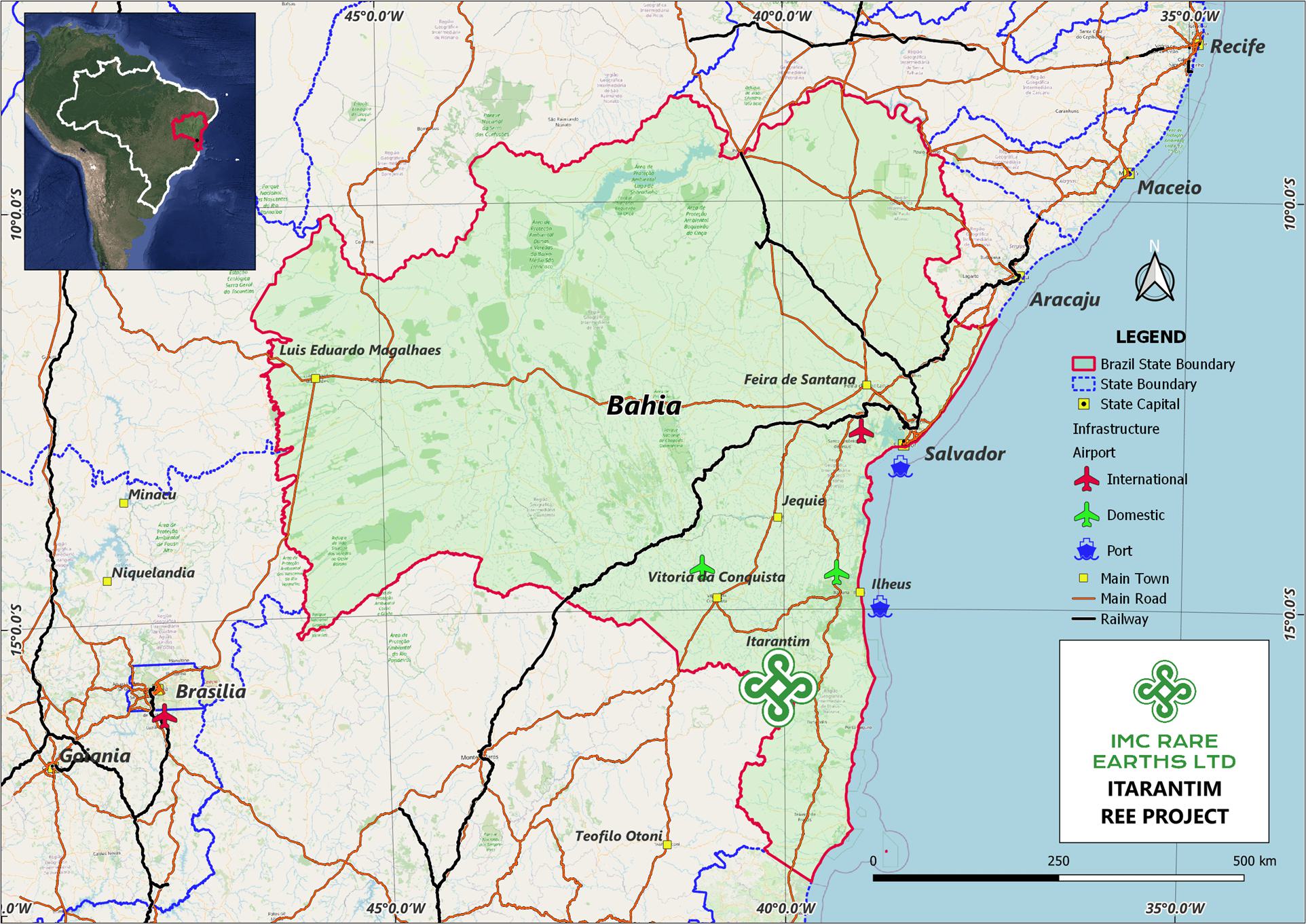
| Figure 3-1 | Location map – Itarantim |
Source: IMC, 2024
| Page 12 |
| ITARANTIM REE PROJECT, BRAZIL, TECHNICAL REPORT SUMMARY | R257,2025 |
| 3.2 | Exploration Permits, Mineral Rights and Surface Rights |
Brazil is regarded as an important and prominent mining jurisdiction globally with stable regulatory and title frameworks. The country has excellent mining infrastructure and services, and strong logistics connections to the USA, Europe and China. IMC has 27 Research Permits held by Niobium Brazil Importacao e Exportacao Ltda (Niobium Brazil), an indirect, wholly owned subsidiary of IMC, and these permits cover an area of 45,224.09 ha (452 km2). All permits are current with expiry dates between December 2025 and July 2026, and all are renewable for the same duration and annual fees as the current permit. All permits are categorized as “Research Permits” in Brazil. For the information regarding the terms, conditions and rights granted by Research Permits in Brazil, refer to a description of mineral rights in Brazil below.
The resource area is covered by seven permits (Alvara de Pesquisa) held by Niobium Brazil and are valid until the 28 July 2026. They include the permits numbered 871657.2022, 871646.2022, 871659.2022, 871653.2022, 871663.2022, 871667.2022, and 871669.2022. All permits are in good standing, and there are no known impediments to the security of tenure.
A research permit map is presented in Figure 3-2 and the research permit schedule is presented in Table 3-1.
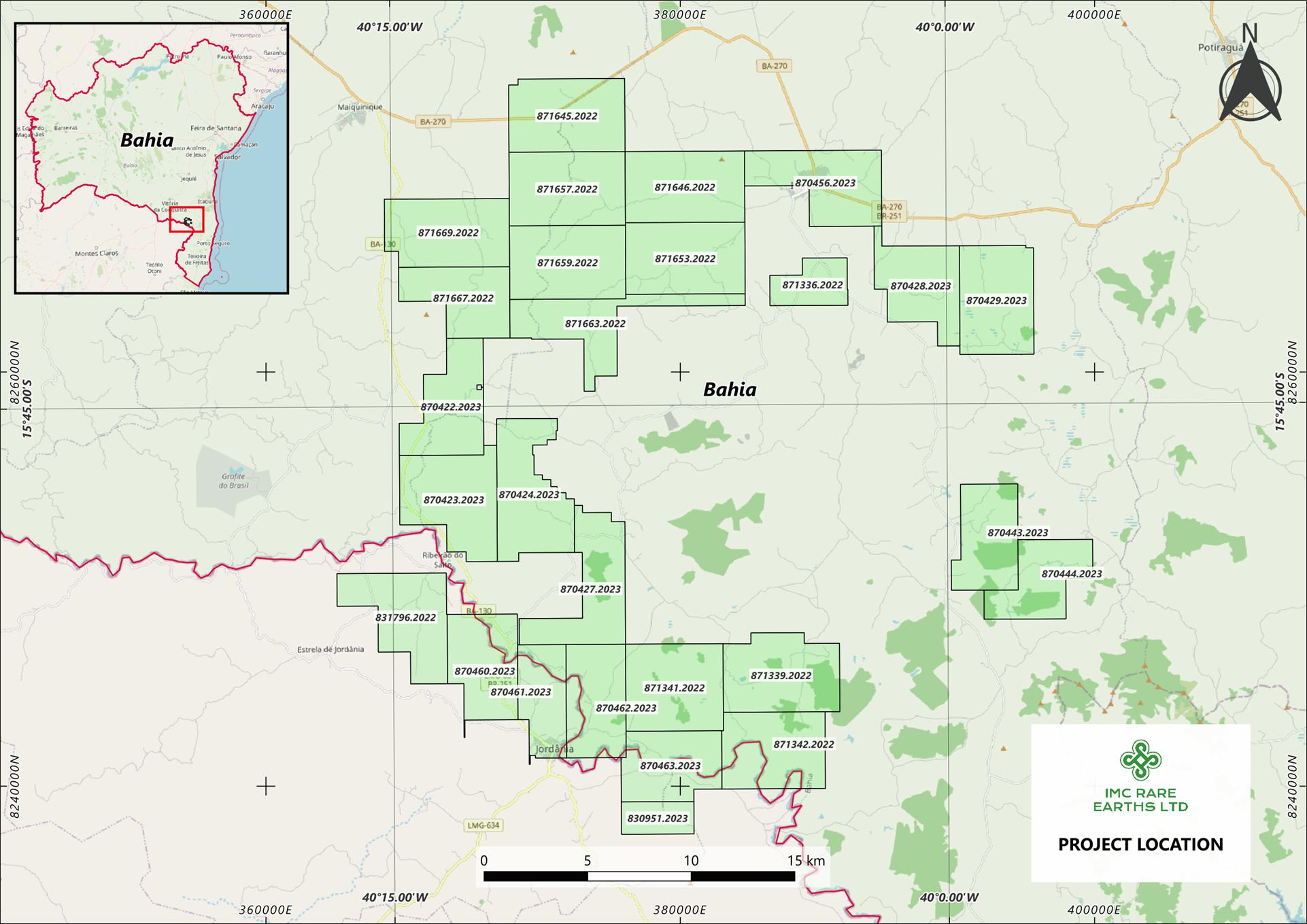
| Figure 3-2 | Itarantim Research Permit Areas |
Source: IMC, 2024
| Page 13 |
| ITARANTIM REE PROJECT, BRAZIL, TECHNICAL REPORT SUMMARY | R257,2025 |
| Table 3-1 | Research Permit Schedule (all permits 100% owned by Niobium Brazil) |
| Permit no. | Issued | Expiry | Area (ha) | State | Municipality | Annual fees (US$) |
| 831.796/2022 | 26/08/2022 | 26/12/2025 | 1,850.40 | Minas Gerais | Jordania | 1,515.79 |
| 871.336/2022 | 25/08/2022 | 9/01/2026 | 729.15 | Bahia | Itarantim | 597.30 |
| 871.339/2022 | 25/08/2022 | 9/01/2026 | 1,990.88 | Bahia | Itarantim | 1,630.87 |
| 871.341/2022 | 25/08/2022 | 9/01/2026 | 1,978.39 | Bahia | Itarantim | 1,620.63 |
| 871.342/2022 | 25/08/2022 | 9/01/2026 | 1,843.37 | Bahia | Itarantim | 1,510.03 |
| 871.645/2022 | 7/10/2022 | 9/01/2026 | 1,966.94 | Bahia | Itarantim | 1,611.25 |
| 871.646/2022 | 7/10/2022 | 9/01/2026 | 1,982.49 | Bahia | Itarantim | 1,623.99 |
| 871.653/2022 | 10/10/2022 | 9/01/2026 | 1,993.89 | Bahia | Itarantim | 1,633.33 |
| 871.657/2022 | 10/10/2022 | 9/01/2026 | 1,993.41 | Bahia | Itarantim | 1,632.94 |
| 871.659/2022 | 10/10/2022 | 9/01/2026 | 1,992.00 | Bahia | Itarantim | 1,631.78 |
| 871.663/2022 | 11/10/2022 | 9/01/2026 | 1,659.77 | Bahia | Itarantim | 1,359.63 |
| 871.667/2022 | 11/10/2022 | 9/01/2026 | 1,435.16 | Bahia | Maiquinique | 1,175.64 |
| 871.669/2022 | 11/10/2022 | 9/01/2026 | 1,934.58 | Bahia | Maiquinique | 1,584.75 |
| 870.422/2023 | 30/03/2023 | 11/07/2026 | 1,617.99 | Bahia | Itarantim | 1,325.41 |
| 870.423/2023 | 30/03/2023 | 11/07/2026 | 1,998.26 | Bahia | Itarantim | 1,636.91 |
| 870.424/2023 | 31/03/2023 | 25/07/2026 | 1,949.19 | Bahia | Itarantim | 1,596.71 |
| 870.427/2023 | 31/03/2023 | 11/07/2026 | 1,758.77 | Bahia | Itarantim | 1,440.73 |
| 870.460/2023 | 6/04/2023 | 18/08/2026 | 1,595.08 | Bahia | Itarantim | 1,306.64 |
| 870.461/2023 | 6/04/2023 | 18/08/2026 | 1,178.73 | Bahia | Itarantim | 965.58 |
| 870.462/2023 | 6/04/2023 | 25/07/2026 | 1,576.70 | Bahia | Itarantim | 1,291.58 |
| 870.463/2023 | 6/04/2023 | 25/07/2026 | 1,546.82 | Bahia | Itarantim | 1,267.11 |
| 830.951/2023 | 6/04/2023 | 28/07/2026 | 548.97 | Bahia | Itarantim | 449.70 |
| 870.428/2023 | 31/03/2023 | 11/07/2026 | 1,572.76 | Bahia | Itarantim | 1,288.35 |
| 870.429/2023 | 31/03/2023 | 11/07/2026 | 1,874.43 | Bahia | Itarantim | 1,535.47 |
| 870.443/2023 | 3/04/2023 | 11/07/2026 | 1,481.80 | Bahia | Itarantim | 1,213.84 |
| 870.444/2023 | 3/04/2023 | 11/07/2026 | 1,361.80 | Bahia | Itarantim | 1,115.54 |
| 870.456/2023 | 5/04/2023 | 25/07/2026 | 1,812.36 | Bahia | Itarantim | 1,484.63 |
| 3.2.1 | Mineral Rights under the Brazilian Mining Code |
A Research Authorization or Research Permit (Alvará de Pesquisa) is issued by the Agência Nacional de Mineração (ANM) for an initial three-year period. The maximum area for the permit is 2,000 hectares. It is renewable for a further three-year period without any relinquishment of land area.
Permissible work which can be undertaken on the Research Permits includes geological surveys and mapping, geophysical and geochemical surveys, drilling, opening of visitable excavations and carrying out surveys of the mineral body, tests on the processing of mineralized materials or useful mineral substances, to obtain concentrates in accordance with market specifications or for industrial use (Article 14). The holder of a Research Permit may carry out the respective works, and necessary auxiliary works and services, on land in the public or private domain, covered by the areas to be researched, provided that he pays the respective owners or occupants compensation for damages and losses that may be caused by the research work (Article 27).
The Research Permit holder pays the annual fee per hectare (TAH) on the last working day of July, if the permit was published in the first half of the year, and on the last working day of January, if the permit was published in the second half of the previous year (Article 20).
The Research Permit may be assigned or transferred, provided that the assignee meets the required legal requirements (Article 22).
| Page 14 |
| ITARANTIM REE PROJECT, BRAZIL, TECHNICAL REPORT SUMMARY | R257,2025 |
Once the final research report has been approved at the end of the Research Permit tenure, the holder will have one year to request a mining concession and, within this period, may negotiate their mining rights (Article 28). The ANM may extend the term for the same period by means of a justified request from the holder.
Article 11 outlines the landowner’s right to participate in the results of mining through a negotiated royalty with the Permit holder. This shall be up to fifty percent of the total amount due to the States, Federal District, Municipalities and bodies of the direct administration of the Union, as financial compensation for the exploration of mineral resources, as provided for in the caput of art. 6º of Law nº 7.990, of 12/29/89 and in art. 2º of Law nº 8.001, of 03/13/90.
All mining permits in Brazil are subject to state and landowner royalties, pursuant to article 20, § 1, of the Constitution and article 11, “b”, of the Mining Code. In Brazil, mining royalties are formally known as Financial Compensation for the Exploration of Mineral Resources (CFEM). It is a monetary compensation, based on gross revenues and less allowable deductions, that companies exploiting mineral resources pay to the Federal government for the use of a nationally owned resource. CFEM rates vary from 1% to 3.5%, depending on the substance. CFEM rates for mining rare earth elements are 2%. The landowners’ royalties may be subject to negotiation; however, if there’s no agreement to access the land or the contract does not specify the royalties, Article 11, §1, of the Mining Code stipulates that the royalties will correspond to half of the amounts paid as CFEM.
CFEM was established by the 1988 Federal Constitution (Article 20, §1) and regulated by the Mining Code (Decree-Law No. 227/1967) and Law No. 13,540/2017, which contains more detailed current rules.
| 3.3 | Royalties |
All mining permits in Brazil are subject to state and landowner royalties, pursuant to Article 20, §1, of the Constitution and Article 11, “b”, of the Mining Code. In Brazil, mining royalties are formally known as Financial Compensation for the Exploration of Mineral Resources (CFEM). It is monetary compensation, based on gross revenues and less allowable deductions, that companies exploiting mineral resources pay to the Federal Government for the use of a nationally owned resource. CFEM rates vary from 1.0% to 3.5%, depending on the substance. CFEM rates for mining REEs are 2.0%.
The landowners’ royalties may be subject to negotiation; however, if there’s no agreement to access the land or the contract does not specify the royalties, Article 11, §1, of the Mining Code stipulates that the royalties will correspond to half of the amounts paid as CFEM.
CFEM was established by the 1988 Federal Constitution (Article 20, §1) and regulated by the Mining Code (Decree-Law No. 227/1967) and Law No. 13,540/2017, which contains more detailed current rules.
| 3.4 | Environmental Liabilities |
ERM is not aware of any environmental liabilities on the Project.
| 3.5 | Significant Encumbrances to the Property |
There are no significant encumbrances to the Project, and the research permits remain in good standing as of the effective
date of this TRS.
| 3.6 | Other Significant Factors and Risks |
There are no significant factors or risks that may affect access, title, or the right or ability to perform work on the Project.
| Page 15 |
| ITARANTIM REE PROJECT, BRAZIL, TECHNICAL REPORT SUMMARY | R257,2025 |
| 4. | Accessibility, Climate, Local Resources, Infrastructure and Physiography | |
| 4.1 | Topography and Physiography |
The Project area is topographically rugged with a 4–30 m thick regolith developed upon granitic rocks. The highest point on the Project is 1,100 metres above sea level in the northeast region and lowest point is 160 metres above sea level in the southeast region. This is expressed as vivid red, clay-rich lateritized regolith, as well as light brown, quartz and mica-rich saprolite soils. The area is in an active state of erosion with common slump features as well as incised drainages noted. The highest and lowest topographic points are characterized by outcropping granite. An example of the physiography is presented in Figure 4-1.
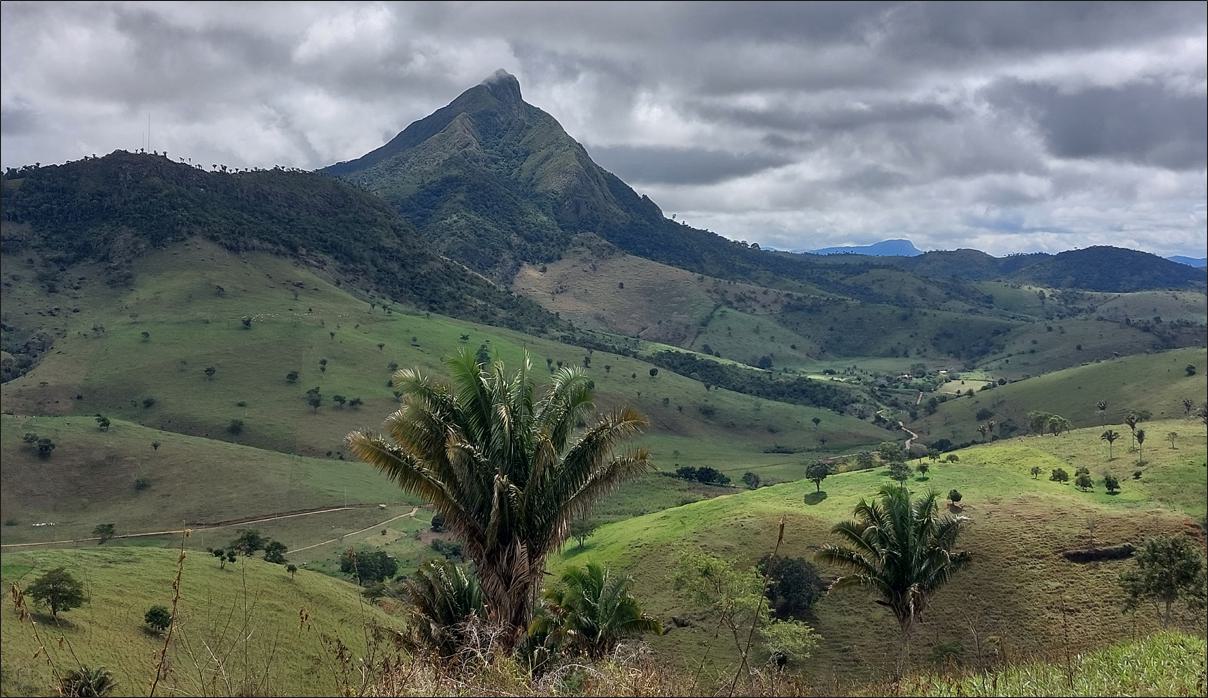
| Figure 4-1 | Photograph of part of the Project area, showing rugged regolith relief with granite “sugarloaf” mountain in background |
| 4.2 | Climate |
The Project area receives rainfall all through the year but increasingly towards the January to March period. The wet season runs from about late-October to mid-April, during which there is a greater than 28% chance of rain on any given day. The dry season is approximately mid-April to late-October. The month with the rainiest days is November averaging ~12.2 days with at least ~0.04 inches of rain. The month with the fewest rainy days is August with ~4.4 days of that minimal precipitation threshold.
The hottest period is from late-November through early-April. In February, the average high reaches about 32°C (89°F) and the average low around 21°C (69°F). The coolest period is from about end of May to late-August. For example, in July the typical high is about 26°C (79°F) and low is about 16–17°C (61°F). Figure 4-2 presents a climate profile for Itarantim.
Exploration activities can be carried out year round, with some reduced access to parts of the Project during the wet season.
| Page 16 |
| ITARANTIM REE PROJECT, BRAZIL, TECHNICAL REPORT SUMMARY | R257,2025 |
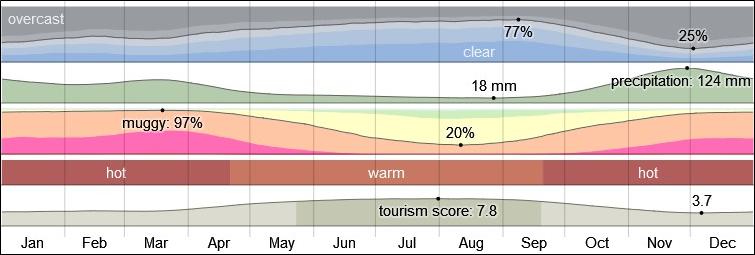
| Figure 4-2 | Climate profile for Itarantim |
Source: Weatherspark.com
| 4.3 | Accessibility, Vegetation, and Local Industry |
Access is by sealed (paved) roads from the city of Vitoria da Conquista to Itarantim, with travel time of approximately two hours. The town of Itarantim has service provision including food, fuel and restaurants while all roads linking the town to the north and south are good quality paved roads. Accommodation in Itarantim is currently considered to be of low quality, therefore Vitoria da Conquista is the preferred location for overnight stays. The Project can be accessed from Itarantim by unsealed roads (gravel or dirt roads). The roads become difficult to negotiate after rain.
Cattle ranching is the primary industry in the Project area. Little primary vegetation growth is noted, with most parts converted to grassland and oil palms. Good relations are evident between the various landowners and IMC’s exploration team.
| 4.4 | Local Resources and Infrastructure |
The regional infrastructure and services are well developed, and the area is 110 km from the nearest airport (Vitoria da Conquista) and 350 km from the Port of Salvador. Porto Sul, a deepwater sea terminal located 150 km northeast of the Project at Ilheus, is scheduled to become operational in 2027.
Electricity supply is available to the Project via the State electrical grid. Water supply is readily available to the Project via local sources including local storage facilities and water bores. There is a reliable labor source locally in Itarantim and other nearby villages as well as from further afield. IMC currently employs many local residents to work on the Project for exploration activities. Bahia State is located adjacent to the State of Minas Gerais, an established mining jurisdiction in Brazil, and therefore experienced mining personnel should be easily sourced for future mining activities from this region. Exploration and drilling supplies, and drilling and geological contractors and labourers are readily available in Bahia State and the region fully supports the Project.
| Page 17 |
| ITARANTIM REE PROJECT, BRAZIL, TECHNICAL REPORT SUMMARY | R257,2025 |
| 5. | History |
| 5.1 | Project and Exploration History |
No prior historical exploration activities for any mineral commodity are known to have occurred on the Project prior to IMC’s involvement. Some drilling for water resources is believed to have occurred, for provision of water for local farms, but details are unknown.
A number of small-scale quarries are located south of the Project area and appear to be developed upon nepheline syenite outcrops. Figure 5-1 presents a photograph of a now disused syenite quarry located 20 km to the south of the Project area.
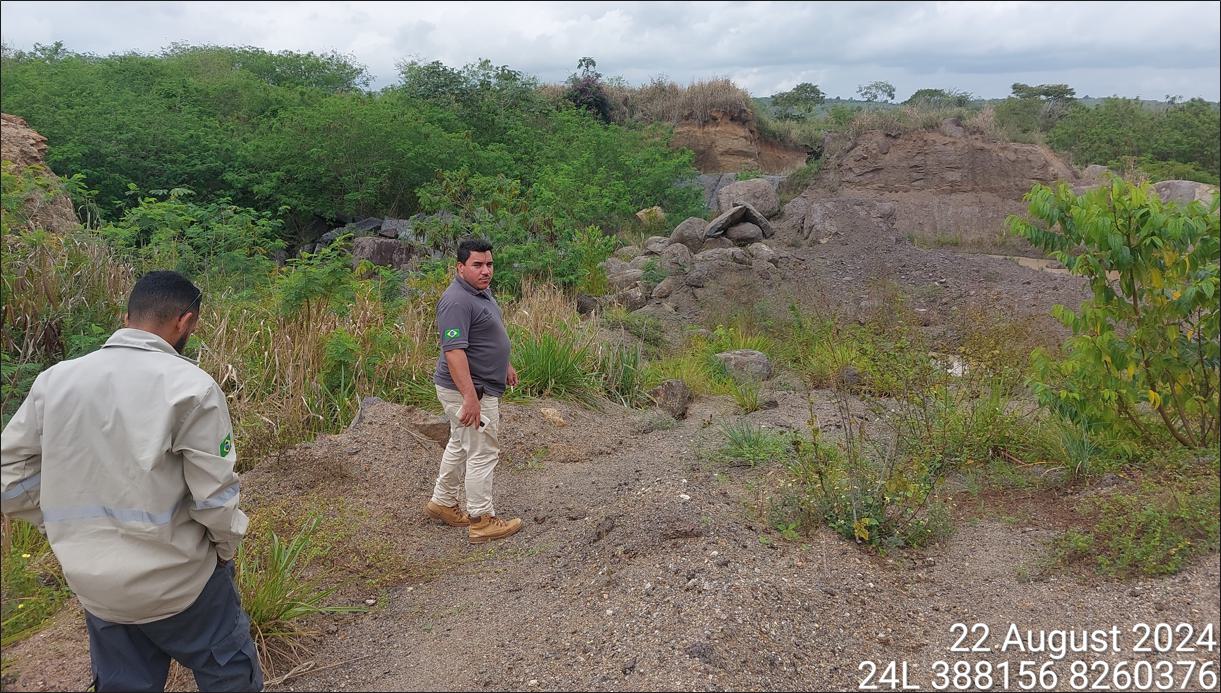
| Figure 5-1 | Syenite quarry, approximately 20 km south of the Project |
| 5.2 | Historical Production |
There has been no prior mining production in the Itarantim Project area.
| Page 18 |
| ITARANTIM REE PROJECT, BRAZIL, TECHNICAL REPORT SUMMARY | R257,2025 |
| 6. | Geological Setting, Mineralization and Deposit |
| 6.1 | Regional and Local Geology |
| 6.1.1 | Regional Geology |
The Project region is underlain by high-grade orthogneisses of the Neoarchean Sao Franciscan terrane, as well as a large, intrusive alkaline granite known as the Itarantim Complex. This granite and aegirine nepheline syenite complex (Rosa et al., 2005) is poorly exposed and forms part of the Neoproterozoic Itabuna Intrusive Suite. A similar intrusion (Palmares Complex), with reported sodalite and of similar age, is located to the northeast of the Itarantim Complex. It is not well understood, but where outcrops can be seen, such outcrops are largely represented by a hornblende and biotite bearing alkaline granite with a pronounced fabric noted. It has a Pb/Pb zircon age from a biotite syenite of about 721 ± 3 Ma (Conceição Rosa et al., 2005).
| 6.1.2 | Local Geology |
The rocks comprising the Itarantim Complex have been mapped and consist of a number of phases including alkaline granites, syenites, nepheline syenites and possible fenite zones. These rocks are exposed in some valley edges, and along the central parts where they have been mined for syenite in the past, while the prominent ridge which forms the Serra da Alegria and Serra da Palmares run through the Project area.
| 6.2 | Property Geology |
The Project area is underlain by various deformed alkaline granites belonging to the Itarantim alkaline granite complex which has been mapped in some detail, although further mapping is recommended to support the geological understanding of the Project. Large areas are erroneously mapped as “fenite”; fenite is related to alkali metasomatism forced by the intrusion of carbonatite complexes, which are not known in the district. A geological map of the Project area is presented in Figure 6-1.
| Page 19 |
| ITARANTIM REE PROJECT, BRAZIL, TECHNICAL REPORT SUMMARY | R257,2025 |
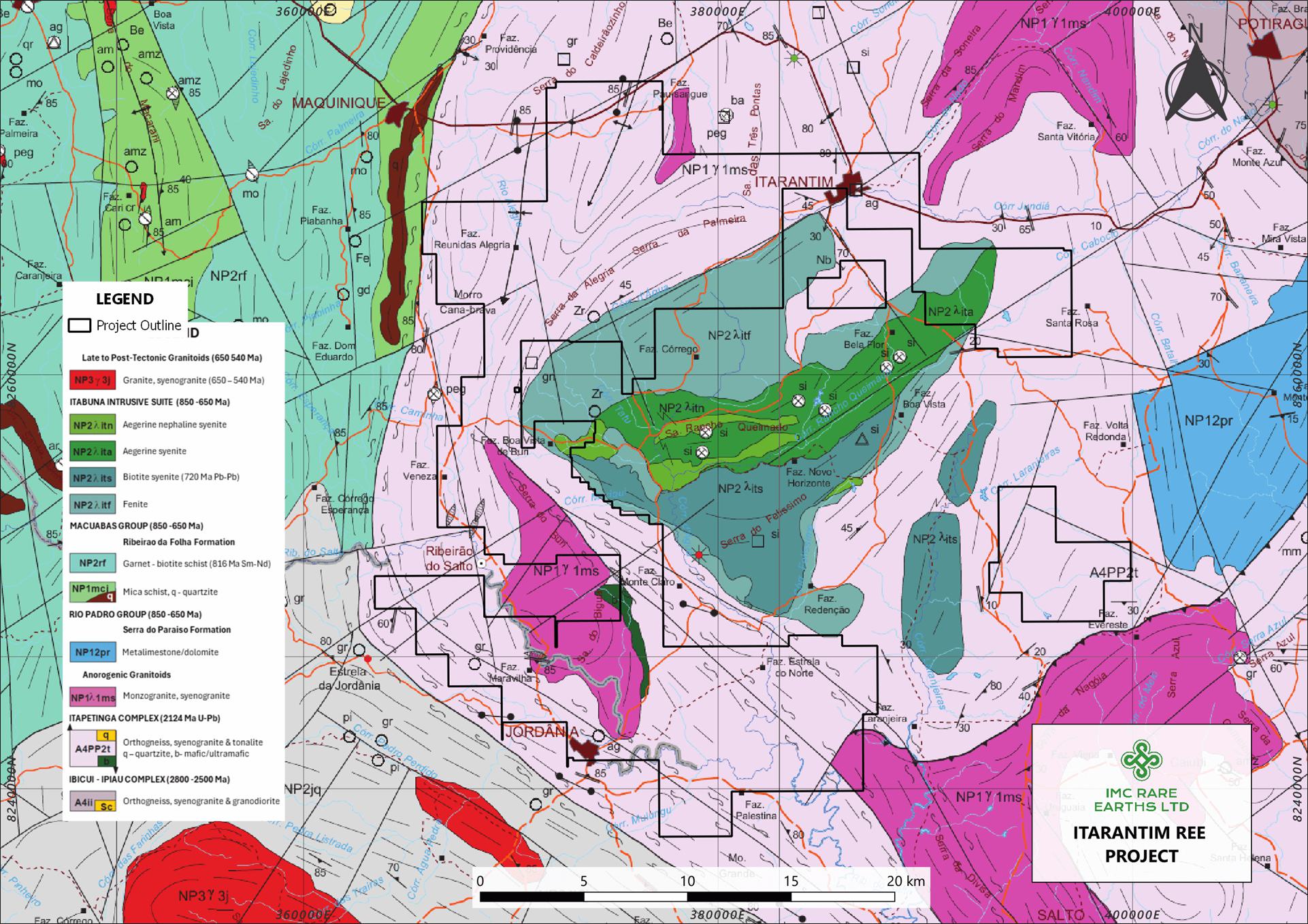
| Figure 6-1 | Geological map of the Itarantim Complex |
Source: IMC, 2024
At this stage, the source of the identified REE mineralization is unknown but the geochemical data suggests that it is most likely hosted in monazite.
| 6.3 | Deposit Type |
Rare earth element (REE) mineralization occurs in economic quantities in a number of rock types, namely carbonatites, alkaline granites and related silica undersaturated rocks, as well as certain pegmatites. The majority of REE minerals in granites are either represented by allanite or monazite, with monazite being particularly important as a source of REEs. REEs may also be hosted in the carbonate mineral bastnaesite. Additionally, REEs may be sequestered onto the surface of certain clay minerals such as kaolinite and this style of REE mineralization allows for the use of in-situ recovery methods to extract the REEs.
The majority of REEs in the alkaline granites of Itarantim are assumed to be included within the mineral monazite. Monazite is resistant to prolonged weathering and erosion and may be concentrated through eluvial enrichment. During chemical weathering, the monazite breaks down and releases REE ions into solution. Granite or alkaline silicate sourced monazite also has a distinct negative europium anomaly when the REEs are plotted as chondrite normalized curves.
| 6.4 | Mineralization |
The Itarantim Project is considered an ionic adsorption clay (IAC) REE deposit hosted in clays within a regolith above an alkali granite.
The rare earth mineralization is then adsorbed onto clay minerals, typically kaolinite and halloysite. The regolith which contains between 500 ppm and 3,000 ppm REE shows that 60–90% of the REE mineralization are adsorbed onto these clay minerals. They are recoverable by using simple inorganic salt solutions by a leaching process, with the REE readily transferred into solution as soluble sulfates or chlorides, depending on whether a salt solution (NaCl) or ammonium sulfate is used as lixiviant.
| Page 20 |
| ITARANTIM REE PROJECT, BRAZIL, TECHNICAL REPORT SUMMARY | R257,2025 |
| 6.4.1 | Weathering |
An important indicator of the potential for the development of IAC deposits is the amount of weathering that has taken place. The Chemical Index of Alteration (CIA) (Nesbitt and Young, 1982) is used as a proxy for the identification of IAC deposit REE enrichment using weathering intensity. The CIA is described as a recognized measure for chemical weathering during the production of clastic sediments, being the degradation of feldspars and the formation of clay minerals during weathering. It may be used to recognize past climate and therefore weathering conditions present during the formation of aluminous shales.
The CIA is calculated as: CIA = (Al2O3/(Al2O3+ CaO+Na2O+K2O) × 100.
Figure 6-2 shows a cross section of a deposit model for Itarantim using CIA to interpret the regolith layers. The CIA ranges used to interpret the layers are presented below:
| ● | CIA >95% indicative of an extremely weathered horizon (Horizon A, not soil A) | |
| ● | CIA 65–95% is indicative of saprolite (Horizon B) | |
| ● | CIA 50–65% is indicative of saprock (Horizon C) | |
| ● | CIA of <50% is indicative of fresh rock (Horizon D). |
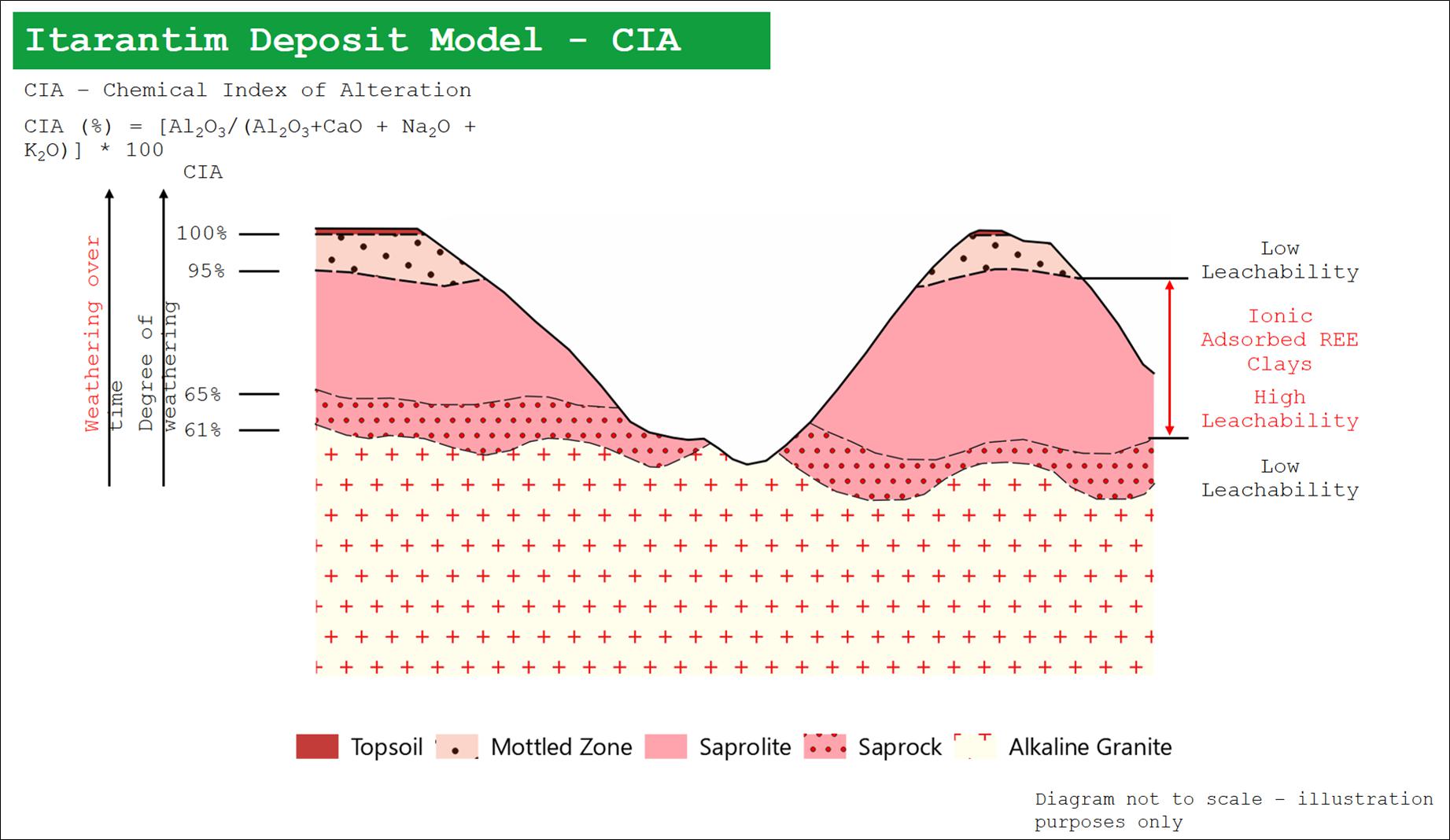
| Figure 6-2 | Schematic cross-section through Itarantim regolith (vertical exaggeration applied) |
Image source: Simon Rollason, 2024
Horizon A: REE grades tend to increase with depth below intensely weathered rock (CIA >95%) at the ground surface where REE ions are leached by surficial processes.
Horizon B: Higher REE grades are hosted in saprolite regolith (CIA ≤95% and ≥65%) preserved in the slope and plateau zones. This horizon therefore would be presumed to be the best host to IAC mineralization.
Horizon C: Lower REE grades are encountered in areas with a lower degree of weathering (CIA <65%). Lower weathering is distinguished by the greater number of grains in the sand fraction, greater presence of mafic minerals, with rock foliation that may be preserved (when the parent rock is oriented), presenting beige to pinkish colors.
Horizon D: Corresponds to parental rocks or protolith hosting primary mineralization.
The vast majority of the ion adsorption clays present a “negative cerium anomaly”, meaning that, contrary to the majority of REEs which are usually physically adsorbed as trivalent ions, Ce3+ can be easily oxidized by atmospheric oxygen (O2) to Ce4+ which then precipitates as cerianite (CeO2). Consequently, the formation of the mineral cerianite results in a natural separation of cerium from the other adsorbed trivalent REEs and makes it impossible to be recovered by ion exchange leaching.
Figure 6-3 shows a schematic cross-section of an ionic clay regolith, showing the importance of chondrite normalized curves for the identification of zones of REE enrichment and depletion, notably europium and cerium.
Depending on the nature of the original host rocks, other metals will be dissolved and transported in solution during the weathering, decomposition and alteration processes. The main impurities associated with the ion adsorption clays are usually aluminum, magnesium, calcium, manganese, zinc, and iron. An additional issue is the presence of the radionuclides uranium and thorium.
| Page 21 |
| ITARANTIM REE PROJECT, BRAZIL, TECHNICAL REPORT SUMMARY | R257,2025 |
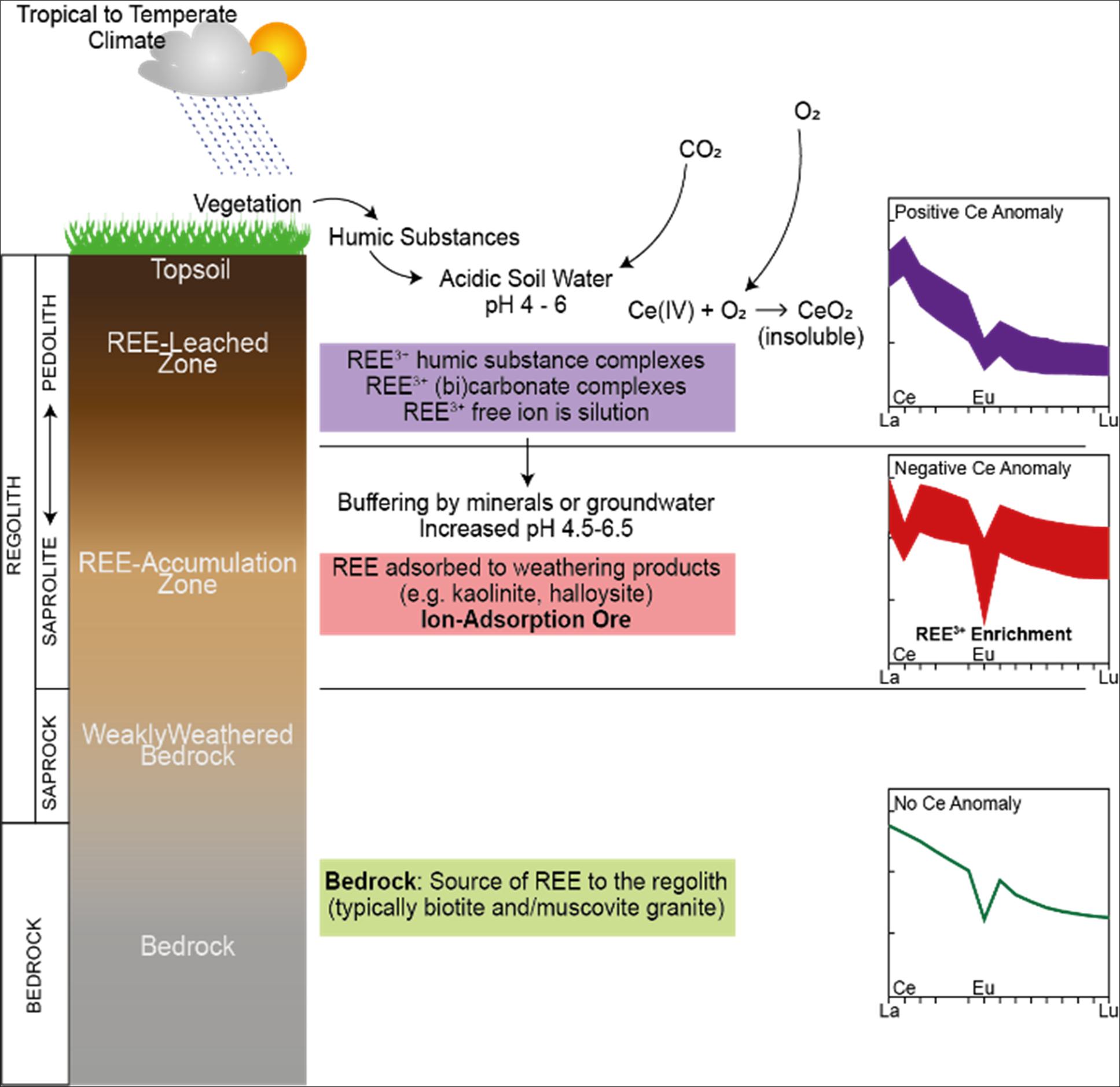
| Figure 6-3 | Stylized cross-section through a regolith hosted IAC deposit, showing cerium and europium anomalies (after Sanematsu and Watanabe, 2016) |
Discussion on the metallurgical properties of REEs and their leachabilities are provided in Section 10.
| 6.4.2 | Factors Affecting Continuity of Grade and Geology |
The ionic adsorbed clay style of deposit at Itarantim is hosted in the regolith profile above an alkaline granite. The regolith profile has an extensive areal extent and IMC has only investigated a part of the regolith across their tenure. The regolith hosts REE mineralization which therefore also has a widespread lateral extent. Development of regolith is sometimes curtailed by outcropping granite and can have a shallow depth in the valley floors.
| Page 22 |
| ITARANTIM REE PROJECT, BRAZIL, TECHNICAL REPORT SUMMARY | R257,2025 |
| 7. | Exploration |
| 7.1 | Exploration History |
There has been no previous exploration activities on the Itarantim Project prior to IMC. Exploration activities completed by IMC are described in the following sections.
| 7.1.1 | Geophysics |
An airborne geophysical survey was completed by CPRM (Serviço Geológico do Brasil) and has been used by IMC to both map prospective geology as well as identifying areas of greatest radiometric thorium response which indicates the presence of monazite and therefore REEs. This data was used to originally identify areas for follow-up geochemical sampling.
| 7.1.2 | Soil Sampling |
A program of detailed soil geochemistry was completed by IMC to identify areas of anomalous REE concentration (Figure 7-1) which was then used to assist with drillhole planning. A total of 2,291 B-horizon soil samples (including QAQC samples) were collected over the current resource blocks and analyzed at SGS Labs in Belo Horizonte. A further 727 soil samples have been collected from southern permits 831796, 870460 and 870427, where demonstration of similar geomorphological characterization to the resource blocks is present (Figure 7-2). The preliminary results in the soils in permits 831796, 870460 and 870427 show laterally persistent, over 2 km length in some instances, TREO trends >1,000 ppm TREO. These trends correlate with mapped regions of saprolite exposure, confirming the presence of an ionic adsorption deposit system in this region (Figure 7-2).
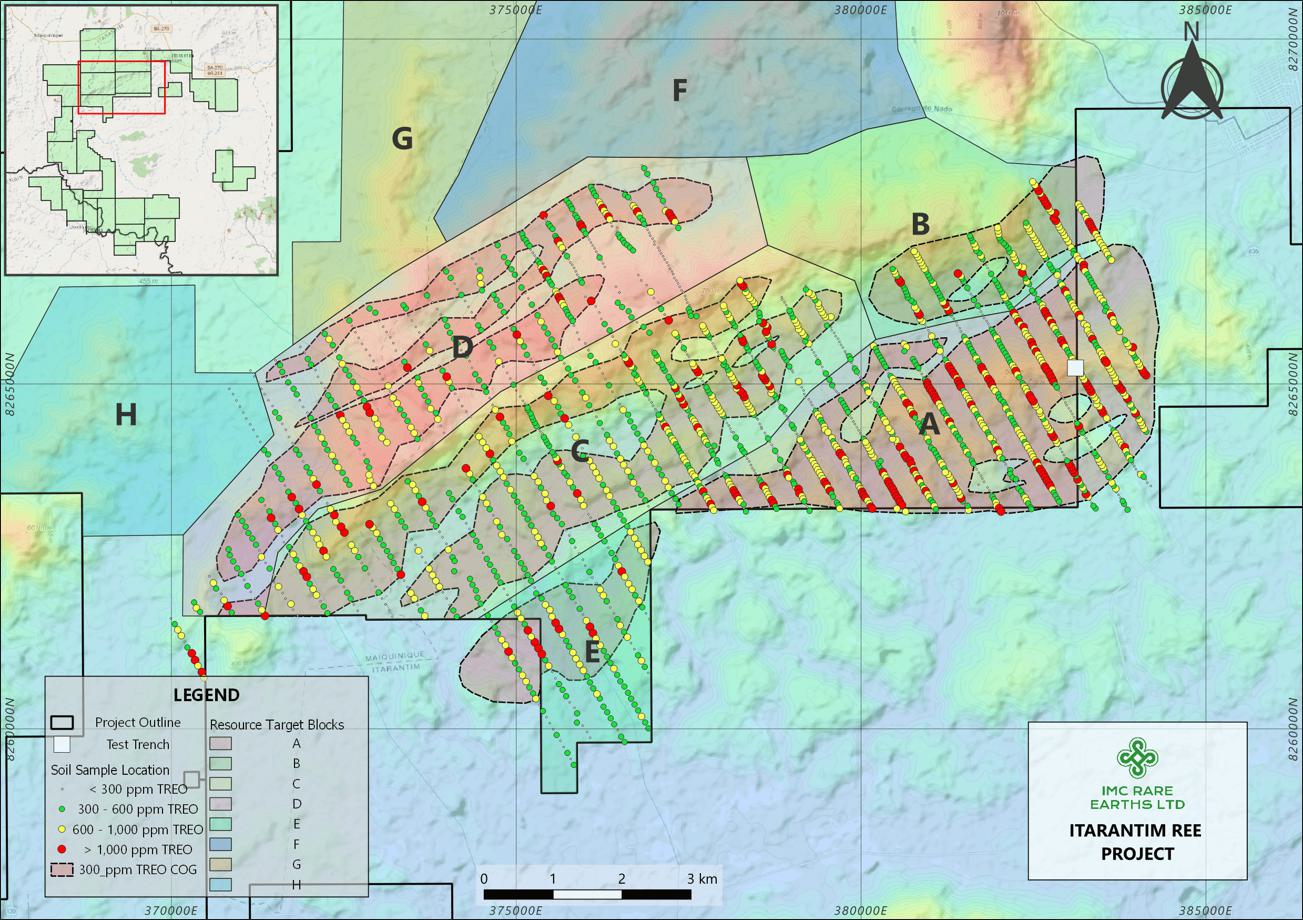
| Figure 7-1 | Soil geochemistry sample locations, by TREO ppm (block domains shown) |
Source: IMC, 2024
| Page 23 |
| ITARANTIM REE PROJECT, BRAZIL, TECHNICAL REPORT SUMMARY | R257,2025 |
Note: Trench location (adjacent to hole AD-00007) shown as white square to right of Block A.
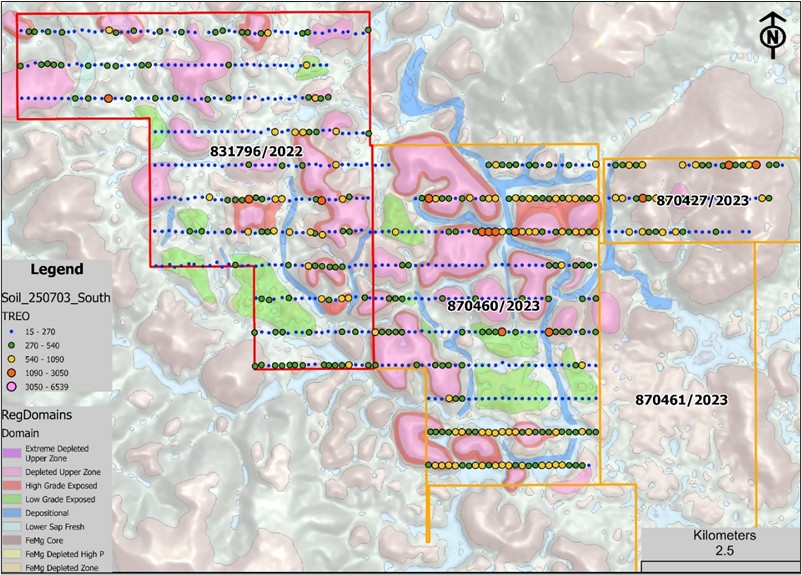
| Figure 7-2 | Soil sample locations and gridded TREO content in three permit areas |
Source: IMC, 2024
The positive identification of an ionic adsorption deposit system in the southern permits provides significant upside for potentially additional resource tonnes to the Project. However, auger drilling will be required to quantify the grade and potential tonnes.
This data was collected and collated on a weekly basis by Cacto Geologia Mineração e Meio Ambiente Ltda (Cacto Geologia) and forms the unique archive for detailing procedures and progress. It is no longer being collected because the surface did not commonly reflect the deeper parts of the regolith profile and was not used to support the current MRE.
Results from the soil geochemistry led to the delineation of regions, referred to by IMC as “blocks”. The blocks (A, B, C, D and E) are not regarded as hard grade boundaries but were established for internal reporting and progress monitoring. Auger drilling and the Mineral Resource block model clearly shows the continuity of grades across the boundaries. IMC considers the blocks to be open, with mineralization expected to continue outside these blocks. The roughly northeast–southwest trend of the blocks follows the approximate form of the historically mapped intrusive units and the data from airborne geophysics. Although useful as an earlier exploration tool, soil geochemistry only tells part of the story as IMC has demonstrated higher-grade mineralization occurring below areas of negative/low soil results, based upon drillhole sample analyses.
Blocks F, G and H have not yet been drill tested, and the current MRE does not include the areas covered by Blocks F, G and H.
| Page 24 |
| ITARANTIM REE PROJECT, BRAZIL, TECHNICAL REPORT SUMMARY | R257,2025 |
Block A covers the area south of the main northeast-southwest river valley and consists of moderate terrain. Block B lies in the northeast extents of the resource block and is truncated by a prominent east–west trending ridge, with the north of Block B having a north-facing aspect and southern Block B having a dominantly south-facing aspect. Block C lies to the north of the river valley over the southern flank of the main topographic ridge. Block D is on high ground and focuses on the “plateau” area, where the greatest thickness of regolith development is observed. Block E lies on the southern extremity of the resource blocks, with the terrain similar to the continuation of Block A to the east.
All soil samples collected are representative of each block, and there are no factors that may have resulted in sample biases.
| 7.1.3 | Trenching |
A 5 m deep by 1 m wide trench was excavated at the location of hole AD-00007 in Block A (Figure 7-3). Material was placed near the trench in piles, representing 1 m depths of excavation. The trench was backfilled following ERM’s site inspection in August 2024. The purpose of the trench was to provide twinned geological and analytical support for the drillhole AD-00007.
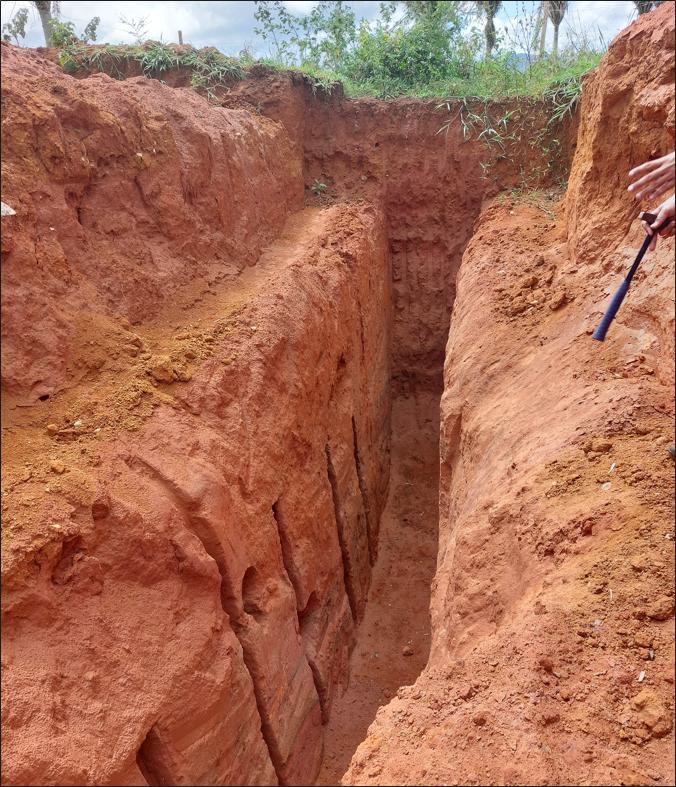
| Figure 7-3 | Trench, with channel sample holes (Block A) |
| 7.1.4 | Significant Results and Interpretation |
Soil sampling as described in Section 7.1.2 identified areas of anomalous REE concentration which was then used to assist with drillhole planning. A total of 2,291 B-horizon soil samples (including QAQC samples) were collected from within the mineral resource blocks, with a further 727 soil samples collected from southern permits 831796, 870460 and 870427, demonstrated similar geomorphological characterization to the resource blocks. The results show laterally persistent, over 2 km length, TREO trends >1,000 ppm TREO. These trends correlate with mapped regions of saprolite exposure, confirming the presence of an ionic adsorption deposit system in this region.
| Page 25 |
| ITARANTIM REE PROJECT, BRAZIL, TECHNICAL REPORT SUMMARY | R257,2025 |
The exploration trench in Block A was excavated within 20 m of drillhole AD-00007, and density penetration test hole STP4 was drilled within the trench wall. The purpose of the trench was to provide twinned verification evidence of geology and assaying. Geological logs of the drillhole and trench demonstrate similar depths for the weathering units. No other holes have been twinned.
| 7.2 | Drilling |
| 7.2.1 | Drilling Techniques and History |
All field geological and sampling activities are managed by Cacto Geologia, an independent Brazilian geological services management company contracted by IMC. Cacto Geologia employs geologists, field and sample yard technicians and prepared a set of standard operating procedures (SOPs) for the drilling and sampling activities.
Drilling commenced on the Project in May 2023. Table 7-1 presents a summary of drilling activity by year for drillholes supporting the current MRE. Holes were drilled using a coring blade attached to 1 m length rods, with rotation provided by a gas motor mounted to the head of the rod string, with downward force into the subsurface substrate provided by four operators holding onto arms of a cross-bar (Figure 7-4). The style of drilling is referred to as machine auger, although the typical spiral auger bit has not been used for the drilling at Itarantim. Five coring or percussion drill bits are used to assist with achieving maximum sample recovery and drill meterage rate, with choice of bit dependent upon ground conditions (Figure 7-5).
| Table 7-1 | Summary of drilling supporting Itarantim MRE, by year and block |
| Year | Block | No. of holes | Total depth (m) |
| 2023 | Block A | 89 | 1,081.5 |
| Block B | 2 | 19 | |
| Block C | 4 | 65 | |
| Block D | 7 | 124 | |
| Subtotal | 102 | 1,289.5 | |
| 2024 | Block A | 62 | 649 |
| Block B | 46 | 422 | |
| Block C | 205 | 2,781 | |
| Block D | 53 | 1,083 | |
| Block E | 20 | 290 | |
| Subtotal | 386 | 5,225 | |
| 2025 | Block B | 28 | 326 |
| Block D | 16 | 239 | |
| Subtotal | 44 | 565 | |
| All | Block A | 154 | 1,743.5 |
| Block B | 76 | 767 | |
| Block C | 209 | 2,846 | |
| Block D | 76 | 1,446 | |
| Block E | 20 | 290 | |
| Total | 532 | 7,079.5 | |
Note: Excludes channel sampling and holes in Blocks 460 and 796. Blocks defined in Section 7.1.2.
| Page 26 |
| ITARANTIM REE PROJECT, BRAZIL, TECHNICAL REPORT SUMMARY | R257,2025 |
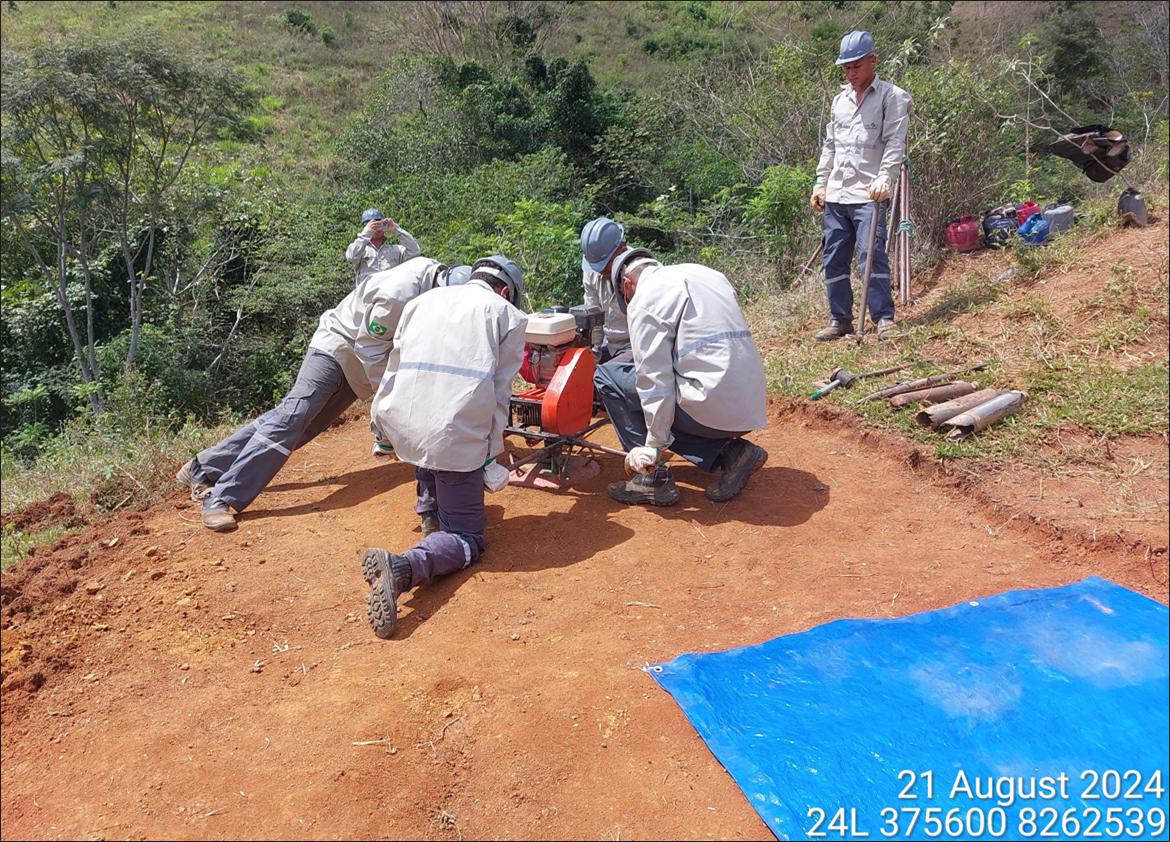
| Figure 7-4 | Drilling activity at hole AD-0412 |
| Page 27 |
| ITARANTIM REE PROJECT, BRAZIL, TECHNICAL REPORT SUMMARY | R257,2025 |
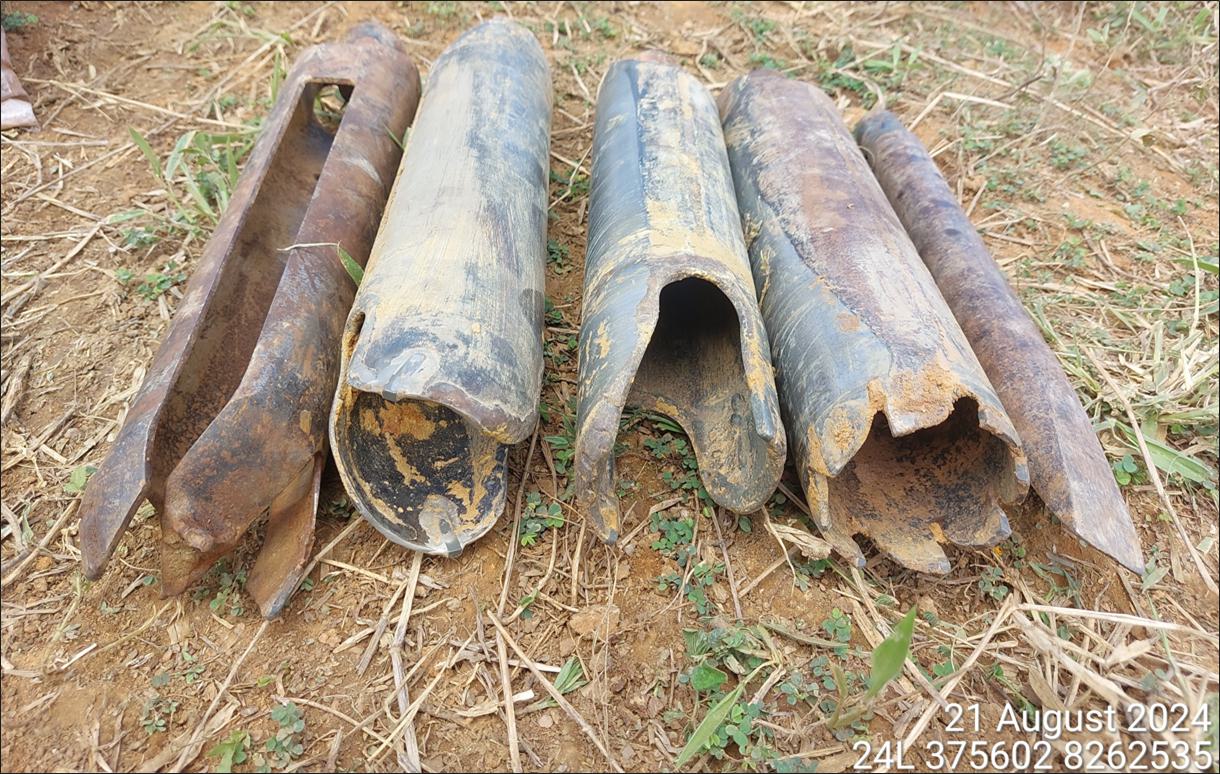
| Figure 7-5 | Auger coring blades (from left, used for soils coring, conventional coring, for harder substrate, for clays, rock breaker) |
Drilling was terminated due to lack of penetration through saprock, and in rare instances, reaching the bedrock interface.
A drillhole collar plot is presented in Figure 7-6 showing the location of holes supporting the September 2024 historical estimate and all holes drilled since September 2024, all of which support the current MRE.
| Page 28 |
| ITARANTIM REE PROJECT, BRAZIL, TECHNICAL REPORT SUMMARY | R257,2025 |
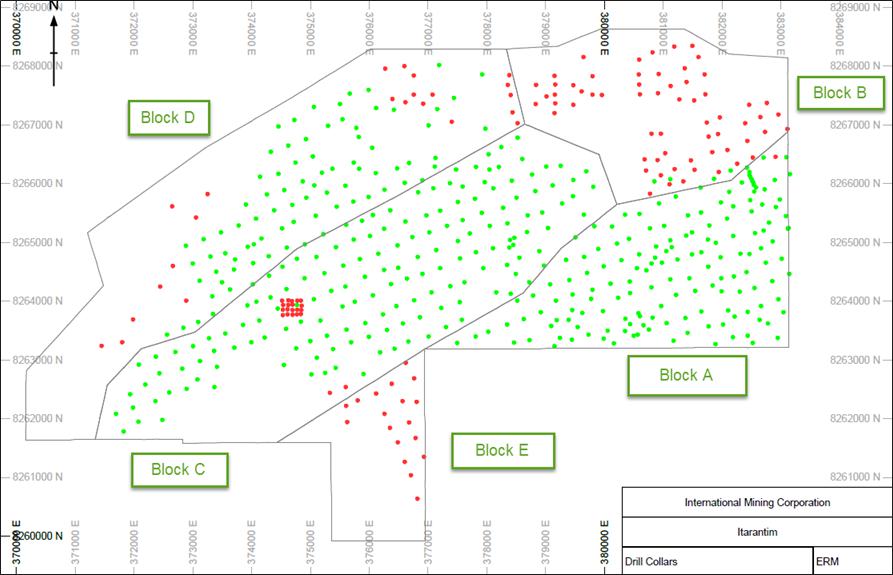
| Figure 7-6 | Drill hole collars (green holes drilled prior to September 2024 MRE, red holes drilled post September 2024 MRE); resource block outlines shown |
The choice of drilling and sampling method is considered by ERM to be appropriate for the host geological units, which ranges from unconsolidated soil through clayey horizons, friable laterites, and saprock.
| 7.2.2 | Sampling Techniques and Sample Recovery |
Machine auger drilling is used to obtain 1 m samples with mass approximately 10–12 kg, which are later subsampled and a 1.8–2.2 kg sample sent to the analytical laboratory, SGS (as defined below).
Sample recovery is generally 100% with minimal sample loss encountered, which would be due to sample falling out of core barrel during extraction of the bit from the hole. The method of drilling ensures sample compaction within the core barrel and a rubber mallet is used to tap the sides of the barrel to dislodge the sample. The barrel is cleaned with wire brush to ensure no sample contamination between meter intervals.
Samples are extracted from the coring tube at approximately 0.2 m intervals following extraction of the drill string from the ground. All advances are measured with a metal tape measure as drilling progresses. The sample is tapped out of the bit tube onto a thick plastic sheet laid on the ground near the collar (Figure 7-7). When 1.0 m of cumulative sample length is obtained, two field technicians combine all samples into one by picking up the sheet, folding it and rolling the samples around to homogenize them, then pouring into a clear plastic sample bag.
| Page 29 |
| ITARANTIM REE PROJECT, BRAZIL, TECHNICAL REPORT SUMMARY | R257,2025 |
All samples collected are representative of each block, and there are no sampling or recovery factors that may have resulted in sample biases.
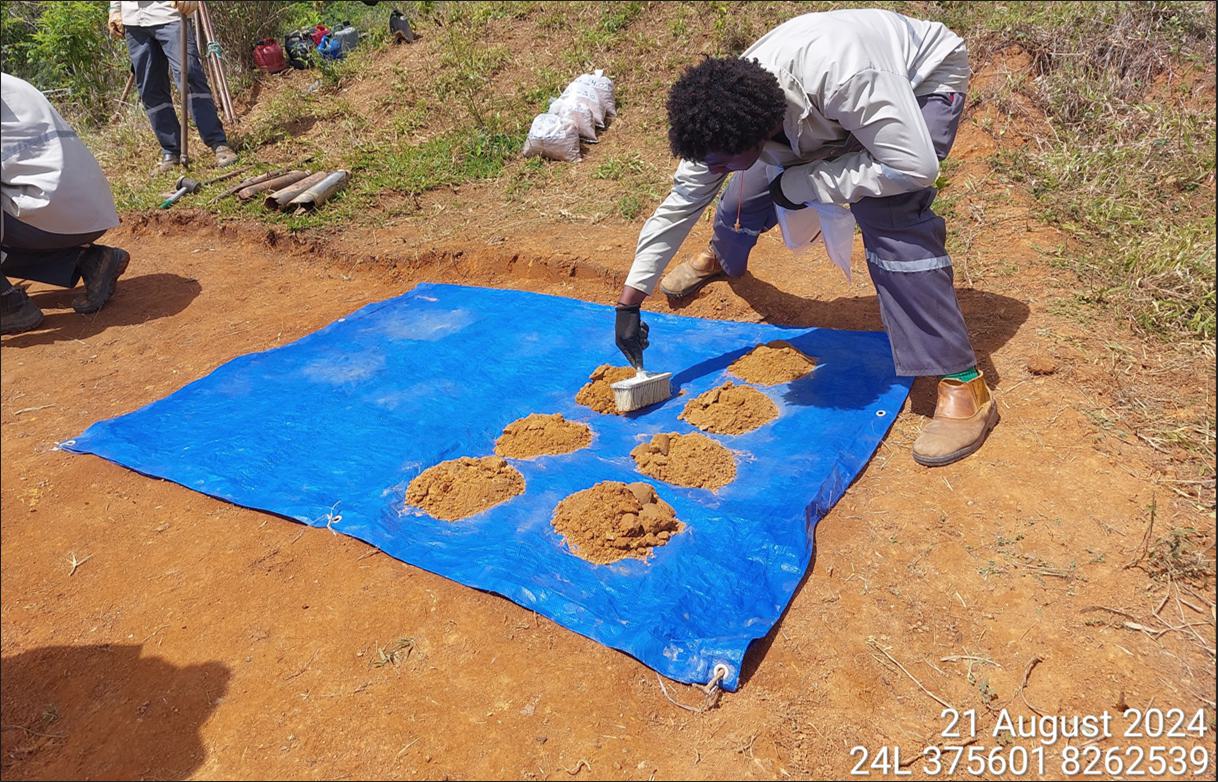
| Figure 7-7 | Sub 1 m samples laid out on plastic sheet (location – hole AD-0412) |
| Page 30 |
| ITARANTIM REE PROJECT, BRAZIL, TECHNICAL REPORT SUMMARY | R257,2025 |
| 7.3 | Logging |
All geological logging is carried out at the drill rig. The field technician, under supervision from a Cacto Geologia geologist, logs each 1 m sample for color, grainsize and mineralogy. The level of detail is considered appropriate to support Mineral Resource estimation.
Logging is qualitative in nature, based upon the technicians’ observations and judgement. All samples are logged. Photographs of the sample chip trays are taken in uniform lighting conditions.
| 7.4 | Location of Data Points |
| 7.4.1 | Topography Data |
A light detection and ranging (LiDAR) survey was flown in August 2024 by Aerosat Engenharia e Aerolevantamentos Ltda (Aerosat). Results from the LiDAR were used to generate a topographic digital terrain model (DTM) at a resolution of 0.1 m. This survey was extended in March 2025 to allow full coverage of the resource blocks and extend to areas of future exploration (Aerosat, 2025).
To allow for a workable 3D mesh, the LiDAR data was reduced to 5 m node spacing and a 3D mesh was generated in Geosoft Oasis software, which was then exported as a 3D Leapfrog mesh. To allow for geological extrapolation beyond the LiDAR boundaries, Shuttle Radar Topography Mission (SRTM) topography points on 25 m spacing were merged with the LiDAR mesh (Figure 7-8). The mineralization envelope and geological model were subsequently trimmed to the resource block model boundary, which also represents the boundaries of the LiDAR survey.
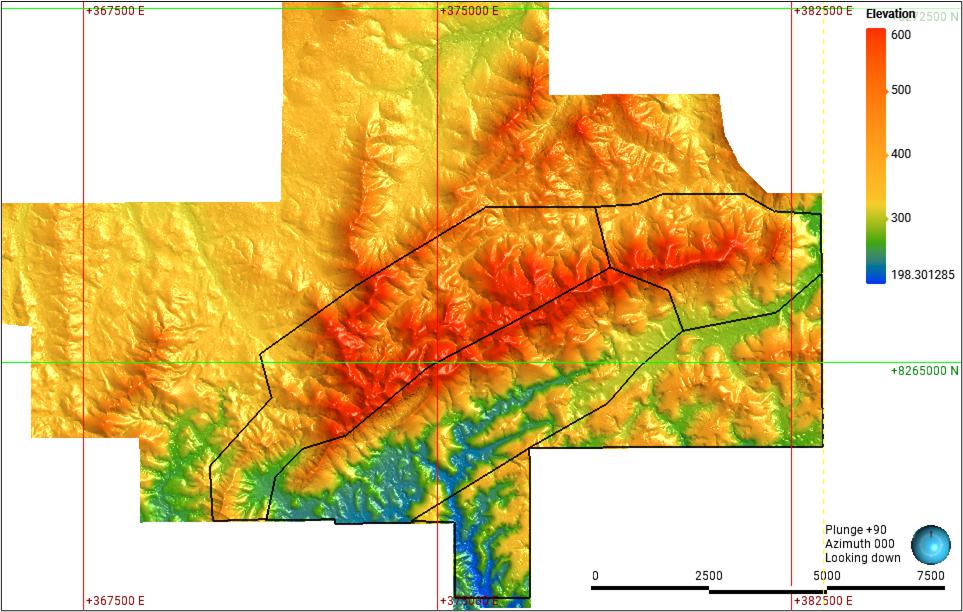
| Figure 7-8 | LiDAR survey boundary (black polyline) with 2 m 3D mesh inside and 25 m SRTM mesh outside |
| 7.4.2 | Collar Data |
Drill collars were surveyed by Cacto Geologia staff using a handheld global positioning system (GPS) in the first instance and later surveyed using a real-time kinematic (RTK) GPS unit (CHCNAV i73 GNSS). Collar elevations were later registered to the LiDAR topographic DTM to obtain a reliable elevation for the collars.
| Page 31 |
| ITARANTIM REE PROJECT, BRAZIL, TECHNICAL REPORT SUMMARY | R257,2025 |
| 7.4.3 | Downhole Survey Data |
All holes are vertical and drilled to relatively shallow depths. Any deviation in drilling with depth is expected to be minimal and not material, therefore, downhole surveys are not considered to be required.
| 7.5 | Data Spacing and Orientation |
Drillholes are presently spaced approximately 320 m apart, both along drill lines and between lines. A grid of holes was drilled by IMC in 2025 in Block C with a spacing of approximately 90 m(X) by 80 m(Y), with drillhole IDs of AD-00470 to AD-00488. The rugged topography has resulted in some variability in collar elevations within relatively close distances between holes. A drill hole collar plot is presented in Figure 7-6. The data spacing and distribution are considered by ERM to be sufficient to establish the degree of geological and grade continuity to support the estimation of a Mineral Resource.
| 7.6 | Orientation in Relation to Geological Structure |
The holes were drilled vertical, which is orthogonal to the distribution of the weathering profile.
| 7.7 | Material Results and Interpretation |
Itarantim is an ionic adsorption clay REE deposit hosted in clays of the regolith above an alkali granite. The majority of REE in the alkaline granites at Itarantim are assumed to be included within the mineral monazite. Monazite is generally resistant to prolonged weathering or erosion and may be concentrated through elluvial enrichment. Monazite forms an important part of the mineral assemblage in heavy mineral sand deposits and may be recognized on its radiometric response, due to commonly containing between 1% and 4% ThO2.
The ion adsorption clays contain between 0.05% and 0.3% REE, from which 60–90% occur physically adsorbed onto clay minerals, notably kaolinite and halloysite. They are recoverable by using simple inorganic salt solutions where, during the leaching process, the REE are relatively easily transferred into solution as soluble sulphates or chlorides, depending on if a salt solution (NaCl) or ammonium sulphate is used as lixiviant.
As mineralisation is hosted in the regolith, regolith domains were identified on the grounds of whole rock element (K2O, Na2O, Al2O3, CaO, MgO, Fe2O3 and MnO) and TREO geochemical profiles. Units defined within domains were identified, from top down, as (1) Depleted Zone (2) Upper Transition Zone, (3) Enriched Zone, (4) Lower Transition Zone, and (5) Fresh Rock.
The drillhole spacing and the resolution of the block model do not support the subsetting of the mineralised envelope and subsequent block model reporting per unit. As a result, the boundaries used for modelling were simplified into Hanging Wall (Depleted Zone), Min 630 (630 cut + Upper Transition Zone + Lower Transition Zone) and Footwall (Fresh).
Mineralisation is generally restricted to the top 15–20 m of the regolith profile, and the depth of drilling is considered appropriate. However, a number of areas were encountered where mineralisation was found to extend beyond the depth of present drilling at 20 m. The mineralisation is generally tabular and stratiform and generally follows the topography.
A high level of confidence is placed on the current geological model, given the amount of drilling, geological understanding and observations made in the field. The confidence in the geological interpretation is reflected in the Mineral Resource classification levels assigned to the Mineral Resource estimate.
| Page 32 |
| ITARANTIM REE PROJECT, BRAZIL, TECHNICAL REPORT SUMMARY | R257,2025 |
Major element geochemistry is used as an effective guide to distinguish the various regolith units, as well as the units which demonstrate the best leach results. Continuity is affected by localized drainages as well as slumping which has, in places, caused localized mixing of regolith types.
Geological models were based upon drillhole samples, including geological logs of lithology and weathering, and sample assays. The geological models guided the Mineral Resource estimation, with sample populations for the TREO mineralisation statistically reviewed.
The geological models extend along and across strike of the deposit with all drillhole data available as at the database cutoff date used to support the geological models. Mineralisation beyond the limits of the geological models are observed and will be drill tested by IMC.
One geological model was prepared using Leapfrog software, using a 630 ppm TREO lower cut-off grade. The continuity of grade is interpreted as continuing along and across strike. The host regolith exhibits continuity along the valleys, flanks and lower hills. Regolith has not developed on mountain summits or very steep topography (>80° inclination) and is noted to be very thin (<3 m) along valley floors.
The Mineral Resource extends 11,400 m along strike, across strike for 5,200 m, and the base of the regolith model extends down dip to a depth of >20 m below surface and usually is 6–10 m in thickness.
For mineralisation contained within Block E, the Mineral Resource extends 1,700 m along strike, and across strike for 2,600 m.
| 7.8 | Hydrogeology |
IMC has recently engaged the services of WSP, an international environmental consulting group with offices in Brazil, to provide hydrogeological services. The work has only recently started and is currently in progress. WSP has completed the compilation and analysis of existing geological and hydrogeological data in the area and plans are underway for the Company to work with WSP to drill and install a network of groundwater monitoring wells in and around the area, with the objective of advancing the understanding of the hydrogeological conditions on the Project.
| 7.9 | Geotechnical |
No geotechnical work or studies have been conducted by or on behalf of IMC.
| Page 33 |
| ITARANTIM REE PROJECT, BRAZIL, TECHNICAL REPORT SUMMARY | R257,2025 |
| 8. | Sample Preparation, Analyses and Security |
| 8.1 | Subsampling Techniques and Sample Preparation |
| 8.1.1 | Itarantim Sample Yard |
The Itarantim sample preparation facility owned by IMC is a secure compound with the following features:
| ● | Vehicle access for delivery and dispatch of samples |
| ● | A well laid-out sample preparation area, with a roof and fans to provide a comfortable work environment |
| ● | Office building, for field technicians to carry out data entry into laptops |
| ● | Yard for storage of archived samples |
| ● | Mechanical workshop for maintenance of auger machines. |
Samples received from the field are stored in the sample preparation area. The following steps are followed for subsampling, with greater detail provided in SOP-00-002:
| 1) | Weigh the full sample. |
| 2) | Screen the samples over a quarter sampler to remove coarse clusters; these are broken down if possible. |
| 3) | Two opposite quartered samples are removed and bagged as reject. |
| 4) | The remaining two quartered samples are homogenized and poured through the screen mesh for a second quarter sampling. |
| 5) | The first two quartered samples are placed into a plastic bag and are treated as the primary sample. |
| 6) | The remaining quartered samples are bagged and treated as the field duplicate. |
| 7) | Samples are weighed to confirm the primary and field duplicate bags are of similar weights. |
| 8) | Bags are ticketed and stored ready for dispatch to the applicable analytical laboratory. |
| Page 34 |
| ITARANTIM REE PROJECT, BRAZIL, TECHNICAL REPORT SUMMARY | R257,2025 |
A selection of subsampling steps is shown in Figure 8-1.
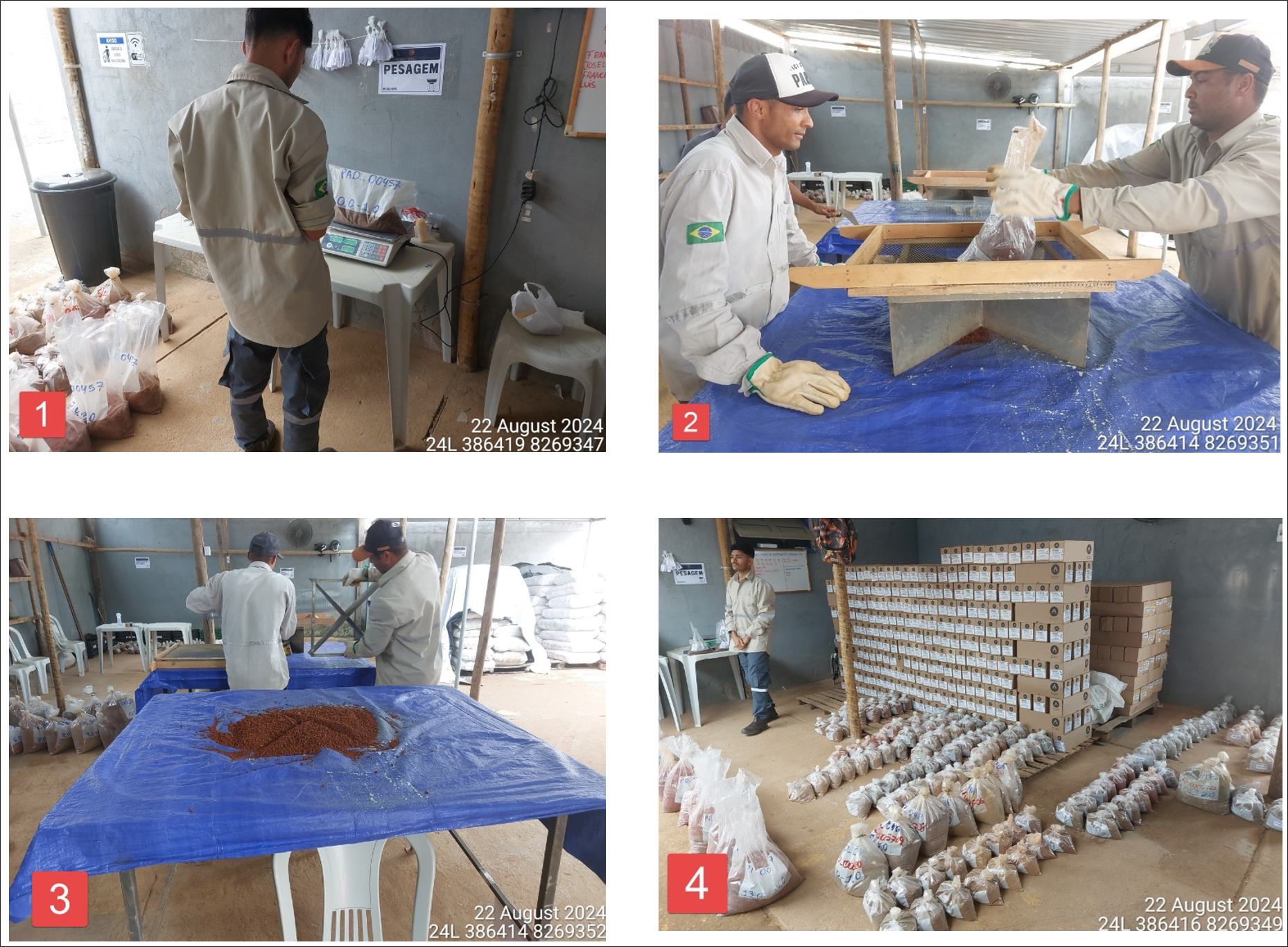
| Figure 8-1 | Sample preparation at Itarantim sample yard – (1) weighing sample; (2) screening and quartering of sample; (3) quartered sample; (4) sample bags ready for distribution, returned pulps in boxes |
| 8.2 | Sample Analyses |
| 8.2.1 | Summary |
Subsamples for each drillhole meter sample are dispatched to the analytical laboratory for sample analyses. Samples from drillholes up to and including AD-00140 were dispatched to SGS Laboratory (SGS) in Belo Horizonte, but due to poor assay turnaround time (the time taken for delivery of assay results from the moment of receipt of sample), IMC commenced using ALS Global (ALS) in Belo Horizonte for sample analyses. The majority of samples tested by SGS were located in Block A. SGS is an ISO/IEC 17025 accredited laboratory that is independent of IMC.
| 8.2.2 | SGS Laboratory |
SGS used the following procedures for sample preparation and analysis:
| 1) | Drying of samples at 105° for 12 hours. |
| 2) | Crush to 3 mm with 75% passing. |
| 3) | Pulverize to <150 mesh (approximately 90 µm) with >95% passing. |
| 4) | 250 g sample taken for analysis. |
| 5) | Analysis by lithium metaborate fusion determination (inductively coupled plasma-mass spectrometry – ICP-MS). |
| Page 35 |
| ITARANTIM REE PROJECT, BRAZIL, TECHNICAL REPORT SUMMARY | R257,2025 |
| 8.2.3 | ALS Global |
Samples from drillhole AD-00141 onwards were dispatched to ALS (Belo Horizonte) for subsampling to produce a pulp sample, which were dispatched to ALS (Lima) for analysis. ALS is an ISO/IEC 17025 accredited laboratory that is independent of IMC.
Sample analysis is by ICP-MS which provides analyses for whole rock major element chemistry as well as for individual REEs. This technique is regarded as appropriate by ERM. ALS used the following procedures for sample preparation and analysis:
| 1) | Split sample with riffle splitter. |
| 2) | Pulverize to <75 µm with 85% passing. |
| 3) | 250 g sample taken. |
| 4) | Whole rock package analysis ICP-atomic emission spectroscopy (AES). |
| 5) | Lithium borate fusion ICP-MS. |
| 8.2.4 | Leach Test |
A subset of samples, selected by IMC geologists, are submitted for leaching tests at ALS, using a weakly acidified ammonium sulfate as the lixiviant. Discussion is provided in Section 10.
| 8.3 | Sample and Data Security |
All samples were securely transported to the IMC sample storage facility in Itarantim at the end of each day by Cacto Geologia staff. The samples were locked in the secure compound. Samples were transported to the ALS sample preparation facility in Belo Horizonte once per week, driven by a Cacto Geologia employee, where the samples came under the ALS chain of custody and security protocols upon receipt of delivery.
| 8.4 | Quality Assurance |
| 8.4.1 | Summary of Procedures |
QAQC involves the use of certified reference material (CRM) assay standards, blanks, field duplicates, laboratory replicate assaying (pulps) and umpire analyses for laboratory QAQC measures. CRMs were sourced from ORE Research & Exploration Pty Ltd (OREAS) and are certified for rare earths.
The ratio of primary-to-quality control samples is set at 5% duplicates, 5% blanks and 5% CRM submitted to the laboratory to ensure the QAQC protocols are followed. This is audited by the database management consultancy Earth SQL, which reports any potential errors in the analytical process or deviations from the required processes. IMC has a SOP regarding response to failures in the quality control results.
| 8.4.2 | Certified Reference Materials |
Table 8-1 presents the REE certified results for the battery REEs and cerium for the three CRMs used by IMC at Itarantim. The certified results are sourced from OREAS certificates of analysis and are for the ICP analyses, being the same analytical process as used to analyze the REEs from the primary samples. IMC regards a CRM to have analytically failed if its assay falls outside the 3 standard deviation (SD) tolerance.
| Page 36 |
| ITARANTIM REE PROJECT, BRAZIL, TECHNICAL REPORT SUMMARY | R257,2025 |
| Table 8-1 | CRMs – selected data |
| CRM | REE | Certified value (ppm) | 1 SD |
OREAS 30a Very low level REE basalt blank material |
Ce | 58 | 3.2 |
| Dy | 1.19 | 0.163 | |
| Nd | 27.4 | 1.55 | |
| Pr | 7.05 | 0.565 | |
| Tb | 0.75 | 0.06 | |
OREAS 100a Moderate to low TREE values that is uranium-bearing |
Ce | 463 | 29 |
| Dy | 23.2 | 0.9 | |
| Nd | 152 | 14 | |
| Pr | 47.1 | 4 | |
| Tb | 3.8 | 0.34 | |
OREAS 460 High TREE carbonatite supergene material |
Ce | 1,798 | 72 |
| Dy | 19.8 | 0.75 | |
| Nd | 781 | 47 | |
| Pr | 244 | 8 | |
| Tb | 4.84 | 0.212 |
| 8.4.3 | Field Duplicates |
Field duplicates are taken at the sample preparation stage as undertaken at the Itarantim sample yard, as discussed in Section 8.1.1.
| 8.4.4 | Blanks |
Blank material utilized for the Project is ITAK QI-01 CRM with known values outlined in ITAK Certificate of Analysis 0484.
The blank was sourced from a white quartz with assays determined by ICP-MS. The certified values (ppm) for selected REEs are: cerium (0.85); terbium (<0.05).
| 8.5 | Quality Control Results |
| 8.5.1 | Certified Reference Materials |
CRM performance charts for neodymium are presented in Figure 8-2 for results received from ALS during the period 1 September 2024 to 10 June 2025. CRM performance charts for praseodymium, dysprosium and terbium were also generated. Full sets of results, by batch and by project to date, can be viewed in IMC (2024, 2025). The X-axis is the date of sampling, and therefore, the chart results are plotted in chronological order. The results from dysprosium and terbium in CRM “OREAS460” are presented in Figure 8-3 and show multiple results falling above the +2 SD line and several failures above the 3 SD line. Performance charts for CRM 100a are shown in comparison, which shows the assay results are within the acceptable data limits for that CRM. ERM consider the higher-grade heavy REE assays from OREAS460 might be over-called, implying that high grade sample assays might return higher dysprosium and terbium assays than the expected true sample grade. ERM recommended that IMC investigates the reasons for these results.
Apart from the issue noted with dysprosium and terbium, the CRMs have performed generally well.
| Page 37 |
| ITARANTIM REE PROJECT, BRAZIL, TECHNICAL REPORT SUMMARY | R257,2025 |
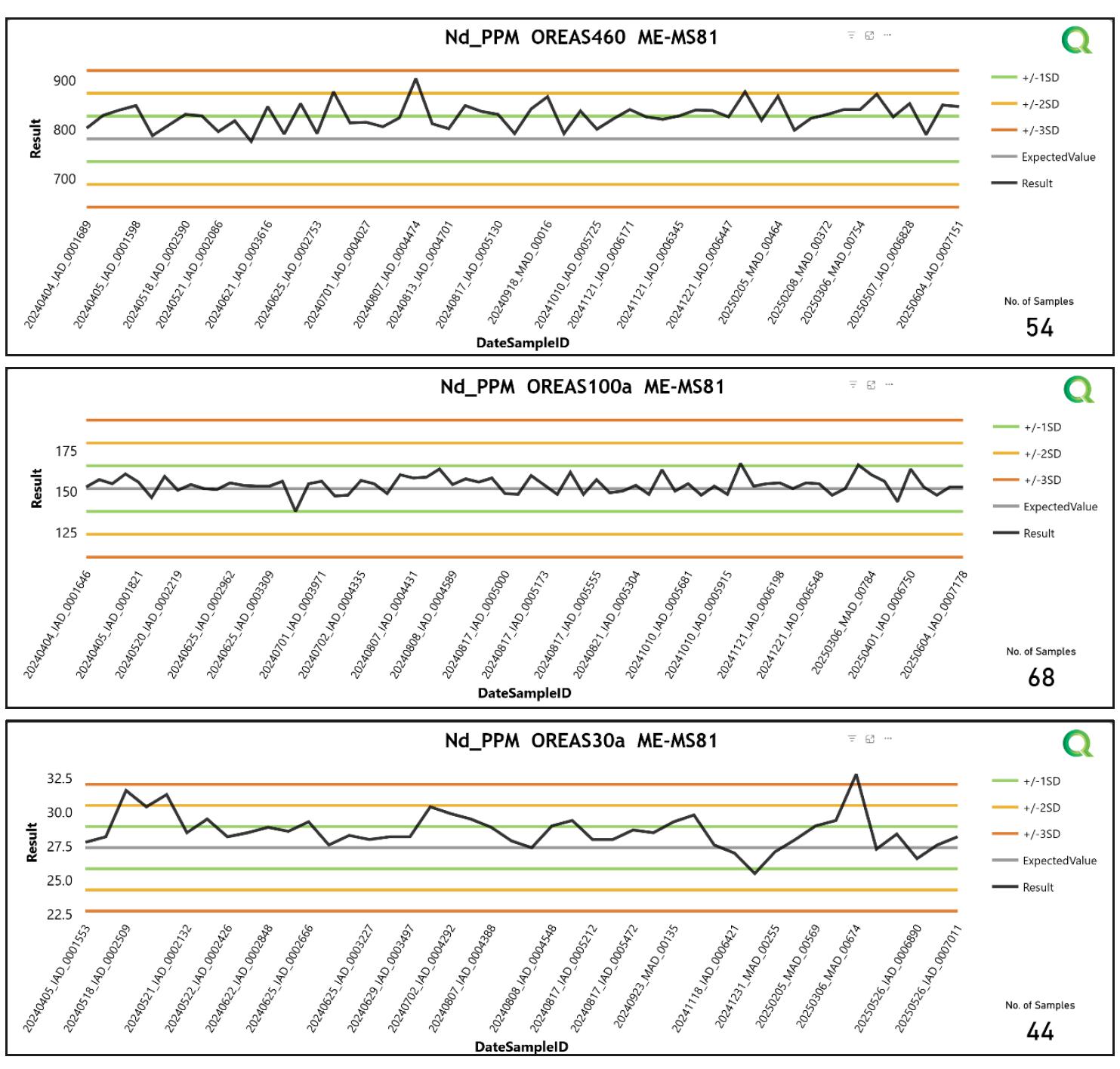
| Figure 8-2 | CRM performance charts, neodymium (sample assays from 1 September 2024 to June 10 2025) |
| Page 38 |
| ITARANTIM REE PROJECT, BRAZIL, TECHNICAL REPORT SUMMARY | R257,2025 |
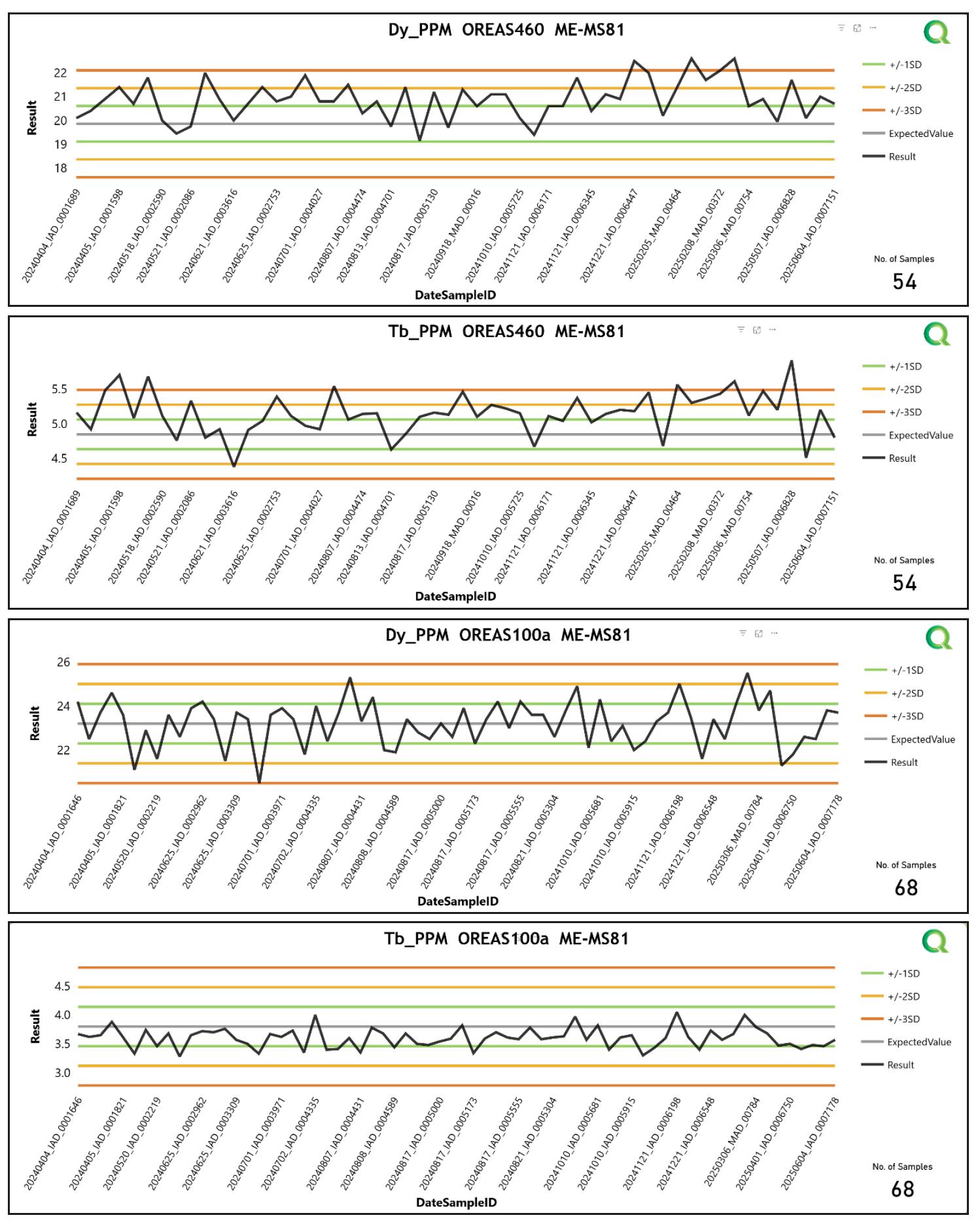
| Figure 8-3 | CRM performance charts OREAS460 and 100a, dysprosium and terbium (sample assays from September 1, 2024 to June 10, 2025) |
| 8.5.2 | Field Duplicates |
Performance charts for field duplicates for neodymium are presented in Figure 8-4. The results are reasonable and indicate that the field duplicates have performed well.
| Page 39 |
| ITARANTIM REE PROJECT, BRAZIL, TECHNICAL REPORT SUMMARY | R257,2025 |
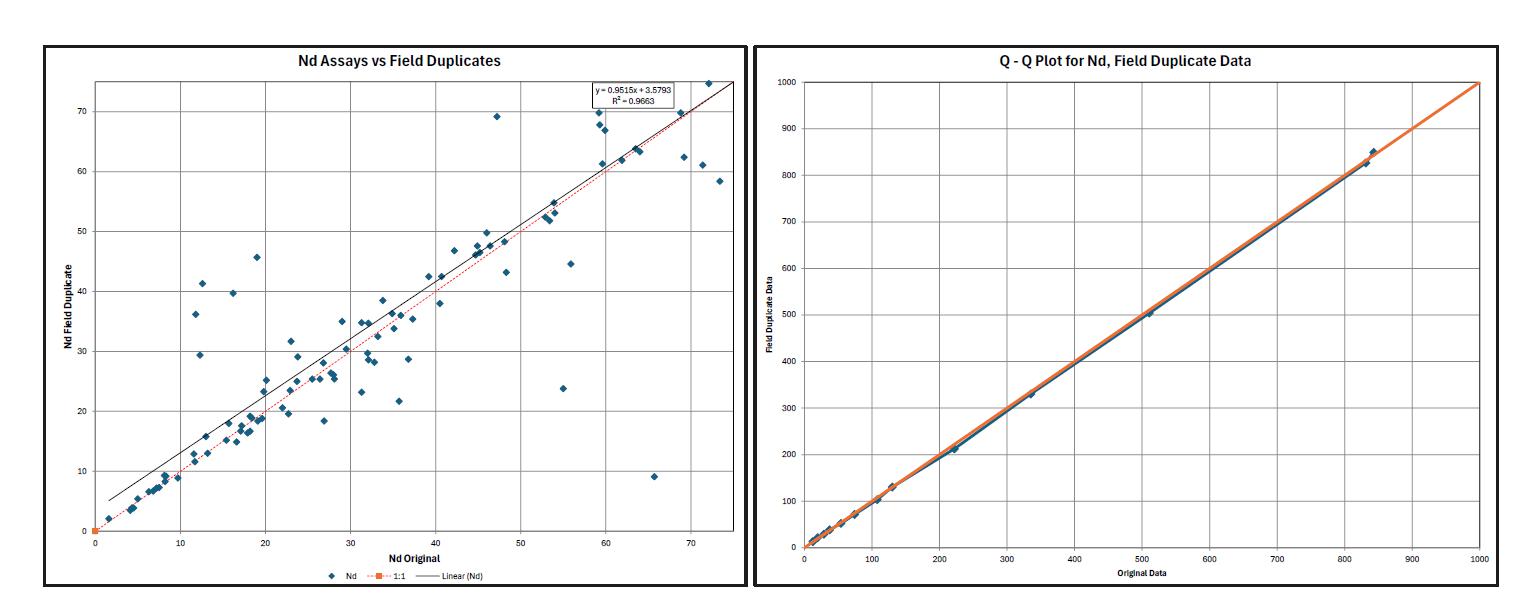
| Figure 8-4 | Scatterplot and quantile-quantile plot, field duplicates, neodymium (ppm) |
| 8.5.3 | Blanks |
Performance charts for selected REE blank assays are presented in Figure 8-5 and demonstrate reasonable performance.
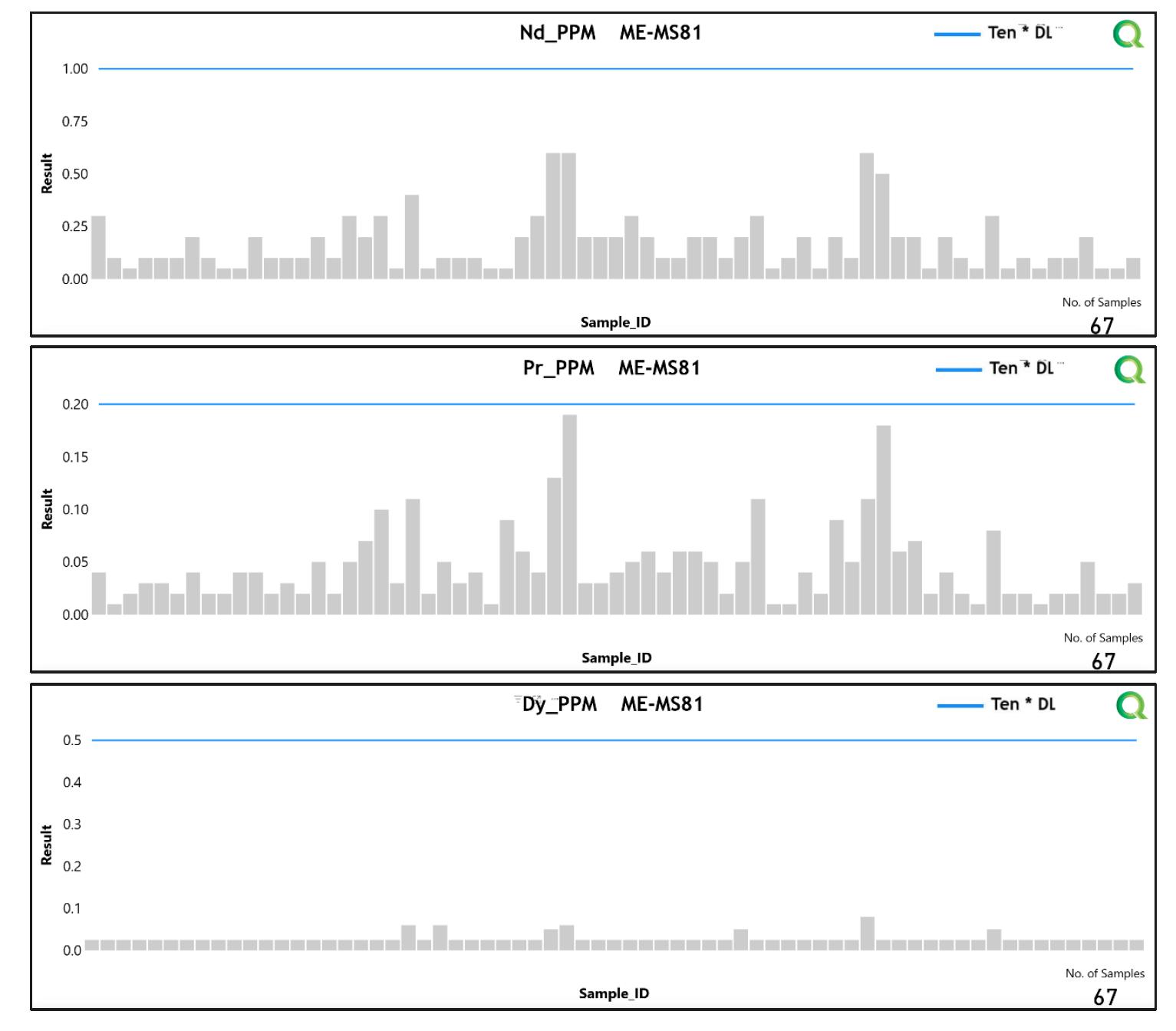
| Page 40 |
| ITARANTIM REE PROJECT, BRAZIL, TECHNICAL REPORT SUMMARY | R257,2025 |
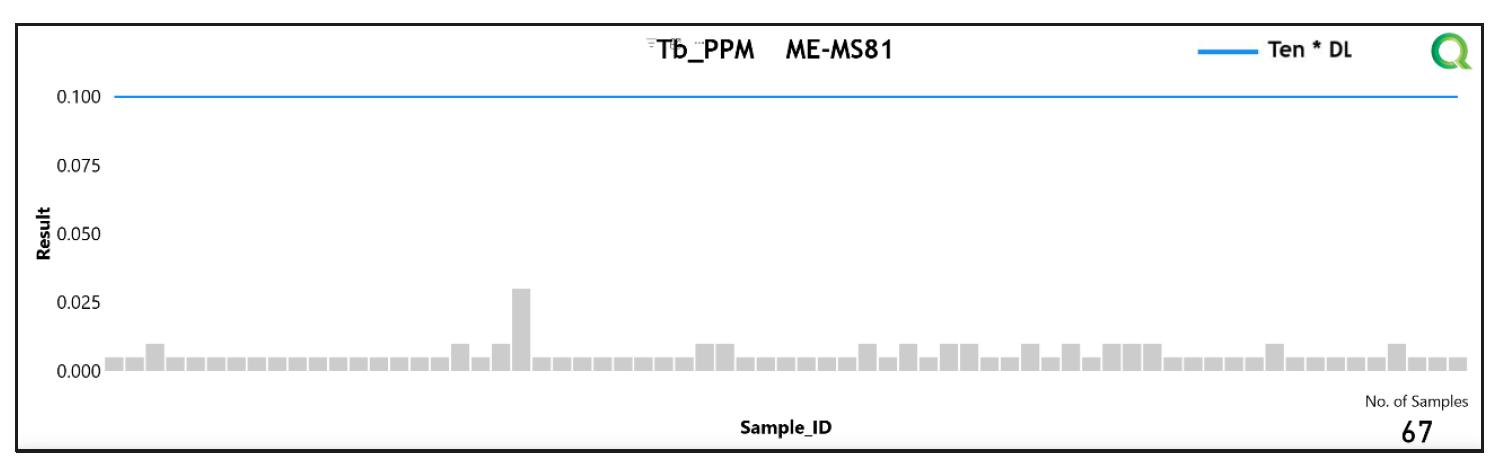
| Figure 8-5 | Performance charts, quality control blanks |
| 8.5.4 | Umpire Laboratory Results |
A subset of the early completed auger holes was submitted for elution leach testing at the laboratory, the Nuclear Technology Development Center (CDTN) in Belo Horizonte. CDTN is an ISO/IEC 17025 accredited laboratory that is independent of IMC. Initial results showed ionic adsorbed leach results of the 119 samples to be highly significant, with over 36% reporting in excess of 50% leach, and 8.4% reporting a >80% leach.
A subset of replicate samples (n=20 from four holes) was sent to the University of Brighton (UK) for umpire leach testing, with results successfully replicated (Smith and Grove, 2024). The University of Brighton is independent of IMC. IMC is uncertain of the accreditation and certification of this particular laboratory.
No other umpire testing has been conducted.
| 8.6 | Qualified Person Opinion |
In ERM’s opinion, data has been collected, sampled, subsampled, and analyzed in a manner that meets or exceeds current industry standards. Additionally, security measures around sample handling, storage and transport meet current industry standards. In addition, sample preparation, security and analytical procedures are adequate to support the MRE.
| Page 41 |
| ITARANTIM REE PROJECT, BRAZIL, TECHNICAL REPORT SUMMARY | R257,2025 |
| 9. | Data Verification |
| 9.1 | Site Visit Details |
An employee of ERM visited the Project between August 20 and 22, 2024. The following aspects of the Project development were reviewed and considered to be acceptable for supporting the MRE:
| ● | Review of topographic and geomorphic expression |
| ● | Verification of a selection of drillhole collar surveys |
| ● | Inspection of IMC sample preparation yard and review of subsampling procedures |
| ● | Discussions regarding Project development and future Mineral Resource development activities |
| ● | Form a judgement regarding reasonable prospects for economic extraction (RPEE). |
ERM did not visit the analytical laboratories, and it was recommended that IMC conducts regular inspections of the laboratory and recommends at least one visit per drill program.
| 9.2 | Database Verification and Validation |
ERM also assessed a selection of data, and relied on verification observations and analysis during the site visit, as well as independently peer reviewing the MRE and input data to satisfy themselves that the quality and quantity of input data is appropriate for the purpose of generating a MRE and supporting the data reported in this TRS.
| 9.3 | Verification of Sampling and Assaying |
| 9.3.1 | Visual Inspection |
IMC geologists and consulting exploration geologists independently verified high-grade assays against chip tray samples.
| 9.3.2 | Twin Drilling |
Hole AD-00007 was drilled within 20 m of an exploration trench, and density penetration test hole STP4, drilled within the trench wall. Geological logs of the drillhole and trench demonstrate similar depths for the weathering units. No other holes have been twinned.
| 9.3.3 | Data Excluded |
All auger drillholes up to AD-00532 are included in the Mineral Resource. Sample assays and associated drillhole geology collars and logs from hole AD-00532 onwards are not included.
The reason for this was a database cut-off date was required to allow for modelling and resource estimation to proceed at a given point in time without adding new holes. Assays were still outstanding for drill holes form AD-00532. ERM is of the opinion that the excluded data is not material to the MRE reported in this Report. All other holes drilled after AD-00532 are expected to be incorporated into the next update of the MRE.
| Page 42 |
| ITARANTIM REE PROJECT, BRAZIL, TECHNICAL REPORT SUMMARY | R257,2025 |
| 9.4 | Qualified Person Verification and Opinion |
ERM conducted a detailed independent verification of the exploration, sampling and analytical data used to support the MRE for the Itarantim Project. In summary, the verification program included:
| ● | Review of original field sampling records, chain-of-custody forms, and laboratory certificates for a representative selection of drillholes and trenches |
| ● | On-site inspection of drill collar locations using a handheld GPS, confirming positional accuracy within ±2 m of surveyed coordinates |
| ● | Confirmation that the drillhole database maintained by IMC is internally consistent and free of critical errors such as overlapping intervals, missing assays, or mismatched collar and survey data |
| ● | Reconciliation of downhole logs, assay tables, and collar files within the master database used for resource estimation |
| ● | Cross-checks of analytical results between primary (ALS Global Belo Horizonte) and secondary laboratories (SGS Brazil), confirming that assay bias is not material |
| ● | Evaluation of QAQC performance including CRMs, blanks, duplicates, and umpire analyses, all of which were found to be within acceptable industry tolerance limits (typically ±2 SD of certified values). |
The database validation process did not identify any material errors or omissions that would materially affect the MRE for the Project. Minor transcription inconsistencies were corrected in consultation with IMC’s database management team.
Based on this review, ERM is satisfied that the geological, analytical, and spatial data are accurate, complete, and reliable for use in mineral resource estimation. The data verification procedures undertaken are consistent with current industry best practice and meet the requirements under S-K 1300.
ERM notes that future infill drilling and additional dry density determinations are recommended to further enhance confidence in geological continuity and tonnage estimates; however, these limitations do not affect the validity of the current Inferred Mineral Resource classification for the Project.
| Page 43 |
| ITARANTIM REE PROJECT, BRAZIL, TECHNICAL REPORT SUMMARY | R257,2025 |
| 10. | Mineral Processing and METALLURGICAL Testing |
| 10.1 | General Summary |
| 10.1.1 | History of Processing Ionic Adsorption Deposits |
Since the discovery of ionic adsorbed REE mineralization in the Jingxi Province of China approximately 50 years ago, China has been at the forefront of research and development of processing these deposits. The first-generation leaching technology, introduced in the early 1970s, was carried out using batch leaching with NaCl. Mineral processing was by means of open cast mining, sieving and leaching with ~1M NaCl in barrels, followed by oxalic acid precipitation. The main disadvantages of this initial approach were the small scale, low yields, high lixiviant concentrations needed and poor product quality (<70% TREO content due to sodium oxalate precipitation).
Extraction of the REE from ionic adsorption deposits is currently active only in China and Myanmar. All operations today make use of ammonium sulfate ((NH4)2SO4) leach solutions, which in experimental studies can achieve 60–90% REE extraction.
| 10.1.2 | Current Processing and REE Extraction Methods |
Prior to 2008, extraction was dominated by heap or tank/pool leaching, but subsequently, in-situ leaching has become more prevalent. Both technologies produce a lower yield than laboratory leaching experiments, with high concentrations of REE remaining in tailings. In-situ leaching operations use PVC-lined injection boreholes of 0.6–0.8 m diameter and between 2 m and 6 m depth, typically with 5 m spacing. Leachate collection wells are drilled either at the base of slopes or in terraces. After a period of leachate injection, the system is typically flushed with fresh water to drive out any remaining leach solution. The REE are precipitated from the resulting solutions using either ammonium bicarbonate or oxalic acid and then calcined to produce mixed rare earth carbonate or oxides, respectively.
The ion adsorption clays in China contain between 0.05% and 0.30% REE, from which 60% to 90% occur physically adsorbed onto clay minerals, notably kaolinite and halloysite. As stated, they are recoverable by using simple inorganic salt solutions where, during the leaching process, the REEs are relatively easily transferred into solution as soluble sulfates or chlorides, depending on whether a salt solution (NaCl) or ammonium sulfate is used as lixiviant.
These solubilized REEs are then precipitated with oxalic acid to form an REE oxalate, which is then converted to mixed REOs by roasting at 900°C. Finally, the mixed REOs are separated into individual REE by dissolution in hydrogen chloride (HCl), and fractional solvent extraction is applied to separate the individual REEs. This is illustrated in Figure 10-1, showing a generic flowsheet detailing the process commonly applied in REE mineral extraction and REE concentrate processing. Early phases indicated in blue are where significant losses (low recoveries) are experienced (after Verbaan et al., 2015). The ionic side of the process is outlined in orange.
| Page 44 |
| ITARANTIM REE PROJECT, BRAZIL, TECHNICAL REPORT SUMMARY | R257,2025 |
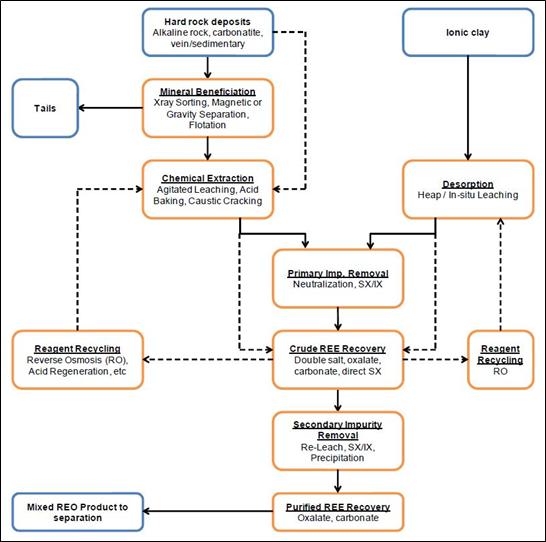
| Figure 10-1 | Generic flowsheet detailing processes commonly applied in REE mineral extraction and REE concentrate processing (after Verbaan et al., 2015) |
Research conducted on the desorption of REE from clays via ion-exchange leaching has indicated that, regardless of the initial content, not all REE reach similar extraction levels. This is well illustrated in the cross-section displayed in Figure 10-5 from Itarantim, where these differences in leachability are indicated. It has been reported the amount of trivalent REE ions that are adsorbed on smectite and kaolinite is inversely proportional to the ionic radii (Pavez et al., 1996). Therefore, the heavy REEs (higher atomic numbers from gadolinium to lutetium) are adsorbed preferentially compared to the light REEs (lanthanum to europium).
Ease of extraction therefore will occur in the following manner over time:
| ● | Sc > La > Ce > Pr > Nd > Sm > Eu > Gd > Tb > Dy > Ho > Y > Er > Tm > Yb > Lu. |
While most base metals occur as part of the mixed mineral phase and do not leach out during the mild ion-exchange REE leaching conditions, aluminum, especially and to a lesser extent calcium and magnesium, constitute the major impurities physically adsorbed on clays that are liable to get desorbed during the process along with the REE.
| Page 45 |
| ITARANTIM REE PROJECT, BRAZIL, TECHNICAL REPORT SUMMARY | R257,2025 |
| 10.1.3 | Itarantim Ionic Adsorption Deposit |
In the Project areas visited in the field by IMC and ERM, the outcropping rocks, as well as the climate, slope and geomorphological setting, are all supportive of the presence of ionic adsorption deposit REE mineralization at Itarantim. Leach testing of representative material also supports the presence of such mineralization. A review of the geomorphology indicates that the area is undergoing erosion, and that mass slumping is an important means of sediment transport. This has resulted in a complex regolith being developed with the possibility of truncated regolith profiles and the possible movement of saprock and saprolite being incorporated above mature pedolith zones (Figure 10-2).
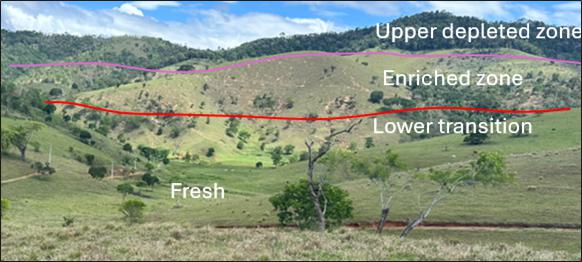
| Figure 10-2 | The north-facing slope of Block D with exposed mineralized saprolite domains in truncated regolith |
| 10.2 | Metallurgical Testwork for Itarantim Project |
Several phases of metallurgical testwork have been carried out by IMC during the Project investigation. These phases can be broken down by: (i) early verification; (ii) progress monitoring and selective sampling; and (iii) channel sampling. The total amount of leach testwork completed on the Project includes 142 auger holes and 3 channel samples for a combined total of 1,917 samples spanning the resource area (Table 10-1, Figure 10-3).
| Table 10-1 | Summary of metallurgical sampling undertaken on the Itarantim Project to date |
| Sample phase | No. holes | No. samples | Comment |
| IAD verification | 9 | 119 | Used to verify ionic leachability and determine leach % |
| Verification umpires | 4 | 20 | Umpire of IAD verification and additional XRD |
| XRD | 9 | 20 | Kaolinite/halloysite dominant clay mineralogy |
| Monitoring and selective | 142 | 1,917 | Sampling throughout the duration of drilling and later selected MREO domains |
Note: IAD = ionic adsorption deposit; XRD = x-ray diffraction.
| Page 46 |
| ITARANTIM REE PROJECT, BRAZIL, TECHNICAL REPORT SUMMARY | R257,2025 |
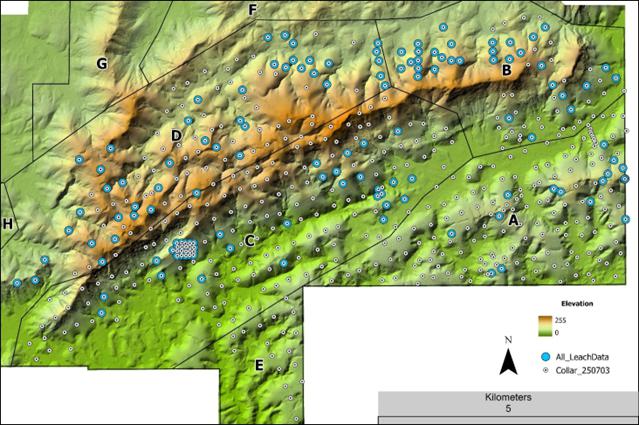
| Figure 10-3 | Complete map of samples selected for leach data across the resource area |
Source: IMC, 2024
When presenting leach testwork, CeO2 is not included in leach results due to Ce3+ being easily oxidized by atmospheric oxygen (O2) to Ce4+ and the subsequent precipitation of the mineral cerianite (CeO2), which is not recoverable by ion-exchange leaching. Therefore, all leach testwork is quoted as TREE-Ce leach %, LREE-Ce leach %, and HREE leach %.
Statistical investigation utilizing histograms and log probability plots of the leach data indicates a common break at 40 leach % for both LREE and HREE (Figure 10-4). This data also indicates there is a greater proportion of HREE >40 leach % than there is LREE. Composites of both LREE and HREE >40 leach %, constrained within the ≥630 ppm mineralized envelope, were made, allowing an average leach % of intersections, representative of modeled mineralization, to be quantified and graphically displayed.
| Page 47 |
| ITARANTIM REE PROJECT, BRAZIL, TECHNICAL REPORT SUMMARY | R257,2025 |
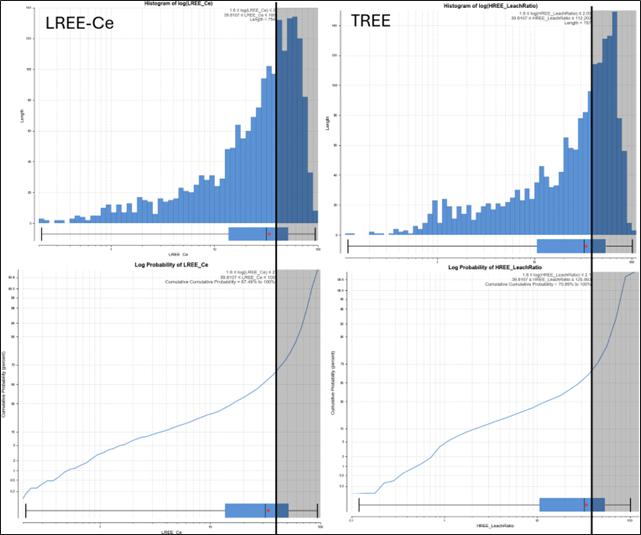
| Figure 10-4 | Statistical analysis of leach % data for both LREE and HREE, showing a break at 40 leach % utilized for compositing intersections within the mineralized envelope |
| 10.3 | Early Verification Metallurgical Testwork |
The early verification metallurgical testwork was executed by IMC to determine the nature of the REE mineralization and if it was amenable to leaching by standard lixiviants such as weak solutions of ammonium sulfate solution or sodium chloride. This would determine if the mineralization could be classified as an IAC deposit. A total of 114 samples from 9 auger holes (AD-00001 to AD-00009) were submitted for elution leach testing at the laboratory of the CDTN in Belo Horizonte. The leached solution was analysed by SGS laboratories utilizing their ICP95A package (lithium borate fusion with ICP-MS). The ratio of leach data/original assay was used to calculate the leach %. These test samples were specifically selected as representative of the various types and styles of REE mineralization at Itarantim.
A composite of the results obtaining TREE-Ce >40% leach demonstrated a mean leach % of 60%, with a minimum leach % of 45% and maximum leach % of 74%. These results demonstrate that the REE mineralization encountered in the drilling may be classified as ionically adsorbed, and the mineral system classified as an ionic adsorption deposit, with the leach % achieved in line with current producers such as Longnan in China (Li et al., 2017).
| Page 48 |
| ITARANTIM REE PROJECT, BRAZIL, TECHNICAL REPORT SUMMARY | R257,2025 |
A further 21 duplicate samples were sent to the University of Brighton (UK) for additional testing and verification including x-ray diffraction (XRD) (Table 10-2) and near infrared (NIR) for clay mineral identification. The results of this work were positive, with the shallow parts of the regolith largely composed of kaolinite and/or halloysite, being the most important clay minerals which host adsorbed REE. Furthermore, the leach studies were successfully replicated, verifying the initial testwork undertaken by CDTN, as discussed in Section 8.5.4 (Smith and Grove, 2024).
| Table 10-2 | Summary of XRD results undertaken at Brighton University |
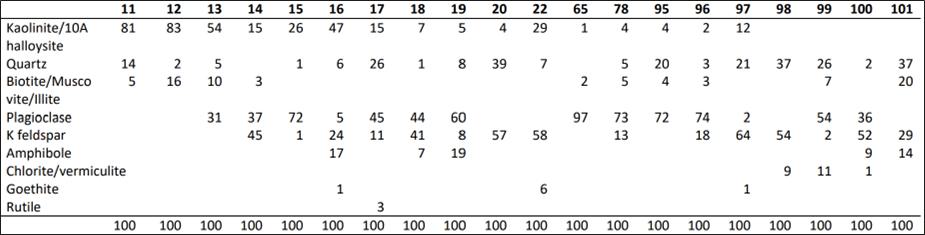
Additional studies on cationic exchange capacities as well as settling were completed by Smith and Grove (2024). Settling tests allow for an estimation of porosity and hence lixiviant activity to be estimated. All these studies confirm the presence of ionic leachable clays as described by Li et al. (2017).
| 10.4 | Progress Monitoring and Selective Sampling |
After confirmation of ionic adsorption deposit and positive leach % ratios, additional samples were selected for leach analysis, as well as select sampling of high-grade results. All further progress and selective sampling analyses were undertaken by ALS Global utilizing their ME-MS19 ammonium sulfate leach and analysis package. ALS is independent of IMC.
A total of 1,917 samples from 142 auger holes and channel samples were submitted to ALS for ME-MS19 analysis. All data was combined for statistical analysis of the leach data and for the preparation of a summary table of all leach testwork results (Table 10-3). In this summary, leach results were composited to a threshold of >40 leach %, within the ≥630 ppm mineralized envelope, for both LREE-Ce and HREE. An average of the composite intersection is a guide to represent the overall leachability of the LREE-Ce and HREE groups within the mineralized domain. The percentage of leach data >40 leach % achieved within the ≥630 ppm TREO envelope could then be quantified (Table 10-3) and visually displayed. Figure 10-5 to Figure 10-8 (source: IMC, 2024) present three typical leach percentage profiles, for low, moderate and high recoveries.
These test samples were specifically selected as representative of the various types and styles of REE mineralization at Itarantim.
| Table 10-3 | Summary of average (Average L%), minimum (Minimum L %) and maximum (Maximum L %) leach % achieved from all leach samples of >40% leach analysed on the Project to date |
| LREE-Ce | HREE | ||||
| Average L % | Minimum L % | Maximum L % | Average L % | Minimum L % | Maximum L % |
| 55 | 40 | 80 | 58 | 41 | 77 |
| Page 49 |
| ITARANTIM REE PROJECT, BRAZIL, TECHNICAL REPORT SUMMARY | R257,2025 |
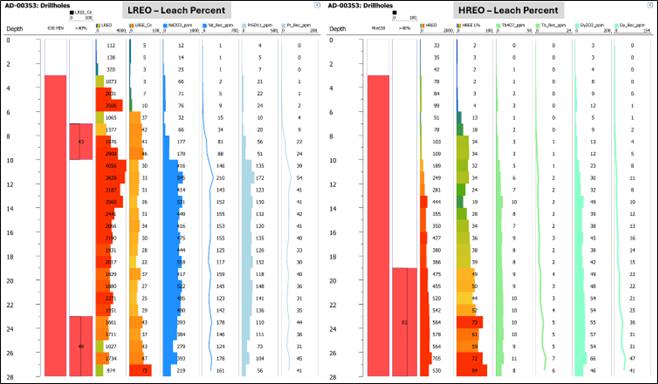
| Figure 10-5 | REE grade and leach % profile for drillhole AD-00353, representing a low percentage of intersection leaching |
Notes: Separate profiles for LREE-Ce and HREE. Column 1 – Intersection inside ≥630 ppm TREO grade shell (solid red), and average REO (ppm) grade where leach % >40% (black polygon). Column 2 – Percentage of Column A, where leach % >40%; therefore, for HREE, 36% of the drillhole samples inside the TREO envelope have leach % >40%. Column 3 – Average leach % of samples with leach % >40%. Column 4 – Leach % per sample. Column 5 – LREO grade profiles. Column 6 – HREO grade profiles.
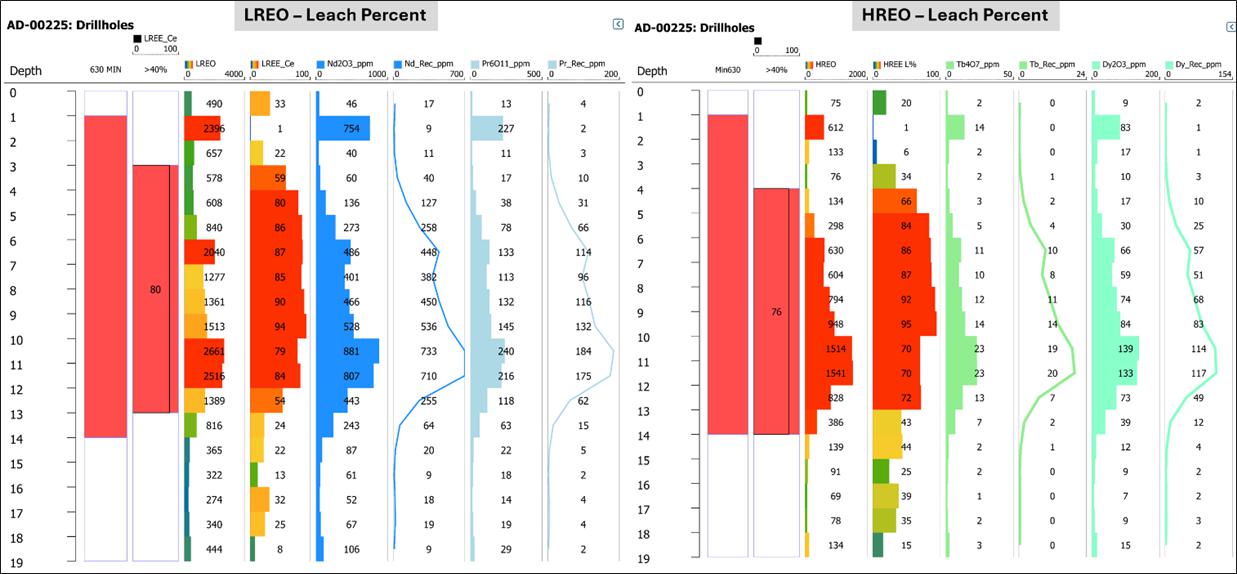
| Figure 10-6 | REE grade and leach % profile for drillhole AD-00225, representing a moderate percentage of intersection leaching but with high leach % |
Note: Refer to Figure 10-5 for footnotes.
| Page 50 |
| ITARANTIM REE PROJECT, BRAZIL, TECHNICAL REPORT SUMMARY | R257,2025 |
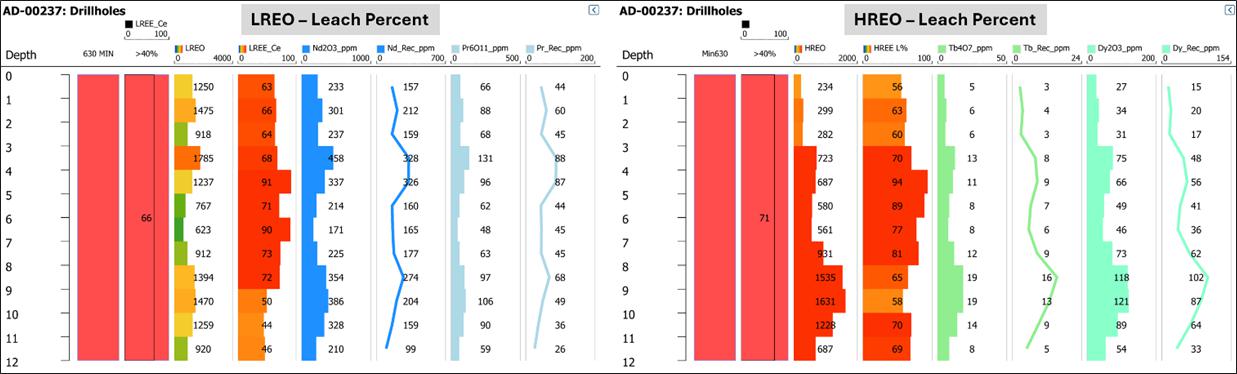
| Figure 10-7 | REE grade and leach % profile for drillhole AD-00237, representing a case of 100% of intersection leaching with high leach % |
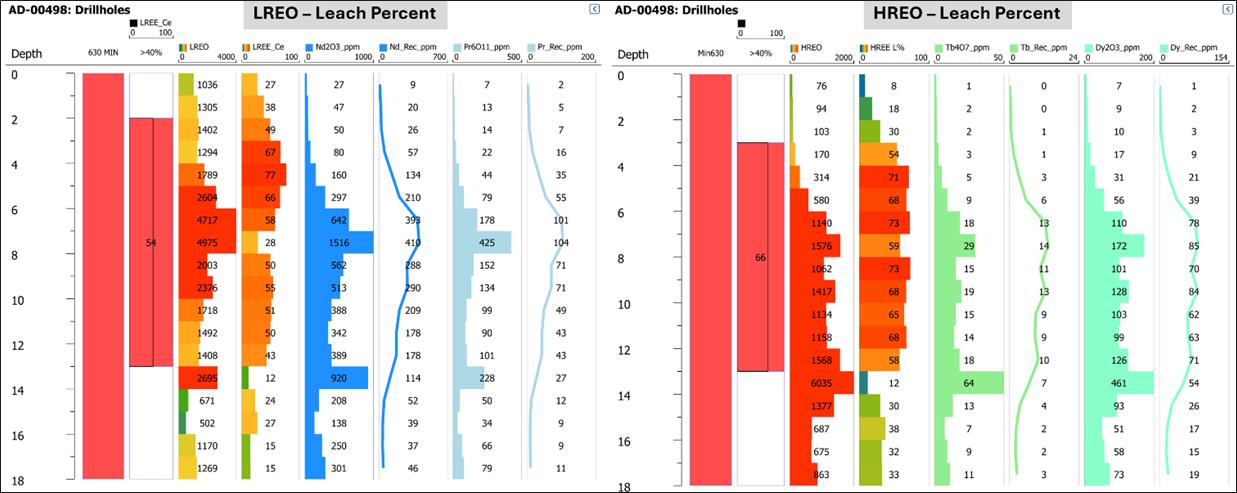
| Figure 10-8 | REE grade and leach % profile for drillhole AD-00498 for representation of moderate leach % and high grade from the recently drilled extension zone of Block B |
Note: Refer to Figure 10-5 for footnotes.
| 10.5 | Channel Sampling |
Three channel profiles were collected from a trench located in the eastern part of Block A (Figure 7-3). Sample intervals of 1 m were taken over channel sample lengths of between 3 m and 5 m for a total of 13 samples. The channel samples obtained an average leach % of 70% for both LREE and HREE, with a range between 55% and 84% for LREE and 56% and 85% for HREE (Table 10-4) (channel 2, Figure 10-9). Samples from channel 1 (3 m) and channel 3 (5 m) showed consistent results compared to channel 2.
These trench channel samples were specifically selected as representative of the various types and styles of REE mineralization at Itarantim.
| Table 10-4 | Summarized ranges of channel samples from Block A |
| LREE-Ce | HREE | ||||
| Average L % | Minimum L % | Maximum L % | Average L % | Minimum L % | Maximum L % |
| 70 | 55 | 84 | 70 | 56 | 85 |
| Page 51 |
| ITARANTIM REE PROJECT, BRAZIL, TECHNICAL REPORT SUMMARY | R257,2025 |
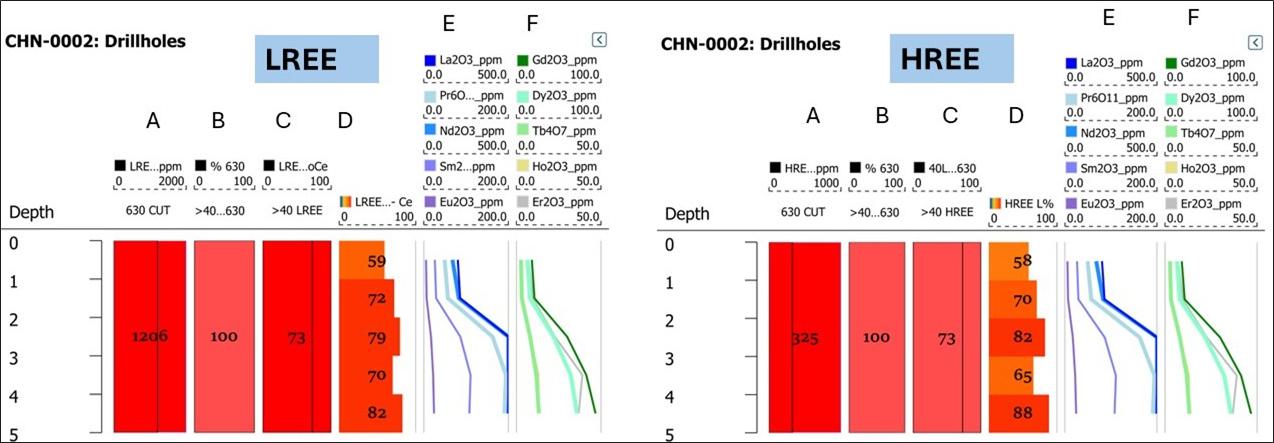
| Figure 10-9 | REE grade and leach % profile for channel 2 |
Note: Refer to footnotes for Figure 10-5 for explanation.
| 10.6 | Qualified Person Opinion and Recommendations |
ERM is of the opinion that the leach recovery data completed to date is adequate for the purposes of generating a MRE for the Project. However, additional petrological and recovery studies should be completed on the regolith material. The majority of gangue material in the samples consists of clay minerals such as kaolinite, iron oxides and hydroxides (largely goethite and hematite) as well as quartz and manganese oxides.
Petrographic studies focused on REE mineral deportment should be considered in the early stages of any exploration stage property. Due to the fine-grain size and omnipresent iron and manganese oxide phase of these deposits, standard petrography is of limited use. A Scanning Electron Microscope (SEM) study has been highlighted as of great importance for the study of the microcrystalline aggregates (Tassinari et al., 2001), as the crystal grains are commonly in the order of a few microns in diameter. These studies are relatively low-cost and are very informative. Additionally, the use of NIR for identifying both clay mineral phases and their crystallinity is a quick and effective method of identification.
These studies should be applied to all mineral extraction; however, it is vital that they are carried out as soon as possible, as they are of significant importance in REE mineral processing. It is imperative that the scheduled geometallurgy studies review both geological and metallurgical inputs (Woodall, 2007).
| Page 52 |
| ITARANTIM REE PROJECT, BRAZIL, TECHNICAL REPORT SUMMARY | R257,2025 |
| 11. | Mineral Resource Estimate |
| 11.1 | Data Import and Validation |
Drillhole data tables provided by IMC to ERM are presented in Table 11-1, and geological models presented in Table 11-2. After completing detailed data verification and due diligence checks of the drill hole database and reviewing the geological models, ERM takes full responsibility for the MRE presented in this Report.
| Table 11-1 | Drillhole database tables |
| IMC filename | Description | ERM filename | Datamine file |
| collar_ontopo.csv | Drillhole collars | Collar_1106.csv | Col.s |
| DHAssays.csv | Assays | DHAssays_1106.csv | Ass.s |
| Lithology.csv | Geological logs | Lithology_1106.csv | Lith.s |
| DHAssaysLeachRatio.csv | Leach results | DHAssaysLeachRatio_1106.csv | Leach.s |
| Table 11-2 | Geology model filenames |
| Leapfrog | Datamine (*tr/pt) | Description |
| Itarantim_250606.dtm | minz630_ | TREO envelope with lower TREO limit 630 ppm |
| Itarantim_250606_topoEx.dtm | Topo_2025_ | LiDAR surface as at April 2025 |
| Model 250618_flagged | It2506md | Resource model (with some domain and field names modified) |
Drillhole data were imported into Leapfrog, with validation tools provided by Leapfrog used to check for:
| ● | Absent collar data |
| ● | Multiple collar entries |
| ● | Overlapping intervals |
| ● | Negative sample lengths |
| ● | Sample intervals which extended beyond the hole depth defined in the collar table. |
The elemental assay fields were converted to oxides using an appropriate stoichiometric equation. IMC used the drillhole files for geological modeling and as a basis for grade interpolation.
ERM followed a similar process for importing the drillhole database tables into Datamine, with Datamine file “asslth.d” created, containing assay data. No errors were noted.
| 11.2 | Geological Modeling |
| 11.2.1 | Software |
Compilation and viewing of drilling, mapping, and sampling data in 2D utilized ArcGIS Pro. Modeling of geological and assay data in 3D utilized Leapfrog Geo version 2023.2.3.
Geostatistical analyses were conducted using Snowden Supervisor software and GeoAccess Professional. Due diligence reviews of the IMC Leapfrog resource model were completed by ERM using Datamine Studio RM (Datamine) software.
| Page 53 |
| ITARANTIM REE PROJECT, BRAZIL, TECHNICAL REPORT SUMMARY | R257,2025 |
| 11.2.2 | Preliminary Statistical Assessment |
Preliminary statistical analysis was undertaken on assay data to determine the cut-off to be used for modeling of the mineralization (TREO) envelope. Statistical analysis was undertaken utilizing TREO to ensure all REEs were captured within the mineralization envelope and estimated at the block model stage. A log histogram and probability plot of TREO indicated that a lower cut-off grade of 630 ppm TREO would be appropriate in delineating TREO mineralization boundaries (Figure 11-1). This is the same cut-off grade as was used to support the September 2024 historical estimate, and ERM still considers it reasonable to continue using the same cut-off grade for the current MRE.
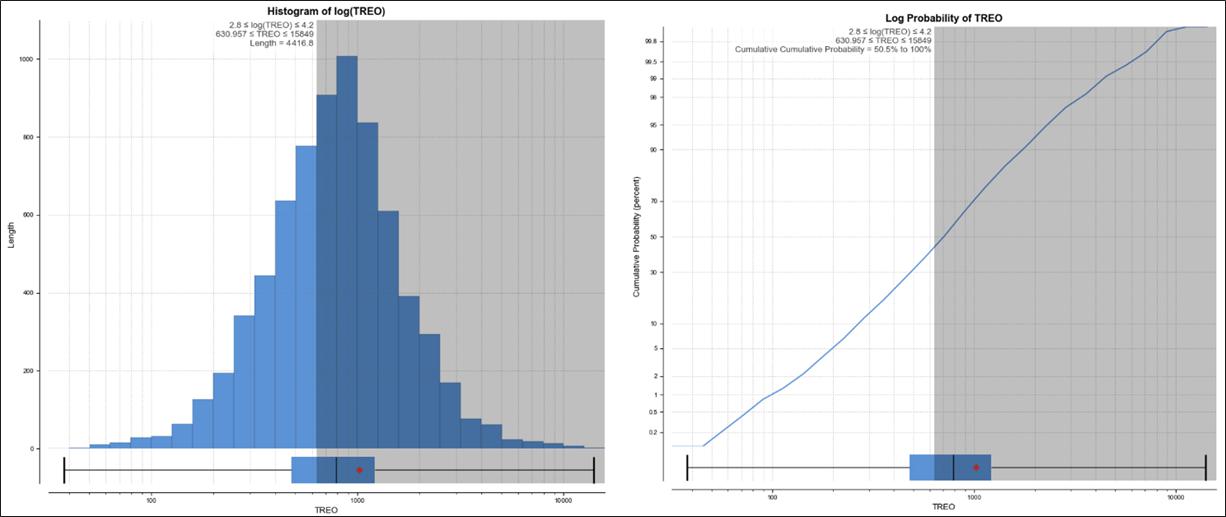
| Figure 11-1 | Histogram and log probability plots for TREO ppm utilized for preliminary statistical analysis of assay data |
| 11.2.3 | Lithology, Structure and Alteration |
As mineralization is hosted in the regolith, regolith domains were identified on the grounds of whole rock element (K2O, Na2O, Al2O3, CaO, MgO, Fe2O3 and MnO) and TREO geochemical profiles. Units defined within domains were identified as (1) Depleted Zone (2) Upper Transition Zone, (3) Enriched Zone, (4) Lower Transition Zone, and (5) Fresh Rock (Figure 11-2).
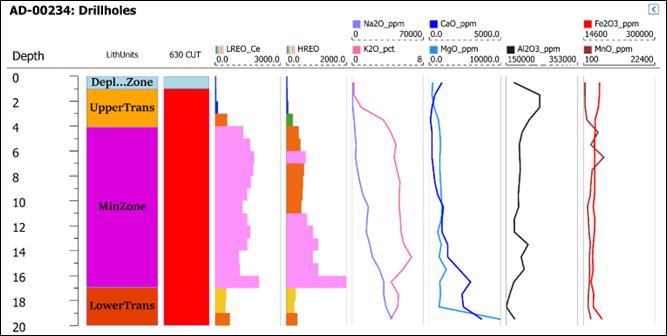
| Page 54 |
| ITARANTIM REE PROJECT, BRAZIL, TECHNICAL REPORT SUMMARY | R257,2025 |
| Figure 11-2 | Example of identified regolith units within the mineralized envelope |
Source: IMC, 2024
Subsequently, it was determined that the drillhole spacing and resolution of the block model did not support sub-domaining of the mineralized envelope and subsequent block model reporting per unit. As a result, the boundaries used for modeling were simplified into Hanging Wall (Depleted Zone), Min 630 (630 cut + Upper Transition Zone + Lower Transition Zone) and Footwall (Fresh) (refer Figure 11-3).
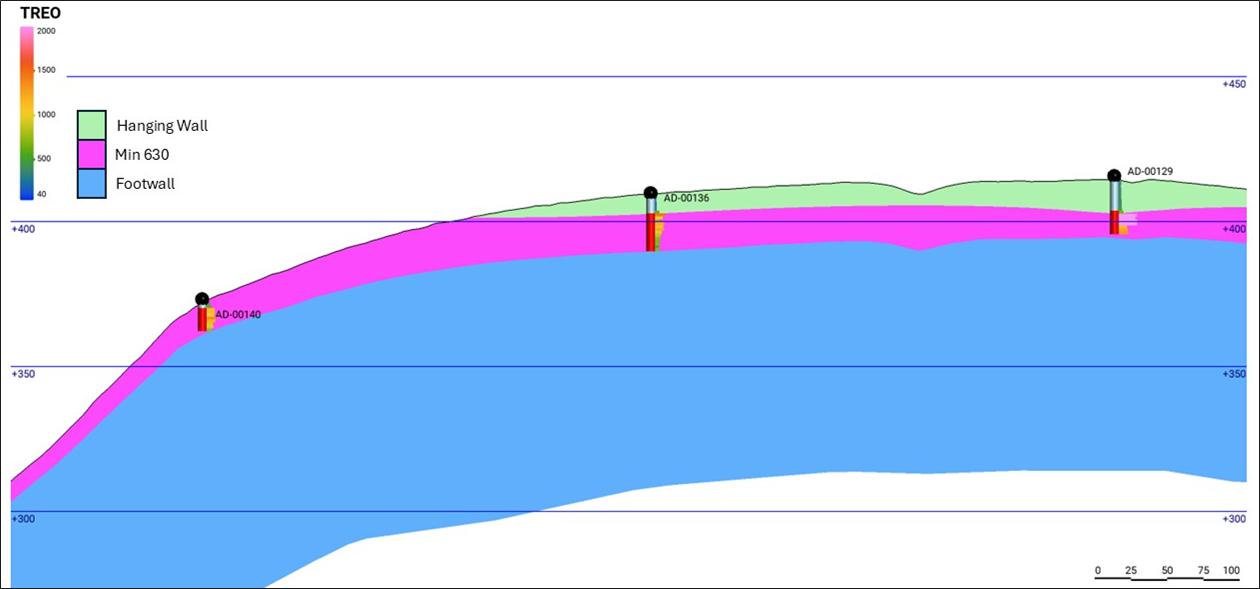
| Figure 11-3 | Representative cross-section of geological models showing mineralized envelope, hanging wall and footwall zones |
Source: IMC, 2024
There are no apparent structural associations associated with this regolith-hosted mineral system. It may be possible that structural relationships within the protolith exist, and which may have bearing on protolith mineralogy and subsequent saprolite grade; however, this is yet to be determined for the Project. Syn and post-mineralization processes that affect grade distribution and subsequent modeling are controlled by weathering, such as slumping and truncation of the regolith profiles through drainage development.
| 11.2.4 | Mineralization |
TREO composite lengths were generated utilizing 3 m intervals with a maximum included waste of 3 m and a 630 ppm TREO lower cut-off grade. Once composite intersections were generated, the top and bottom points of the 630 ppm TREO composite lengths were produced and utilized in generating the hanging wall and footwall boundaries of the mineralized envelope.
The footwall surface was either snapped to the end of hole, if 630 ppm mineralization persisted to the end of hole, or to the base of the 630 ppm cut interval if mineralization terminated prior to the end of hole. The topography was utilized as a reference surface to extrapolate between drillholes, defining the footwall geometry.
The hanging wall surface was defined by either the topography, if mineralization persisted to the top of hole, or to the top of 630 ppm cut interval if the mineralization is intersected lower than the top of the hole. The hanging wall domain effectively represents the Depleted Zone and was removed from the mineralization model and excluded from the estimation process.
The hanging wall and footwall surfaces were combined to produce a solid envelope representing the ≥630 ppm TREO population.
| 11.2.5 | Weathering |
Weathering has resulted in the IAC hosted deposit to be located within the regolith overlying an intrusive alkali granite of the Itarantim Complex. As a result, no specific weathering horizons are identified, nor modeled, nor are they relevant to modeling, for this style of deposit. The units within the saprolite zone of the regolith are of interest as these relate to grade and recovery. Closer infill drill spacing is required to interpret these stratigraphic internal domains.
| Page 55 |
| ITARANTIM REE PROJECT, BRAZIL, TECHNICAL REPORT SUMMARY | R257,2025 |
| 11.3 | Statistical and Geostatistical Analysis |
| 11.3.1 | Summary |
Statistical assessment of the input drill data was completed prior to grade estimation to understand the data grade distribution and populations. Drill sample data were statistically reviewed, and variograms were modeled to determine spatial continuity for all grade variables.
Statistical analyses were carried out using GeoAccess Professional and Snowden Supervisor software. ERM provided relevant results to IMC to enable them to carry out the grade interpolation. All statistical results were shared and discussed with IMC.
| 11.3.2 | Data Coding and Composite Length Analysis |
Datamine drillhole file “asslth.d” was flagged within the mineralization domain presented in Table 11-2 with the output Datamine file “assay.z” created.
Rare earths are grouped into HREO and LREO on the following basis:
| ● | LREO: La2O3, CeO2, Pr6O11, Nd2O3, Sm2O3, Eu2O3 |
| ● | HREO: Tb4O7, Dy2O3, Ho2O3, Er2O3, Tm2O3, Yb2O3, Lu2O3, Gd2O3; + Y2O3. |
A statistical analysis of sample lengths inside the mineralization domain was carried out to determine the appropriate composite length. All drillholes were sampled to lengths of 1 m and therefore 1 m was selected as the composite length.
| 11.4 | Statistical Analysis and Data Handling |
Statistical analyses were initially carried out for all REOs and other selected oxides using non-composited sample data, which was used to carry out final data verification, and for validation of the composited sample data. The statistical analyses presented in this section are from the composited and domained data within the ≥630 ppm TREO domain. Histograms and log probability plots were prepared and reviewed, which assisted with decision making on the combination of sample populations.
Statistical plots were generated by ERM in Microsoft Excel spreadsheets and relevant statistical plots are provided below.
When presenting statistical results for REO in ionic adsorption deposits, CeO2 is not included due to Ce3+ being easily oxidized by atmospheric oxygen (O2) to Ce4+ and the subsequent precipitation of the mineral cerianite (CeO2), which is not recoverable by ion-exchange leaching. Therefore, all leach testwork is presented as leach percentage quoted as TREE-Ce leach %, LREE-Ce leach %, and HREE leach %.
Composited sample data for TREO within the mineralized envelope are presented as a log histogram and as a normal histogram in Figure 11-4 and for LREO-CeO2 and HREO in Figure 11-5 and Figure 11-6. Histograms for other REOs, U3O8 and ThO2 were also generated.
The additional drilling supporting the MRE accounts for a 20% increase in the number of samples contained within the mineralization envelope, compared to earlier estimates. The location of the additional drilling is presented in Figure 7-6.
| Page 56 |
| ITARANTIM REE PROJECT, BRAZIL, TECHNICAL REPORT SUMMARY | R257,2025 |
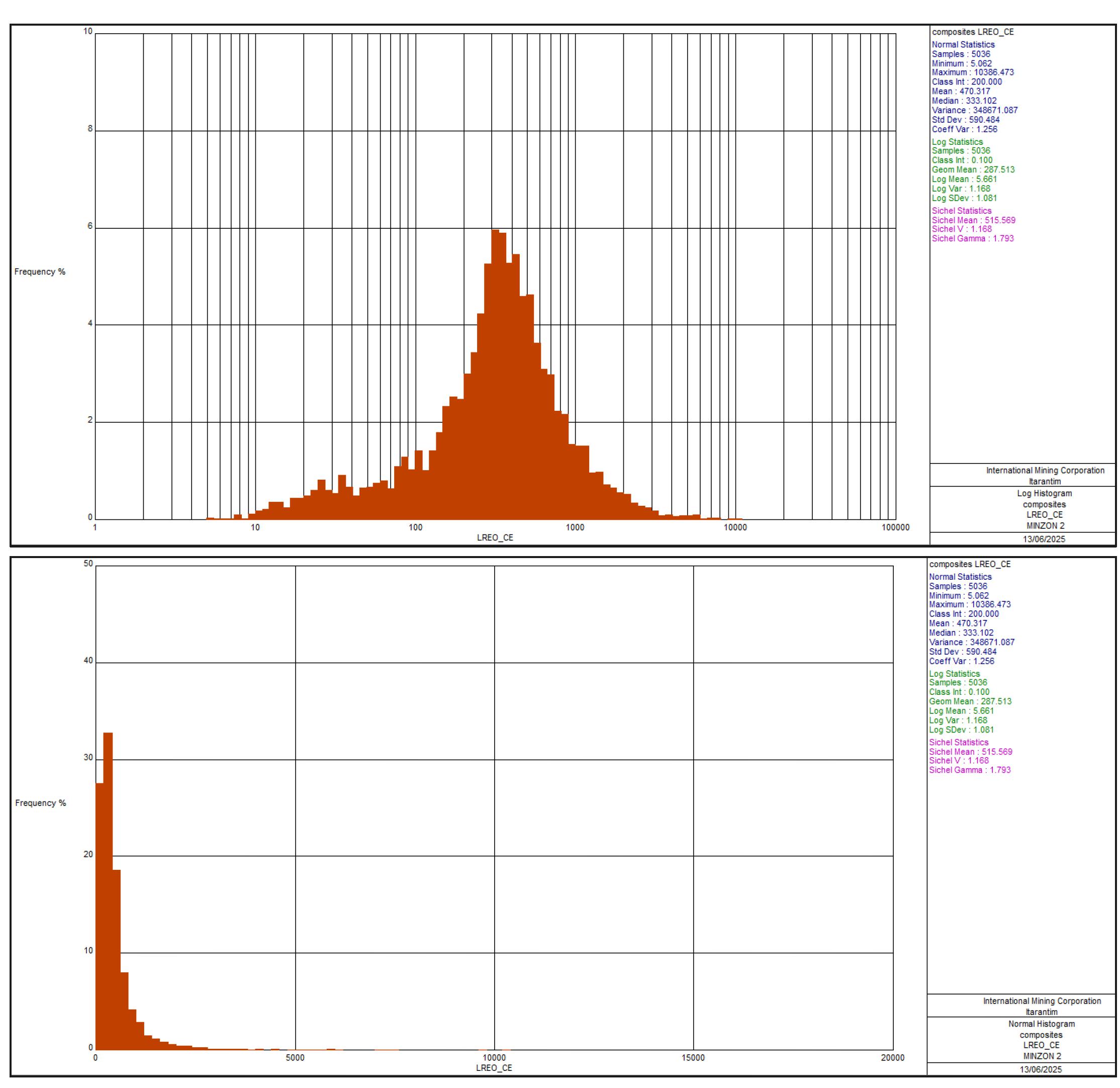
| Figure 11-4 | Log histogram (top) and normal histogram for TREO, from composited sample data in mineralization envelope |
| Page 57 |
| ITARANTIM REE PROJECT, BRAZIL, TECHNICAL REPORT SUMMARY | R257,2025 |
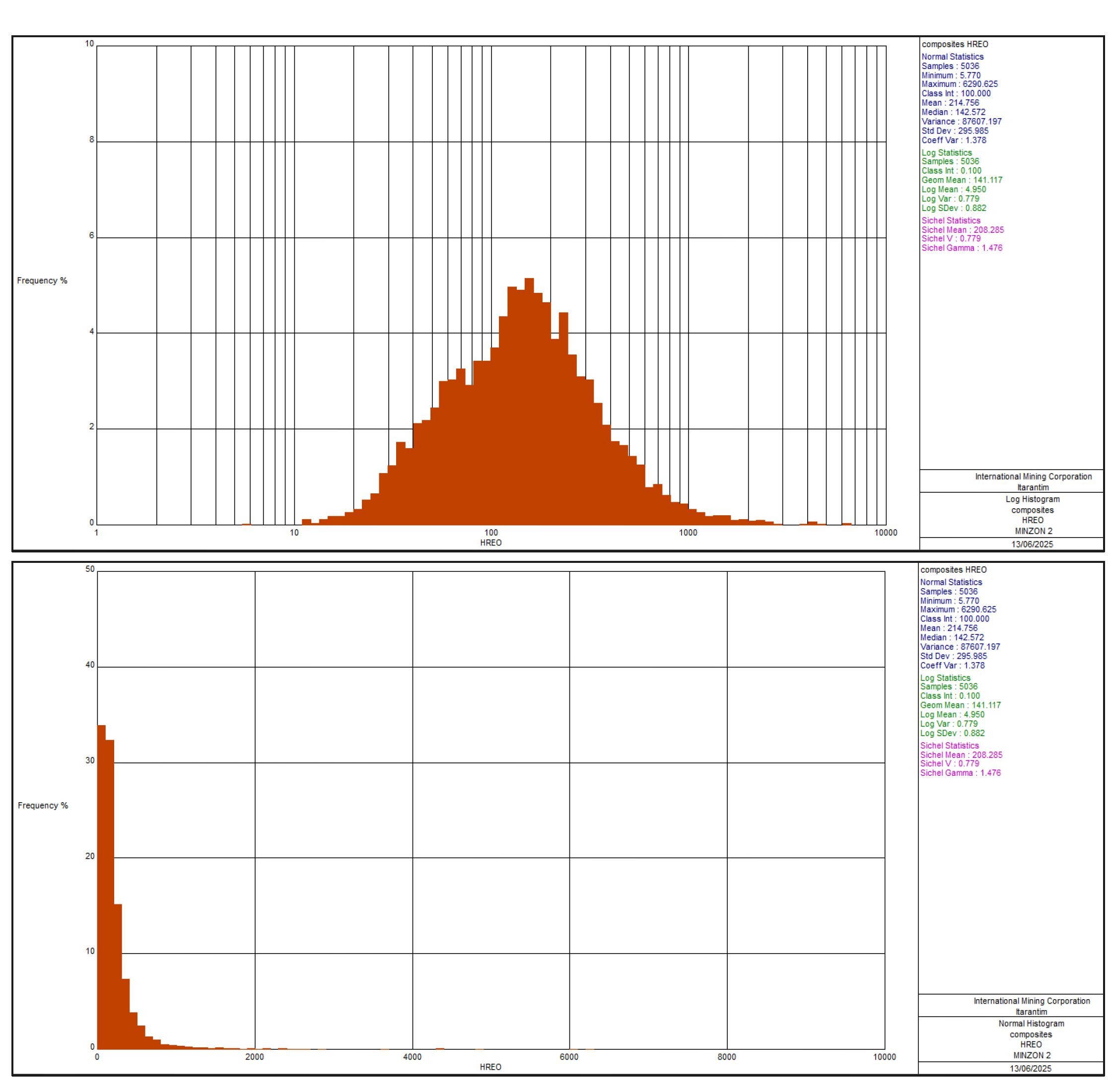
| Figure 11-5 | Log histogram (top) and normal histogram for LREO-CeO2, from composited sample data in mineralization envelope |
| Page 58 |
| ITARANTIM REE PROJECT, BRAZIL, TECHNICAL REPORT SUMMARY | R257,2025 |
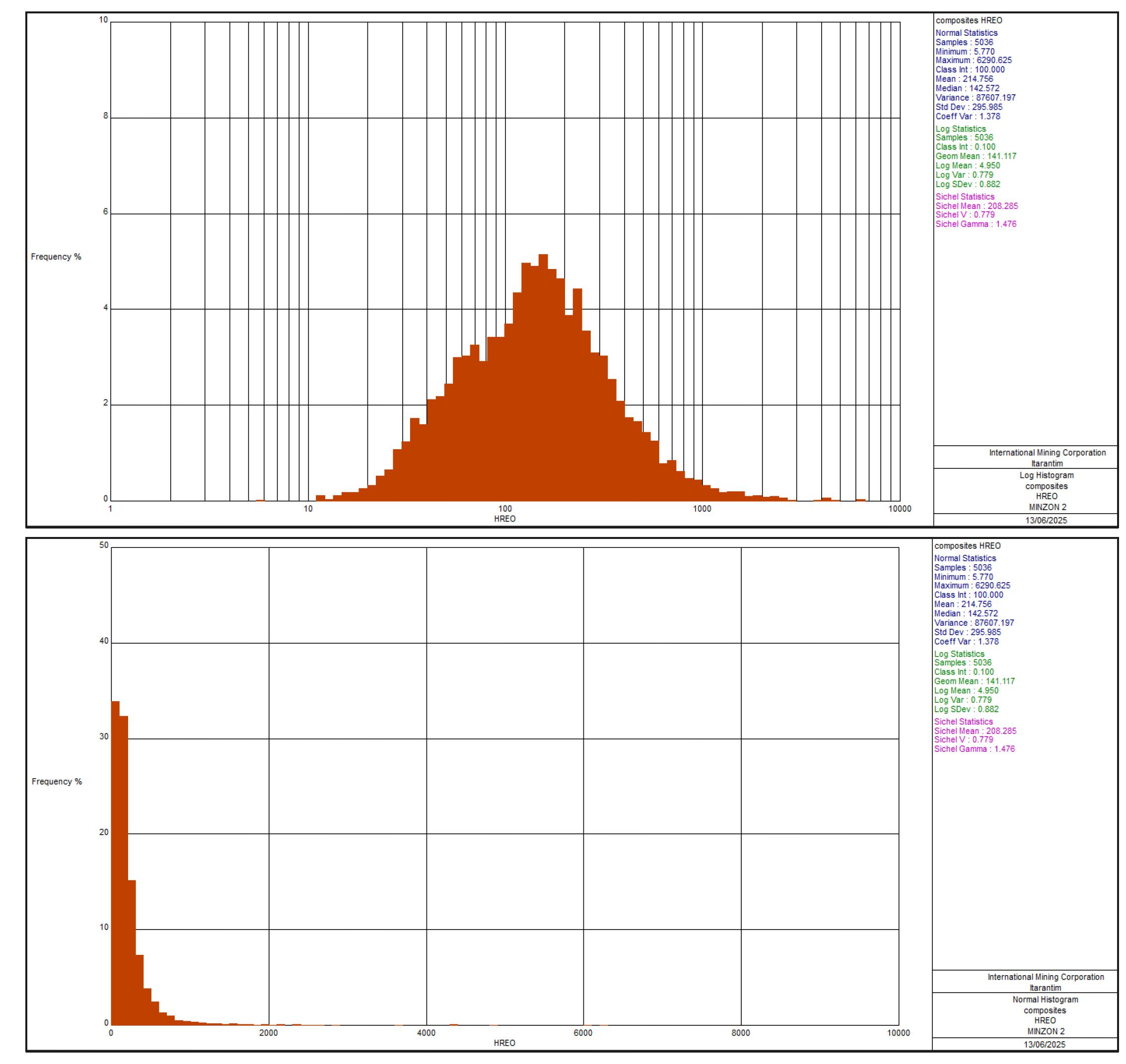
| Figure 11-6 | Log histogram (top) and normal histogram for HREO, from composited sample data in mineralization envelope |
| 11.4.1 | Treatment of Outliers |
A review of grade outliers was undertaken to ensure that extreme grades are treated appropriately during grade interpolation. Whilst grade outliers are real, they are potentially not representative of the volume they inform during estimation, and if not assessed appropriately they have the potential to result in significant grade overestimation on a local basis.
The decision to apply top cuts (grade capping) was based upon statistical analyses of composited sample populations. Log histograms of all domains were reviewed, and if deemed necessary, top cuts were chosen.
Top cuts for the affected oxides are presented in Table 11-3, with grades in ppm. The total number of samples within the ≥630 ppm TREO mineralization envelope is 5,036.
| Page 59 |
| ITARANTIM REE PROJECT, BRAZIL, TECHNICAL REPORT SUMMARY | R257,2025 |
| Table 11-3 | Grade capping summary |
| REO | Maximum grade | Top cut | Mean grade (cut) | No. samples cut |
| La2O3 | 5,279 | 3,100 | 207 | 3 |
| CeO2 | 12,403 | 10,000 | 578 | 1 |
| Pr6O11 | 1,063 | - | 49 | - |
| Nd2O3 | 4,326 | - | 177 | - |
| Sm2O3 | 739 | 500 | 32 | 2 |
| Eu2O3 | 83 | - | 5 | - |
| Gd2O3 | 514 | - | 26 | - |
| Tb4O7 | 94 | 50 | 4 | 7 |
| Dy2O3 | 605 | 300 | 23 | 7 |
| Ho2O3 | 129 | 60 | 4 | 7 |
| Er2O3 | 400 | 250 | 13 | 4 |
| Tm2O3 | 56 | 30 | 2 | 5 |
| Yb2O3 | 355 | 150 | 12 | 7 |
| Lu2O3 | 44 | - | 2 | - |
| Y2O3 | 4,407 | 2,500 | 128 | 7 |
| TREO | 14,032 | 12,000 | 1,263 | 4 |
| LREO | 13,685 | 12,000 | 1,049 | 1 |
| LREO-CeO2 | 10,386 | 7,000 | 469 | 6 |
| HREO | 6,291 | 3,000 | 212 | 7 |
| ThO2 | 404 | 200 | 30 | 2 |
| U3O8 | 348 | 80 | 8 | 4 |
Note: Summed REO grades (TREO, LREO, HREO) were not interpolated into the model, but were calculated from the individual REO grades. Therefore the top cuts for these were not utilized.
| 11.4.2 | Geostatistical Analysis kriging parameters and to guide |
Variography was completed to determine the choice of grade estimation search radii. Data were adjusted to normal scores prior to variography to assist with modeling the moderate to high positive skew sometimes displayed by the variables. Variograms were generated from 1 m top cut composited data.
Example variograms for Dy2O3 and Pr6O11 are presented in Figure 11-7 and Figure 11-8.
| Page 60 |
| ITARANTIM REE PROJECT, BRAZIL, TECHNICAL REPORT SUMMARY | R257,2025 |
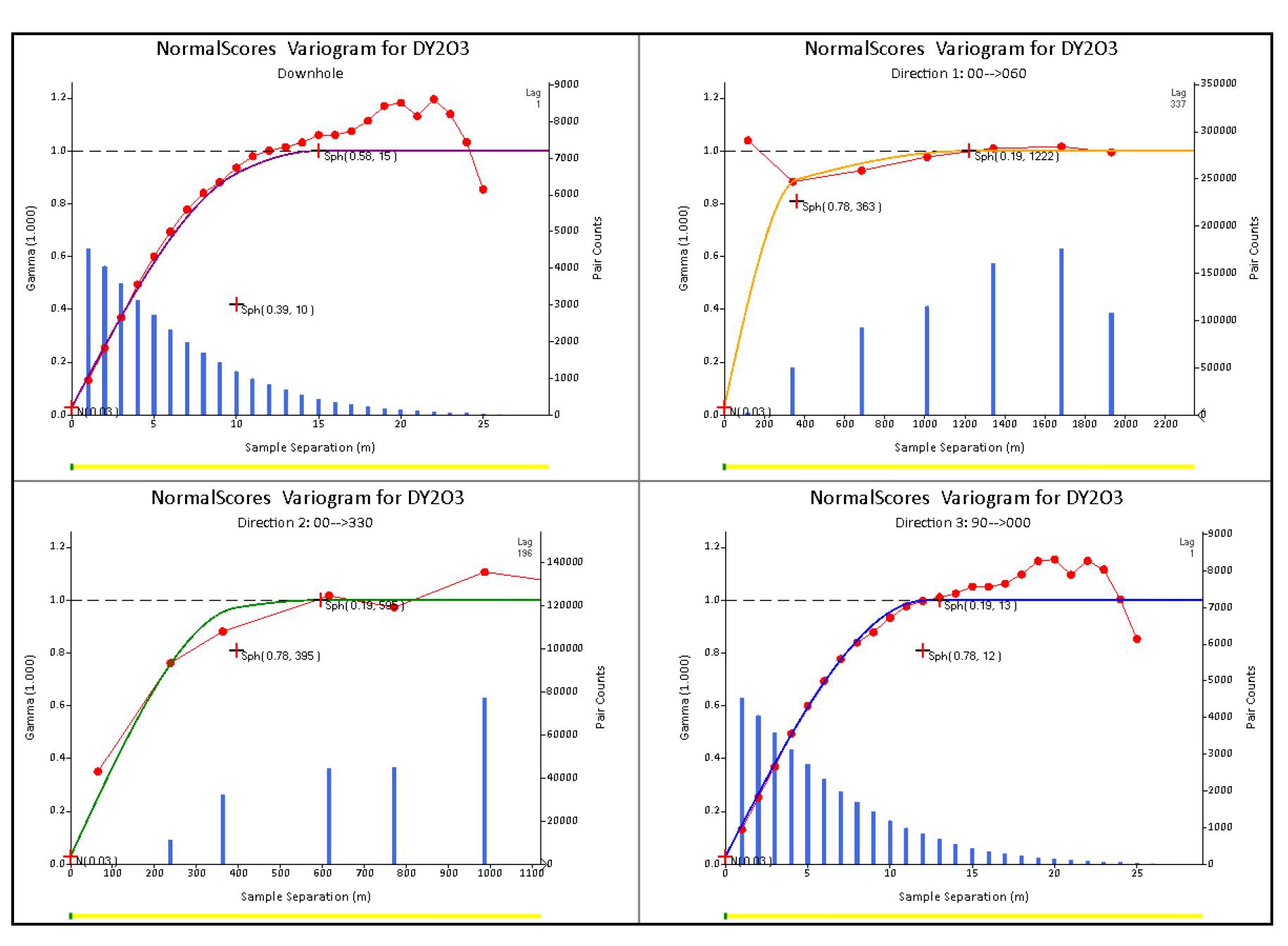
| Figure 11-7 | Normal scores variogram models, Dy2O3 |
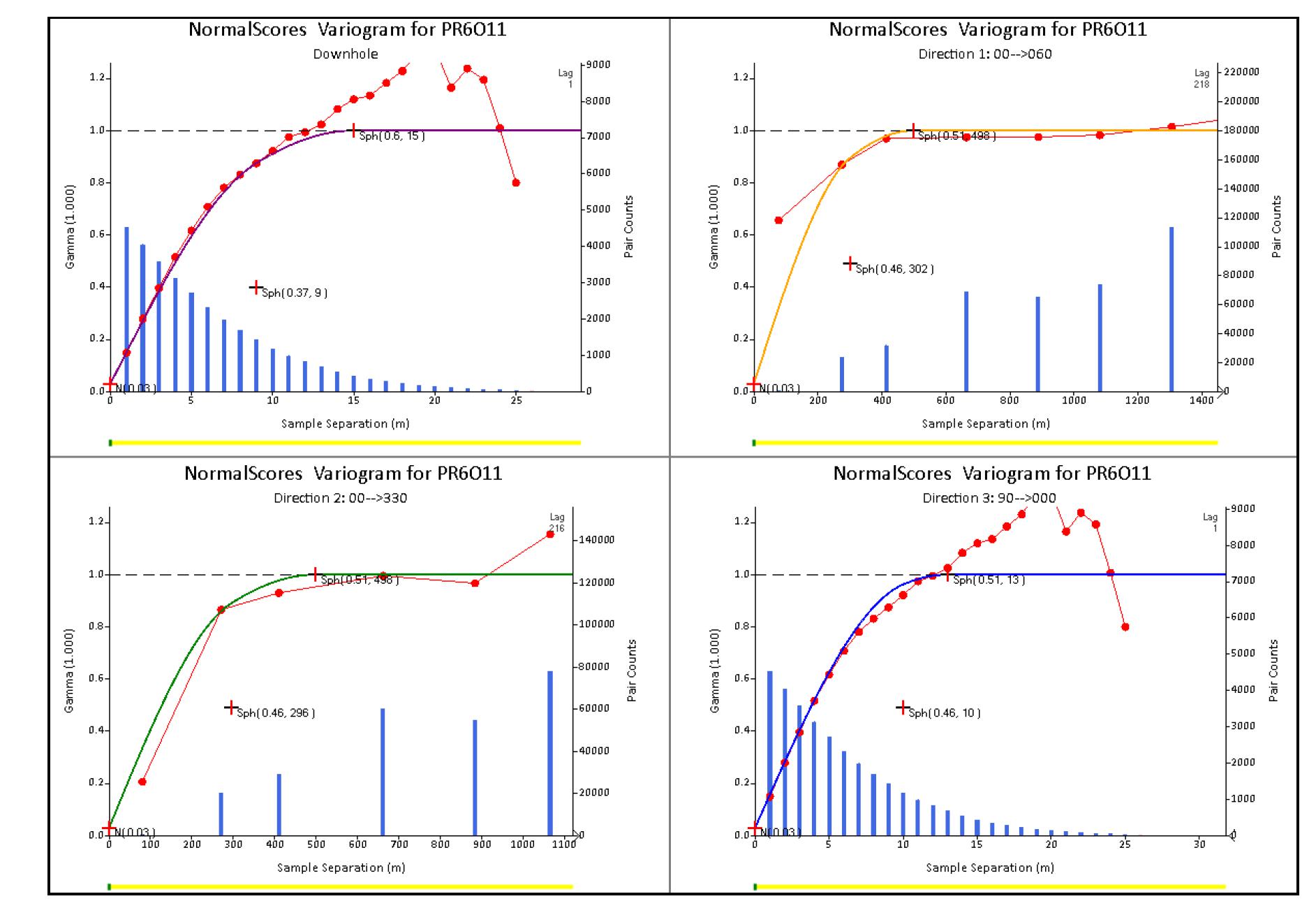
| Figure 11-8 | Variogram models, Pr6O11 |
| Page 61 |
| ITARANTIM REE PROJECT, BRAZIL, TECHNICAL REPORT SUMMARY | R257,2025 |
| 11.5 | Density |
Limited density measurements have been taken to date on the Project. A total of 59 samples were collected from ten sites in Blocks A and C and tested using the Standard Penetration Test (SPT) method. For SPP, a borehole must be drilled to the desired sampling depth. The test uses a thick-walled sample tube, with an outside diameter of 50.8 mm and an inside diameter of 35 mm, and a length of around 650 mm. The split-spoon sampler that is attached to the drill rod is placed at the testing point. A hammer of 63.5 kg is dropped repeatedly from a height of 76 cm driving the sampler into the ground until reaching a depth of 15 cm. The number of required blows is recorded. This procedure is repeated two more times until a total penetration of 45 cm is achieved. Samples were then sent to ALS for density determination using method GRA09as. This method does not require the sample to be oven dried but is coated in paraffin wax prior to weighing in a water bath. The density values are therefore regarded as “wet density”. Sample locations are presented in Figure 11-9.
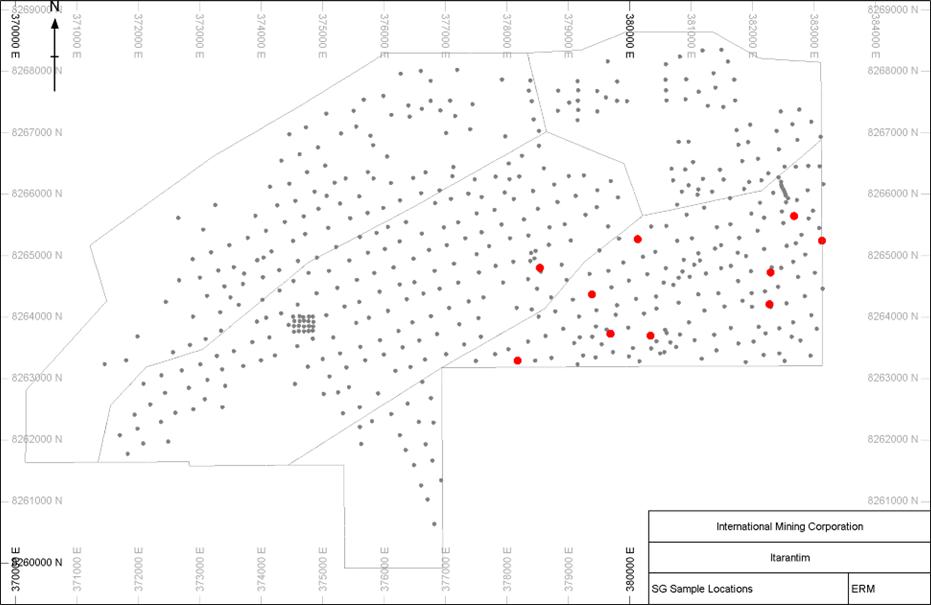
| Figure 11-9 | Specific gravity sample locations (red) and auger drill hole collars (grey) |
The average density of the 59 samples is 1.75 t/m3. Moisture content was not measured, and the density is assumed to be a wet density. The result was used to provide guidance for the choice of an appropriate density to assign to the resource model, assigned as 1.8 t/m3, which ERM considers to be appropriate for the host lithology. The QP author ERM recommends that IMC increase its efforts to obtain density data across the entire deposit, which can be derived from sampling methods such as diamond core drilling or trenching.
| Page 62 |
| ITARANTIM REE PROJECT, BRAZIL, TECHNICAL REPORT SUMMARY | R257,2025 |
For resource reporting, this average wet density was applied uniformly across the mineralized domain due to the shallow and homogeneous nature of the regolith. ERM recognizes that “dry density” values are preferred for tonnage estimation under S-K 1300. Accordingly, the use of wet density introduces a minor uncertainty that is not expected to materially affect tonnage at the current Inferred Resource classification level.
ERM recommends that future density programs determine dry bulk density through oven-drying of representative samples from all regolith units to support higher-confidence resource classifications and mine design studies.
| 11.6 | Block Modeling |
| 11.6.1 | Block Model Construction |
A block model was prepared for Itarantim using model limits and variables as presented in Table 11-4. The block model was created using Leapfrog software and imported into Datamine, which is regarded as the final version of the block model and is to be used for ongoing technical studies.
| Table 11-4 | Block model parameters and variables (grade variables are ppm) |
| Easting (X) | Northing (Y) | RL (Z) | |
| Itarantim Datamine filename “it2506md” | |||
| Origin | 370,000 | 8,259,900 | 170 |
| Extent (m) | 13,200 | 8,800 | 700 |
| Block size (sub-block) | 100 m (10 m) | 100 m (10 m) | 4 m (2 m) |
| Attributes | Description | ||
| MINZON | Hanging wall (=1), Mineralization domain 630 ppm (=2), Footwall domain (=3) | ||
| Block | Deposit block | ||
| Various REO | Estimated REO grade (ordinary kriging) (ppm) – La2O3, CeO2, Pr6O11, Nd2O3, Sm2O3, Eu2O3, Gd2O3, Dy2O3, Ho2O3, Er2O3, Tm2O3, Yb2O3, Lu2O3, Y2O3, Nb2O5 | ||
| TREO | Summed TREO grade (ordinary kriging) (ppm) – sum of all REO interpolated grades | ||
| HREO | Summed grade of the following REOs: Gd2O3, Tb4O7, Dy2O3, Ho2O3, Er2O3, Tm2O3, Yb2O3, Lu2O3, Y2O3 | ||
| LREO | Summed grade of the following REOs: La2O3, CeO2, Pr6O11, Nd2O3, Sm2O3, Eu2O3 | ||
| HMREO | Heavy magnet REO (DyTb) Dy2O3 + Tb4O7 | ||
| LMREO | Light magnet REO (NdPr) Pr6O11 + Nd2O3 | ||
| MREO | DyTb+ NdPr | ||
| TREO_CE | TREO – CeO2 | ||
| ThO2 | Estimated ThO2 (ordinary kriging) | ||
| U3O8 | Estimated U3O8 (ordinary kriging) | ||
| RESCAT | MRE classification: 3 = Inferred, 4 = Unclassified | ||
| DENSITY | Assigned density | ||
Parent block sizes were based upon approximately half to one-third of the typical drill spacing. Sub-blocks were used to allow the blocking process to adequately fill the domain volumes. The block model was not rotated.
| Page 63 |
| ITARANTIM REE PROJECT, BRAZIL, TECHNICAL REPORT SUMMARY | R257,2025 |
| 11.6.2 | Grade Interpolation |
Top cut composited samples were used to interpolate the grade variables (listed in Table 11-4) into the block model using ordinary kriging. Grades were interpolated into the ≥630 ppm mineralization domain defined as MINZON 2 in the block model.
A search ellipse of 1,000 m(X) by 1,000 m(Y) by 600 m(Z) was used to select samples for grade interpolation, with a minimum of 8 and a maximum of 16 samples used per block estimate. A maximum of 4 samples per drillhole were permitted for each block estimate. Grades were interpolated into the parent cell and the grades assigned to all sub-cells.
| 11.7 | Block Model Validation |
Validation of the block model and grade estimates was completed by:
| ● | Visual checks on screen in cross-section and plan view to ensure that block model grades honor the grade of sample composited grades |
| ● | Statistical comparison of sample and block grades |
| ● | Generation of swath plots to compare input and output grades in a semi-local sense, by easting, northing and elevation |
| ● | Check for negative or absent block grades. |
| 11.7.1 | Visual Validation |
The block model was reviewed by stepping through cross-sections, ensuring that estimated REO grades were consistent with the surrounding drillhole sample grades.
| 11.7.2 | Statistical Validation |
Mean block grades for selected domains were compared to the mean sample grades. Naïve average sample grades for selected top cut and composited samples for the mineralization domain were used and compared.
Validation results showed the mean block grades compared favorably with the mean sample grades. Table 11-5 shows results for selected REOs.
| Table 11-5 | Model, naïve grades (ppm) |
| Data | Tb4O7 | Dy2O3 | Pr6O11 | Nd2O3 | ThO2 |
| Block model | 3.87 | 21.6 | 45.1 | 161.4 | 33.2 |
| Naïve composites | 4.00 | 23.1 | 49.1 | 176.8 | 29.9 |
Swath plots compare the trend of average grades of the model and input sample data, along a specified direction. Figure 11-10 to Figure 11-12 present swath plots for Pr6O11, Dy2O3 and CeO2 within the ≥630 ppm TREO mineralization domain. These demonstrate some smoothing of the interpolated block grades compared to the input sample data, which is to be expected by ordinary kriging methodology, however, the sample data trends can still be observed in the block grade distribution. Of interest is the reversed trends of Pr6O11 and Dy2O3, compared to CeO2, by elevation of the sample and block centroid.
| Page 64 |
| ITARANTIM REE PROJECT, BRAZIL, TECHNICAL REPORT SUMMARY | R257,2025 |
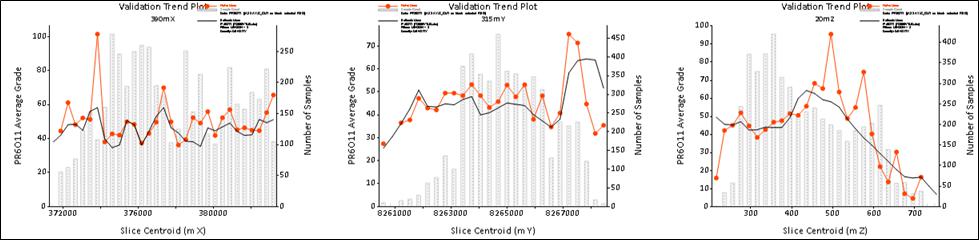
| Figure 11-10 | Swath plots, Pr6O11 |
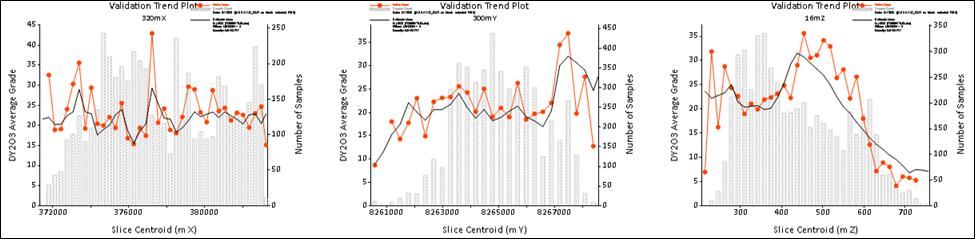
| Figure 11-11 | Swath plots, Dy2O3 |
| Figure 11-12 | Swath plots, CeO2 |
| 11.8 | Mineral Resource Reporting |
| 11.8.1 | Initial Assessment and Reasonable Prospects for Economic Extraction |
ERM has completed an Initial Assessment and believes there are RPEE of the MRE due to the deposit demonstrating sufficient grade, quantity and continuity to support RPEE. Additionally, the deposit is supported by nearby infrastructure including: (1) close proximity to large population centers; (2) located within 150 km of a planned maritime port facility at Ilheus and 350 km from the port at Salvado; and (3) and close to power and water infrastructure.
The leachability of the rare earth mineralization from the clay host minerals is favorable for extraction by either in-situ leaching or open pit mining, followed by heap leaching or alternative extraction methods. Leachability and recovery work, completed by IMC, that supports this is detailed in Sections 10.2 to 10.5.
Cut-off Grade Determination
A cut-off grade of >650 ppm TREO has been selected and determined to be appropriate for reporting the Inferred MRE and meeting RPEE (refer Figure 11-14).
The cut-off grade, referred to here as the marginal cut-off grade, has been derived as the optimal grade where revenue from processing one tonne of already-mined material equals the processing cost. A marginal cut-off grade was determined using a revenue-to-cost methodology based on a full rare earth oxide (REO) basket, determined using individual element grades, metallurgical recoveries, and commodity prices (in USD as of March31, 2025) as presented in Table 11-6, and the reasonable assumptions, based on an assumed open-pit mining method, as summarized in Table 11-7.
The commodity prices were selected based on each REE oxide pertinent to the Project sourced from the Shanghai Metals Market (SMM), a leading global provider of nonferrous and ferrous metal prices analysis and consensus reference, and assuming a six month trailing average for REE prices. The QP considers that while the commodity prices may be considered conservative they are also considered realistic to apply to an Inferred Mineral resource at this stage of the Project assessment. Also that the prices are similar to the prices used by similar REE operations.
| Page 65 |
| ITARANTIM REE PROJECT, BRAZIL, TECHNICAL REPORT SUMMARY | R257,2025 |
| Table 11-6 | REE commodity prices in USD used for Initial Assessment of Itarantim Inferred Mineral Resource, cut-off grade TREO >650 ppm, pricing effective March 31, 2025 |
| Commodity (REE oxide) | Unit | Value | % REE Oxide | Recovery % |
| La2O3 | USD/t | 640 | 15.6 | 52 |
| CeO2 | USD/t | 1,742 | 47.9 | 10 |
| Pr6O11 | USD/t | 64,000 | 3.7 | 55 |
| Nd2O3 | USD/t | 68,922 | 13.3 | 58 |
| Sm2O3 | USD/t | 2,100 | 2.4 | 55 |
| Eu2O3 | USD/t | 24,751 | 0.4 | 55 |
| Gd2O3 | USD/t | 24,200 | 2.0 | 57 |
| Tb4O7 | USD/t | 1,032,453 | 0.3 | 52 |
| Dy2O3 | USD/t | 229,315 | 1.8 | 55 |
| Ho2O3 | USD/t | 69,080 | 0.4 | 53 |
| Er2O3 | USD/t | 48,560 | 1.0 | 55 |
| Tm2O3 | USD/t | 200 | 0.2 | 50 |
| Yb2O3 | USD/t | 12,800 | 0.9 | 48 |
| Y2O3 | USD/t | 8,000 | 10.0 | 61 |
| Lu2O3 | USD/t | 730,000 | 0.1 | 46 |
Notes:
| ● | Commodity price assumptions effective as at March 31, 2025. |
| ● | Source of commodity pricing – Shanghai Metals Market (SMM) - https://www.metal.com/Rare-Earth-Oxides |
| Table 11-7 | Economic parameter assumptions used for Initial Assessment of Itarantim Inferred Mineral Resource, cut-off grade TREO >650 ppm effective March 31, 2025 |
| Parameter | Unit | Value |
| Metal prices | USD/t | As per Table 11-6 |
| Mining recovery | % | 90 |
| Processing recovery HREO | % | 28–71 |
| Processing recovery LREO | % | 23–58 |
| Payability | % | 80 |
| Mining cost | USD/t rock | 2.10 |
| Processing cost | USD/t feed | 9.50 |
| Bulk density (wet) | t/m3 | 1.8 |
| G&A cost | USD/t feed | 0.90 |
Note: Assumptions effective as at March 31, 2025.
The marginal (processing-based) cut-off approach was adopted because it reflects a strategy focused on optimizing processing activities within a laterally continuous, near-surface ionic clay mineralized system. The deposit comprises near-surface, laterally continuous ionic clay mineralisation with minimal stripping required, no drilling or blasting requirement, and limited variability in mining conditions, resulting in effectively uniform mining costs across mineralised material. As such, the key economic decision is whether material is prioritized for processing or scheduled for later treatment, making processing cost the key controlling variable.
A marginal (processing-based) cut-off is therefore applied, consistent with industry practice for similar deposits and aligned with a strategy of optimizing processing activities and processing plant utilization. This allows for lower-grade material to be deferred and processed under improved operating conditions or during periods of stronger pricing, particularly given the potential for short-term price increases in magnet rare earth markets.
Mining costs are not included in the cut-off grade determination, as they are: low in cost; consistent with near surface ionic adsorbed clay (IAC) style of rare earth deposits; do not form the primary economic discriminator within the mineralised horizon; and do not materially influence processing decisions within the mineralised domain. Whilst mining costs are implicitly captured in the overall economic framework it is not appropriate to use them as the controlling parameter for cut-off grade determination for this style of mineralization.
A processing-based approach was applied to the element grades, metallurgical recoveries, and commodity prices, to determine a value of revenue per tonne of mineralized material using the following formula:
Revenue (USD/t mineralized material) = Σ [(Gradeᵢ (ppm) / 1,000,000) × Recoveryᵢ × Priceᵢ]
The total assumed revenue per tonne of mineralized material, based on the weighted average resource composition and pricing assumptions (Table 11-8), corresponds to an estimated basket value of approximately USD 0.012–0.013 per ppm TREO. The basket case is a Value per ppm, and is a determination by the formula below:
Total revenue per tonne of mineralized material / TREO ppm (15.38 / 1,233 = 0.0125)
The marginal (processing-based) cut-off grade is then defined as the grade at which processing cost are covered and derived using the following formula:
Cut-off grade (ppm) = Processing Cost (USD/t) / Value per ppm (USD/ppm)
Using the calculated total revenue per tonne of mineralized material and corresponding Value per ppm, processing costs were evaluated over a range of USD 8.2/t to USD 9.5/t. Applying the above relationship results in the following marginal (processing-based) cut-off range of:
Cut-off grade of 650 ppm TREO at USD 8.2/t (Cut-off (ppm) = 8.2/0.0125
Cut-off grade of 750 ppm TREO at USD 9.5/t (Cut-off (ppm) = 9.5/0.0125
The cut-off grades are rounded to the nearest 50 ppm TREO. Further details are provided in Table 11-9.
| Page 66 |
| ITARANTIM REE PROJECT, BRAZIL, TECHNICAL REPORT SUMMARY | R257,2025 |
This defines a reasonable operating range for processing decisions and supports the selection of a cut-off grade within this range. A cut-off grade of 650 ppm TREO was selected, representing the lower bound of the evaluated range and aligning with a strategy of maximizing the recoverable resource while maintaining efficient processing through selective scheduling of mined ore.
The lower processing cost assumption is supported by favourable ionic clay metallurgy, including low reagent consumption and ambient leaching conditions, as well as benchmarking against comparable operations.
The REO basket is weighted toward magnet rare earths (notably Nd, Pr, Dy and Tb), which are associated with strong long-term demand fundamentals. While the cut-off is based on current price assumptions, the potential for improved pricing conditions supports the selection of a lower cut-off within the evaluated range as part of an optimisation-driven operating strategy.
The QP compared the 650 ppm TREO cut-off grade with the grade tonnage table (Figure 11-14) and determined that a TREO cut-off grade of >650 ppm was reasonable for reporting the MRE, and reflects the physical characteristics of the deposit, realistic operating assumptions, and a processing-led optimisation strategy.
Table 11-8 Calculated assumed revenue per tonne of mineralized material
| Commodity (REE oxide) | Grade (ppm) | Recovery (%) | Price (USD/t) | Assumed Revenue ($/t mineralized material) |
| La2O3 | 192 | 0.52 | 640 | 0.06 |
| CeO2 | 590 | 0.1 | 1,742 | 0.10 |
| Pr6O11 | 46 | 0.55 | 64,000 | 1.61 |
| Nd2O3 | 164 | 0.58 | 68,922 | 6.56 |
| Sm2O3 | 30 | 0.55 | 2,100 | 0.03 |
| Eu2O3 | 5 | 0.55 | 24,751 | 0.07 |
| Gd2O3 | 24 | 0.57 | 24,200 | 0.33 |
| Tb4O7 | 4 | 0.52 | 1,032,453 | 2.11 |
| Dy2O3 | 22 | 0.55 | 229,315 | 2.76 |
| Ho2O3 | 4 | 0.53 | 69,080 | 0.16 |
| Er2O3 | 12 | 0.55 | 48,560 | 0.33 |
| Tm2O3 | 2 | 0.5 | 200 | 0.00 |
| Yb2O3 | 12 | 0.48 | 12,800 | 0.07 |
| Y2O3 | 123 | 0.61 | 8,000 | 0.60 |
| Lu2O3 | 2 | 0.46 | 730,000 | 0.57 |
| TREO | 1,233 | |||
| Total Assumed Revenue ($/t mineralized material) | 15.38 | |||
Note:
Revenue ($/tonne of mineralized material) = (Grade (ppm)/1,000,000) * Recovery % * Price
Table 11-9 Ranges for determination of marginal cut-off grade
| Costs | High | Low |
| Mining Cost ($/t) | 2.1 | 1.9 |
| Processing Cost ($/t) | 9.5 | 8.2 |
| G&A Cost ($/t) | 0.9 | 0.5 |
| Total Cost ($/t) | 12.5 | 10.6 |
| Marginal Cut-off grade (ppm) | 761 | 657 |
Notes:
Total Assumed Revenue ($/t mineralized material) = 15.38
Total grade (TREO ppm) = 1233
Value per TREO ppm ($/ppm) = 0.0125
The QP considered the lower confidence level for the estimated rare earth grades for an Inferred MRE, as discussed in Section 11.8.2, and also considered a range of grades within a reasonable tolerance limit when selecting the marginal cut-off grade. The calculated value was then compared with the grade tonnage table (Figure 11-14) and the QP determined that a TREO cut-off grade of >650 ppm was reasonable for reporting the MRE.
| 11.8.2 | Mineral Resource Estimate Classification |
The MRE has been prepared and reported in accordance with Item 1300 of Regulation S-K (Subpart 229.1300) under the United States SEC. The Mineral Resource category of Inferred Mineral Resource used in this Report follows the definitions set out in §229.1300 Definitions. The estimation methodology and classification criteria have been reviewed by ERM and are consistent with the requirements of S-K 1300, including the criteria set forth in §229.1302(d)(1). The MRE classification is based upon an assessment of geological understanding of the deposit, geological and grade continuity, drillhole spacing, quality control results, search and interpolation parameters, and an analysis of available density information. Mineral Resources are not Mineral Reserves and do not have demonstrated economic viability. There is no certainty that all or any part of an Inferred Mineral Resource will be converted into Indicated or Measured Mineral Resource or that Mineral Resources will be converted into Mineral Reserves.
Confidence in the estimate of Inferred Mineral Resources is not sufficient to allow the results of the application of any technical and economic parameters to be used for detailed mine planning as part of pre-feasibility or feasibility studies.
| Page 67 |
| ITARANTIM REE PROJECT, BRAZIL, TECHNICAL REPORT SUMMARY | R257,2025 |
The Inferred Mineral Resource has not been significantly extrapolated beyond the limits of the drillholes. Volumes of the block model located outside IMC tenure are not classified. Figure 11-13 shows a drillhole location plan of the deposit with the mineralization domain shown. A discussion of the blocks shown in Figure 11-13 is presented in Section 7.1.2.
ERM notes that the Project is an early-stage exploration stage project and that Inferred Mineral Resource estimates have significant geological uncertainty as they are based on limited geological evidence and sampling. Sources of uncertainty for the Inferred Mineral Resource estimates reported in this Report include: sampling and drilling methods, data processing and handling, geologic modeling and estimation. The Inferred Mineral Resource estimates may also be impacted by further infill and exploration drilling that may result in an increase or decrease in future resource evaluations. The Inferred Mineral Resource estimates may also be affected by subsequent assessment of mining, environmental, processing, permitting, taxation, socio-economic and other factors. Such factors may include: changes to commodity price and exchange rate assumptions; changes to the assumptions used to generate a cut-off grade for TREO of >650 ppm; changes in local interpretations of mineralization geometry and continuity of mineralized zones; changes to geological and mineralization shape and geological and grade continuity assumptions; density and domain assignments; changes to geotechnical, extraction, processing and production assumptions; changes to the input and design parameter assumptions that pertain to mining design; assumptions as to the continued ability to access the site, retain mineral and surface rights titles, maintain environment and other regulatory permits and maintain the social license to operate.
IMC intends to continue exploration activities including: infill drilling, further resource definition drilling, detailed density testwork, early stage geotechnical and hydrogeological assessments, ongoing detailed metallurgical testwork, baseline environmental studies, and initial economic assessment of mining options. ERM is of the opinion that this additional work will enable an increased confidence in classification of future MREs and will contribute to increased precision in the RPEE criteria in the future. ERM is of the opinion that any issues relating to the relevant technical and economic factors likely to influence the prospect of economic extraction can be resolved with further work.
| Page 68 |
| ITARANTIM REE PROJECT, BRAZIL, TECHNICAL REPORT SUMMARY | R257,2025 |
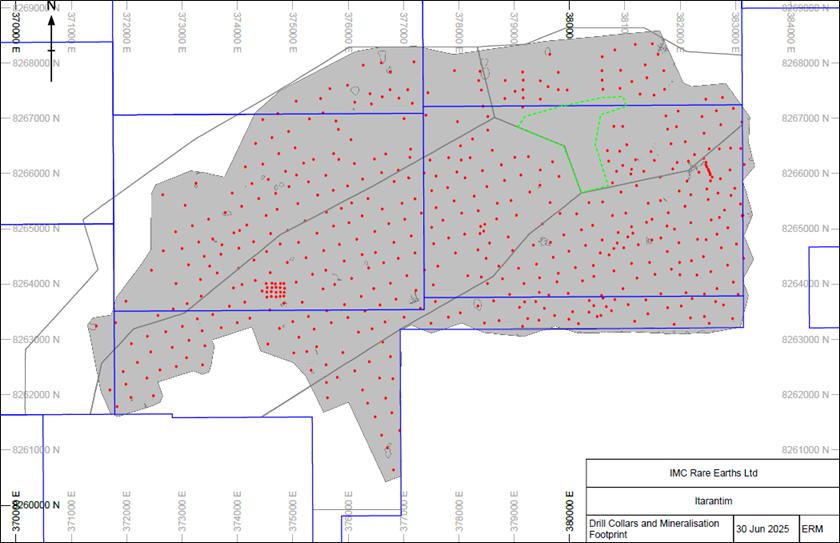
| Figure 11-13 | Drillhole collar plan, showing drillhole collars (red), TREO mineralization domain (grey), tenure (blue), “blocks” (grey), and region of unclassified resources (dashed green polygon) |
Note: All TREO domains are classified as Inferred, except for edges outside tenure and the unclassified resource in the northeast area (cyan).
| 11.8.3 | Mineral Resource Estimate Statement |
The MRE is classified as an Inferred Mineral Resources (refer Section 11.8.2) and is presented in Table 11-8 and reported above a cut-off grade of 650 ppm total rare earth oxides (TREO). The MRE has an effective date of March 31, 2025. The MRE includes reporting of “heavy rare earth oxides” (HREO), “light rare earth oxides” (LREO), “magnet rare earth oxides” (MREO), “heavy MREO” (DyTb), “light MREO” (NdPr), individual magnet rare earth oxides (Tb4O7,DY2O3, PR6O11, ND2O3, and deleterious oxides U3O8 and ThO2. The MRE is reported by block region, as discussed in Section 7.1.2.
The MRE is reported on an in-situ basis, representing the estimated tonnes and grades (ppm TREO) in the ground and prior to the application of any modifying factors. The resource is constrained a by mineralised envelope defined at a statistical threshold of approximately 630 ppm TREO, which distinguishes mineralised material from surrounding lower-grade zones.
No adjustments have been made to the reported Mineral Resource for mining recovery, dilution, metallurgical recovery, payability, or other economic modifying factors. These factors have been considered separately to support reasonable prospects for eventual economic extraction, including the derivation of the cut-off grade, but have not been applied to the reported resource.
Accordingly, the Mineral Resource is reported on an in-situ basis in compliance with Item 1304(d)(1) of Regulation S-K.
A grade-tonnage graph showing the reported tonnage and grades above incrementally increasing TREO cut-off grades is presented in Figure 11-14, note that the base case for the MRE is TREO >650 ppm (red line denotes TREO 650 ppm - this COG shows the optimal tonnage at the best grade for TREO).
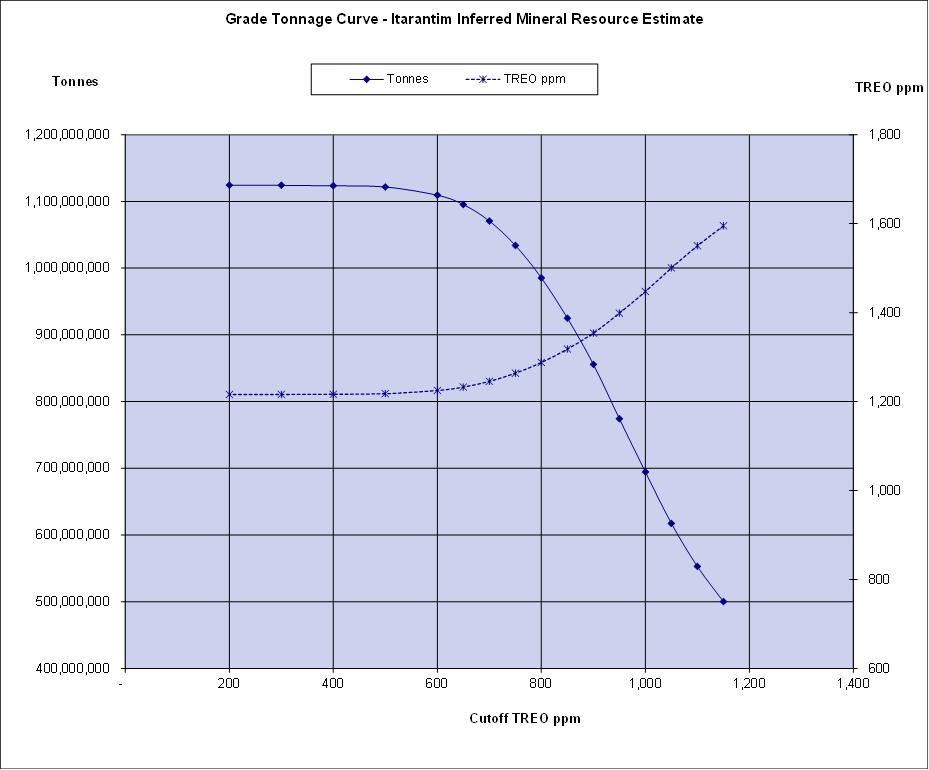
| Figure 11-14 | Grade-tonnage table by TREO cut-off grades (base case for MRE reporting is TREO >650 ppm) |
| Page 69 |
| ITARANTIM REE PROJECT, BRAZIL, TECHNICAL REPORT SUMMARY | R257,2025 |
| Table 11-8 | Itarantim Inferred Mineral Resource with cut-off grade of TREO >650 ppm - effective March 31, 2025 |
| Mineral Resource Estimate | Block | Tonnes (Mt) | TREO (ppm) | Contained TREO (Mt) | LREO (ppm) | HREO (ppm) | MREO (ppm) | Ratio MREO:TREO | NdPr (ppm) | DyTb (ppm) | Tb4O7 (ppm) |
Dy2O3 (ppm) |
Pr6O11 (ppm) |
Nd2O3 (ppm) |
U3O8 (ppm) |
ThO2 (ppm) |
| Inferred | A | 190 | 1,148 | 0.223 | 951 | 198 | 239 | 0.21 | 214 | 25 | 4 | 21 | 47 | 168 | 6 | 24 |
| B | 120 | 1,170 | 0.143 | 941 | 228 | 237 | 0.20 | 209 | 28 | 4 | 24 | 46 | 163 | 8 | 38 | |
| C | 330 | 1,127 | 0.372 | 934 | 193 | 216 | 0.19 | 191 | 24 | 4 | 21 | 42 | 150 | 8 | 33 | |
| D | 410 | 1,390 | 0.574 | 1,175 | 216 | 251 | 0.18 | 224 | 27 | 4 | 23 | 49 | 175 | 10 | 37 | |
| E | 40 | 1,057 | 0.038 | 898 | 159 | 222 | 0.21 | 202 | 21 | 3 | 17 | 43 | 159 | 5 | 18 | |
| Total Inferred Resources | 1,100 | 1,233 | 1.350 | 1,027 | 205 | 236 | 0.19 | 210 | 26 | 4 | 22 | 46 | 164 | 8 | 33 | |
Notes to accompany MRE table:
| ● | Mineral resources are reported using definitions set out in Regulation S-K 1300 and are current as of March 31, 2025. |
| ● | The third-party firm responsible for the MRE is ERM. |
| ● | Mineral resources are reported at a cut-off grade above 650 ppm TREO. Key assumptions used in the MRE and to meet RPEE are indicated in Table 11-7 above. |
| ● | The point of reference for the MRE is in situ. |
| ● | Mineral resources have been rounded and due to effects of rounding, the total may not represent the sum of all components. |
| ● | Mineral Resource is only reported from blocks within the permit areas. |
| ● | LREO = La2O3, CeO2, Pr6O11, Nd2O3, Sm2O3, Eu2O3. |
| ● | HREO = Gd2O3, Tb4O7, Dy2O3, Ho2O3, Er2O3, Tm2O3, Yb2O3, Lu2O3, Y2O3. |
| ● | TREO = LREO + HREO. |
| ● | Contained TREO (MT) = (Tonnes * TREO (converted to percent))/1,000,000 |
| ● | Ratio MREO:TREO = MREO / TREO |
| ● | DyTb = Tb4O7 + Dy2O3, being the sum of the heavy magnetic rare earth oxides |
| ● | NdPr = Pr6O11 + Nd2O3, being the sum of the light magnetic rare earth oxides |
| ● | MREO = DyTb + NdPr. |
| ● | Density of 1.8 t/m3 applied to all blocks in mineralization zone. Density is a wet density. |
| Page 70 |
| ITARANTIM REE PROJECT, BRAZIL, TECHNICAL REPORT SUMMARY | R257,2025 |
The MRE is also reported above a cut-off grade of 400 ppm total magnetic rare earth oxides (MREO). A grade-tonnage graph above incrementally increasing MREO cut-off grades is presented in Figure 11-15, note that the base case for the MRE is MREO >400 ppm.
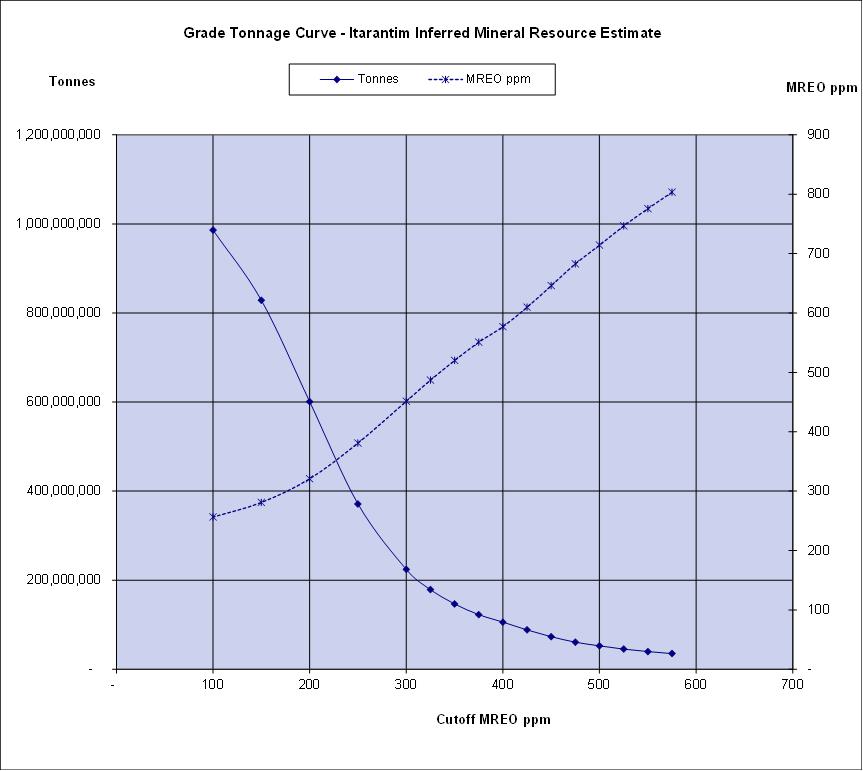
| Figure 11-15 | Grade tonnage table by MREO cut-off grades (base case for MRE reporting is MREO >400 ppm) |
The leachability of the Itarantim ionic adsorption deposit is presented in Table 11-9. Figure 11-16 presents a typical profile of a drillhole showing the vertical variability of REO grades and corresponding leach % and should be used to provide guidance for understanding Table 11-9. Other examples are presented in Section 10.4.
| Page 71 |
| ITARANTIM REE PROJECT, BRAZIL, TECHNICAL REPORT SUMMARY | R257,2025 |
| Table 11-9 | Summary of leach results, Itarantim |
| LREE-Ce | HREE | ||||
| Average L % | Minimum L % | Maximum L % | Average L % | Minimum L % | Maximum L % |
| 55 | 40 | 80 | 58 | 41 | 77 |
Notes:
| ● | All leach results from samples contained within the ≥630 ppm TREO grade shell, and where leach % >40%. |
| ● | Results are for elemental rare earths, not oxides. |
| ● | LREE-Ce = total light rare earth elements minus Ce. |
| ● | HREE = total heavy rare earth elements. |
| ● | Leach % = leach (ppm) / REE (ppm). |
| ● | Total number of tests supporting Table 11-9; HREE (89), LREE-Ce (103). |
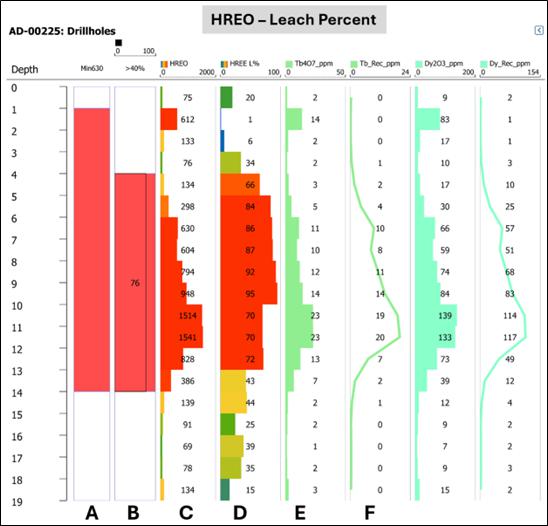
| Figure 11-16 | REE grade and leach % profile for drillhole AD-00225 |
Notes: Separate profiles for LREE-Ce and HREE. Column A – ≥630 ppm TREO grade shell (solid red). Column B – Leach % >40 interval and average leach percent annotated. Column C – Element grade profile. Column D – Leach % profile. Column E – Element grade. Column F – Element Recovered (grade x leach percent).
| Page 72 |
| ITARANTIM REE PROJECT, BRAZIL, TECHNICAL REPORT SUMMARY | R257,2025 |
| 12. | Mineral Reserve EstimateS |
Not applicable to this TRS.
| 13. | Mining Methods |
Not applicable to this TRS.
| 14. | Processing and Recovery Methods |
Not applicable to this TRS.
| 15. | Infrastructure |
Not applicable to this TRS.
| 16. | Market Studies |
Not applicable to this TRS.
| 17. | Environmental Studies, Permitting, and Plans, Negotiations, or Agreements with Local Individuals or Groups |
Not applicable to this TRS.
| 18. | Capital and Operating Costs |
Not applicable to this TRS.
| 19. | Economic Analysis |
Not applicable to this TRS.
| 20. | Adjacent Properties |
There are no adjacent properties to the Project.
| 21. | Other Relevant Data and Information |
No additional information or explanation is necessary to provide a complete and balanced presentation of the value of the Project to the Registrant.
| Page 73 |
| ITARANTIM REE PROJECT, BRAZIL, TECHNICAL REPORT SUMMARY | R257,2025 |
| 22. | Interpretation and Conclusions |
The Itarantim REE Ionic Adsorption Project represents an early-stage exploration stage property in the Bahia State located in northeast Brazil. The Project is a new REE discovery and has had moderate to intensive exploration activities (including geophysics, geological mapping, surface geochemistry and auger drilling) conducted by IMC over the past four years.
An Inferred MRE is supported by drilling completed by IMC. The Project contains REE mineralization with 60–90% of the REEs physically adsorbed onto clay minerals, notably kaolinite and halloysite. These REEs can be recovered by using simple inorganic salt solutions whereby during the leaching process, the REEs are readily transferred into solution as soluble sulfates or chlorides, depending upon the lixiviant used.
ERM considers that data collection techniques are consistent with current industry best practice and suitable for use in the preparation of a Mineral Resource to be reported in accordance with S-K 1300. QAQC sampling and results supports the integrity of the data which has been used to prepare the current MRE.
A 3D wireframe model representing TREO mineralization (TREO ≥630 ppm) is based upon geological logs and geochemical analyses of drillhole samples. Machine augered drillhole samples were used to interpolate grades into blocks using ordinary kriging. Several methods were used to validate the block model, including visual review and comparison of sampling and block model grades.
The MRE was classified as Inferred Mineral Resources and is reported above a cut-off grade of 650 ppm TREO. Global leachability results support the reporting of an ionic adsorption Mineral Resource. The QP has determined that the cut-off >650 ppm TREO to be appropriate for reporting the Inferred Mineral Resource and meeting RPEE.
ERM has completed an Initial Assessment and is of the opinion that the Inferred Mineral Resource classification is appropriate based on the informing data and underlying understanding of the mineralization of the deposit at this stage of the Project. Furthermore, ERM is of the opinion that deposit is of sufficient grade, quantity and coherence to meet RPEE at this stage of the Project development. Further work is required, in particular infill drilling at a closer drill spacing, to enable detailed interpretation of internal stratigraphic domaining of the mineralization to inform mine studies for economic evaluation.
ERM is of the opinion that the exploration potential for the Itarantim Project is high. The combination of favorable regional geological location, highly prospective local geology and potential structural framework, an active geomorphology, favorable and coincident geochemical and geophysical anomalies, and successful drill results to date, confirm the prospectivity of the area for discovery of further REE mineralization.
| 22.1 | Material Risks and Uncertainties |
In the opinion of ERM, the Itarantim REE Project represents an early-stage exploration stage property with no known fatal flaws. The Project exhibits favorable geological setting, mineralization style, and jurisdictional characteristics that support RPEE.
However, as typical for projects at the Initial Assessment stage, certain technical, environmental, permitting, and market uncertainties remain. These uncertainties are not considered to materially affect ERM’s overall conclusions but could influence the timing, cost, or ultimate development pathway for the Project. The principal risks and corresponding mitigation measures are summarized below.
| Page 74 |
| ITARANTIM REE PROJECT, BRAZIL, TECHNICAL REPORT SUMMARY | R257,2025 |
| Table 22-1 | Principal risks and mitigation strategies for the Itarantim REE Project |
| Risk category | Description of risk/uncertainty | Potential impact | Proposed mitigation / ERM comment |
| Geological and Resource | The current MRE is based on auger drilling at moderate spacing with limited dry-density data. Geological and grade continuity within the regolith may not be fully constrained. | Possible tonnage or grade adjustments with additional data; may affect resource classification confidence. | Conduct infill drilling (90 m x 80 m grid), twin auger holes with sonic/diamond drilling, and obtain dry-density measurements to replace wet density values. |
| Metallurgical/ Processing | Leachability and recovery assumptions rely on laboratory-scale testwork; pilot or industrial-scale performance unverified. | May affect recovery rates and operating cost estimates. | Continue leach and variability testing; advance to pilot-scale column or vat leach trials using site-specific water chemistry. |
| Hydrogeology/ Water management | Hydrogeological characterization is limited; the WSP baseline program is ongoing. | Potential influence on process-water balance and leach operations. | Complete hydrogeological drilling and monitoring network; integrate results into environmental and process design studies. |
| Environmental/ Permitting | Further baseline environmental and social data will be required for future development permits; regulatory changes may affect timelines. | Possible delay in obtaining development approvals or need for additional studies. | Maintain proactive engagement with ANM and Bahia State agencies; align baseline programs with International Finance Corporation (IFC) Performance Standards and Equator Principles. |
| Market and pricing | REE oxide prices are volatile and dominated by Chinese supply; magnet-REE price fluctuations may impact project economics. | Potential reduction in project margins or delay in financing. | Use conservative long-term NdPr and DyTb price forecasts; target high-value magnet-REEs to enhance resilience. |
| Infrastructure/ logistics | Dependence on future commissioning of Porto Sul deep-water terminal (expected 2027). | Export logistics or cost uncertainty if port completion is delayed. | Maintain contingency export route via Port of Salvador and coordinate with Bahia State infrastructure planning. |
| Community/ESG | Although current relations are positive, future expansion could raise community expectations or environmental scrutiny. | Potential reputational risk or delay in social permit. | Continue transparent engagement, prioritize local employment, and report ESG performance annually. |
| Currency and economic environment | Costs incurred in BRL while revenues projected in USD; subject to exchange-rate variability. | Fluctuations in future operating margins. | Conduct multi-currency cost sensitivity analyses and evaluate hedging strategies. |
ERM consider that none of the identified risks constitute fatal flaws for the Project. The risks are typical of an Initial Assessment stage project and are expected to be mitigated through continued exploration, expanded density and metallurgical testwork, detailed hydrogeological and environmental studies, and ongoing community engagement. The Project continues to demonstrate favorable characteristics and strong potential for advancement toward future economic evaluation.
| Page 75 |
| ITARANTIM REE PROJECT, BRAZIL, TECHNICAL REPORT SUMMARY | R257,2025 |
| 23. | Recommendations |
ERM recommends the following actions are completed to support the ongoing Mineral Resource evaluation effort at Itarantim:
| ● | Further geological mapping is recommended to support the geological understanding of the Project, focusing on zones with elevated MREO grades and other key target areas. |
| ● | Petrographic studies focused on REE mineral deportment and host clay mineralogy, by SEM or NIR. |
| ● | Undertake an alternative drilling method (diamond, sonic) that can penetrate below the base of mineralization and/or into the primary rock. |
| ● | Twin several auger holes with the new drilling method for QAQC purposes. |
| ● | Infill drilling at closer spacing is required to allow for geological interpretation of high-grade leachability resource zones. |
| ● | Undertake a substantial program of density testwork. The samples should be oven dried prior to density calculations to ensure future density determinations are regarded as “dry density”. |
| ● | Continue with the current QAQC efforts, with regular monitoring of results and action on any failed results. |
| ● | IMC technical staff should conduct a laboratory visit at least once per year. |
| ● | Incorporate full umpire testing for sample assays, initially targeting the MREO zones. |
| ● | Planned geometallurgy studies should include both geological and metallurgical data reviews. |
IMC should continue their efforts to fulfill obligations regarding ESG, including studies such as baseline environmental surveys, early-stage hydrogeological assessments, community engagement workshops, and other related activities for future reporting requirements.
IMC provided ERM with a projection of its planned exploration expenditures for the Project for an initial two-year period assuming the completion of a planned initial public offering and listing on the NYSE American.
ERM has reviewed this expenditure in the context of the work activities recommended for the Project and considers the proposed budgets are consistent with the exploration potential of the Project, are adequate to cover the costs of the proposed programs, and are appropriate for the type and weighting of activities at the Project.
Table 23-1 provides a detailed breakdown of exploration expenditure over the first two years based on meeting the recommended work activities required to continue advancing the Project.
| Table 23-1 | Planned expenditure for recommended exploration activities during first two years (USD million) |
| Proposed expenditure | Year 1 (USD million) | Year 2 (USD million) | Total (USD million) |
| Geological/Geophysical survey | 0.8 | 0.7 | 1.6 |
| Regional geochemistry | 0.03 | 0.03 | 1.0 |
| Exploration drilling | 0.1 | 0.1 | 0.2 |
| MREO infill drilling | 0.4 | 0.3 | 0.7 |
| Diamond drilling | 0.1 | 0.1 | 0.2 |
| Hydrological drilling | 0.2 | 0.2 | 0.4 |
| Resource drilling | 0.2 | 0.9 | 1.1 |
| Assaying | 0.3 | 0.3 | 0.7 |
| Technical/Metallurgical studies | 1.5 | 4.2 | 5.7 |
| ESG - baseline studies | 0.1 | 0.2 | 0.3 |
| Total | 3.7 | 7.1 | 10.8 |
| Page 76 |
| ITARANTIM REE PROJECT, BRAZIL, TECHNICAL REPORT SUMMARY | R257,2025 |
| 24. | References |
Aerosat, 2025. “SERVICESOF SURVEY AERIAL PHOTOGRAMMETRIC, PROFILING THE LASER, SUPPORT LAND, AEROTRIANGULATION, GENERATION OF MDS AND MDT, GENERATION OF CURVES OF LEVEL, GENERATION OF ORTHOPHOTOS”. Report by Aerosat Engineering and Aerial Surveys Ltda, April 2025.
Antoniassi, J.L., Uliana, D., Contessotto, R., Kahn, H., and Ulsen, C., 2020 “Process mineralogy of rare earths from deeply weathered alkali-carbonatite deposits in Brazil”. Journal of Materials Research and Technology, 9(4): pp. 8842-8853
Conceicao, H., de Lourdes da Silva Rosa, M., Moura, C.A., Macambira, M.J.B., Galarza, M.A., Rios, D.C., Marinho, M.M., Menezes, R.C.L., and Cunha, M.P., 2009. “Petrology of the Neoproterozoic Itarantim nepheline syenite batholith, São Francisco Craton, Bahia, Brazil.’’ The Canadian Mineralogist, 47(6), pp.1527-1550
ERM, 2024. “Mineral Resource Estimate, Itarantim Rare Earths Ionic Adsorption Deposit, Brazil”. ERM Report 268.2024. October 2024.
ERM, 2025. “Mineral Resource Estimate, Itarantim Rare Earths Ionic Adsorption Deposit, Brazil”. ERM Report 165.2025. July 2025.
IMC, 2024. “241004 Itarantim QC Plots All Data.pptx”. MS PowerPoint presentation
IMC, 2025. “250701_Itarantim QAQC update.pptx”. MS PowerPoint presentation
Li, Y.H.M., Zhao, W.W., and Zhou, M.F., 2017. “Nature of parent rocks, mineralization styles and ore genesis of regolith-hosted REE deposits in South China: An integrated genetic model.’’ Journal of Asian Earth Sciences, 148, pp.65-95
Nesbitt, H.W., and Young, G.M., 1982 “Early Proterozoic climates and plate motions inferred from major element chemistry of lutites”, Nature Vol. 299, pp. 715-717
Pavez, O., Brandao, P.R.G., and Peres, A.E.C., 1996 “Adsorption of Oleate and Octyl-Hydroxamate on to rare earth minerals”. Minerals Engineering, Vol. 9, No. 3, pp. 357-366
Rosa, M.L.S., Conceição, H., Macambira, M.J.B., Menezes, R.C.L., Cunha, M.P., Rios, D.C., and Marinho, M.M., 2005. “Magmatismo alcalino intraplaca Neoproterozóico no Sul do Estado da Bahia: Batólito Nefelina-Sienítico Itarantim.’’ Revista Brasileira de Geociências, 35(4), pp.47-58
Sanematsu, K., and Watanabe, Y., 2016 “Characteristics and genesis of ion adsorption-type rare earth element deposits.” (2016). Rare Earth and Critical Elements in Ore Deposits, Philip L. Verplanck, Murray W. Hitzman, Reviews in Economic Geology.
Smith, M., and Grove, M., 2024 “Report to Geoafrica Ltd. on Mineralogy and REE leaching behaviour of Weathering Profile samples from Brazil’’ School of Applied Sciences, University of Brighton, U.K. Private Report 20pp.
Tassinari, M.M.L., Kahn, H., and Ratti, G., 2001 “Process mineralogy studies of Corrego do Garimpo REE Ore, Catalao-1 Alkaline Complex, Goias, Brazil”. Minerals Engineering, Vol. 14, pp. 1609-1617
VALMIN, 2015, Australasian Code for Public Reporting of Technical Assessments and Valuations of Mineral Assets (The VALMIN Code), 2015 edition. [online]. Available from http://www.valmin.org (The VALMIN Committee of The Australasian Institute of Mining and Metallurgy, and The Australian Institute of Geoscientists).
Verbaan, N., Bradley, K., Brown, J., and Mackie, S., 2015. “A review of hydrometallurgical flowsheets considered in current REE projects”. In: Simandl, G.J. and Neetz, M., (Eds.), Symposium on Strategic and Critical Materials Proceedings, November 13-14, 2015, Victoria, British Columbia. British Columbia Ministry of Energy and Mines, British Columbia Geological Survey Paper, pp. 147-162
Woodall, R., 2007. “Project evaluation: getting the geology right”. AusIMM Bulletin September/October (2007), pp67 – 72.
| Page 77 |
| ITARANTIM REE PROJECT, BRAZIL, TECHNICAL REPORT SUMMARY | R257,2025 |
| 25. | Reliance on Information Provided by the Registrant |
This TRS has been prepared by ERM for IMC (the “Registrant”). The information, conclusions, opinions, and estimates contained herein are based on:
| ● | Information available to ERM at the time of preparation of this TRS |
| ● | Assumptions, conditions, and qualifications as set forth in this TRS |
| ● | Data, reports, and other information supplied by IMC and other third-party sources including: |
| ○ | Macroeconomic trends, data, and assumptions, and interest rates; | |
| ○ | Marketing information and plans within the control of the Registrant; |
| ○ | Legal matters outside the expertise of ERM, such as statutory and regulatory interpretations regarding the permitting regime in Brazil; |
| ○ | Environmental matters outside the expertise of ERM; and |
| ○ | Governmental factors outside the expertise of ERM. |
ERM has not researched property title or mineral rights for the Itarantim Project as they consider it reasonable to rely on IMC’s legal counsel who is responsible for maintaining this information. ERM has relied on IMC for guidance on applicable taxes, royalties, and other government levies or interests applicable to the Itarantim Project as stated in the Executive Summary and Section 3 (Property Description) of this TRS. The Itarantim Project has only early project exploration, however, IMC’s management have considerable experience in exploration and mining development on other projects.
ERM has taken all appropriate steps, in their professional opinion, to ensure that the above information from IMC is sound.
Except for the purposes legislated under U.S. federal securities laws or regulations, any use of this TRS by any third party is at that party’s sole risk.
| Page 78 |
| ITARANTIM REE PROJECT, BRAZIL, TECHNICAL REPORT SUMMARY | R257,2025 |
| 26. | Forward-Looking Statements |
This Technical Report Summary contains forward-looking statements and information that reflect the current expectations, assumptions, and opinions of the Registrant and ERM regarding future events and the potential development of the Itarantim REE Project. Forward-looking statements are often identified by words such as “believe,” “expect,” “anticipate,” “intend,” “plan,” “estimate,” “may,” “could,” “would,” or similar expressions.
Such statements include, but are not limited to, estimates of Mineral Resources; interpretations of geological and metallurgical information; expectations regarding exploration potential, mining methods, recovery rates, capital and operating costs, permitting schedules, and market conditions for rare earth products. These statements are based on assumptions considered reasonable at the time of preparation; however, they are subject to known and unknown risks, uncertainties, and other factors that may cause actual results to differ materially from those expressed or implied.
The Registrant and ERM do not undertake any obligation to update or revise forward-looking statements except as required by applicable securities laws. Readers are cautioned not to place undue reliance on forward-looking statements contained herein, which are provided for the purpose of demonstrating reasonable prospects for eventual economic extraction and should not be construed as guarantees of future performance.
| Page 79 |
|
Calculation of Filing Fee Tables |
|||
|
|
|||
|
|
|||
| Table 1: Newly Registered and Carry Forward Securities |
|---|
|
Security Type |
Security Class Title |
Fee Calculation or Carry Forward Rule |
Amount Registered |
Proposed Maximum Offering Price Per Unit |
Maximum Aggregate Offering Price |
Fee Rate |
Amount of Registration Fee |
Carry Forward Form Type |
Carry Forward File Number |
Carry Forward Initial Effective Date |
Filing Fee Previously Paid in Connection with Unsold Securities to be Carried Forward |
||
|---|---|---|---|---|---|---|---|---|---|---|---|---|---|
| Newly Registered Securities | |||||||||||||
|
|
1 |
|
|
|
|
$
|
$
|
|
$
|
||||
| Fees Previously Paid | |||||||||||||
| Carry Forward Securities | |||||||||||||
| Carry Forward Securities | |||||||||||||
|
Total Offering Amounts: |
$
|
$
|
|||||||||||
|
Total Fees Previously Paid: |
$
|
||||||||||||
|
Total Fee Offsets: |
$
|
||||||||||||
|
Net Fee Due: |
$
|
||||||||||||
|
Offering Note |
|
1 |
|
||||||
|
|
|||||||
| Table 2: Fee Offset Claims and Sources |
|---|
| Registrant or Filer Name | Form or Filing Type | File Number | Initial Filing Date | Filing Date | Fee Offset Claimed | Security Type Associated with Fee Offset Claimed | Security Title Associated with Fee Offset Claimed | Unsold Securities Associated with Fee Offset Claimed | Unsold Aggregate Offering Amount Associated with Fee Offset Claimed | Fee Paid with Fee Offset Source | |||
|---|---|---|---|---|---|---|---|---|---|---|---|---|---|
| Rules 457(b) and 0-11(a)(2) | |||||||||||||
| Fee Offset Claims | |||||||||||||
| Fee Offset Sources | |||||||||||||
| Rule 457(p) | |||||||||||||
| Fee Offset Claims | |||||||||||||
| Fee Offset Sources | |||||||||||||
| Table 3: Combined Prospectuses |
|---|
|
Security Type |
Security Class Title |
Amount of Securities Previously Registered |
Maximum Aggregate Offering Price of Securities Previously Registered |
Form Type |
File Number |
Initial Effective Date |
|
|---|---|---|---|---|---|---|---|